If you're researching a hybrid or plug-in hybrid purchase, one question almost certainly tops your list: how long do batteries in hybrid cars last? It's a fair concern. The high-voltage traction battery is the most expensive component in any electrified vehicle, and replacement costs can reach into the thousands. But the data tells a reassuring story — modern hybrid batteries routinely outlast the vehicles they power, and federal warranty mandates provide a robust safety net.
This guide covers the real-world lifespan data for both conventional hybrid (HEV) and plug-in hybrid (PHEV) batteries, the chemistry trade-offs between LFP and NMC cells, what degradation actually looks like over 100,000+ miles, and exactly what you'll pay if a replacement is ever needed.
How Long Do Hybrid and PHEV Batteries Actually Last?
The short answer: most hybrid batteries last between 10 and 15 years or 150,000 to 200,000 miles before degradation becomes noticeable enough to affect daily driving. Many outlive the car itself.
Conventional hybrids (HEVs) like the Toyota Prius or Honda Accord Hybrid use relatively small battery packs — typically 1.0 to 1.8 kWh — that never fully charge or discharge. The battery management system (BMS) keeps the state of charge (SoC) in a narrow window, usually between 40% and 80%. This shallow cycling dramatically reduces stress on the cells, which is why Toyota Prius batteries regularly surpass 200,000 miles with minimal capacity loss.
Plug-in hybrids (PHEVs) use larger packs — typically 13 to 25 kWh — that cycle more deeply since drivers regularly deplete the electric-only range and recharge. Even so, modern PHEV batteries from manufacturers like Hyundai, BMW, and Jeep are engineered for 1,500 to 3,000 full charge cycles before reaching 70-80% of original capacity. At a typical PHEV electric range of 30-40 miles per cycle, that translates to 45,000 to 120,000 electric-only miles before meaningful degradation, plus whatever gasoline-powered miles you drive.
Real-World Degradation Data Points:
- Toyota Prius (HEV, 4th gen): ~8-12% capacity loss at 150,000 miles based on fleet data and owner reports
- Hyundai Ioniq PHEV: ~5-10% capacity loss at 100,000 miles (NMC chemistry, liquid-cooled)
- Chevrolet Volt (discontinued, 2016-2019): 10-15% loss at 120,000 miles; many packs still functional at 180,000+ miles per fueleconomy.gov owner data
- Toyota RAV4 Prime (PHEV): Early data shows ~5-8% loss at 60,000 miles; liquid-cooled pack with conservative BMS
HEV vs. PHEV Battery Chemistry: LFP vs. NMC Trade-Offs
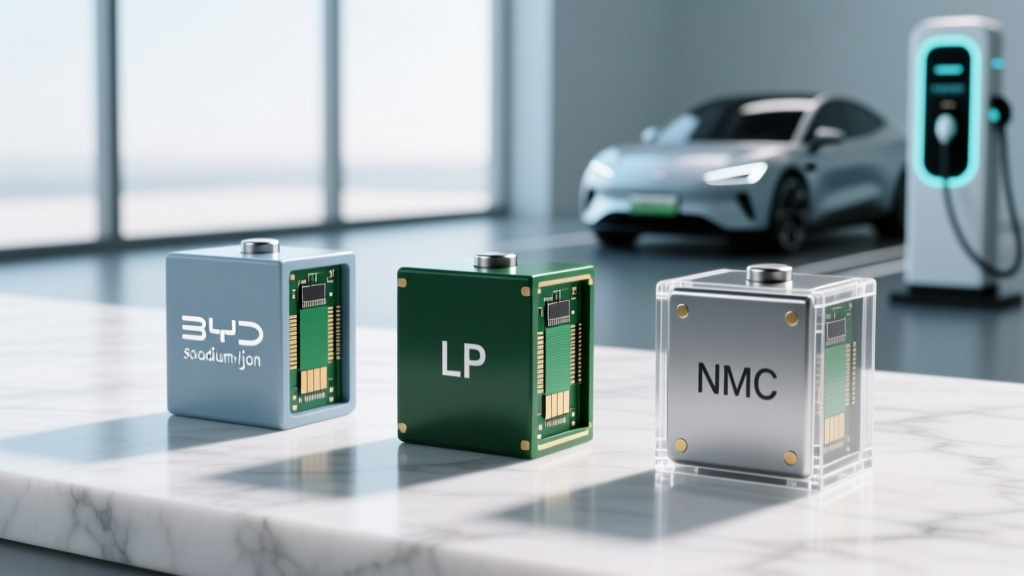
Hybrid batteries use one of two dominant lithium-ion chemistries: NMC (nickel manganese cobalt) or LFP (lithium iron phosphate). Most current HEVs and PHEVs sold in the US still use NMC, but LFP adoption is accelerating, especially in PHEVs from Chinese-market manufacturers entering global markets.
| Attribute | NMC (Nickel Manganese Cobalt) | LFP (Lithium Iron Phosphate) |
|---|---|---|
| Energy Density | Higher (~200-260 Wh/kg) — smaller pack for same kWh | Lower (~140-180 Wh/kg) — needs more space/weight |
| Cycle Life | 1,500-3,000 cycles to 80% SoH | 3,000-6,000+ cycles to 80% SoH |
| Cold-Weather Performance | Better low-temp power delivery | Reduced power and charge acceptance below 32°F |
| Thermal Stability | Good; requires active thermal management | Excellent; inherently more stable chemistry |
| Cost per kWh | Higher ($120-$160/kWh at pack level) | Lower ($80-$110/kWh at pack level) |
| Cobalt Content | Yes — supply chain and ethical concerns | None — more sustainable sourcing |
| Typical Hybrid Use | Most current HEVs/PHEVs (Toyota, Hyundai, BMW, Jeep) | Emerging in PHEVs (BYD, some 2026+ models) |
For a conventional HEV with a tiny 1.3 kWh pack, energy density matters more than cycle life — the pack is already small enough that NMC's advantage keeps vehicle weight down. For PHEVs with 15-25 kWh packs, LFP's superior cycle life (potentially double that of NMC) makes it increasingly attractive, and the weight penalty is manageable.
What Does the Hybrid Battery Warranty Actually Cover?
Federal law mandates that hybrid and PHEV batteries carry a minimum warranty of 8 years or 100,000 miles (whichever comes first). In California Air Resources Board (CARB) states — which include California, New York, Massachusetts, and about a dozen others — the mandate extends to 10 years or 150,000 miles for PZEV/AT-PZEV certified vehicles, which covers most hybrids sold in those states.
| Manufacturer | Warranty Term | Capacity Retention Threshold | Notes |
|---|---|---|---|
| Toyota (HEV & PHEV) | 10 yr / 150,000 mi (all states) | Not explicitly stated; case-by-case | Industry-leading term; covers Prius, RAV4 Hybrid/Prime, Camry Hybrid |
| Hyundai / Kia (HEV & PHEV) | 10 yr / 100,000 mi | ~70% capacity retention | Applies to Tucson Hybrid/PHEV, Sorento PHEV, Ioniq |
| Honda (HEV) | 8 yr / 100,000 mi (10/150k in CARB states) | Not publicly specified | Covers Accord Hybrid, CR-V Hybrid |
| Ford (HEV & PHEV) | 8 yr / 100,000 mi | Not publicly specified | Maverick Hybrid, Escape PHEV |
| Jeep (PHEV) | 8 yr / 100,000 mi | ~70% capacity | Wrangler 4xe, Grand Cherokee 4xe |
The capacity retention threshold is critical. Most warranties only trigger a free replacement if the battery degrades below approximately 70% of its original capacity — meaning you'd need to lose more than 30% before the manufacturer covers it. In practice, very few hybrid batteries degrade that far within the warranty period under normal use.
How Much Does a Hybrid Battery Replacement Cost?
If your battery does fail outside the warranty window — which remains uncommon for vehicles under 200,000 miles — replacement costs vary significantly by pack size and model. HEV batteries are generally cheaper to replace than PHEV batteries because they're smaller.
| Vehicle | Battery Size (kWh) | New OEM Replacement | Refurbished/Aftermarket | Typical Replacement Mileage |
|---|---|---|---|---|
| Toyota Prius (HEV) | ~1.3 kWh | $2,500 - $3,500 | $1,200 - $2,000 | 180,000 - 250,000+ mi |
| Honda Accord Hybrid | ~1.3 kWh | $2,800 - $4,000 | $1,500 - $2,500 | 170,000 - 220,000+ mi |
| Toyota RAV4 Prime (PHEV) | 18.1 kWh | $8,000 - $12,000 | $5,000 - $7,500 | Rarely needed; limited data |
| Jeep Wrangler 4xe (PHEV) | 17.3 kWh | $9,000 - $14,000 | $6,000 - $9,000 | Rarely needed; limited data |
| Ford Escape PHEV | 14.4 kWh | $7,000 - $10,000 | $4,500 - $7,000 | 150,000 - 200,000+ mi |
| Chevrolet Volt (used, discontinued) | 18.4 kWh | $6,000 - $9,000 | $3,500 - $5,500 | 140,000 - 200,000+ mi |
A few important context points: these are worst-case, full-pack replacement costs. In many cases, only individual modules within the pack have degraded, and a specialist can replace just those modules for $500 to $1,500. Independent hybrid battery shops have become increasingly common in major metro areas, offering refurbished packs at 40-60% below OEM pricing. And again — the vast majority of hybrid batteries never need replacement during the typical ownership period. Per Consumer Reports reliability data, hybrid battery failure rates within the first 10 years remain well below 5%.
Factors That Accelerate (or Preserve) Hybrid Battery Life
Not all hybrid batteries age equally. How you drive, charge, and store your vehicle has a measurable impact on long-term battery health.
Maximize Your Hybrid Battery's Lifespan:
- Avoid sustained 100% SoC (PHEVs): If your PHEV allows setting a charge limit, target 80-90% for daily use. Charging to 100% every night accelerates NMC degradation. Reserve full charges for days you need maximum electric range.
- Minimize DC fast charging (PHEVs): Most PHEVs support only Level 2 AC charging, but a few (like the Mitsubishi Outlander PHEV) offer DC fast charging. Frequent DC fast charging generates heat that degrades cells faster. Use it for road trips, not daily routine.
- Park in shade or a garage in hot climates: Sustained battery temperatures above 95°F accelerate chemical degradation. This matters more in Arizona, Texas, and Florida than in cooler climates.
- Don't let PHEVs sit at 0% SoC for weeks: If storing a PHEV, leave it at roughly 50% SoC. Extended storage at very low or very high charge stresses the cells.
- Drive regularly: HEV batteries benefit from regular use. The BMS performs balancing routines during normal driving cycles. Cars that sit unused for months may develop cell-imbalance issues.
- Use preconditioning when available: Some PHEVs (RAV4 Prime, BMW X5 xDrive50e) offer battery preconditioning, which warms or cools the pack before driving or charging. Use it — thermal management is the single biggest factor in battery longevity.
For conventional HEVs, most of these factors are managed automatically by the vehicle's BMS. The car never lets the battery reach true 0% or 100% — the usable window is typically 40-80% SoC even when the dashboard shows "full" or "empty." PHEV owners have more control and therefore more responsibility.
How to Check Your Hybrid Battery's State of Health (SoH)
State of Health (SoH) is expressed as a percentage: a brand-new battery is 100% SoH, and a battery that has lost 15% of its original capacity is at 85% SoH. Here's how to monitor it:
Dealer diagnostic scan: Any authorized dealer can pull a battery health report using the manufacturer's diagnostic tool. This gives you individual cell voltage readings, internal resistance data, and an SoH percentage. Most dealers will do this during routine service visits at no extra charge — just ask.
OBD-II scanner apps: Tools like the OBDLink SX or Vgate iCar paired with apps such as Dr. Prius (Toyota-specific), Hybrid Assistant (Toyota/Lexus), or Torque Pro (general) can read real-time battery data from your hybrid's CAN bus. These show current SoC, cell voltages, battery temperature, and in some cases estimated SoH. A $30-$60 OBD-II adapter and a free or $10 app is often enough for DIY monitoring.
Dashboard indicators: Some PHEVs display estimated electric range that naturally decreases as the battery ages. If your RAV4 Prime used to show 42 miles of EV range at full charge and now shows 36, that's roughly a 14% capacity loss. This isn't a precise SoH measurement, but it's a useful trend indicator.
Fuel economy decline (HEVs): For conventional hybrids, a noticeable drop in MPG — say from 52 to 46 combined — can indicate battery degradation, since the gasoline engine compensates for reduced electric assist. Track your fuel economy over time using the trip computer or an app like Fuelly.
Emerging Battery Technology: What's Next for Hybrids?
Several next-generation battery technologies are in development, but none are ready for production hybrid vehicles as of 2026. Here's a realistic timeline:
Silicon-dominant anodes: Companies like Sila Nanotechnologies and Group14 are replacing graphite anodes with silicon-based materials, boosting energy density by 20-40%. This means smaller, lighter hybrid packs with the same capacity. Toyota and Mercedes-Benz have announced partnerships, with limited production expected in 2027-2028 models. Expect this in premium PHEVs first.
Solid-state batteries: These replace the liquid electrolyte with a solid material, offering potentially 2x energy density, faster charging, and improved safety. Toyota, Samsung SDI, and QuantumScape are leading development. Toyota has announced a solid-state battery pilot for a limited-production EV, not a hybrid, targeted for 2027-2028. Widespread solid-state adoption in mainstream hybrids is realistically a 2030+ timeline, given cost and manufacturing scale challenges.
Sodium-ion batteries: CATL and BYD are producing sodium-ion cells that eliminate lithium and cobalt entirely. Energy density is lower than LFP, making them better suited for HEVs with small packs than for PHEVs needing 20+ kWh. Limited deployment in Chinese-market vehicles began in 2025; US-market availability remains unannounced.
None of these technologies should delay a hybrid purchase today. Current NMC and LFP batteries are mature, reliable, and well-warrantied. The next-generation chemistries will arrive as incremental improvements, not as reasons to wait.
Frequently Asked Questions
How long do batteries in hybrid cars last before needing replacement?
Most hybrid batteries last 150,000 to 200,000+ miles or 10-15 years before degradation meaningfully affects performance. Many never need replacement during the vehicle's life. Conventional HEVs with small, shallow-cycling batteries (like the Prius) tend to outlast PHEVs with larger, deeper-cycling packs, though both are engineered for well over a decade of service.
Is it worth replacing a hybrid battery on an older car?
It depends on the vehicle's overall condition and value. A $2,500-$3,500 Prius battery replacement on a car with 180,000 miles but a clean interior and solid drivetrain can add another 5-8 years of economical driving. For a PHEV requiring a $10,000+ pack replacement, the math is tougher — consider whether the rest of the vehicle justifies that investment versus trading in.
Does the 12-volt battery in my hybrid need separate attention?
Yes. Every hybrid also has a standard 12V auxiliary battery that powers electronics, lights, and the computer that manages the high-voltage system. This 12V battery typically lasts 3-5 years and is inexpensive to replace ($150-$300). A dead 12V battery can prevent the car from starting even if the high-voltage traction battery is perfectly healthy — they are entirely separate systems.
Do hybrid batteries degrade faster in hot climates?
Yes. Sustained high temperatures are the primary enemy of lithium-ion longevity. Hybrids in Phoenix, Houston, or Miami may see 2-5% more capacity loss over 100,000 miles compared to identical vehicles in Seattle or Minneapolis. Toyota addresses this with battery cooling ducts in the Prius; PHEVs with active liquid cooling (RAV4 Prime, BMW X5 xDrive50e) handle heat better than passively cooled packs.
Can I still pass emissions if my hybrid battery has degraded?
Usually, yes. A degraded hybrid battery means the gasoline engine works harder, slightly increasing tailpipe emissions. However, most hybrids still pass state emissions tests even with 15-20% battery degradation because the engine and catalytic converter remain the primary emissions-control systems. The exception would be severe battery failure that triggers a check-engine light, which is an automatic fail in most testing jurisdictions.
LFP vs. NMC — which hybrid battery chemistry is better?
Neither is universally better. NMC offers higher energy density, which matters for keeping HEV packs small and light. LFP offers roughly double the cycle life, no cobalt, lower cost, and superior thermal stability, making it ideal for PHEVs where pack size is less constrained. If you're choosing between two PHEVs and one uses LFP, that's a longevity and sustainability advantage — but don't reject an NMC PHEV for it. Both chemistries will outlast most ownership periods.
For authoritative data on hybrid fuel economy, battery specifications, and emissions certifications, consult fueleconomy.gov (the official EPA source) and NHTSA.gov for safety and recall information specific to your model year.