The Short Answer: Most EV Batteries Outlive the Car
If you're asking how long do batteries last on electric cars, the data points to a reassuring reality: the high-voltage traction battery in a modern EV is engineered to outlast the vehicle's practical service life. Based on fleet data, warranty claim rates, and long-term ownership studies through 2025-2026, most liquid-cooled EV batteries retain 85-92% of their original capacity after 100,000 miles and 70-80% after 150,000 miles. That translates to 15-20 years of typical use before capacity drops enough to meaningfully affect daily driving.
The fear of a $15,000+ battery swap at year eight persists in online forums, but the actual failure rate is remarkably low. According to data aggregated by Recurrent Auto from over 15,000 EVs, fewer than 1.5% of EV batteries have required out-of-warranty replacement due to catastrophic failure. The far more common scenario is gradual capacity loss — and even that is slower than most buyers expect.
LFP vs NMC: Chemistry Determines Longevity
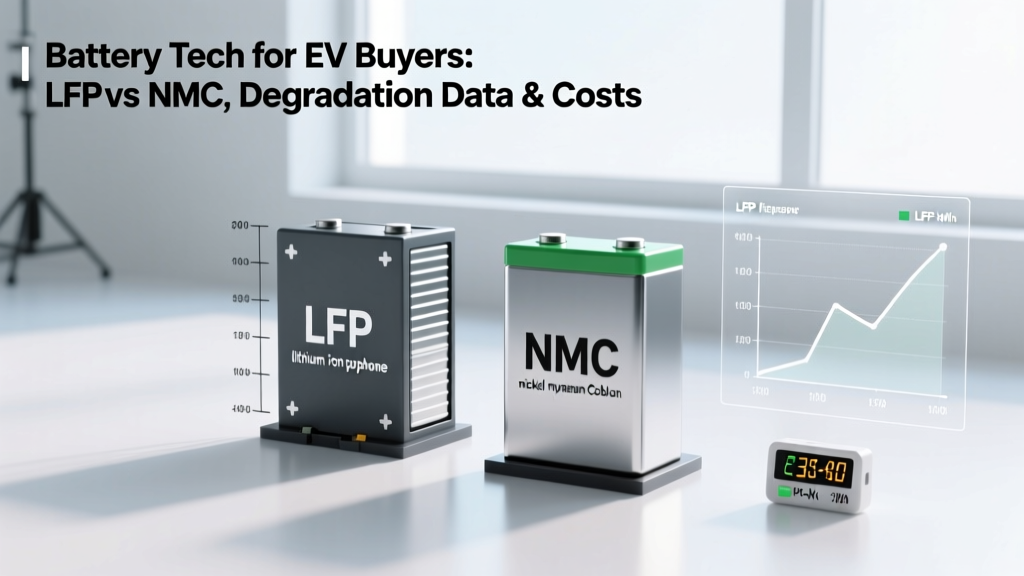
Not all EV batteries are built the same. The two dominant chemistries in 2026 EVs — lithium iron phosphate (LFP) and nickel manganese cobalt (NMC) — have fundamentally different degradation profiles, energy densities, and cost structures. Understanding which chemistry your EV uses is the single biggest predictor of how long its battery will last.
| Attribute | LFP (Lithium Iron Phosphate) | NMC/NCA (Nickel-based) |
|---|---|---|
| Typical Cycle Life | 3,000-5,000+ cycles | 1,000-2,000 cycles |
| Energy Density | Lower (~160 Wh/kg cell-level) | Higher (~250-300 Wh/kg cell-level) |
| Calendar Degradation | Slower; minimal capacity fade at rest | Moderate; accelerates at high SoC + heat |
| Cold-Weather Performance | Weaker below 32°F; slower charging | Better low-temp discharge and regen |
| Max Recommended SoC | 100% daily charging is fine | 80% daily recommended for longevity |
| Cost per kWh | Lower ($80-100/kWh pack-level) | Higher ($110-140/kWh pack-level) |
| Common in (2026 models) | Tesla Model 3/Y RWD, Ford Mustang Mach-E Select (base), BYD models | Tesla Long Range, Hyundai Ioniq 5/6, Rivian, BMW iX, most premium EVs |
What this means for longevity: LFP batteries can tolerate daily 100% charging and deep cycling far better than NMC, making them ideal for high-mileage drivers, rideshare use, and owners without home charging who rely on frequent DC fast charging. NMC packs offer more range per pound — critical for larger vehicles and long-range trims — but reward careful SoC management with a longer useful life.
Real Degradation Data: What the Numbers Actually Show
EV battery degradation is not linear. Most packs experience a steeper loss in the first 1-2 years (roughly 2-5% as the solid electrolyte interphase stabilizes), then settle into a slow, predictable decline of roughly 1-2% per year or per 15,000-20,000 miles. Here's what long-term fleet data shows for popular platforms:
Observed Capacity Retention by Mileage (Fleet Averages):
- 50,000 miles: 93-97% retained (most EVs; LFP often >95%)
- 100,000 miles: 88-93% retained (NMC); 92-96% (LFP)
- 150,000 miles: 82-88% retained (NMC); 88-93% (LFP)
- 200,000 miles: 76-84% retained (NMC); 84-90% (LFP)
Sources: Recurrent Auto fleet data (2025), Tesla fleet telemetry analysis, iSeeCars longevity study. Figures represent averages; individual results vary with climate, charging habits, and thermal management quality.
For context, a 2026 Hyundai Ioniq 5 with its 77.4 kWh NMC battery and EPA-rated 305-mile range would, at 85% retained capacity (roughly 120,000 miles), still deliver approximately 259 miles of EPA-equivalent range — more than adequate for the vast majority of daily driving and road trips with planned charging stops.
What the Battery Warranty Actually Covers
Federal law mandates that EV batteries carry a minimum warranty of 8 years or 100,000 miles (10 years/150,000 miles in CARB states including California, New York, and others). But the details of what triggers a warranty claim vary significantly by manufacturer, and understanding the capacity retention threshold is critical.
| Manufacturer | Warranty Period | Mileage Cap | Capacity Threshold |
|---|---|---|---|
| Tesla (Model 3/Y RWD — LFP) | 8 years | 100,000 miles | 70% retention |
| Tesla (Model 3/Y LR, Model S/X) | 8 years | 120,000-150,000 miles | 70% retention |
| Hyundai/Kia (Ioniq 5/6, EV6/EV9) | 10 years | 100,000 miles | 70% retention |
| Ford (Mach-E, F-150 Lightning) | 8 years | 100,000 miles | 70% retention |
| General Motors (Equinox EV, Blazer EV, Silverado EV) | 8 years | 100,000 miles | 70% retention (60% for fleet/commercial) |
| Rivian (R1T, R1S) | 8 years | 120,000 miles | 70% retention |
| BMW (i4, iX, i7) | 8 years | 100,000 miles | 70% retention |
Key warranty nuance: The 70% threshold means the manufacturer only replaces or repairs the battery if it degrades below 70% of original capacity within the warranty window. Given that real-world data shows most EVs retain 85%+ at 100,000 miles, warranty claims for gradual degradation are rare. Most claims involve manufacturing defects (bad cell groups, BMS faults, coolant leaks) that surface in the first 1-3 years, not capacity fade.
Warranties typically cover the battery pack, battery management system (BMS), and associated cooling hardware. They do not cover damage from collisions, flooding, unauthorized modifications, or using non-approved charging equipment that causes electrical damage. Always review the specific warranty booklet for your model year.
EV Battery Replacement Cost: When and How Much
If your battery does fall below the warranty threshold — or if you're keeping an EV well past the warranty window — replacement is the nuclear option. Here's what it costs across common platforms in 2026:
| Vehicle | Battery Size | Chemistry | Replacement Cost (Parts + Labor) |
|---|---|---|---|
| Tesla Model 3 RWD | ~60 kWh | LFP | $8,000 - $12,000 |
| Tesla Model Y Long Range | ~75 kWh | NMC | $12,000 - $16,000 |
| Hyundai Ioniq 5 | 77.4 kWh | NMC | $11,000 - $15,000 |
| Ford Mustang Mach-E Extended Range | 91 kWh | NMC | $14,000 - $18,000 |
| Ford F-150 Lightning Extended Range | 131 kWh | NMC | $18,000 - $25,000 |
| Rivian R1T (Large Pack) | ~135 kWh | NMC | $20,000 - $28,000 |
| Chevrolet Equinox EV | ~85 kWh | NMC (Ultium) | $12,000 - $16,000 |
Critical context on replacement timing: Pack-level battery costs have dropped from roughly $190/kWh in 2020 to approximately $110-130/kWh in 2026, and they continue to decline. More importantly, most EV batteries never need full replacement. When capacity-related issues do arise post-warranty, module-level repair (replacing individual cell modules rather than the entire pack) is increasingly available from independent EV shops for $2,000-$6,000, depending on the pack architecture.
The vehicles most likely to need a battery replacement are high-mileage fleet vehicles, rideshare cars exceeding 200,000 miles, and older early-generation EVs (2011-2017 Nissan Leaf, early Chevy Spark EV) that lacked active liquid cooling. Modern liquid-cooled packs from 2020 onward are a fundamentally different product.
Five Factors That Actually Kill EV Batteries
While most degradation is inevitable and gradual, certain habits and conditions accelerate it significantly. Here are the five biggest factors, ranked by impact:
1. Sustained High State of Charge + Heat (Biggest Killer)
Storing an NMC battery at 95-100% SoC in hot climates (sustained 90°F+) accelerates calendar degradation more than any other single factor. The electrolyte decomposes faster at high voltage and high temperature simultaneously. Mitigation: Set daily charge limit to 80% for NMC vehicles; use scheduled departure charging so the car reaches 100% only when you're about to drive. LFP owners can ignore this — 100% daily is fine.
2. Exclusive DC Fast Charging Without Preconditioning
Repeatedly DC fast charging a cold battery (below 50°F) without preconditioning forces lithium plating on the anode — a permanent capacity loss mechanism. Modern EVs with route-to-charger preconditioning (Tesla, Hyundai E-GMP, GM Ultium, Ford) largely prevent this, but plugging into a random fast charger without navigation-based preconditioning bypasses this protection. Mitigation: Always navigate to the charger via the car's built-in nav, or precondition manually if your vehicle supports it.
3. Frequent Deep Discharge to 0%
Letting the battery sit at or near 0% SoC for extended periods stresses cell chemistry. Driving to 5% and charging soon after is fine; leaving the car unplugged at 2% for a week in the summer sun is not. Mitigation: Charge to at least 20% if the car will sit unused.
4. Extreme Ambient Heat Without Garage Parking
Batteries in Phoenix, Dubai, or Riyadh that regularly soak at 110°F+ ambient while parked will degrade faster, even with thermal management. Active cooling systems mitigate this while driving and charging, but a parked car in direct sun relies on passive insulation. Mitigation: Park in shade or a garage; enable cabin/battery preconditioning while plugged in.
5. Aftermarket Software Modifications / Unauthorized Tuning
Third-party software that increases charge limits, disables thermal management, or raises discharge current limits can void warranties and accelerate degradation. This is rare but increasingly documented in enthusiast communities. Mitigation: Use only manufacturer-approved software and settings.
How to Check Your EV's Battery Health (State of Health)
State of Health (SoH) is the metric that tells you what percentage of original capacity your battery retains. Monitoring it is easier than most owners realize:
- In-car displays: Tesla's service menu (hold model name on About screen for 3 seconds → Battery Health test), Hyundai/Kia's EV battery health screen in the cluster, and GM's Ultium-based vehicles include SoH readouts accessible through diagnostic menus or dealer tools.
- OBD-II + App tools: Devices like the OBDLink SX paired with apps such as LeafSpy (Nissan), TeslaFi, or OBDeleven (VW Group) can pull SoH data from the BMS. ScanGauge and Torque Pro also read battery parameters on many platforms.
- Third-party reports: Services like Recurrent and some dealerships provide battery health certificates — increasingly useful when buying or selling a used EV.
- Manual calculation: Charge to 100%, note the displayed range, and compare it to the original EPA-rated range (adjusted for the fact that the displayed range may use a different standard). A 2026 Ioniq 5 that showed 305 miles at 100% when new but now shows 272 miles at 100% is at roughly 89% SoH.
Check SoH every 6-12 months, or before purchasing a used EV. A healthy battery should show SoH within the expected degradation curve for its age and mileage.
What's Next: Solid-State and Silicon Anode Batteries
The next generational leap in EV battery technology centers on solid-state electrolytes and silicon-dominant anodes, both of which promise significant improvements in energy density, charge speed, and cycle life.
Solid-state batteries replace the liquid electrolyte with a solid ceramic, sulfide, or polymer layer. This eliminates flammability risk, enables lithium-metal anodes (doubling energy density), and potentially extends cycle life to 5,000+ cycles. Toyota has announced commercial solid-state EV production for 2027-2028, initially in limited, premium models. Samsung SDI and QuantumScape are targeting similar timelines for sample production. Realistic expectation: Solid-state will be available in low-volume, high-cost applications by 2028-2029, with mainstream affordability not arriving until 2032+.
Silicon anode technology is closer to market. Companies like Sila Nanotechnologies and Group14 are already shipping silicon-composite anode materials that boost energy density 20-40% over graphite. The Mercedes-Benz G-Class electric (announced for 2025-2026) was among the first to incorporate silicon-anode cells from Sila. Expect broader adoption across premium EVs by 2027-2028.
Bottom line: Neither technology changes the buying decision today. Current LFP and NMC batteries, properly cared for, will serve you for 15+ years. The next-gen chemistries are worth tracking but are not a reason to delay a purchase.
Frequently Asked Questions
How long do EV batteries last in years?
Based on fleet data, modern liquid-cooled EV batteries last 15-20 years in typical ownership before degrading to a point (below 70% capacity) where range meaningfully impacts usability. Many will outlive the vehicle they're installed in.
How long do EV batteries last in miles?
Most NMC batteries retain 80%+ capacity at 150,000 miles. LFP batteries often retain 85%+ at the same mileage. High-cycle LFP packs (like those in Tesla Model 3 RWD) are rated for 3,000-5,000 charge cycles, which translates to 500,000+ miles before reaching 80% capacity — far beyond what most vehicles see.
How much does it cost to replace an EV battery?
Full pack replacement costs range from $8,000 for a small LFP pack (Tesla Model 3 RWD) to $25,000+ for large packs (F-150 Lightning Extended Range, Rivian R1T). However, most batteries never need replacement, and module-level repairs cost $2,000-$6,000 when they do.
Is LFP better than NMC for battery longevity?
For pure cycle life and calendar longevity, yes — LFP batteries last significantly more charge cycles and tolerate 100% daily charging without accelerated degradation. However, NMC offers 40-60% higher energy density (more range in the same weight/volume), better cold-weather performance, and faster charging in cold conditions. The "better" chemistry depends on your priorities: LFP for maximum durability and lower cost; NMC for maximum range and cold-climate usability.
Does fast charging damage EV batteries?
DC fast charging causes more degradation than Level 2 charging, but the difference is smaller than commonly believed — roughly an additional 0.5-1% capacity loss per year for frequent fast chargers versus L2-only users. The real risk is fast charging a cold battery without preconditioning, which can cause lithium plating. Modern EV thermal management systems largely prevent this when you navigate to the charger using the car's built-in system.
What voids an EV battery warranty?
Common warranty voids include: collision or flood damage, unauthorized software modifications, use of non-approved charging equipment that causes electrical damage, failure to maintain the cooling system per the service schedule, and commercial/rideshare use beyond the warranty's stated mileage limits (some manufacturers differentiate personal vs. commercial terms).