If you're shopping for an electric vehicle in 2026, the battery is the single most expensive component in the car — and the one buyers worry about most. The question isn't whether an EV battery will degrade (it will), but how slowly it will degrade and whether you'll ever need to pay for a replacement out of warranty.
The short answer: most modern EV batteries outlast the vehicle they're installed in. Data from fleets, long-term owner surveys, and manufacturer reports show that the average EV battery retains 85–92% of its original capacity after 100,000 miles. Catastrophic failure is rare. But chemistry choice, charging habits, and climate all shift that number meaningfully. Here's what the data actually says.
How Long Do EV Batteries Last in Real-World Use?
EV batteries don't "die" the way a phone battery might stop holding a charge entirely. They gradually lose capacity — a process called degradation — until the remaining range no longer meets the owner's needs. The industry standard for "end of life" is typically 70–80% of original capacity, not total failure.
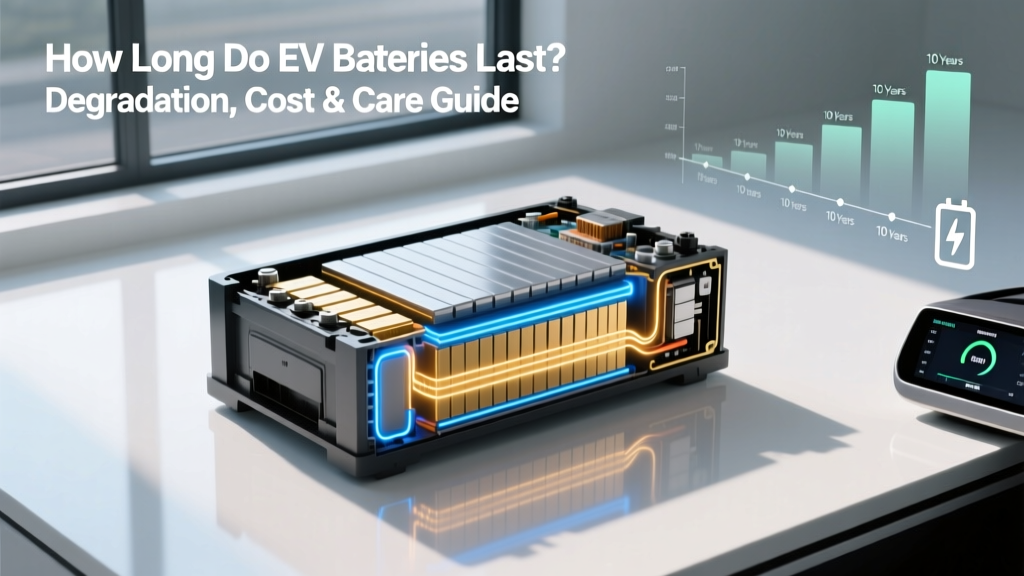
Based on aggregated fleet data, long-term owner reports, and studies from sources including Geotab's large-scale battery health study of over 10,000 EVs, here's what degradation looks like in practice:
Typical EV Battery Degradation Curve (NMC Chemistry, Moderate Climate):
- Year 1 / 15,000 mi: ~2–4% capacity loss (initial drop, then stabilizes)
- Year 3 / 45,000 mi: ~5–8% total loss
- Year 5 / 75,000 mi: ~8–12% total loss
- Year 8 / 120,000 mi: ~12–18% total loss
- Year 10 / 150,000 mi: ~15–22% total loss
LFP (lithium iron phosphate) batteries typically show 2–5% less total degradation over the same period, thanks to superior cycle life. Vehicles in extreme heat climates (Arizona, Texas) without active thermal management may see 3–7% additional loss.
For a 2026 Tesla Model 3 Long Range with an EPA-estimated 341 miles of range and an NMC battery, that translates to roughly 290–310 miles of real range at the 100,000-mile mark — still plenty for daily driving and road trips. A 2026 BYD-equipped or Tesla Model 3 RWD with an LFP battery would show even less drop.
The critical insight: degradation is fastest in the first year or two, then slows to a near-linear rate. Most owners never reach a point where the battery needs replacement before selling or trading the vehicle.
LFP vs NMC: Which Battery Chemistry Lasts Longer?
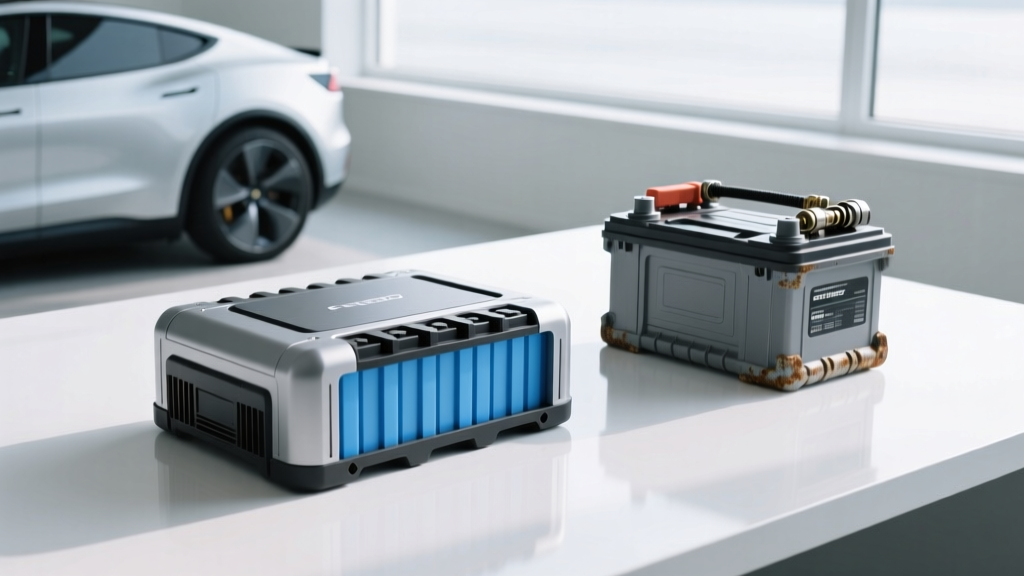
In 2026, two lithium-ion chemistries dominate the EV market: NMC (nickel manganese cobalt) and LFP (lithium iron phosphate). Your chemistry choice — often determined by trim level — has a direct impact on longevity, range, and charging behavior.
| Factor | NMC / NCA | LFP |
|---|---|---|
| Energy Density | Higher (more range per kg) | Lower (~15–20% less per kg) |
| Cycle Life | 1,000–2,000 full cycles | 3,000–5,000+ full cycles |
| Typical Degradation at 100K mi | 10–15% | 6–10% |
| Cold-Weather Performance | Better (less range loss) | Worse (more range loss below freezing) |
| Charging to 100% | Not recommended daily (accelerates wear) | Recommended regularly (helps BMS calibration) |
| Cost per kWh (pack level) | $110–$140 | $80–$100 |
| Common In (2026 Models) | Long-range trims, performance models | Standard-range trims, budget EVs |
Which is better? It depends on your use case. If you plan to keep the car 10+ years or drive high annual mileage (20,000+ mi/yr), LFP's superior cycle life makes it the longevity winner. If you need maximum range in a single charge and regularly drive in cold climates, NMC's energy density and cold-weather advantage matter more. Many 2026 buyers choosing a Tesla Model 3 RWD or a base-trim EV are getting LFP without realizing it — and that's a net positive for battery lifespan.
What Does the EV Battery Warranty Actually Cover?
Federal law mandates a minimum battery warranty of 8 years / 100,000 miles for EVs sold in the US (extended to 10 years / 150,000 miles in California and states adopting CARB standards). Most manufacturers meet or exceed this baseline, but the details matter enormously.
| Manufacturer (2026 Models) | Warranty Period | Capacity Threshold | Notes |
|---|---|---|---|
| Tesla (Model 3/Y) | 8 yr / 120,000 mi (LR); 8 yr / 100,000 mi (RWD) | 70% retention | Module replacement, not always full pack |
| Hyundai / Kia | 10 yr / 100,000 mi | 70% retention | Among the longest coverage in the industry |
| Ford (Mustang Mach-E, F-150 Lightning) | 8 yr / 100,000 mi | 70% retention | Covers battery and hybrid/electric components |
| GM (Ultium-based: Equinox EV, Blazer EV) | 8 yr / 100,000 mi | 70% retention | Ultium packs designed for module-level service |
| BMW / Mercedes-Benz | 8 yr / 100,000 mi | 70% retention | Some offer extended purchase options |
| Rivian | 8 yr / 175,000 mi | 70% retention | Highest mileage cap among major OEMs |
The key term is capacity retention threshold. A warranty that guarantees 70% means the manufacturer will repair or replace the battery (or individual modules) only if capacity drops below 70% of the original usable kWh within the warranty period. Gradual degradation above that threshold is considered normal wear — not a defect.
Per fueleconomy.gov, EV battery warranties are separate from the general powertrain warranty and specifically cover the high-voltage traction battery pack, not the 12V auxiliary battery that powers accessories and electronics.
How Much Does an EV Battery Replacement Cost?
Out-of-warranty battery replacement is the scenario that generates the most fear — and the most misinformation. Here's what the actual numbers look like in 2026:
| Vehicle Category | Battery Size (usable kWh) | Estimated Replacement Cost (Parts + Labor) |
|---|---|---|
| Compact EV (Chevy Bolt, Nissan Leaf) | 60–65 kWh | $6,000–$9,000 |
| Midsize sedan (Tesla Model 3, Hyundai Ioniq 6) | 75–82 kWh | $8,000–$13,000 |
| SUV / Crossover (Tesla Model Y, Ford Mach-E) | 75–91 kWh | $10,000–$15,000 |
| Large truck / SUV (F-150 Lightning, Rivian R1T) | 100–135 kWh | $14,000–$22,000 |
| Luxury / Performance (BMW iX, Mercedes EQS) | 100–120 kWh | $15,000–$25,000+ |
Context matters here. These costs include the battery pack and installation labor but assume a full pack replacement. Many modern EV platforms (GM Ultium, some Hyundai E-GMP configurations) support module-level repair, where a single degraded or failed module is replaced for $1,500–$4,000 instead of swapping the entire pack.
When is replacement actually needed? Based on current data, most EV batteries reach 70% capacity between 150,000 and 250,000 miles — well beyond the point where most first and second owners have sold the vehicle. Complete pack failure (sudden, total loss) is extremely rare and almost always covered under warranty. The fear of a $20,000 surprise bill at 80,000 miles is not supported by the data.
What Factors Accelerate EV Battery Degradation?
Not all miles are equal when it comes to battery wear. Five factors have an outsized impact on how quickly your battery loses capacity:
1. Frequent DC Fast Charging
Occasional road-trip fast charging is fine. But relying on DC fast charging (50–350 kW) as your primary charging method accelerates degradation by an estimated 1–3% over the battery's life compared to predominantly Level 2 (home) charging. The high currents generate heat, and heat is the enemy of lithium-ion cells. Aim for 80%+ of your charging on Level 2 (7–19 kW).
2. Extreme Temperatures
Batteries operate happiest between 60–80°F (15–27°C). Sustained exposure to ambient temperatures above 95°F accelerates chemical aging. Vehicles with active liquid thermal management (Tesla, Hyundai E-GMP, GM Ultium) handle this far better than passively cooled packs (older Nissan Leaf). In extreme cold, degradation impact is less about wear and more about temporary range loss — expect 20–30% less range below 20°F, which recovers when temperatures rise.
3. State of Charge (SoC) Habits
For NMC/NCA batteries, regularly charging to 100% and leaving the car sitting at full charge stresses the cells. The sweet spot for daily use is 20–80% SoC. For LFP batteries, manufacturers like Tesla and BYD actually recommend charging to 100% at least weekly to keep the Battery Management System (BMS) calibrated — LFP's flat voltage curve makes SoC estimation harder without full-charge reference points.
4. Deep Discharges
Regularly driving the battery to 0% (or near it) and leaving it in a depleted state causes copper dissolution in the anode. Try not to let the SoC drop below 10% for extended periods. If you must store the vehicle, aim for 40–60% SoC.
5. High-Performance Driving
Sustained high-speed driving and aggressive acceleration draw high continuous current, generating internal cell heat. Occasional spirited driving is fine; daily track use or consistent 90+ mph highway driving will age the pack faster.
How to Monitor Your EV Battery Health (State of Health)
Most 2026 EVs provide at least basic battery health data through the infotainment system or companion app. Here's how to check and interpret it:
In-Vehicle Displays: Tesla's service menu shows estimated range at 100% compared to original. Hyundai/Kia's EV menu displays a battery health percentage. Ford's MyFordPass app includes a battery health indicator. BMW's iDrive system provides a battery capacity readout under vehicle settings.
Third-Party Tools: OBD-II dongles paired with apps like LeafSpy (Nissan), TeslaFi, or ABRP (A Better Route Planner) with OBD integration can read detailed cell-level data including individual cell voltage variance, internal resistance, and precise State of Health (SoH) percentage. For a used-EV purchase, an independent SoH readout is the single most valuable data point you can get.
What SoH Numbers Mean:
- 95–100%: Essentially new; normal for under 15,000 miles
- 88–95%: Healthy; expected for 30,000–70,000 miles
- 80–88%: Moderate degradation; still very usable
- 70–80%: Approaching warranty threshold; check coverage
- Below 70%: Likely qualifies for warranty repair/replacement
Per NHTSA guidance, any sudden or unusual drop in range or battery health should be reported to the manufacturer and can be filed as a safety concern if it occurs unexpectedly.
What's Next: Solid-State and Silicon-Anode Batteries
Two emerging technologies promise to reshape EV battery longevity and performance — but neither is available in production vehicles as of 2026.
Solid-State Batteries replace the liquid electrolyte in current lithium-ion cells with a solid material (ceramic, sulfide, or polymer). The theoretical benefits are substantial: 2–3x the energy density, faster charging (potentially 10–80% in under 10 minutes), dramatically improved safety (no flammable electrolyte), and cycle life exceeding 10,000 cycles. Toyota, Samsung SDI, and QuantumScape are leading development, with Toyota announcing limited production in select models for 2027–2028. However, manufacturing scale-up and cost remain significant hurdles. Expect solid-state to appear in low-volume or premium models first, with mainstream availability likely in the 2030–2032 timeframe.
Silicon-Anode Batteries replace the graphite anode with silicon, which can store roughly 10x more lithium ions per unit mass. Companies like Sila Nanotechnologies and Group14 are supplying silicon-dominant anode materials to manufacturers including Mercedes-Benz (for the upcoming G-Class EV) and Panasonic. Early implementations use silicon as a partial blend with graphite (5–20% silicon) to gain 10–20% energy density improvement without solving the full expansion/contraction challenge that pure silicon anodes face. Expect blended silicon anodes in select 2027–2028 models, with higher-silicon content arriving progressively through the early 2030s.
For buyers deciding today: current NMC and LFP batteries are mature, well-understood technologies with strong track records. Waiting for solid-state means waiting years and likely paying a significant premium when it first arrives.
Frequently Asked Questions
How long do EV batteries last in years and miles?
Most EV batteries retain 80–90% of original capacity at 100,000 miles and 70–85% at 150,000 miles. In years, that translates to a functional lifespan of 12–20 years for typical drivers covering 10,000–15,000 miles annually. The battery will likely outlast other major vehicle components.
How much does it cost to replace an EV battery in 2026?
Full pack replacement ranges from roughly $6,000 for a compact EV (Chevy Bolt-class) to $22,000+ for a large truck or luxury EV (F-150 Lightning, BMW iX). Module-level repairs, available on some platforms, cost $1,500–$4,000. Most owners never need an out-of-warranty replacement.
What does the federal battery warranty require?
US federal law requires a minimum 8-year / 100,000-mile warranty on EV batteries, with California and CARB states requiring 10 years / 150,000 miles. Coverage triggers when capacity drops below the stated threshold (usually 70% of original). Check your specific manufacturer's terms — some, like Rivian, offer 8 yr / 175,000 mi.
Is LFP better than NMC for battery longevity?
For pure cycle life and degradation resistance, yes — LFP batteries typically last 3,000–5,000 full charge cycles versus 1,000–2,000 for NMC, and show 2–5% less degradation at equivalent mileage. However, NMC offers higher energy density (more range in the same weight) and better cold-weather performance. The "better" chemistry depends on your climate, driving patterns, and ownership timeline.
Can I check my EV battery health myself?
Yes. Most 2026 EVs display battery health or estimated full-charge range in the infotainment system or companion app. For more granular data, OBD-II dongles with apps like TeslaFi, LeafSpy, or ABRP can read precise State of Health (SoH) percentages and individual cell voltages. Always check SoH before buying a used EV.
Does fast charging damage my EV battery?
Occasional DC fast charging (road trips) has minimal impact. Daily fast charging as your primary method can accelerate degradation by 1–3% over the pack's life. For best longevity, do 80%+ of your charging on a home Level 2 charger (7–19 kW) and reserve DC fast charging for trips. Preconditioning the battery before fast charging (a feature in most 2026 EVs) reduces heat-related stress.
Should I charge my EV to 100% every night?
For NMC/NCA batteries: no. Set your daily charge limit to 80% and only charge to 100% when you need the full range for a trip. For LFP batteries: manufacturers recommend charging to 100% at least once a week to calibrate the BMS. Check your owner's manual for chemistry-specific guidance.