The single most persistent question among EV shoppers isn't about range or charging speed — it's about longevity. How long do electric car batteries last? The short answer, backed by millions of real-world miles of fleet and consumer data: most modern EV batteries are engineered to outlast the vehicle itself, with typical degradation of 10–15% over 150,000 miles. But the full picture depends heavily on chemistry, climate, charging habits, and how you define "last."
This guide breaks down the real data on EV battery lifespan, the chemistry trade-offs between LFP and NMC, what warranties actually cover, what a replacement costs in 2026, and exactly what you can do to maximize your pack's State of Health (SoH).
How Long Do EV Batteries Actually Last? The Real-World Data
When we ask how long electric car batteries last, we're really asking two things: when does the battery fail catastrophically, and when does degradation become noticeable? Catastrophic failure is rare — far rarer than engine or transmission failure in gas cars. The real concern is gradual capacity loss, measured as a percentage of original kWh.
- Tesla fleet data (2025 Impact Report): Model 3/Y batteries retain ~88% capacity at 200,000 miles — meaning ~12% loss over a distance that exceeds the average vehicle's entire lifespan.
- Geotab fleet study (2024, 10,000+ EVs): Average annual degradation across all brands was 1.8% per year, with most vehicles retaining 85–90% capacity after 8 years.
- Nissan Leaf (earlier-gen, passively cooled): Higher degradation observed — some 2013–2017 Leafs lost 20–30% capacity within 5–7 years in hot climates, underscoring the importance of active thermal management.
- Consumer Reports analysis: The average EV battery replacement rate is under 5% within the warranty period, and replacements are most often covered under warranty.
The takeaway: a modern, liquid-cooled EV battery from a major manufacturer will typically deliver 200,000+ miles before degrading below 80% of original capacity — a threshold most owners will never reach before selling or trading the vehicle. For context, the average age of a vehicle on US roads is 12.6 years, and the average car is driven ~13,500 miles/year (FHWA data), meaning most cars are retired around 170,000 miles total.
LFP vs. NMC: Which Battery Chemistry Lasts Longer?
Battery chemistry is the single biggest factor in longevity, cost, and performance trade-offs. In 2026, two chemistries dominate the EV market: Lithium Iron Phosphate (LFP) and Nickel Manganese Cobalt (NMC) (along with the related NCA — Nickel Cobalt Aluminum). Here's how they compare:
| Attribute | LFP (LiFePO4) | NMC / NCA |
|---|---|---|
| Cycle Life | 3,000–5,000+ cycles | 1,000–2,500 cycles |
| Energy Density | Lower (~160 Wh/kg cell-level) | Higher (~250–300 Wh/kg cell-level) |
| Calendar Aging | Slower — less capacity loss when parked | Faster — especially at high SoC |
| Cold Performance | Weaker — more range loss below freezing | Better low-temp discharge and charge acceptance |
| Cost (per kWh) | Lower — no cobalt or nickel | Higher — commodity-sensitive pricing |
| Recommended Daily SoC | 100% OK (manufacturers recommend periodic full charges for BMS calibration) | 80% preferred for daily use; 100% for trips only |
| Thermal Stability | Excellent — very resistant to thermal runaway | Good — requires robust BMS and cooling |
| Typical Use Cases (2026) | Tesla Model 3/Y RWD, Ford Mustang Mach-E Select (LFP trims), BYD models, Rivian Standard | Tesla Long Range/Performance, Hyundai Ioniq 5/6, Kia EV6/EV9, GM Ultium-based vehicles, BMW iX |
Which is better? It depends on your use case. If you prioritize maximum longevity and plan to keep the car 10+ years, LFP's superior cycle life and tolerance for 100% daily charging make it compelling — especially if you don't need the extra 30–40 miles of range that NMC's higher energy density provides. If you need maximum range, frequently drive in cold climates, or want the fastest DC charging speeds, NMC remains the stronger choice, provided you follow the 80% daily charge guideline.
Many manufacturers now offer both chemistries across their lineups. Tesla's Standard Range (RWD) trims use CATL-supplied LFP, while Long Range and Performance trims use NMC/NCA. This lets buyers self-select based on their priorities.
What Does the EV Battery Warranty Actually Cover?
Federal law mandates a minimum battery warranty of 8 years / 100,000 miles for all EVs sold in the US (10 years / 150,000 miles in California and states adopting CARB standards). But the details matter — specifically, the capacity retention threshold that triggers a warranty claim.
| Manufacturer | Warranty Period | Mileage Limit | Capacity Threshold |
|---|---|---|---|
| Tesla (Model 3/Y LFP) | 8 years | 120,000 mi | 70% retention |
| Tesla (Model 3/Y LR/Perf, S/X) | 8 years | 120,000–150,000 mi | 70% retention |
| Hyundai / Kia (E-GMP) | 10 years | 100,000 mi | 70% retention |
| GM (Ultium-based) | 8 years | 100,000 mi | 60–70% retention (varies by model) |
| Ford (Mach-E, F-150 Lightning) | 8 years | 100,000 mi | 70% retention |
| Rivian | 8 years | 175,000 mi (Max Pack) | 70% retention |
| BMW | 8 years | 100,000 mi | 70% retention |
What's covered: Capacity loss below the stated threshold, manufacturing defects, and cell/module failures. The manufacturer will repair or replace enough modules to bring the pack above the threshold — not necessarily a full pack replacement.
What's NOT covered: Normal degradation above the threshold (e.g., going from 100% to 72% over 8 years is "normal"), damage from accidents, flooding, or unauthorized modifications, and cosmetic issues. Some warranties also exclude vehicles used in commercial fleet or rideshare service beyond certain mileage thresholds.
EV Battery Replacement Cost: What You'd Actually Pay
This is where fear-mongering runs rampant, so let's anchor this in real numbers. Yes, an out-of-warranty battery replacement is expensive. But context matters: most EV batteries never need replacement during typical ownership, and when they do, it's often under warranty.
| Vehicle / Battery Size | Battery Capacity | Estimated Replacement Cost | Notes |
|---|---|---|---|
| Tesla Model 3 RWD (LFP) | ~60 kWh | $12,000–$15,000 | Module-level repair often $3,000–$5,000 |
| Tesla Model Y Long Range | ~82 kWh | $16,000–$20,000 | Full pack; partial repair cheaper |
| Hyundai Ioniq 5 | 77.4 kWh | $14,000–$18,000 | Modular pack allows partial replacement |
| Ford F-150 Lightning (Extended) | ~131 kWh | $25,000–$32,000 | Largest consumer pack on market |
| Chevrolet Equinox EV | ~85 kWh | $14,000–$17,000 | Ultium modular architecture |
| Nissan Ariya | ~91 kWh | $16,000–$20,000 | Limited third-party repair network |
When is replacement typically needed? In practice, full pack replacements are rare. More common is module-level repair — replacing one or more defective modules within the pack for $3,000–$7,000. Catastrophic pack failure (from crash damage, manufacturing defect, or severe coolant intrusion) is the main scenario requiring full replacement, and most of these occur within the warranty period.
For perspective: a $15,000 battery replacement at year 12 is comparable to the $8,000–$12,000 many gas-car owners spend on engine and transmission repairs over the same period (timing chains, head gaskets, torque converters, fuel injectors). The difference is that EV battery costs are more concentrated in a single line item.
What Actually Kills an EV Battery? Key Degradation Factors
Not all miles are created equal when it comes to battery wear. Research from NREL and real-world fleet data identify these primary degradation accelerators:
1. Extreme State of Charge (SoC) Habits
Keeping an NMC battery at 100% SoC for extended periods accelerates calendar aging — the chemical degradation that occurs even when the car is parked. The stress on the cathode at high voltage causes micro-cracking and electrolyte decomposition. For NMC packs, the 20–80% daily window is the longevity sweet spot. LFP packs are far more tolerant of 100% SoC, which is why Tesla and BYD recommend periodic full charges for LFP vehicles.
2. Frequent DC Fast Charging
DC fast charging generates significant heat and forces lithium ions through the anode at high C-rates. Occasional fast charging (road trips, a few times a month) has minimal impact. But daily DC fast charging — especially at 150+ kW without adequate preconditioning — measurably accelerates degradation. Studies suggest daily DCFC users see 1.5–2x the annual degradation of Level 2 home chargers. This is why fleet operators and rideshare drivers who rely exclusively on DCFC tend to see faster capacity loss.
3. Extreme Temperatures
Heat is the #1 enemy of lithium-ion longevity. Sustained exposure to ambient temperatures above 95°F (35°C) — particularly in vehicles without active thermal management — accelerates both calendar and cycle aging. Cold doesn't degrade the battery permanently, but charging a cold battery without preconditioning can cause lithium plating on the anode, which is permanent damage. Always use your vehicle's battery preconditioning feature before DC fast charging in cold weather.
4. Deep Discharge Cycles
Regularly draining the battery to 0% (or near-zero) puts stress on the cell chemistry. Most modern BMS (Battery Management Systems) include a buffer — the "0%" displayed to the driver isn't truly empty — but habitually running the battery very low still accelerates wear. Try to keep the pack above 10–15% for daily use.
5. High-Mileage, High-Cycle Use
Every charge-discharge cycle consumes a small fraction of the battery's total cycle life. A driver covering 30,000 miles/year will accumulate cycles roughly twice as fast as someone driving 15,000 miles/year. This is pure math, not a defect — and it's why LFP's 3,000–5,000 cycle life is so valuable for high-mileage drivers.
- ✅ Set daily charge limit to 80% (NMC) or 100% (LFP — follow manufacturer guidance)
- ✅ Use Level 2 home charging as your primary method; reserve DCFC for road trips
- ✅ Enable battery preconditioning before DC fast charging (especially in cold weather)
- ✅ Avoid leaving the car at 100% SoC for more than a few hours — schedule charging to finish near departure time
- ✅ Don't let the battery sit at 0% for extended periods — if storing the car, leave it at ~50% SoC
- ✅ Park in shade or a garage in hot climates when possible
- ✅ Keep up with coolant system maintenance — battery thermal management depends on it
How to Check Your EV Battery's State of Health (SoH)
State of Health (SoH) is the percentage of original battery capacity that remains available. A new battery is 100% SoH; a battery that has degraded to hold 88 kWh of its original 100 kWh is at 88% SoH. Here's how to monitor it:
In-Vehicle Displays
Some manufacturers now surface SoH directly. Hyundai/Kia's E-GMP vehicles display battery health in the EV settings menu. Tesla provides a "Battery Health" indicator in the service menu (accessible via the car's touchscreen in recent software versions). GM's Ultium-based vehicles include a battery health estimate in the MyChevrolet/MyCadillac app.
OBD-II Diagnostic Tools
Third-party OBD-II readers like the OBDLink SX paired with apps such as EV Health or Car Scanner can read the BMS-reported SoH value directly. This is the most reliable DIY method and works with most EVs from 2018 onward. The BMS tracks coulomb counting and internal resistance measurements to estimate remaining capacity.
Dealer Diagnostics
Any authorized dealer can run a full battery health report. This is recommended before purchasing a used EV — ask for a printed SoH report as part of the pre-purchase inspection. Some dealers may charge $50–$100 for this service outside of a warranty claim.
Range-Based Estimation
A rough method: if your car originally displayed 310 miles at 100% SoC and now displays 275 miles under the same conditions (same temperature, same tire pressure, same driving mode), you can estimate roughly 11% degradation. This is imprecise because the range estimator also factors in recent driving efficiency, but it provides a useful sanity check.
What's Next: Solid-State and Silicon Anode Batteries
Looking beyond current lithium-ion technology, two developments are frequently cited as the next leap in EV battery longevity and performance. It's important to separate what's real from what's still in the lab.
Solid-State Batteries
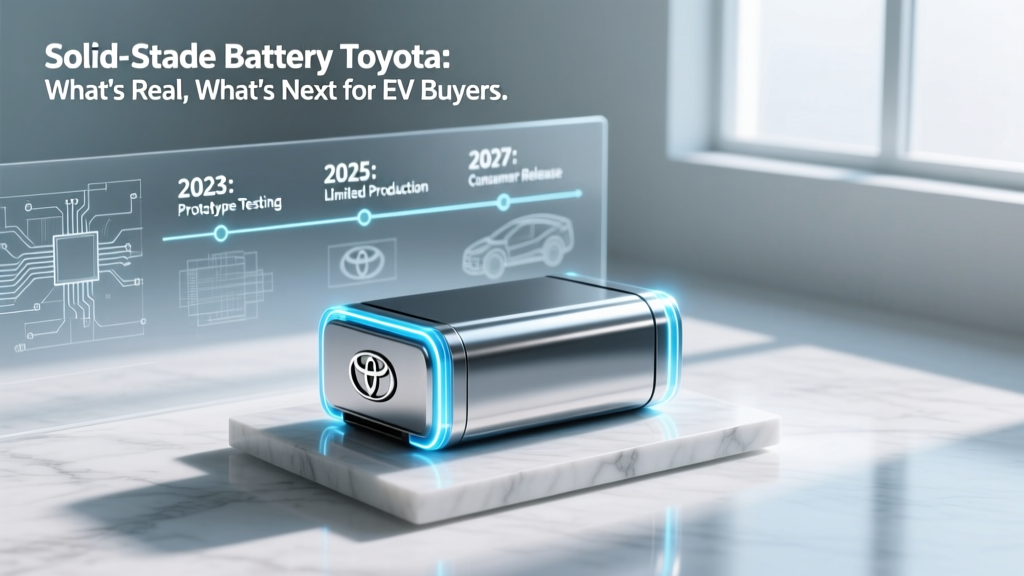
Solid-state batteries replace the liquid electrolyte with a solid conductor (ceramic, sulfide, or polymer), promising higher energy density, faster charging, improved safety (no flammable electrolyte), and potentially 5,000–10,000+ cycle life. Current status (2026): Toyota has announced limited production of solid-state-equipped vehicles for 2027–2028, initially in small volumes for the Japanese market. Samsung SDI and QuantumScape are supplying prototype cells to OEM partners, but no mass-market vehicle with a full solid-state pack is currently available for purchase in the US. Expect solid-state to reach meaningful US market volume no earlier than 2029–2030, with premium vehicles first.
Silicon Anode Technology
Replacing graphite anodes with silicon (or silicon-carbon composites) can increase energy density by 20–40%. Companies like Sila Nanotechnologies and Group14 are supplying silicon anode materials to battery manufacturers. Current status: Partial silicon anodes are already in use in some 2025–2026 cells (e.g., in certain GM Ultium and Mercedes-Benz EQXX-derived packs), but full silicon anodes — which would deliver the largest gains — remain limited by swelling issues during charge cycles. Expect broader adoption in 2027–2029 model-year vehicles.
Neither technology changes the core advice for today's buyers: current-generation LFP and NMC batteries, properly cared for, will last the life of the vehicle for the vast majority of owners.
Frequently Asked Questions
How long do electric car batteries last in years?
Based on fleet data, most modern EV batteries retain 80–90% of their original capacity after 8–10 years of typical use (12,000–15,000 miles/year). Catastrophic failure is rare, and most packs will deliver 200,000+ miles before reaching the 70–80% capacity threshold that manufacturers use as a warranty benchmark.
How much does it cost to replace an EV battery?
Out-of-warranty replacement costs range from approximately $12,000 for a ~60 kWh pack (e.g., Tesla Model 3 RWD) to $25,000–$32,000 for large packs like the F-150 Lightning Extended Range (~131 kWh). However, most batteries never require full replacement during ownership, and module-level repairs typically cost $3,000–$7,000. Warranty coverage handles the vast majority of premature failures.
Is LFP better than NMC for longevity?
Yes, for pure cycle life and calendar aging, LFP is superior — offering 3,000–5,000+ cycles vs. 1,000–2,500 for NMC, plus better tolerance for 100% SoC storage. The trade-off is lower energy density (less range per kWh) and weaker cold-weather performance. For drivers who don't need maximum range and live in moderate climates, LFP is the longevity-optimal choice.
Does fast charging damage my EV battery?
Occasional DC fast charging has minimal impact on battery health. The concern is with frequent, daily DC fast charging, which generates sustained heat and high C-rate stress. Studies suggest daily DCFC users experience 1.5–2x the degradation rate of Level 2 charging. For daily use, a home Level 2 charger (7–11 kW) is the longevity-friendly choice; reserve DCFC for road trips.
Should I worry about battery replacement when buying a used EV?
Check the SoH (State of Health) via OBD-II diagnostics or a dealer report before purchasing. A used EV at 60,000–80,000 miles with 90%+ SoH is typical and not a concern. Also verify whether the original 8-year/100,000-mile battery warranty is still active — it transfers to subsequent owners. A used EV with a degraded battery that's still under warranty may qualify for a free repair.
What voids an EV battery warranty?
Common exclusions include: accident or flood damage, unauthorized modifications to the battery or BMS, use of non-OEM charging equipment that causes damage, commercial/rideshare use beyond stated mileage limits, and failure to maintain the thermal management (coolant) system per the service schedule. Normal degradation above the capacity threshold (typically 70%) is not a warranty claim.