The Physics of Charging a Lithium-Ion EV Battery
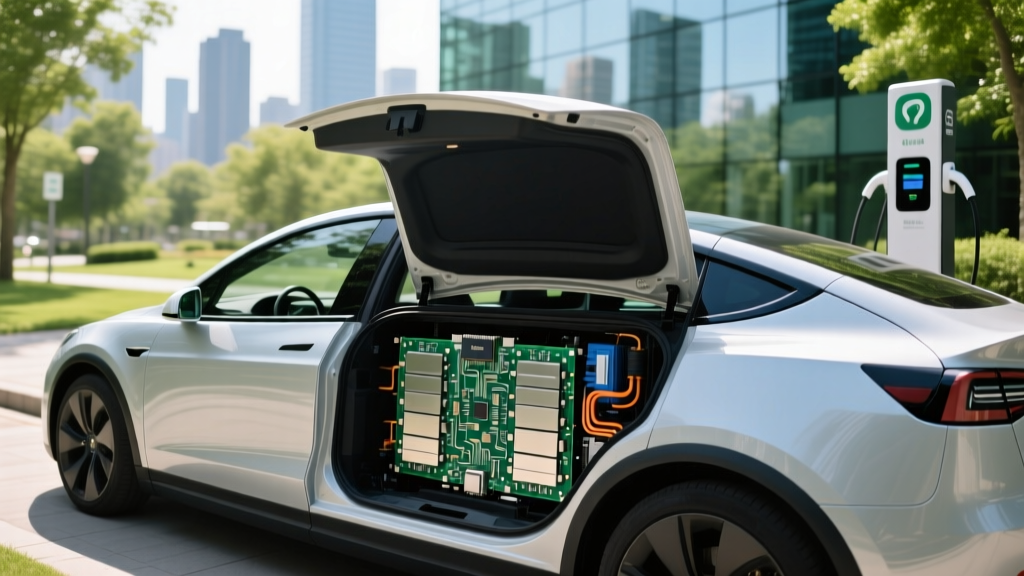
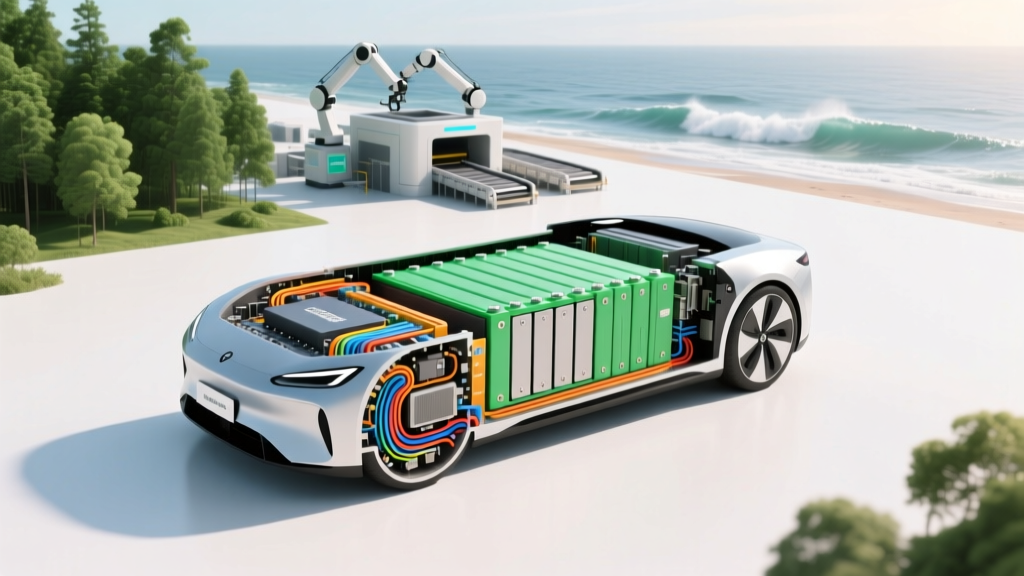
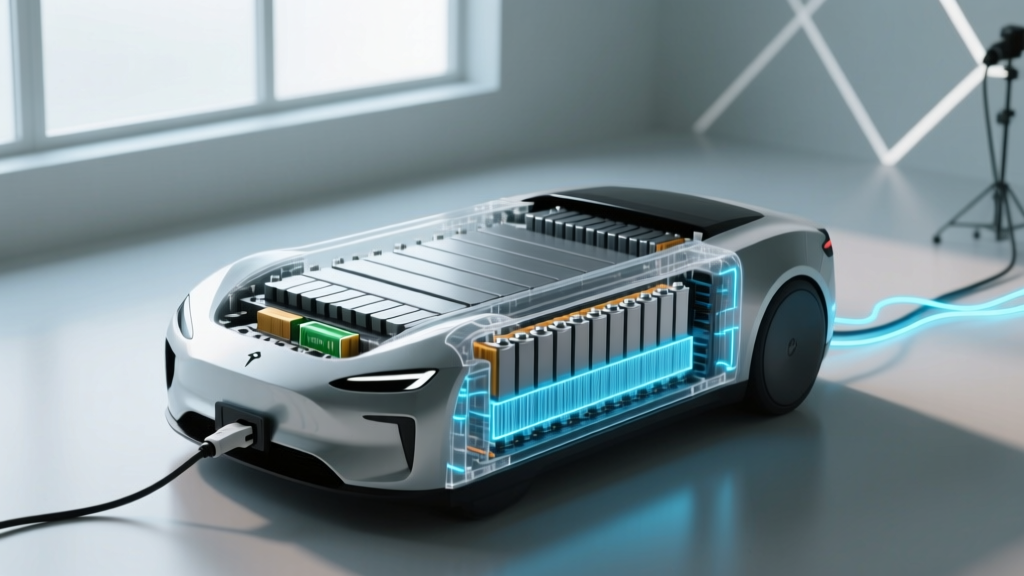
When you plug an electric vehicle into a charger, you are not "filling" a tank — you are driving a controlled electrochemical reaction. Lithium ions move from the cathode (positive electrode) through a liquid electrolyte and a porous separator to the anode (negative electrode), where they intercalate — essentially wedge themselves — into the anode material, typically graphite. Electrons travel the external circuit to balance the charge. This is how charging a battery works at the cell level: electrical energy from the grid is converted into chemical potential energy stored in the electrode materials.
During discharge (when you drive), the process reverses. Lithium ions migrate back to the cathode, electrons flow through the motor controller, and stored chemical energy becomes kinetic energy. Every charge-discharge cycle causes microscopic structural stress on the electrode materials. Over hundreds to thousands of cycles, this stress manifests as capacity loss — what the industry calls degradation.
The speed and severity of that degradation depend heavily on battery chemistry, charging habits, thermal management, and how deeply the battery is cycled. Understanding these variables is the single most important thing an EV owner or buyer can do to protect a component that can cost $10,000–$22,000 to replace.
LFP vs NMC vs NCA: Chemistry Determines Everything
Not all lithium-ion batteries are the same. The cathode material defines the trade-offs between energy density, cycle life, cost, cold-weather performance, and safety. The three dominant chemistries in 2026 EVs are:
- NMC (Nickel Manganese Cobalt) — Used in most long-range vehicles (Hyundai Ioniq 5, VW ID.4, Ford Mustang Mach-E Extended Range). High energy density enables 300+ mile EPA ranges in compact packages. Trade-off: higher cost, more thermal sensitivity, shorter cycle life than LFP.
- NCA (Nickel Cobalt Aluminum) — Tesla's long-range packs (Model 3/Y Long Range, Cybertruck). Similar to NMC in performance, slightly higher energy density, similar trade-offs.
- LFP (Lithium Iron Phosphate) — Tesla Model 3/Y Standard Range, Ford F-150 Lightning Standard Range, many Chinese-market EVs. Lower energy density but dramatically longer cycle life, lower cost, better thermal stability, and can be charged to 100% daily without accelerated degradation.
| Attribute | LFP | NMC/NCA |
|---|---|---|
| Energy density (Wh/kg) | 160–200 | 220–300 |
| Typical cycle life | 3,000–6,000+ | 1,000–2,500 |
| Recommended daily charge limit | 100% | 80–90% |
| Cold-weather performance | Weaker (more range loss below 32°F) | Better (heat pump + chemistry) |
| Cost per kWh (2026) | ~$80–$100 | ~$110–$140 |
| Thermal runaway risk | Very low | Low (with BMS management) |
| Best for | Daily commuters, fleet, budget EVs | Long-range, performance, cold climates |
The practical implication: if you charge at home nightly and drive under 60 miles a day, LFP is arguably the better chemistry — you can charge to 100% every night and still expect minimal degradation over 10+ years. If you need 300+ miles of EPA range for road trips or live in a cold climate, NMC/NCA delivers the density you need, but you should follow the 80% daily charge rule.
EV Battery Degradation: What the Real Data Shows
Modern EV batteries do not degrade like laptop batteries. Active liquid thermal management systems, buffer zones (hidden capacity above and below the displayed 0–100%), and sophisticated Battery Management Systems (BMS) have dramatically slowed capacity loss. Here is what long-term fleet data shows:
- Year 1: ~2–3% loss (initial formation loss, steepest part of the curve)
- Years 2–4: ~0.5–1% per year
- Years 5–8: ~0.5% per year
- Year 8 average total loss: ~8–12% for NMC/NCA; ~5–8% for LFP
- Year 10 projected total loss: ~12–18% for NMC/NCA; ~8–12% for LFP
Sources: Geotab fleet data, Recurrent Auto battery health reports, manufacturer warranty claims data.
A 2023 Tesla Model 3 Long Range (NCA, ~75 kWh usable) that starts at 333 miles EPA might show ~305 miles at the 5-year mark — a loss most owners barely notice in daily driving. A 2024 Tesla Model 3 RWD with LFP chemistry may lose even less. The key insight: degradation is non-linear. The steepest drop happens early, then the curve flattens significantly. Most EV batteries will outlast the vehicle's body, suspension, and interior.
What Does the EV Battery Warranty Actually Cover?
Federal law mandates a minimum 8-year/100,000-mile warranty on EV battery packs (10 years/150,000 miles in California Air Resources Board states). But the details matter enormously — not all warranties are equal.
| Manufacturer | Duration | Mileage | Capacity Threshold | Notes |
|---|---|---|---|---|
| Tesla (Model 3/Y) | 8 years | 100,000–120,000 mi | 70% retention | Varies by trim; RWD = 100k, LR = 120k |
| Hyundai/Kia | 10 years | 100,000 mi | 70% retention | Industry-leading duration |
| Ford (F-150 Lightning, Mach-E) | 8 years | 100,000 mi | 70% retention | Covers individual module replacement |
| Volkswagen (ID.4) | 8 years | 100,000 mi | 70% retention | Transferable to second owner |
| GM (Ultium platform) | 8 years | 100,000 mi | 70% retention | Covers Bolt recall replacement precedent |
| Rivian | 8 years | 175,000 mi | 70% retention | Highest mileage cap in segment |
The critical number is the capacity retention threshold. If your battery drops below 70% of original capacity within the warranty period, the manufacturer must repair or replace it — typically by swapping failed modules rather than the entire pack. In practice, very few liquid-cooled EV batteries from 2020 onward have fallen below 70% within their warranty window. According to Recurrent Auto's analysis of over 15,000 vehicles, fewer than 1.5% of EV batteries have needed warranty replacement.
EV Battery Replacement Cost: What to Expect
Out-of-warranty battery replacement remains the single largest financial risk in EV ownership — but context is essential. Most EVs are totaled, traded, or retired before the battery needs replacement. For those that do need one, here are current 2026 replacement cost ranges:
| Vehicle | Battery Size | Chemistry | Full Pack Cost | Module Repair Cost |
|---|---|---|---|---|
| Tesla Model 3 RWD | ~60 kWh | LFP | $10,000–$13,000 | $2,000–$4,000 |
| Tesla Model 3/Y LR | ~75 kWh | NCA | $13,000–$16,000 | $3,000–$5,000 |
| Hyundai Ioniq 5 | ~77.4 kWh | NMC | $14,000–$18,000 | $3,000–$6,000 |
| Ford F-150 Lightning ER | ~131 kWh | NMC | $18,000–$22,000 | $4,000–$8,000 |
| Chevrolet Bolt EV/EUV | ~65 kWh | NMC | $14,000–$16,000 | N/A (recall replaced full packs) |
Module-level repair is increasingly common. Most degradation or failure involves individual cell groups within a module. A technician can diagnose and swap the affected module for a fraction of the full-pack cost. As battery cell prices continue falling (pack-level prices dropped below $130/kWh in 2025, per BloombergNEF), replacement costs will continue declining through the end of the decade.
Factors That Accelerate Battery Degradation
Not all miles are equal when it comes to battery wear. These factors have the largest measurable impact on long-term capacity retention:
1. DC Fast Charging Frequency
Charging at 150+ kW generates significant internal heat. Occasional road-trip fast charging is fine — modern BMS systems precondition the pack and manage thermal load. But daily DCFC sessions (common among ride-share drivers without home charging) measurably accelerate degradation. Geotab data shows vehicles that DC fast-charged more than 3x per week lost capacity roughly 1.5x faster than those that primarily used Level 2.
2. State of Charge (SoC) Extremes
For NMC/NCA batteries, sitting at 100% SoC for extended periods causes electrolyte oxidation at the cathode. Sitting at very low SoC (below 10%) risks copper dissolution in the anode current collector. The "20–80% rule" is not a myth — it is electrochemistry. LFP batteries are the exception: their flatter voltage curve and more stable olivine crystal structure tolerate 100% SoC without significant penalty.
3. Extreme Temperatures
Charging in sub-freezing temperatures without preconditioning can cause lithium plating — metallic lithium deposits on the anode surface that permanently reduce capacity and can create dendrite shorts. Charging in sustained 100°F+ ambient heat without active cooling accelerates electrolyte decomposition. Most modern EVs handle this via thermal preconditioning, but it is why preconditioning before a fast-charge session is non-negotiable for battery health.
4. High-Discharge Loads
Repeated hard acceleration (drawing 300+ kW from the pack) and frequent towing at maximum capacity generate high C-rates that stress cells. This is a minor factor for normal drivers but relevant for performance-oriented use or heavy commercial towing.
- ✅ Set daily charge limit to 80% for NMC/NCA; 100% is fine for LFP
- ✅ Use Level 2 home charging as your primary method (6–11 kW, gentle on cells)
- ✅ Precondition the battery before DC fast charging (use navigation to a charger)
- ✅ Avoid leaving the vehicle at 100% SoC for more than a few hours
- ✅ In freezing weather, precondition before any charge session
- ✅ Avoid storing the vehicle long-term below 20% or above 80% SoC
- ✅ Limit DC fast charging to road trips when possible; don't make it your daily routine
How to Check Your EV Battery's State of Health (SoH)
State of Health (SoH) is the percentage of original capacity your battery can still hold. A new battery is 100% SoH; one that holds 88 kWh of its original 100 kWh is at 88% SoH. Here is how to monitor it:
- In-vehicle displays: Tesla shows estimated range at 100% (compare to original EPA figure). Some Hyundai/Kia models display SoH percentage in the EV settings menu. Nissan Leaf has a 12-bar capacity gauge.
- OBD-II diagnostic apps: Tools like Leaf Spy (Nissan), Scan My Tesla, or generic OBD-II readers with EV support can read the BMS-reported SoH directly. This is the most accurate consumer-accessible method.
- Dealer diagnostic reports: Request a battery health report during service visits. Most manufacturers can pull a detailed SoH reading, cell balance data, and charge history.
- Third-party services: Companies like Recurrent Auto offer free battery health scoring by connecting to your vehicle's telematics data.
- Manual calculation: Charge to 100%, note the displayed range, and compare it to the original EPA range. Account for temperature (cold reduces displayed range temporarily — test in mild weather for accuracy).
For used-EV buyers, a SoH reading is the single most important pre-purchase check — more critical than exterior condition or mileage. A 2021 EV with 90% SoH and 60,000 miles is a better battery bet than one with 95% SoH and 20,000 miles that was repeatedly DC fast-charged and stored at 100%.
Emerging Battery Technology: What Is Coming and When
Current lithium-ion technology is mature and reliable, but several next-generation chemistries are in development. All timelines below are forward-looking estimates based on manufacturer announcements and industry analysis — none are available in production vehicles as of early 2026.
- Silicon-dominant anodes: Replacing graphite with silicon can increase energy density by 20–40%. Companies like Sila Nanotechnologies and Group14 are scaling production. Expected in limited production vehicles by 2027–2028. Trade-off: silicon expands ~300% during lithiation, requiring novel structural solutions.
- Semi-solid-state batteries: NIO's 150 kWh semi-solid pack (available in China) demonstrates 360 Wh/kg cell-level density. Western OEMs are targeting 2028–2030 for limited deployment. These use a gel-polymer electrolyte rather than a full solid electrolyte.
- Full solid-state batteries: Toyota, Samsung SDI, and QuantumScape target 2028–2032 for production vehicles. Promise: 2x energy density, 10-minute fast charging, no liquid electrolyte fire risk. Reality: manufacturing scale-up remains the primary bottleneck. Expect initial deployment in premium/low-volume models first.
- Sodium-ion batteries: CATL and BYD are deploying sodium-ion packs in Chinese-market budget EVs. Lower energy density (~120–150 Wh/kg) but dramatically cheaper raw materials and excellent cold performance. Possible in US-market fleet/budget vehicles by 2028+.
The practical takeaway: current lithium-ion batteries (both LFP and NMC) are well-proven, well-warrantied, and sufficient for the vast majority of drivers. Waiting for solid-state is a valid choice for buyers who plan to purchase in 2030+, but it should not delay a purchase today.
Frequently Asked Questions
How long do EV batteries last in years and miles?
Based on fleet data from Geotab and Recurrent Auto, modern liquid-cooled EV batteries (2020+) are projected to last 15–20 years or 200,000+ miles before dropping below 70% capacity. Many will outlast the vehicle itself. The federal warranty minimum is 8 years/100,000 miles; Hyundai and Kia offer 10 years/100,000 miles.
How much does an EV battery cost to replace?
Full pack replacement ranges from ~$10,000 (smaller LFP packs) to ~$22,000 (large NMC packs like the F-150 Lightning Extended Range). Module-level repair costs $2,000–$8,000 depending on the vehicle. Prices are declining as cell costs fall. Most EVs never need an out-of-warranty replacement.
What does the battery warranty cover?
Manufacturer warranties cover capacity loss below a stated threshold (typically 70% of original capacity) within the warranty period (typically 8 years/100,000 miles). They also cover manufacturing defects, module failures, and BMS malfunctions. Warranties generally do not cover damage from accidents, flooding, or unauthorized modifications. Check the IRS §30D guidelines for related tax credit rules on battery sourcing.
LFP vs NMC — which battery chemistry is better?
Neither is universally better. LFP wins on cycle life (3,000–6,000 cycles vs 1,000–2,500), cost (~$80–100/kWh vs ~$110–140/kWh), thermal safety, and the ability to charge to 100% daily. NMC/NCA wins on energy density (enabling 300+ mile ranges in smaller packs), cold-weather performance, and suitability for long-range and performance vehicles. Choose LFP for daily commuting and budget; choose NMC for range and cold climates.
How do I check and maximize my EV battery health?
Check SoH via your vehicle's in-dash display, an OBD-II diagnostic app, or a dealer service report. Maximize health by charging to 80% daily (NMC/NCA), using Level 2 as your primary charge method, preconditioning before fast charging, avoiding extreme SoC storage, and limiting DCFC frequency. See the battery care checklist above for a complete guide.
Does fast charging damage my EV battery?
Occasional DC fast charging (road trips, a few times per month) causes negligible additional degradation in modern liquid-cooled packs. Daily DCFC use does measurably accelerate wear — roughly 1.5x the degradation rate of Level 2-only charging according to fleet data. The key is using your vehicle's navigation-based preconditioning, which warms the battery to optimal temperature before a fast-charge session, reducing stress on the cells.