If you're researching Honda CR-V hybrid battery life before buying or as a current owner, you're asking the right question. The high-voltage traction battery is the most expensive single component in any electrified vehicle, and its longevity directly affects total cost of ownership. The good news: Honda's hybrid battery packs are among the most durable in the industry, routinely lasting well beyond their warranty periods.
This guide covers the specific battery hardware in the 2024–2026 Honda CR-V Hybrid, real-world degradation patterns, warranty coverage, replacement economics, and the broader battery chemistry landscape so you can contextualize what you're driving — and what's coming next.
Honda CR-V Hybrid Battery: Specs, Chemistry, and Design
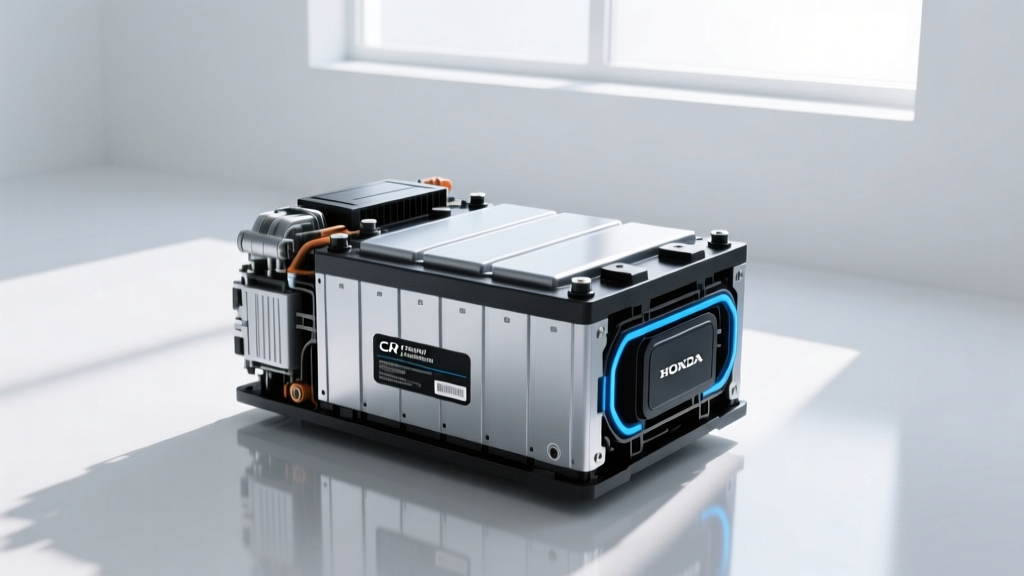
The current-generation Honda CR-V Hybrid (2024–2026 model years) uses a two-motor hybrid system paired with a 1.5 kWh lithium-ion traction battery. This is a relatively small pack by electrified-vehicle standards — and that's by design. Honda's e:HEV (also called the two-motor hybrid system) uses the battery as a buffer for energy recapture and electric-only assist at low speeds, not as a primary range source like a plug-in hybrid or full EV.
The CR-V Hybrid's pack uses NMC (nickel manganese cobalt) lithium-ion cells. This chemistry is chosen for its balance of energy density and power delivery — critical for a hybrid that cycles the battery frequently through charge and discharge during regenerative braking and acceleration assist.
| Specification | Value |
|---|---|
| Battery capacity | 1.5 kWh (lithium-ion NMC) |
| Combined system output | 204 hp / 247 lb-ft torque |
| EPA combined fuel economy | 40 MPG (FWD) / 39 MPG (AWD) |
| Electric-only driving | Low-speed assist only (~1–2 miles at moderate speeds) |
| Battery location | Under rear cargo floor |
| Base MSRP (Sport Hybrid FWD) | $36,395 |
Source: fueleconomy.gov
How Long Do Hybrid Batteries Actually Last?
Honda CR-V hybrid battery life typically extends to 150,000–200,000 miles or 12–15 years under normal ownership conditions, based on fleet data from earlier Honda hybrid systems (the Insight, Accord Hybrid, and prior CR-V Hybrid generations). Many Honda hybrid batteries outlast the vehicles they're installed in.
Hybrid batteries degrade differently than full EV batteries. Because the pack is small and the vehicle's battery management system (BMS) keeps the state of charge in a narrow middle band — typically between 40% and 80% SoC — the cells experience far less stress than a BEV pack that's regularly charged to 100% or depleted to single digits.
Real-World Degradation Data
Based on aggregated owner reports and fleet data for Honda's two-motor hybrid systems:
- Years 1–3 (0–50,000 miles): Minimal measurable degradation. The BMS buffers effectively, and capacity loss is typically under 2–3%.
- Years 4–7 (50,000–120,000 miles): Gradual capacity loss of approximately 5–10%. You may notice slightly reduced electric-only assist duration at low speeds, but fuel economy remains within 1–2 MPG of original.
- Years 8–12 (120,000–200,000 miles): Total capacity loss of 10–20%. Fuel economy may drop 2–4 MPG from new. The battery still functions but provides less electric assist, shifting more load to the gasoline engine.
- Beyond 200,000 miles: Significant degradation is possible but not guaranteed. Many packs continue operating with reduced performance; some require replacement.
Honda's Hybrid Battery Warranty Explained
Honda provides robust warranty coverage for the CR-V Hybrid's traction battery, consistent with federal requirements for hybrid and EV components. Here's exactly what's covered:
| Coverage Item | Terms |
|---|---|
| Hybrid battery (traction) | 8 years / 100,000 miles (10 years / 150,000 miles in CARB states) |
| Capacity retention threshold | Honda replaces if capacity falls below functional failure threshold (not a fixed % like BEVs) |
| Hybrid system components | 8 years / 100,000 miles (inverter, electric motors, BMS) |
| Transferability | Fully transferable to subsequent owners |
| 12V auxiliary battery | 3 years / 36,000 miles (standard new-vehicle battery warranty) |
CARB states with extended 10-year/150,000-mile coverage include California, Colorado, Connecticut, Maine, Maryland, Massachusetts, New Jersey, New York, Oregon, Rhode Island, Vermont, Virginia, and Washington. Confirm your state's status at Honda's warranty page.
The hybrid battery warranty covers defects in materials and workmanship, as well as premature capacity loss that causes the system to malfunction. Unlike BEV warranties (which typically guarantee 70% capacity retention), Honda's hybrid warranty is structured around functional failure rather than a specific capacity percentage — because the small pack isn't providing measurable range in the way a 75 kWh EV battery does.
Honda CR-V Hybrid Battery Replacement Cost
If your CR-V Hybrid battery fails outside warranty coverage, here's what to expect financially:
| Component | Estimated Cost |
|---|---|
| CR-V Hybrid traction battery (OEM new) | $2,500–$4,000 |
| Remanufactured/reconditioned pack | $1,500–$2,500 |
| Labor (dealership) | $500–$1,000 |
| Labor (independent hybrid specialist) | $300–$600 |
| Total out-of-pocket (OEM + dealer labor) | $3,000–$5,000 |
Compared to a full EV battery replacement ($8,000–$20,000+ depending on pack size), the CR-V Hybrid's small 1.5 kWh pack is relatively affordable to replace. And because hybrid batteries typically last 150,000+ miles, most owners will sell or retire the vehicle before a replacement is needed.
What Affects Honda CR-V Hybrid Battery Life?
Several factors influence how quickly the traction battery degrades. Understanding these helps you maximize longevity:
1. State of Charge Management
Honda's BMS already handles this for you. The system keeps the battery in a middle SoC window (roughly 40–80%), avoiding the high-stress extremes of full charge and deep discharge. You don't need to micromanage this — just drive normally.
2. Temperature Extremes
Heat is the primary enemy of lithium-ion longevity. Sustained ambient temperatures above 95°F accelerate chemical degradation inside the cells. The CR-V Hybrid's battery is passively cooled (air-cooled via cabin air), so parking in shade or a garage during hot summers meaningfully extends pack life.
Cold weather temporarily reduces battery performance — you'll notice less electric assist and slightly lower MPG in sub-freezing conditions — but cold does not cause permanent degradation the way heat does.
3. Driving Patterns
Frequent stop-and-go driving actually benefits hybrid battery longevity because it keeps the pack cycling through shallow charge-discharge cycles, which is ideal for lithium-ion chemistry. Highway-only driving with minimal regen engagement is neutral — not harmful, but not beneficial either.
4. Vehicle Storage
Leaving a hybrid un-driven for extended periods (months) with the battery at very low or very high SoC can cause damage. If storing the CR-V Hybrid for more than 30 days, drive it for at least 30 minutes every few weeks to let the BMS manage the pack.
-
Battery Care Checklist for CR-V Hybrid Owners:
- ✅ Park in shade or a garage during hot weather when possible
- ✅ Drive regularly — avoid leaving the vehicle sitting for months
- ✅ Keep up with scheduled maintenance (cooling system checks)
- ✅ Don't worry about charge levels — the BMS handles this automatically
- ✅ Address warning lights promptly — don't ignore hybrid system alerts
- ❌ Don't attempt to modify or disable the BMS
- ❌ Don't store the vehicle long-term in extreme heat without periodic use
LFP vs. NMC: Understanding Battery Chemistry Trade-Offs
The CR-V Hybrid uses NMC cells, but understanding the broader battery chemistry landscape helps you evaluate any electrified vehicle. Here's how the two dominant lithium-ion chemistries compare:
| Attribute | LFP (Lithium Iron Phosphate) | NMC (Nickel Manganese Cobalt) |
|---|---|---|
| Energy density | Lower (~160 Wh/kg) | Higher (~220–260 Wh/kg) |
| Cycle life | 3,000–5,000+ cycles | 1,500–3,000 cycles |
| Cold-weather performance | Weaker — more range loss below freezing | Better low-temp discharge capability |
| Thermal stability | Excellent — very low thermal runaway risk | Good — requires more active thermal management |
| Cost | Lower (no cobalt or nickel) | Higher (commodity-linked pricing) |
| 100% SoC tolerance | Can charge to 100% daily without harm | Best kept at 80% daily; 100% for trips only |
| Common applications | Tesla Model 3/Y RWD, Ford Mustang Mach-E Select, BYD | Most long-range EVs, Honda/Acura hybrids, PHEVs |
Which is better? It depends on the application. For a hybrid like the CR-V, NMC's higher energy density and power delivery in a compact package makes it the right choice — the battery needs to deliver quick bursts of power for acceleration assist and absorb rapid regen pulses, all within a small physical footprint under the cargo floor.
LFP excels in full EVs where the pack is large (60–100 kWh), daily 100% charging is practical, and the priority is maximum cycle life over decades. Tesla's standard-range vehicles, for example, use LFP and recommend charging to 100% regularly — something you'd avoid with NMC.
How to Check Your CR-V Hybrid Battery Health
Unlike full EVs, which increasingly offer in-dash State of Health (SoH) readouts or app-based battery health monitoring, Honda's hybrid system doesn't expose a direct battery health percentage to the driver. Here's how to assess your pack's condition:
At-Home Indicators
- Fuel economy tracking: Monitor your average MPG over consistent routes. A gradual drop of 3+ MPG over tens of thousands of miles can indicate battery degradation.
- Electric assist behavior: If the gasoline engine engages more frequently at low speeds where it previously stayed in EV mode, the battery may be losing capacity.
- Regen effectiveness: Noticeably reduced regenerative braking capture on downhill segments suggests the pack can't accept charge as readily.
Professional Diagnostics
A Honda dealership can run a hybrid battery diagnostic scan that reads individual cell voltages, internal resistance, and capacity estimates. Request this during routine service if you're past 100,000 miles or noticing performance changes. Independent hybrid specialists can also perform these scans, often at lower cost.
Third-party OBD-II scanners with hybrid/EV capability (such as the Autel MaxiCOM or Launch X431 series) can read some Honda hybrid battery parameters, though dealer-level diagnostics remain the most thorough option.
Future Battery Technology: What's Coming Next
While the CR-V Hybrid's current NMC pack represents mature, proven technology, the broader battery landscape is shifting. Here's what's on the horizon — with realistic timelines:
Solid-State Batteries
Solid-state cells replace the liquid electrolyte with a solid material, promising higher energy density (~400+ Wh/kg), faster charging, and improved safety. Honda has announced a solid-state battery demonstration production line and targets commercialization in the late 2020s. Realistic consumer availability in Honda production vehicles: 2028–2030 timeframe, likely debuting in full EVs before hybrids.
Silicon-Dominant Anodes
Replacing graphite anodes with silicon can increase energy density by 20–40%. Companies like Sila Nanotechnologies and Group14 are already supplying early-production cells. Expect broader adoption in EVs by 2027–2028, with trickle-down to hybrid applications following.
Sodium-Ion Batteries
Sodium-ion chemistry eliminates lithium entirely, offering lower cost and abundant raw materials at the trade-off of lower energy density. Currently deployed in some Chinese-market EVs (BYD Seagull). US-market availability remains 2027+ at earliest, and sodium-ion is better suited to budget EVs than performance hybrids.
Frequently Asked Questions
How long do Honda CR-V Hybrid batteries last?
Based on fleet data and Honda's hybrid system track record, expect 150,000–200,000 miles or 12–15 years before significant degradation. Many packs outlast the vehicle itself. The 8-year/100,000-mile warranty (10 years/150,000 miles in CARB states) provides a strong floor.
How much does it cost to replace a Honda CR-V Hybrid battery?
An OEM replacement battery plus dealership labor runs $3,000–$5,000. Remanufactured packs installed by independent hybrid specialists can reduce this to $1,800–$3,100. For context, a full EV battery replacement typically costs $8,000–$20,000+.
What does the Honda hybrid battery warranty cover?
The warranty covers defects and premature capacity loss causing system malfunction for 8 years/100,000 miles (10 years/150,000 miles in CARB states). It's fully transferable to subsequent owners and includes the battery, inverter, electric motors, and battery management system.
How do I maximize my CR-V Hybrid battery's lifespan?
Park in shade during extreme heat, drive the vehicle regularly (avoid months-long storage), and address hybrid system warning lights promptly. Honda's BMS handles state-of-charge management automatically — there's nothing you need to manually optimize.
Is LFP or NMC better for a hybrid battery?
NMC is the better fit for hybrid applications like the CR-V. Its higher energy density and superior power delivery in a compact package suit the rapid charge-discharge cycling of a hybrid system. LFP's strengths — extreme cycle life and 100% SoC tolerance — are more valuable in full EVs with large packs.
Will my CR-V Hybrid battery degrade noticeably in cold weather?
Cold weather temporarily reduces battery performance — expect less electric assist and 2–4 MPG lower fuel economy in sustained sub-freezing temperatures. This is temporary and does not cause permanent damage. Performance returns when temperatures rise.
Can I still drive if the hybrid battery fails completely?
No. Unlike a mild-hybrid system, the CR-V Hybrid's two-motor system depends on the traction battery for core drivetrain operation. A complete battery failure will trigger a hybrid system warning and the vehicle will enter a reduced-power limp mode or shut down. This is rare and typically preceded by warning indicators over weeks or months.