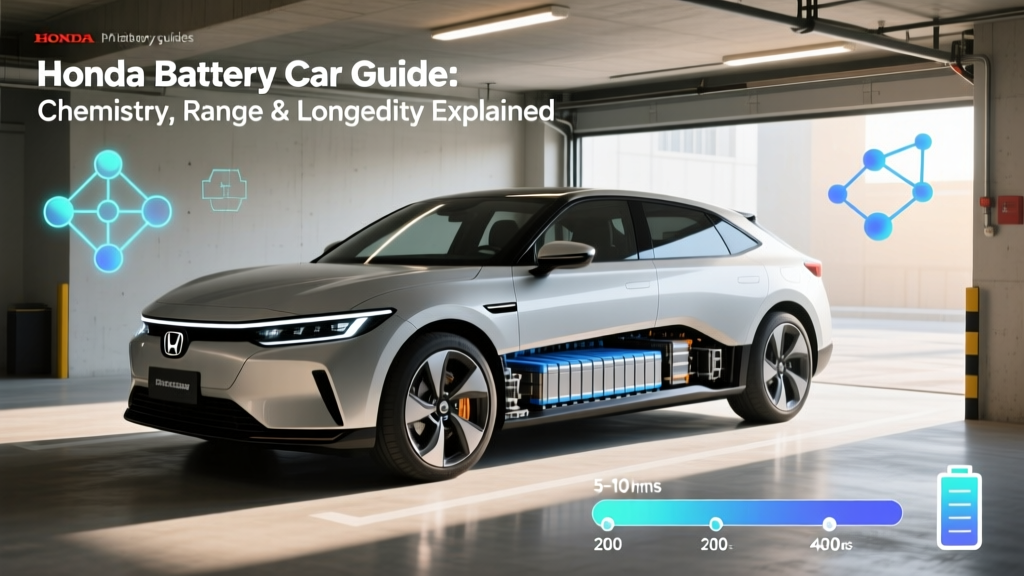
Honda's electric ambitions have shifted dramatically. After launching the 2024 Prologue on General Motors' Ultium platform, Honda is now rolling out its own dedicated EV architecture under the "0 Series" banner, beginning with models arriving for the 2026 model year. For buyers researching a Honda battery car, the critical questions aren't just about range and styling — they're about what's inside the battery pack, how long it will last, and what happens when it ages.
This guide breaks down Honda's battery chemistry choices, real-world degradation expectations, warranty coverage, replacement economics, and the habits that maximize pack longevity. Whether you're eyeing a Prologue on the lot or waiting for the 0 Series saloon and SUV, the battery is the single most expensive component in the vehicle. Understanding it is non-negotiable.
Honda's Current and Upcoming EV Battery Lineup
Honda's EV strategy in North America currently spans two distinct battery architectures:
- Prologue (2024–present): Built on GM's Ultium platform with an 85 kWh (usable) lithium-ion pack using NMC (nickel manganese cobalt) chemistry. Available in front-wheel-drive (single motor, 212 hp) and all-wheel-drive (dual motor, 288 hp). EPA-rated range spans 296 miles (FWD) to 273 miles (AWD), per fueleconomy.gov.
- 0 Series (announced for 2026+): Honda's in-house EV platform, unveiled at CES 2024. Honda has confirmed a new thin, lightweight battery pack design and has signaled a mix of NMC and potentially LFP chemistries across the lineup, though final specifications for North American models remain preliminary.
LFP vs NMC: Which Battery Chemistry Does Honda Use?
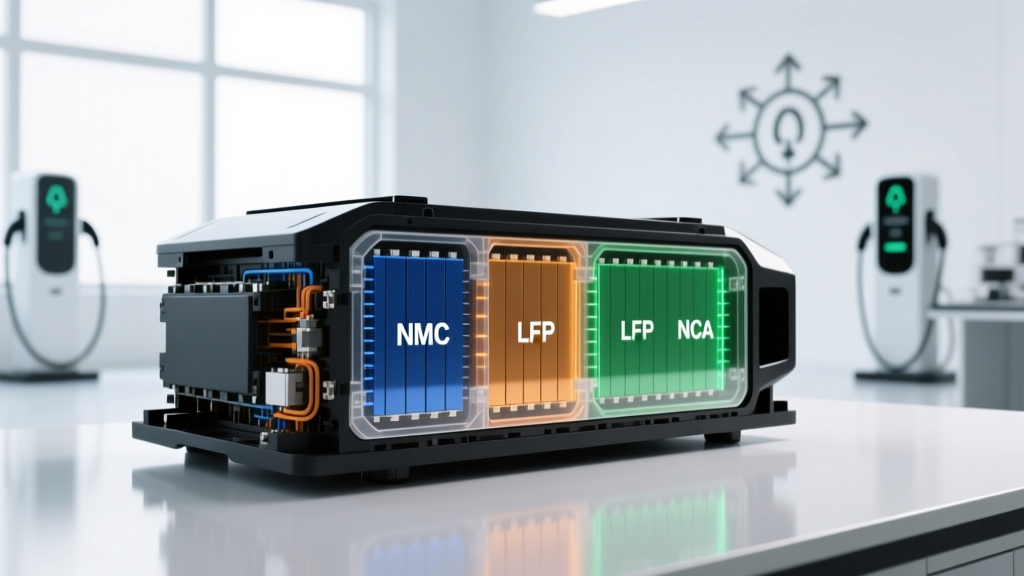
Battery chemistry defines an EV's energy density, longevity, cost, and cold-weather behavior. Honda's Prologue uses NMC chemistry via GM's Ultium supply chain. The upcoming 0 Series may introduce LFP options in lower trims, following the industry trend set by Tesla, Ford, and others.
| Attribute | NMC (Nickel Manganese Cobalt) | LFP (Lithium Iron Phosphate) |
|---|---|---|
| Energy Density | Higher (~250 Wh/kg cell-level) | Lower (~170 Wh/kg cell-level) |
| Cycle Life | ~1,000–1,500 full cycles | ~2,500–4,000+ full cycles |
| Cold Performance | Better at sub-freezing temps | Reduced range & slower charging in cold |
| Cost per kWh | Higher (cobalt/nickel supply chain) | Lower (abundant iron/phosphate) |
| Thermal Stability | Good, requires active management | Excellent, inherently safer chemistry |
| Charging to 100% | Recommended to stay below 90% daily | Can charge to 100% regularly without harm |
| Honda Application | Prologue (all trims), 0 Series (expected) | 0 Series (potential for base trims) |
The practical takeaway: NMC gives Honda the range density needed for competitive EPA ratings in the Prologue's midsize SUV form factor. LFP, if adopted for 0 Series base models, would trade some range for significantly longer cycle life and a lower price point. Neither chemistry is universally "better" — the right choice depends on your driving patterns and climate.
How Long Do Honda EV Batteries Actually Last?
The fear of a dead battery pack is the single largest barrier to EV adoption. The data tells a more reassuring story.
Modern liquid-cooled lithium-ion packs, including the Ultium architecture in the Prologue, are engineered for 1,000–2,000+ charge cycles before significant degradation. At an average of 3–4 miles per kWh and a usable capacity of 85 kWh, that translates to roughly 250,000–500,000 miles of driving before the pack falls below 80% of its original capacity.
- Year 1 / 15,000 miles: ~2–4% capacity loss (initial formation loss)
- Year 3 / 45,000 miles: ~6–9% total loss
- Year 5 / 75,000 miles: ~8–12% total loss
- Year 8 / 120,000 miles: ~10–16% total loss
- Year 10 / 150,000 miles: ~12–20% total loss
Sources: Geotab fleet data, Recurrent Auto battery studies. Individual results vary based on climate, charging habits, and thermal management usage.
For a Prologue owner driving 12,000 miles annually, expect roughly 270 miles of range in year one to settle around 245–255 miles by year five. This is gradual, not cliff-like. Most EV batteries outlast the vehicles they're installed in — total pack failure is rare, and capacity loss is the real-world concern, not sudden death.
Honda EV Battery Warranty: What's Covered
Honda follows the federal mandate for EV battery warranties and, in the case of the Prologue, aligns with GM's Ultium coverage terms since the powertrain is GM-sourced.
| Coverage Area | Prologue (GM Ultium) | Federal Minimum (all EVs) |
|---|---|---|
| Battery Pack | 8 years / 100,000 miles | 8 years / 100,000 miles (10/150k in CARB states) |
| Capacity Retention Threshold | ~70% of original capacity | Varies; most manufacturers set 60–70% |
| Powertrain Components | 8 years / 100,000 miles | 8 years / 100,000 miles |
| Bumper-to-Bumper | 3 years / 36,000 miles | N/A |
If your Prologue's battery degrades below the threshold (approximately 70% capacity, meaning your 296-mile EPA range drops below ~207 miles under the same test conditions) within the warranty period, Honda — through its GM partnership — will repair or replace the pack at no cost. In practice, warranty claims for battery degradation are uncommon in the first eight years for liquid-cooled packs. Most degradation-related claims arise in high-mileage fleet vehicles or those repeatedly exposed to extreme heat without preconditioning.
For the upcoming 0 Series, Honda has not yet published final warranty terms. Given industry standards and competitive pressure, expect similar 8-year/100,000-mile coverage. Honda's historical reputation for powertrain durability suggests they will meet or exceed the baseline.
EV Battery Replacement Cost: What Honda Owners Should Budget
Out-of-warranty battery replacement is the nightmare scenario. Here's what it actually costs — and how likely you are to face it.
| Vehicle / Pack Size | Battery Cost (parts) | Labor & Programming | Total Estimated Range |
|---|---|---|---|
| Honda Prologue (85 kWh NMC) | $12,000–$16,000 | $2,500–$4,000 | $14,500–$20,000 |
| Comparable midsize EV (75–90 kWh) | $10,000–$18,000 | $2,000–$4,500 | $12,000–$22,500 |
| Compact EV / future LFP (60 kWh) | $7,000–$11,000 | $2,000–$3,500 | $9,000–$14,500 |
Context that matters: Battery pack prices have fallen roughly 80% since 2013 and continue declining. By the time a 2024 Prologue reaches 150,000 miles (roughly 2036), replacement packs will cost significantly less. Additionally, module-level repair is increasingly viable — a technician can replace degraded modules within a pack rather than swapping the entire assembly, cutting costs by 50–70%.
The statistical likelihood of needing a full out-of-warranty replacement is low. According to Consumer Reports and industry warranty data, fewer than 5% of modern liquid-cooled EV batteries require replacement within the first 10 years. Most EVs are retired, traded, or scrapped for non-battery reasons before the pack reaches end-of-life.
Factors That Accelerate (or Preserve) Battery Health
Battery degradation isn't purely a function of time and mileage. How you charge, drive, and store your Honda EV materially affects long-term capacity retention.
- Limit DC fast charging: Occasional road-trip fast charging is fine, but daily reliance on 150+ kW DC charging accelerates degradation. The Prologue peaks at approximately 150 kW DC; use Level 2 home charging as your daily routine.
- Maintain 20–80% State of Charge for daily use: For NMC chemistry (Prologue), avoid routinely charging to 100% or draining below 10%. Set your charge limit to 80% in the vehicle's settings for daily commuting.
- Precondition before fast charging: Use the Prologue's navigation-based battery preconditioning. Routing to a DC fast charger via the nav system warms the pack for optimal charge acceptance, reducing stress on cells.
- Avoid prolonged extreme-temperature storage at high SoC: Parking in direct sun at 100% charge in Arizona summer, or leaving the car at 5% in a Minnesota January, stresses cells. Store between 30–60% SoC if the car will sit for weeks.
- Use regenerative braking moderately: The Prologue's regen settings are calibrated well from the factory. Aggressive one-pedal driving in cold weather (before the pack is warmed) can stress cells. Allow the car to warm up before heavy regen use.
- Keep firmware updated: Honda and GM periodically release battery management system (BMS) updates that optimize thermal management and charging curves. Stay current.
Monitoring Your Honda's Battery State of Health (SoH)
Unlike a gas car's engine, you can't hear a battery degrading. Here's how to track it:
In-Vehicle Tools
The Prologue's infotainment system includes basic battery status information under the energy/charging menus. While Honda doesn't expose a precise SoH percentage like some competitors, you can monitor your observed range versus the EPA sticker over time. A consistent drop of 15–20% over several years is normal; a sudden range cliff suggests a module issue warranting dealer diagnosis.
Third-Party Diagnostics
Services like Recurrent Auto and Geotab offer battery health reports by connecting to your vehicle's OBD-II port or telematics data. These reports provide a more granular State of Health percentage, cell balance data, and degradation trend lines. For a pre-purchase inspection on a used Prologue, a third-party battery report is the single most valuable document you can obtain.
Dealer Diagnostics
Honda dealers can run a full battery health scan that reads individual module voltages, internal resistance, and thermal sensor data. Request this during routine service visits, especially as the vehicle approaches the warranty mileage threshold. If degradation is approaching the warranty claim level, having documentation from multiple time points strengthens your case.
What's Next: Honda's Solid-State Battery Plans
Honda has been vocal about its solid-state battery ambitions. The company opened a demonstration production line in Tochigi, Japan, and has stated goals to introduce solid-state cells in production EVs in the latter half of the 2020s.
What solid-state promises: Solid electrolytes replace the liquid electrolyte in current lithium-ion cells, potentially doubling energy density (enabling 500+ mile ranges in compact packages), dramatically reducing fire risk, and enabling faster charging. Cycle life projections exceed 5,000 cycles.
Realistic timeline: Honda has indicated solid-state batteries will appear in production vehicles around 2028–2030, initially in limited, likely premium applications. Mass-market adoption at competitive pricing is not expected before 2032+. Toyota, Nissan, and Samsung SDI have published similar timelines.
What this means for today's buyers: Do not delay an EV purchase waiting for solid-state. The Prologue's NMC pack and the 0 Series' upcoming chemistry represent mature, proven technology with extensive degradation data. Solid-state will be a generational improvement, but it is years away from volume production and will debut at premium price points. Current Honda battery car technology is ready for real-world ownership today.
Federal Tax Credit: How It Applies to Honda EVs
The IRS §30D Clean Vehicle Credit offers up to $7,500 for qualifying new EVs, but eligibility depends on MSRP caps, buyer income limits, and battery component/critical mineral sourcing requirements that change annually.
- MSRP Cap: SUVs (including the Prologue) must have an MSRP at or below $80,000; sedans at or below $55,000.
- Buyler Income Cap: Modified adjusted gross income must not exceed $300,000 (joint), $225,000 (head of household), or $150,000 (individual).
- Battery Sourcing: For 2026, increasing percentages of battery components must be manufactured or assembled in North America, and critical minerals must be sourced from the U.S. or free-trade-agreement partners.
- Point-of-Sale Transfer: Eligible buyers can transfer the credit to the dealer at purchase, reducing the sale price directly rather than waiting for a tax refund.
The Prologue, built at GM's Spring Hill, Tennessee plant, has qualified for partial or full credit depending on the tax year and specific sourcing compliance. Always verify current eligibility on fueleconomy.gov before purchasing, as component sourcing rules tighten each year. Consult a tax professional for your specific situation.
Frequently Asked Questions
How long do Honda EV batteries last in years and miles?
Based on industry degradation data for liquid-cooled NMC packs like the Prologue's Ultium battery, expect 15–20 years or 250,000–400,000 miles before the pack drops below 70–80% of original capacity. Most packs outlive the vehicle itself. Sudden failure is extremely rare; gradual capacity loss is the norm.
How much does it cost to replace a Honda Prologue battery?
A full out-of-warranty replacement for the Prologue's 85 kWh pack currently runs $14,500–$20,000 including labor. However, module-level repair can cut this to $5,000–$8,000, and pack prices continue declining. Fewer than 5% of modern EV batteries require full replacement within 10 years.
What does the Honda EV battery warranty actually cover?
The Prologue carries an 8-year/100,000-mile battery warranty covering defects and capacity loss below approximately 70% of original capacity. This is backed through Honda's partnership with GM. In CARB states (California and adopting states), coverage extends to 10 years/150,000 miles.
How do I check my Honda EV's battery health?
Monitor your observed range over time compared to the EPA sticker, use third-party services like Recurrent Auto for detailed SoH reports, and request a full battery diagnostic scan at your Honda dealer during service visits. The Prologue's infotainment system shows basic charging and battery status but does not display a precise SoH percentage.
Is LFP or NMC better for a Honda battery car?
Neither is universally superior. NMC (used in the Prologue) offers higher energy density and better cold-weather performance, making it ideal for maximizing range in a midsize SUV. LFP provides longer cycle life, lower cost, and the ability to charge to 100% regularly — better for high-mileage commuters in moderate climates. If Honda offers LFP in 0 Series base trims, it will suit buyers prioritizing longevity and price over maximum range.
Does frequent DC fast charging damage the Prologue's battery?
Occasional DC fast charging (road trips, a few times per month) causes negligible additional degradation. Daily DC fast charging, especially at the Prologue's 150 kW peak rate, does accelerate wear over years. The battery management system actively manages temperatures and tapers charge rate to protect cells, but Level 2 home charging should be your daily routine for optimal longevity.
Will Honda's solid-state batteries be worth waiting for?
Solid-state technology promises transformative improvements in range, charging speed, and safety. However, Honda's timeline places production vehicles at 2028–2030 at the earliest, with mass-market pricing not expected until 2032+. Current NMC technology is mature, well-understood, and backed by extensive real-world data. Waiting 4–6+ years for unproven technology at premium prices is not practical for buyers who need a vehicle now.