The "Germany Salt and Air Battery" Headlines: What's Actually Happening
Every few months, a headline circulates claiming that a "salt and air battery" developed in Germany will revolutionize electric vehicles. These stories usually point to research into sodium-oxygen (Na-O₂) or sodium-air batteries — experimental cells that use abundant sodium ions and ambient oxygen to store energy. Some coverage also conflates this with Germany's well-established sodium-sulfur (NaS) stationary storage programs or Fraunhofer Institute research into salt-based electrolytes.
The reality in 2026: no production EV uses a salt-and-air or sodium-air battery. These chemistries remain in the laboratory phase, with cycle-life numbers in the low hundreds and operating conditions that don't yet suit a vehicle platform. What they promise — cheap, abundant materials and potentially high energy density — is genuinely exciting. But for anyone buying an EV today or in the next 3–5 years, the battery in your car will be a lithium-ion pack using either NMC/NCA or LFP chemistry.
This guide explains what the German salt/air research actually is, then gives you the complete, data-backed picture of the EV batteries you can actually buy: how they degrade, what warranties cover, what replacement costs, and how to maximize longevity.
What "Salt and Air" Battery Technology Actually Means
The term "salt and air battery" as it appears in English-language media is a loose translation that bundles together several distinct German research programs:
- Sodium-oxygen (Na-O₂) batteries: Use sodium ions and oxygen from the air as the cathode reactant. Theoretical energy density rivals lithium-ion, but practical cycle life remains under 200 cycles in lab settings, and the cells require carefully filtered, dry air to prevent side reactions with moisture and CO₂.
- Sodium-sulfur (NaS) batteries: A mature technology used in grid-scale stationary storage for decades. They operate at ~300°C, making them entirely unsuitable for vehicles but excellent for utility load-leveling.
- Salt-based solid electrolytes: Fraunhofer and university groups have researched halide-based solid electrolytes (using chloride or bromide salts) for solid-state lithium batteries. These are components within lithium cells, not a separate "salt battery" chemistry.
None of these are ready for automotive deployment. Sodium-ion (Na-ion) batteries — a related but distinct technology — are entering production, notably from CATL in China for lower-range city EVs. But Na-ion is not a "salt and air" battery; it's a conventional rocking-chair cell that swaps lithium for sodium. We'll revisit Na-ion timelines below.
Today's EV Battery Chemistry: LFP vs. NMC/NCA
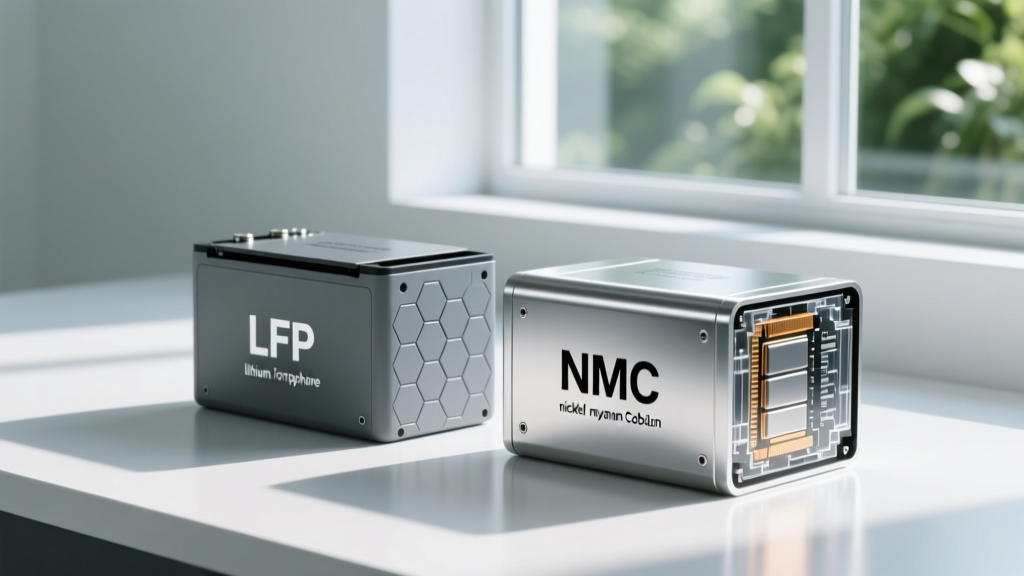
Every mainstream EV sold in the US in 2026 uses one of two lithium-ion cathode chemistries. Understanding the trade-offs is the single most important battery-knowledge gap for buyers.
| Attribute | LFP (Lithium Iron Phosphate) | NMC/NCA (Nickel Manganese Cobalt / Nickel Cobalt Aluminum) |
|---|---|---|
| Energy density (cell-level) | 160–180 Wh/kg | 220–300 Wh/kg |
| Typical cycle life | 3,000–5,000+ cycles to 80% SoH | 1,000–2,000 cycles to 80% SoH |
| Cold-weather performance | Weaker — greater range loss below 32°F; slower charge acceptance without preconditioning | Better low-temp conductivity; still loses 20–30% range in deep cold |
| Thermal stability / safety | Excellent — higher thermal runaway threshold (~270°C) | Good — but lower thermal runaway threshold (~210°C); requires more robust BMS |
| Cost per kWh (pack-level, 2026) | ~$90–$110/kWh | ~$120–$150/kWh |
| SoC recommendation | Can charge to 100% regularly; periodic full charges help BMS calibration | Daily charge to 80%; reserve 100% for trips |
| Common in (2026 US models) | Tesla Model 3/Y RWD, Ford Mustang Mach-E Select, Rivian Standard, BYD models | Tesla Long Range/Performance, Hyundai Ioniq 5/6, Chevy Equinox EV, BMW iX, most luxury EVs |
| Critical mineral concerns | No cobalt or nickel — simpler supply chain | Cobalt and nickel sourcing subject to §30D tax-credit critical-mineral requirements |
Which is better? There is no universal winner. LFP is the right call if you want maximum cycle life, lower cost, and can accept slightly less range per kWh of pack weight. NMC/NCA is better when you need the longest possible range in the lightest package — which is why nearly every 300+ mile EV uses it. If you charge at home every night and rarely road-trip, LFP's longevity advantage compounds over a decade of ownership.
How Long Do EV Batteries Actually Last?
The fear that EV batteries need replacement at 100,000 miles is not supported by fleet data. Here's what real-world degradation looks like:
Typical Degradation Curve (NMC and LFP, aggregated fleet data):
- Year 1 / 15,000 mi: 2–5% capacity loss (initial formation loss, steepest part of the curve)
- Year 3 / 45,000 mi: 5–8% total loss
- Year 5 / 75,000 mi: 8–12% total loss
- Year 8 / 120,000 mi: 10–17% total loss (most packs still above warranty threshold)
- Year 10 / 150,000 mi: 12–20% total loss for NMC; 8–14% for LFP
Sources: Recurrent Auto fleet data, Tesla Impact Reports, Geotab longitudinal studies.
A 20% loss on a 300-mile EPA-rated EV leaves you with ~240 miles of range — still entirely usable for daily driving. The vast majority of EV batteries outlast the vehicles they're installed in. Catastrophic failure (a pack that simply dies) is rare; gradual capacity loss is the norm.
Key insight: Degradation is non-linear. The steepest drop occurs in the first year or two, then the curve flattens considerably. This is why a 3-year-old EV with 8% loss is unlikely to hit 20% loss by year 6 — the rate slows.
Battery Warranties: What's Covered and What Isn't
Federal law mandates a minimum 8-year / 100,000-mile warranty on EV battery packs for emissions-related compliance, and nearly every manufacturer matches or exceeds this baseline. Here's how the major warranties compare:
| Manufacturer | Warranty Period | Mileage Cap | Capacity Retention Threshold |
|---|---|---|---|
| Tesla (Model 3/Y LFP) | 8 years | 100,000 mi | 70% |
| Tesla (Model 3/Y LR, Model S/X) | 8 years | 120,000 mi | 70% |
| Hyundai / Kia (Ioniq 5/6, EV6) | 10 years | 100,000 mi | 70% |
| Ford (Mach-E, F-150 Lightning) | 8 years | 100,000 mi | 70% |
| GM (Ultium platform — Equinox, Blazer, Silverado EV) | 8 years | 100,000 mi | 70% |
| Rivian (R1T, R1S) | 8 years | 175,000 mi (Max pack) | 70% |
| BMW (i4, iX, i7) | 8 years | 100,000 mi | 70% |
What the warranty covers: If your pack falls below the stated capacity retention threshold (typically 70% of original usable kWh) within the warranty period, the manufacturer will repair or replace modules or the full pack at no cost. Some warranties also cover defects that cause sudden capacity loss or failure to charge.
What it does NOT cover: Normal gradual degradation above the threshold, damage from accidents, flooding, or unauthorized modifications, and cosmetic issues. Read your specific warranty booklet — terms vary, and some manufacturers require documented maintenance (e.g., cooling system fluid checks) to keep the warranty valid.
EV Battery Replacement Cost: Real Numbers and Context
This is the topic that generates the most anxiety, so let's be precise. Full pack replacement is uncommon under 150,000 miles, but here's what it costs when it is needed:
| Vehicle / Pack Size | Battery Chemistry | Approx. Pack Cost (Parts) | Labor + Total Estimate |
|---|---|---|---|
| Tesla Model 3 RWD (~60 kWh) | LFP | $7,000–$9,000 | $9,000–$12,000 |
| Tesla Model Y LR (~75 kWh) | NMC | $10,000–$13,000 | $12,000–$16,000 |
| Hyundai Ioniq 5 (~77.4 kWh) | NMC | $11,000–$14,000 | $13,000–$17,000 |
| Ford F-150 Lightning Ext. Range (~131 kWh) | NMC | $18,000–$25,000 | $22,000–$30,000 |
| Chevy Equinox EV (~85 kWh) | NMC (Ultium) | $12,000–$16,000 | $14,000–$20,000 |
| Rivian R1T Max Pack (~149 kWh) | NMC | $20,000–$28,000 | $25,000–$34,000 |
Important context: Pack-level costs have dropped roughly 15–20% since 2022 due to manufacturing scale and falling lithium prices. Module-level repair (replacing only degraded modules rather than the entire pack) is increasingly common and can cost $3,000–$7,000 depending on the vehicle. Many independent EV shops now offer module-level service, which was rare five years ago.
For perspective, a $15,000 battery replacement at year 12 on a vehicle you've saved $8,000–$12,000 in fuel and maintenance on still nets out favorably versus a comparable gas vehicle's total operating cost. And most owners sell or trade before replacement is needed.
Factors That Accelerate (or Preserve) Battery Life
Not all miles age a battery equally. The following factors have the largest measurable impact on long-term State of Health (SoH):
What degrades batteries faster:
- Frequent DC fast charging above 150 kW: High C-rates generate heat and accelerate solid-electrolyte interphase (SEI) growth. Occasional road-trip fast charging is fine; daily reliance on DCFC measurably increases degradation by 1–3% over 5 years vs. Level 2 charging.
- Sitting at 100% SoC for extended periods: Especially damaging for NMC. A pack held at 100% in hot weather degrades faster than one cycled between 20–80%. LFP tolerates 100% better but still shouldn't sit full for weeks.
- Extreme heat exposure: Sustained ambient temps above 95°F with a high SoC is the worst-case scenario. Garage parking and thermal preconditioning matter.
- Deep discharges to 0%: Dropping below the low-voltage cutoff stresses anode copper current collectors. Try not to regularly dip below 10%.
- Aggressive track/launch use: Sustained high-current discharge generates internal heat beyond what the thermal management system can shed.
What preserves battery health:
- Level 2 home charging as your primary routine: 7–11 kW charging is gentle on cells and allows the BMS to balance effectively.
- 20–80% SoC window for NMC; 20–100% for LFP: Follow your manufacturer's specific guidance. Tesla recommends 100% at least weekly for LFP packs to maintain BMS calibration.
- Preconditioning before fast charging: Navigating to a Supercharger or using the preconditioning feature warms the pack to optimal charge temperature (~35–40°C), reducing lithium plating risk.
- Using scheduled departure/charging features: Charge to 80% timed to finish just before you leave, rather than sitting at 80% for 10 hours.
- Moderate climates or garaged parking: Temperature is the single biggest environmental variable.
Monitoring Your Battery's State of Health (SoH)
State of Health (SoH) is the percentage of original capacity your pack can still hold. A new battery is 100% SoH; a battery that held 77.4 kWh when new and now holds 69.7 kWh is at ~90% SoH.
How to check SoH:
- In-vehicle displays: Tesla shows estimated range at 100% (which you can cross-reference to original EPA range). Some Hyundai/Kia models display SoH percentage in the service menu. BMW's iDrive includes a battery health indicator.
- OBD-II apps: Tools like Scan My Tesla, LeafSpy (for Nissan), or ABRP's OBD integration read the BMS directly and report SoH, cell voltage variance, and pack temperature.
- Third-party services: Recurrent Auto offers free battery health reports by connecting to your vehicle's telematics. Geotab provides fleet-grade SoH tracking.
- Dealer diagnostics: Any authorized service center can pull a full BMS report showing SoH, cell imbalance, and charge/discharge history. Request this before buying a used EV.
What to watch for: Cell voltage variance above 0.1V between the highest and lowest cell in the pack can indicate a weak module. Rapid SoH drops (more than 3% in a single month) warrant a service visit. Otherwise, a slow, steady decline of 1–2% per year is entirely normal.
What's Next: Sodium-Ion, Solid-State, and Realistic Timelines
This is where the "Germany salt and air battery" headlines connect to real, if still-emerging, technology. Here's an honest timeline assessment:
- Sodium-ion (Na-ion) batteries: Already in limited production in China (CATL, HiNa). Energy density is ~140–160 Wh/kg — lower than LFP — but cost is significantly lower due to abundant sodium. Expect Na-ion to appear in US-market budget EVs or as a secondary pack in hybrid-battery architectures by 2028–2030. Not suitable for long-range vehicles.
- Solid-state batteries: Toyota, Samsung SDI, and QuantumScape have demonstrated prototype cells with 350–400 Wh/kg energy density. Toyota has announced a 2027–2028 production target for a limited run. Realistic mass-market availability: 2030+ at the earliest. Solid-state promises faster charging and better safety but faces manufacturing yield and cost challenges.
- Silicon-dominant anodes: Companies like Sila Nanotechnologies and Group14 are shipping silicon-carbon anode materials that boost energy density 10–20% over graphite. These are already appearing in some 2025–2026 model-year packs (notably in Mercedes-Benz and Panasonic collaborations) and represent the most near-term, commercially available improvement.
- Sodium-oxygen / metal-air: Lab-stage only. Cycle life, moisture sensitivity, and power density remain unsolved for automotive use. Realistic vehicle application: 2035+ if ever.
The bottom line: the next meaningful leap in EV batteries you can actually buy will be silicon-anode NMC packs with incrementally better density and faster charging, arriving now through 2028. Solid-state is a genuine technology shift but remains years from scale production. Salt-and-air chemistries are a research curiosity, not a purchasing consideration.
Frequently Asked Questions
How long do EV batteries last in years and miles?
Most modern EV batteries retain 80–88% of original capacity at 150,000 miles / 10 years. LFP packs tend to outlast NMC packs by 3–5 percentage points at equivalent mileage. Catastrophic failure before 200,000 miles is rare. Expect the battery to outlast other major vehicle components.
How much does it cost to replace an EV battery in 2026?
Full pack replacement ranges from roughly $9,000 for a compact LFP pack (Tesla Model 3 RWD) to $30,000+ for a large NMC pack (F-150 Lightning Extended Range, Rivian Max Pack). Module-level repair, when available, costs $3,000–$7,000. Most owners never need a replacement under normal ownership timelines of 8–12 years.
What does the EV battery warranty actually cover?
Federally mandated minimum coverage is 8 years / 100,000 miles. Most manufacturers guarantee the pack will retain at least 70% of original capacity within that window. If it drops below the threshold, the manufacturer repairs or replaces the pack at no cost. Warranties do not cover damage from accidents, misuse, or unauthorized modifications. Hyundai/Kia offers a longer 10-year/100,000-mile term.
How do I check my EV battery's State of Health?
Use your vehicle's built-in range or health display, an OBD-II diagnostic app (like Scan My Tesla or LeafSpy), a free service like Recurrent Auto, or request a BMS report from your dealer. Check SoH annually or before purchasing a used EV.
LFP vs. NMC — which battery chemistry should I choose?
Choose LFP if: you charge at home nightly, prioritize longevity and lower cost, don't need maximum range, and want the option to charge to 100% regularly. Choose NMC/NCA if: you need 300+ miles of range, road-trip frequently, live in a very cold climate where LFP's cold-weather disadvantage is more pronounced, or want the lightest possible pack for performance. Both chemistries are proven and reliable in 2026.
Will the Germany salt-and-air battery make today's EVs obsolete?
No — not in any foreseeable timeframe. Sodium-air and metal-air chemistries remain in laboratory research with cycle lives under 200 cycles and strict environmental controls. They will not reach production vehicles before the mid-2030s at the earliest, and likely later. If you're considering an EV purchase, waiting for salt-and-air technology is not a practical strategy.
Does fast charging damage my EV battery?
Occasional DC fast charging (road trips, a few times per month) has a negligible impact on long-term SoH. Daily DC fast charging — especially at 150+ kW without preconditioning — can add 1–3% additional degradation over 5 years compared to Level 2 home charging. If DCFC is your only option, precondition the battery, limit charge sessions to 80%, and avoid charging in extreme heat when possible.
Sources: fueleconomy.gov (EPA range and efficiency data), Recurrent Auto battery degradation studies, manufacturer warranty documentation, IRS §30D clean vehicle credit guidance.