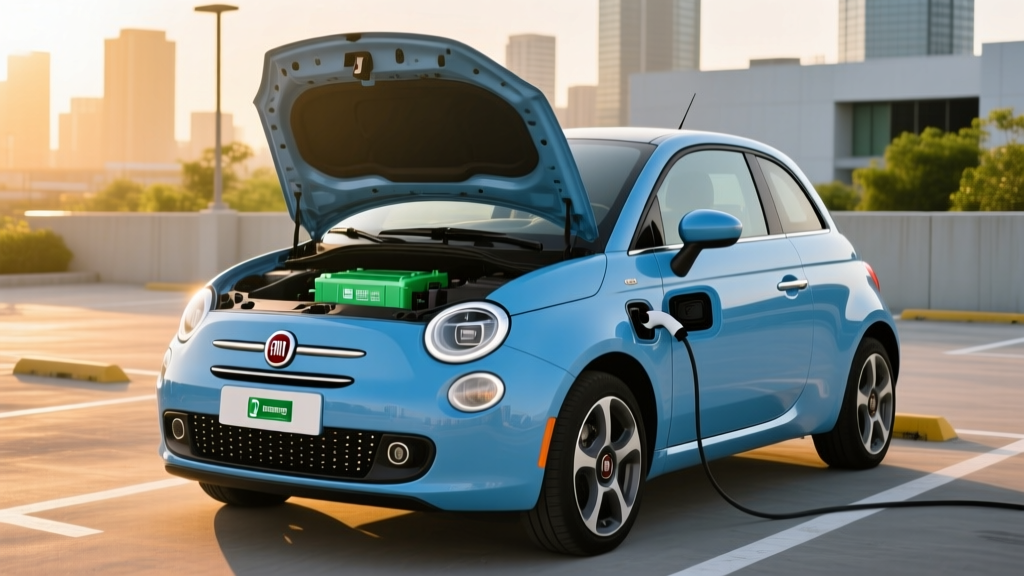
The 2024–2026 Fiat 500e returns to the U.S. market as a compact urban EV with retro styling and a 42 kWh battery pack. But beyond the Italian flair, buyers want to know: how does the Fiat 500e battery range hold up over years of ownership, what chemistry is inside, and what happens if it degrades? This guide breaks down the 500e's battery specs, real-world range expectations, degradation data, warranty coverage, and the broader EV battery technology context every prospective owner should understand.
Fiat 500e Battery Specs and Real-World Range
The current-generation Fiat 500e uses a 42 kWh lithium-ion battery pack with NMC (nickel manganese cobalt) cell chemistry, paired with a front-mounted permanent-magnet electric motor producing 118 horsepower and 162 lb-ft of torque. Here's the full spec breakdown:
| Spec | Value |
|---|---|
| Battery capacity (usable) | 42 kWh |
| Cell chemistry | NMC (Nickel Manganese Cobalt) |
| EPA-estimated range | 149 miles |
| Real-world range (highway/cold) | ~115–135 miles |
| EPA efficiency | 116 MPGe combined (29 kWh/100 mi) |
| Max DC fast charge rate | 85 kW (CCS) |
| 10–80% DC fast charge time | ~35 minutes |
| Level 2 AC charge rate | 11 kW |
| Level 2 full charge time | ~4.5 hours |
| 0–60 mph | 8.6 seconds |
| Base MSRP (Red) | $36,500 |
| Battery warranty | 8 years / 100,000 miles |
EV Battery Chemistry: LFP vs NMC and What the 500e Uses
The Fiat 500e uses NMC cells, which is typical for European-market compact EVs prioritizing energy density in a small physical package. But across the broader EV market, two dominant chemistries compete for your dollars. Here's how they compare:
| Attribute | LFP (Lithium Iron Phosphate) | NMC (Nickel Manganese Cobalt) |
|---|---|---|
| Energy density | Lower (~160 Wh/kg cell-level) | Higher (~220–260 Wh/kg cell-level) |
| Range per pack size | Less range for same weight/volume | More range in compact packages |
| Cycle life | 3,000–5,000+ cycles | 1,000–2,000 cycles typical |
| Degradation rate | Slower; ~5–8% loss over 8 years | Moderate; ~8–12% loss over 8 years |
| Cold-weather performance | Reduced charge acceptance below freezing | Better cold-weather charge/discharge |
| Cost per kWh | Lower (no cobalt/nickel) | Higher (commodity-sensitive) |
| Recommended daily SoC | Can charge to 100% daily | 80% daily recommended; 100% for trips |
| Examples | Tesla Model 3 RWD, Ford Mustang Mach-E Select (2025+) | Fiat 500e, Hyundai Ioniq 5, BMW i4 |
Why Fiat chose NMC: The 500e's compact dimensions leave limited physical space for a battery pack. NMC's higher energy density allows 42 kWh in a small footprint, delivering 149 EPA miles where an LFP pack of the same size might yield closer to 120–130 miles. The trade-off is slightly faster long-term degradation and the need to limit daily charging to ~80% for optimal longevity.
How Long Do EV Batteries Last? Degradation Data
Modern EV batteries are engineered to outlast most owners' time with the vehicle. The question isn't "will it die?" — it's "how much capacity will it lose?"
Based on aggregated fleet data from sources like Geotab's EV Battery Degradation Study, which tracks over 10,000 EVs in real-world operation, the average EV loses approximately 1.8% of battery capacity per year across all chemistries and climates. For NMC packs specifically, the curve is slightly steeper in the first two years (~2–3% annually) before flattening.
- Year 1: ~41.0 kWh usable (2–3% loss)
- Year 3: ~38.5–39.5 kWh (~6–9% cumulative loss)
- Year 5: ~37.0–38.0 kWh (~10–12% cumulative loss)
- Year 8: ~35.0–36.5 kWh (~13–17% cumulative loss)
- Year 10: ~33.5–35.5 kWh (~15–20% cumulative loss)
Real-world factors that accelerate or slow degradation include:
- DC fast-charging frequency: Daily use of DC fast charging (especially above 100 kW) increases thermal stress. Occasional road-trip fast charging has negligible impact.
- State of charge habits: Regularly sitting at 100% SoC for extended periods accelerates NMC degradation. The 80% daily limit recommendation exists for a reason.
- Extreme temperatures: Sustained exposure to 100°F+ ambient heat (think Phoenix summers) causes more calendar degradation than cold climates. Battery thermal management systems mitigate this, but the 500e's system is air-cooled on some markets and liquid-cooled on U.S. trims — verify your model year.
- Depth of discharge: Frequently draining below 10% SoC stresses cells. Keeping between 20–80% for daily use maximizes cycle life.
Fiat 500e Battery Warranty: What's Covered
Stellantis (Fiat's parent company) provides a high-voltage battery warranty that meets the U.S. industry standard for EVs. Here are the terms:
| Coverage Item | Term |
|---|---|
| Duration | 8 years or 100,000 miles (whichever comes first) |
| Capacity retention threshold | 70% of original capacity |
| What triggers a claim | Battery degrades below ~29.4 kWh usable (70% of 42 kWh) |
| Remedy | Repair, module replacement, or full pack replacement at Stellantis discretion |
| Transferability | Yes — transfers to subsequent owners |
| CARB-state extension | Some states (CA, NY, MA, and others adopting California emissions standards) may extend to 10 years / 150,000 miles for certain components — verify with your dealer |
What the warranty does NOT cover: Normal degradation above the 70% threshold, damage from accidents or modifications, and cosmetic issues unrelated to function. If your 500e's battery drops to 72% capacity at Year 7, that's considered normal wear — no claim. If it drops to 68%, Stellantis must remedy it.
In practice, warranty claims for battery replacement are rare. Data from fueleconomy.gov and owner forums suggests fewer than 5% of EVs require warranty battery service within the coverage period. Most NMC packs retain 80–85% capacity at the 8-year mark under normal use.
EV Battery Replacement Cost: What If the Warranty Expires?
If you plan to keep a 500e beyond 100,000 miles or 8 years and the battery degrades past usability, replacement is the fallback. Costs vary significantly by model and battery size:
| Vehicle | Battery Size | Estimated Replacement Cost (Parts + Labor) |
|---|---|---|
| Fiat 500e | 42 kWh | $8,000–$12,000 |
| Nissan Leaf (60 kWh) | 60 kWh | $9,000–$14,000 |
| Chevrolet Bolt EV/EUV | 65 kWh | $10,000–$15,000 |
| Hyundai Ioniq 5 | 77.4 kWh | $12,000–$18,000 |
| Tesla Model 3/Y | 60–82 kWh | $12,000–$20,000 |
| Ford F-150 Lightning | 98–131 kWh | $18,000–$30,000 |
For the Fiat 500e, the smaller 42 kWh pack keeps replacement costs at the lower end of the EV spectrum. However, it's critical to frame this correctly: most EV batteries never need replacement during the vehicle's useful life. A 2023 study by Consumer Reports found that the vast majority of EV batteries last 150,000–200,000 miles before degrading to a level that meaningfully impacts usability. The 500e, as a city commuter covering 8,000–12,000 miles annually, is unlikely to reach that mileage threshold before the car itself is retired for other reasons.
Additionally, as the EV market matures, third-party battery refurbishment and module-level repair services are expanding. Rather than replacing an entire pack, a specialist can often swap degraded modules for $2,000–$5,000, restoring 90%+ capacity.
How to Check and Maximize Fiat 500e Battery Health
Monitoring your battery's State of Health (SoH) helps you track degradation and catch problems early.
How to Check Battery SoH
- In-vehicle display: The 500e's infotainment system shows estimated range and energy consumption, but does not provide a direct SoH percentage readout like some competitors.
- OBD-II diagnostic tools: Plug-in scanners like the OBDLink SX paired with apps such as EV Health or LeafSpy (adapted for Fiat protocols) can read battery voltage, cell balance, and estimated SoH from the BMS (Battery Management System).
- Dealer diagnostic: A Stellantis service center can run a full battery health report during scheduled maintenance. Request this specifically — it's not always part of standard service.
- Range tracking: The simplest method — track your maximum range at 100% SoC over time. If your 500e showed 149 miles when new and now shows 135 miles at full charge after 3 years, that's roughly 9% degradation — normal and expected.
- Set daily charge limit to 80% (use the vehicle's scheduled charging or charger-level limit)
- Charge to 100% only when you need full range for a trip — and drive soon after reaching full
- Avoid letting the battery sit below 10% SoC for more than a few hours
- Use DC fast charging sparingly — rely on Level 2 home charging for daily needs
- In extreme heat, park in shade or a garage when possible to reduce thermal stress
- In cold weather, precondition the battery while plugged in (use the Fiat app's scheduled departure feature) — this warms the pack and improves efficiency and regen braking
- Keep tire pressure at spec — under-inflated tires increase rolling resistance and energy consumption
Future Battery Tech: Solid-State and Silicon Anodes
Looking ahead, two emerging technologies could reshape EV batteries — but neither is commercially available in production vehicles as of 2026.
Solid-state batteries replace the liquid electrolyte in current lithium-ion cells with a solid material (ceramic, sulfide, or polymer). Promised benefits include 2–3x energy density, faster charging, and improved safety (no flammable electrolyte). Toyota, Samsung SDI, and QuantumScape are leading development, with Toyota announcing limited production in select models for 2027–2028. Realistic mass-market availability is projected for 2029–2032.
Silicon anode batteries replace the graphite anode with silicon, which can store roughly 10x more lithium ions per unit mass. Companies like Sila Nanotechnologies and Group14 are supplying early silicon-dominant anode materials to manufacturers. These are beginning to appear in limited applications (e.g., Mercedes-Benz's G-Class 580e PHEV uses a silicon-anode battery from Sila), but full silicon-anode EV packs at scale are expected around 2027–2030.
For current 500e buyers, these technologies are context rather than purchase factors. The NMC battery in the 500e is mature, well-understood, and sufficient for the car's urban-commuter role. Waiting for solid-state would mean a 4–6 year delay with no guarantee of availability in a compact, affordable EV.
Is the Fiat 500e's Battery Right for Your Driving Pattern?
The Fiat 500e's 42 kWh NMC battery delivers 149 EPA miles — enough for daily urban commutes of 30–60 miles round-trip with comfortable margin, but tight for drivers who regularly exceed 80 miles per day or need highway range in cold weather. The NMC chemistry provides good energy density in a small package, though it requires more careful charging habits than LFP.
With proper care — 80% daily SoC limit, mostly Level 2 charging, and avoiding extreme heat exposure — the 500e's battery should retain 83–88% capacity at the 8-year mark, translating to roughly 125–130 miles of real range. That's still viable for city driving, and the 70% warranty threshold provides a safety net for the unlikely event of accelerated degradation.
If your daily driving exceeds 100 miles or you lack reliable home charging, a longer-range EV (250+ miles EPA) with DC fast charging above 150 kW — like the Hyundai Ioniq 5 or Tesla Model 3 — will serve you better. But for the urban, home-charging-empowered driver, the 500e's battery package is appropriately sized, affordable to replace if ever needed, and backed by a solid warranty.
Frequently Asked Questions
How long does the Fiat 500e battery last in years and miles?
Based on NMC degradation data, the 500e's 42 kWh battery should retain 80–85% of its original capacity after 8 years or 100,000 miles. Many EV batteries function at usable capacity levels for 150,000–200,000 miles. The 500e, as a low-mileage city car, will likely see the rest of the vehicle wear out before the battery becomes unusable.
How much does it cost to replace a Fiat 500e battery?
Estimated replacement cost for the 42 kWh pack is $8,000–$12,000 including parts and labor, based on 2026 pricing. Module-level repair (replacing individual degraded cells or modules rather than the full pack) can reduce this to $2,000–$5,000 through third-party specialists. Most owners will never face this cost during their ownership.
What does the Fiat 500e battery warranty cover?
Stellantis covers the high-voltage battery for 8 years or 100,000 miles against degradation below 70% of original capacity (approximately 29.4 kWh). If the battery falls below this threshold, Stellantis will repair, replace modules, or replace the full pack at their discretion. The warranty is transferable to subsequent owners.
LFP vs NMC — which battery chemistry is better for me?
If you prioritize longevity, lower cost, and don't mind slightly less range, LFP is superior — it lasts more charge cycles and can be charged to 100% daily without harm. If you need maximum range in a compact vehicle and are willing to manage charging habits (80% daily limit), NMC offers better energy density. The Fiat 500e uses NMC because its small physical size demands high energy density to achieve 149 miles of range.
How do I check my Fiat 500e's battery health?
The 500e doesn't display a direct State of Health percentage in its infotainment system. You can estimate degradation by tracking your maximum range at 100% charge over time, use an OBD-II scanner with EV-compatible software to read BMS data, or request a full battery health report from a Stellantis dealer during service.