If you've ever searched "how to remove a battery from a car" with an electric vehicle in mind, you're likely facing one of two very different projects. In a conventional car, pulling the 12-volt battery is a weekend task requiring a socket wrench and ten minutes. In an EV, removing the high-voltage traction battery — the massive pack that actually propels the vehicle — is an entirely different category of work: high-voltage, heavily regulated, and almost never a DIY job.
This guide breaks down what EV battery removal actually involves, when it's needed, what it costs, and the chemistry, degradation, and warranty details every EV owner or prospective buyer should understand in 2026.
The Two Batteries in Your EV: Traction vs. 12V Auxiliary
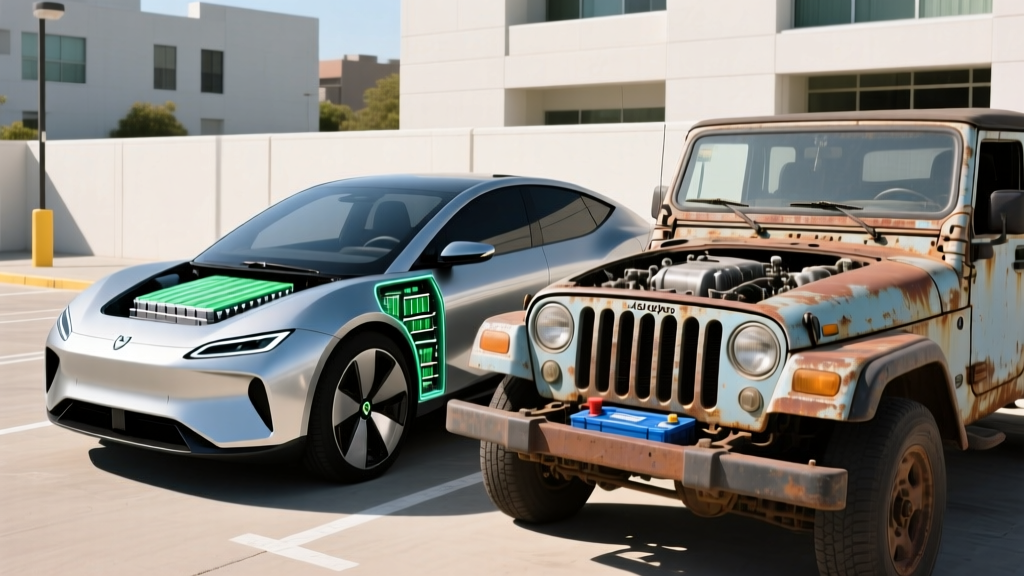
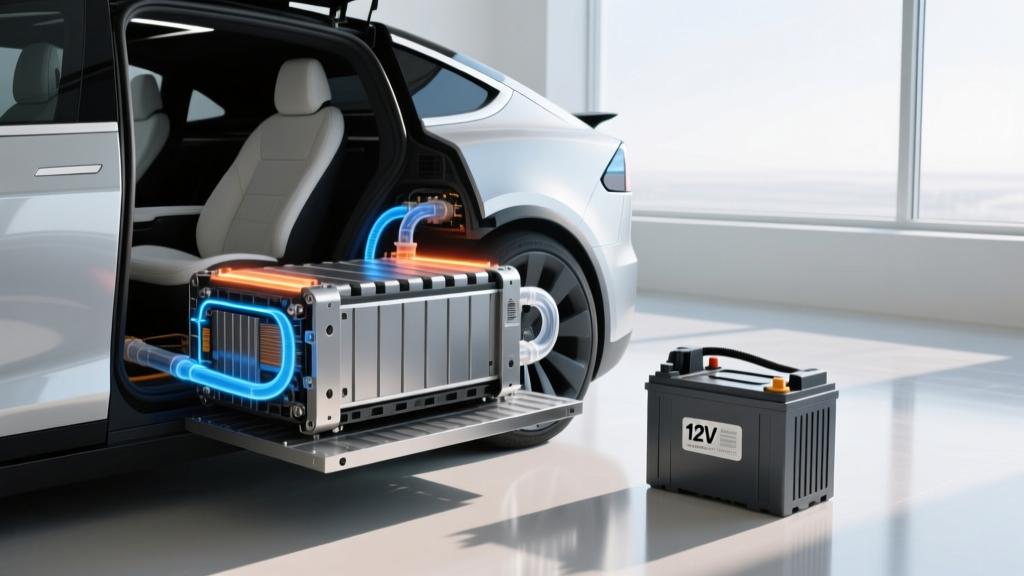
Every modern EV contains two separate battery systems, and confusing them is the most common mistake in online battery discussions:
- High-Voltage Traction Battery (200–800V, 50–130+ kWh): This is the main pack mounted in the vehicle floor that powers the electric motor(s). It weighs 600–1,200+ lbs and is integrated into the vehicle's structural chassis. Removing it requires a professional lift, high-voltage safety certification, specialized insulated tools, and manufacturer-specific diagnostic software.
- 12V Auxiliary Battery (~12V, ~1 kWh): This small lead-acid or lithium-iron-phosphate battery powers the vehicle's computers, lights, infotainment, and door locks — including the systems that enable the high-voltage contactors to close. If your 12V dies, the car won't start even with a full traction battery. Replacing this battery is comparable to a conventional car and is the only "battery removal" most EV owners will ever perform themselves.
When EV owners and mechanics discuss "removing the battery," they almost always mean the traction pack — and that is the focus of this guide.
Why Would You Need to Remove an EV Traction Battery?
Traction battery removal is rare and typically driven by one of these scenarios:
- End-of-life capacity degradation: The battery has fallen below the warranty threshold (typically 70% of original capacity) and the owner or manufacturer initiates replacement.
- Physical damage: Collision, flood submersion, or underbody impact has compromised the pack enclosure or cooling system.
- Cell or module failure: A specific module or cell group has failed, requiring the pack to be opened for module-level repair (a practice growing among specialized EV repair shops).
- Vehicle repurposing: The battery is being removed for second-life energy storage applications or recycling at end of vehicle life.
- Recall campaigns: Manufacturers occasionally issue recalls requiring pack inspection or replacement — for example, early Hyundai Kona Electric and Chevrolet Bolt EV packs were replaced under recall due to manufacturing defects.
For context, the vast majority of EVs will never need a traction battery replacement during their useful life. Real-world fleet data from manufacturers and independent studies consistently show that modern packs outlast the vehicles they're installed in.
How Long Do EV Batteries Last? Real Degradation Data
The question "how long will my EV battery last?" drives more purchase hesitation than almost any other. The data, however, is reassuring.
Based on fleet data aggregated from sources like fueleconomy.gov, manufacturer reports, and independent analyses by Recurrent Auto and Geotab, here is what typical degradation looks like for modern liquid-cooled EV batteries:
| Timeframe | Mileage | Avg. Capacity Retained | Notes |
|---|---|---|---|
| Year 1 | ~12,000 mi | 95–97% | Initial formation loss; steepest early drop |
| Year 3 | ~36,000 mi | 90–93% | Degradation curve flattens significantly |
| Year 5 | ~60,000 mi | 86–90% | Most owners notice minimal real-world range change |
| Year 8 | ~100,000 mi | 80–87% | Still well above warranty threshold for most packs |
| Year 10+ | ~150,000 mi | 75–85% | Varies by chemistry, climate, and charging habits |
Key observations from the data:
- Degradation is non-linear. Most capacity loss occurs in the first 12–24 months, then the curve flattens dramatically. A battery that retains 92% after two years is statistically likely to retain 80%+ at 150,000 miles.
- Tesla's 2025 Impact Report showed its Model 3/Y fleet retained an average of ~88% capacity at 150,000 miles — well within usable range.
- Recurrent Auto's 2025 fleet study of over 15,000 EVs found that only ~1.5% of vehicles needed battery replacement outside of recall campaigns, and most of those were early-generation models.
- LFP chemistry packs (see below) show even slower degradation in many applications, with some fleet data suggesting 90%+ retention at 100,000 miles.
LFP vs. NMC/NCA: Which Battery Chemistry Is Better?
Battery chemistry determines your EV's range, longevity, cold-weather behavior, and cost. In 2026, two chemistries dominate the passenger EV market:
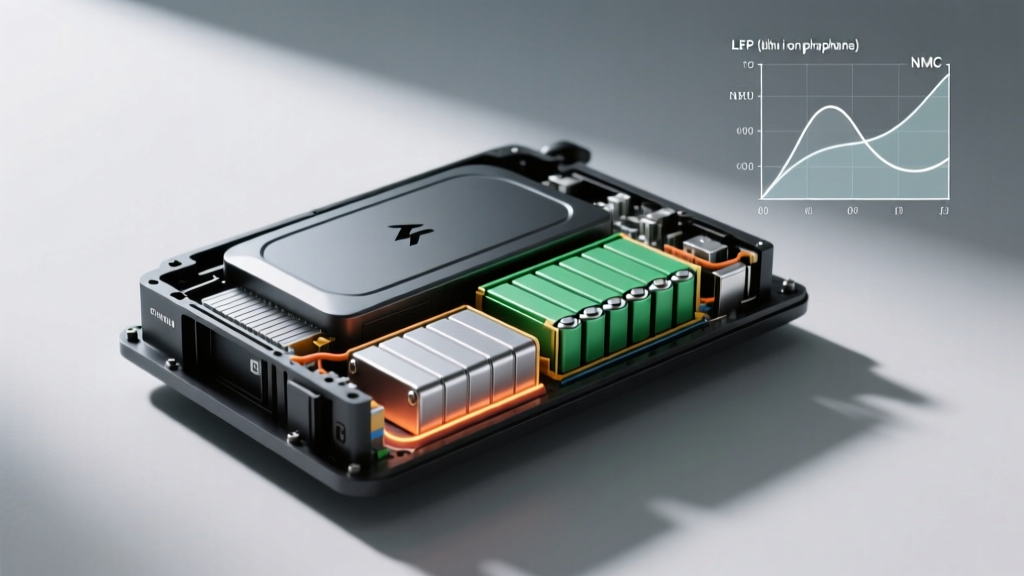
| Factor | LFP (Lithium Iron Phosphate) | NMC/NCA (Nickel Manganese Cobalt / Nickel Cobalt Aluminum) |
|---|---|---|
| Energy Density | Lower (~160 Wh/kg cell-level) — heavier pack for same range | Higher (~250–300 Wh/kg) — more range per pound |
| Cycle Life | Excellent: 3,000–5,000+ cycles to 80% SoH | Good: 1,000–2,000 cycles to 80% SoH |
| Cold-Weather Performance | Weaker — more range loss below freezing, slower cold charging | Better — retains more range and charges faster in cold |
| Cost | Lower — no cobalt or nickel; ~$100/kWh pack-level in 2026 | Higher — ~$130–$150/kWh pack-level; commodity price sensitive |
| Charging to 100% | Recommended periodically for BMS calibration; tolerates high SoC well | Best kept at 80–90% daily; 100% only for road trips |
| Safety / Thermal Stability | Superior — higher thermal runaway threshold (~270°C) | Good but lower thermal runaway threshold (~210°C) |
| Typical Vehicles (2026) | Tesla Model 3 RWD, Model Y RWD, Ford Mustang Mach-E Select, BYD models | Tesla Long Range/Performance, Hyundai Ioniq 5/6, Rivian, Lucid, BMW iX |
Which is better? It depends on your use case. LFP is the superior choice for daily commuting, warm climates, and buyers prioritizing longevity and cost. NMC/NCA is better for long-range needs, cold climates, and performance-oriented driving. Neither chemistry is universally "best" — they're optimized for different priorities.
What Does the EV Battery Warranty Actually Cover?
Federal law mandates that EV batteries carry a minimum warranty of 8 years / 100,000 miles. In California Air Resources Board (CARB) states, that extends to 10 years / 150,000 miles. Most manufacturers meet or exceed these minimums. Here's how the major brands stack up in 2026:
| Manufacturer | Warranty Period | Capacity Retention Threshold | Notes |
|---|---|---|---|
| Tesla (Model 3/Y RWD — LFP) | 8 yr / 120,000 mi | 70% | Long Range/Performance: 8 yr / 120,000 mi at 70% |
| Hyundai / Kia | 10 yr / 100,000 mi | 70% | Among the longest coverage in the industry |
| Ford (Mustang Mach-E, F-150 Lightning) | 8 yr / 100,000 mi | 70% | Covers battery components and capacity loss |
| General Motors (Ultium platform) | 8 yr / 100,000 mi | 70% | Module-level repair capability reduces full-pack replacements |
| Rivian | 8 yr / 175,000 mi | 70% | Higher mileage cap reflects adventure/truck use case |
| BMW | 8 yr / 100,000 mi | 70% | Includes battery conditioning system coverage |
What's covered: Capacity loss below the stated threshold, manufacturing defects, and failures of the battery management system (BMS), cooling system, and internal components. What's typically excluded: Damage from accidents, flooding, improper modifications, or use outside manufacturer guidelines (e.g., persistent DC fast charging beyond recommended limits, though this is rarely enforced).
The 70% threshold is significant: a vehicle with an original EPA range of 300 miles would still deliver ~210 miles at the warranty boundary — still highly usable for daily driving.
How Much Does an EV Battery Replacement Cost?
If your battery falls outside warranty coverage and needs full replacement, costs are substantial but declining. Pack-level pricing has dropped from ~$200/kWh in 2020 to roughly $100–$150/kWh in 2026, but labor and diagnostic costs remain significant.
| Vehicle / Battery Size | Battery Capacity | Estimated Parts Cost | Estimated Labor | Total Range |
|---|---|---|---|---|
| Tesla Model 3 RWD (LFP) | ~60 kWh | $8,000–$10,000 | $2,000–$3,500 | $10,000–$13,500 |
| Tesla Model Y Long Range | ~82 kWh | $12,000–$15,000 | $2,500–$4,000 | $14,500–$19,000 |
| Hyundai Ioniq 5 | ~77.4 kWh | $11,000–$14,000 | $2,500–$4,000 | $13,500–$18,000 |
| Ford F-150 Lightning Extended Range | ~131 kWh | $18,000–$25,000 | $3,000–$5,000 | $21,000–$30,000 |
| Chevrolet Equinox EV | ~85 kWh | $12,000–$15,000 | $2,500–$4,000 | $14,500–$19,000 |
When is replacement typically needed? For the vast majority of owners, it isn't. Based on current degradation curves, a modern liquid-cooled EV battery will retain 75–85% capacity at 150,000 miles. Most vehicles are retired, traded, or totaled in collisions before the battery reaches end-of-life. Out-of-warranty full-pack replacements remain statistically uncommon — affecting roughly 1–2% of the EV fleet based on 2025 industry data.
A growing alternative is module-level repair: instead of replacing the entire pack, specialized shops can identify and swap individual degraded or failed modules for $2,000–$6,000. GM's Ultium platform and the Hyundai/Kia E-GMP platform were both designed with module-level serviceability in mind.
How the Traction Battery Is Actually Removed
For those curious about the physical process — or evaluating whether this is a feasible DIY project (spoiler: it isn't) — here's what professional EV battery removal involves:
- High-voltage safety lockout: The vehicle's service disconnect is pulled, and the pack is verified de-energized with a CAT III/IV multimeter. Technicians wear Class 0 insulated gloves rated to 1,000V.
- Vehicle lift and underbody access: The car is raised on a drive-on or frame-engaging lift. The full underbody panel is removed to expose the battery enclosure.
- Coolant and electrical disconnect: The thermal management coolant loop is drained. High-voltage cables (typically orange-sheathed) are disconnected, along as the 12V communication harness.
- Structural unbolt: Depending on the vehicle, 20–40+ bolts secure the pack to the chassis. On structural-pack vehicles like the Tesla Model Y, the battery is a stressed member of the chassis, making removal more complex.
- Controlled lowering: A battery-specific lift table (rated for 1,500+ lbs) lowers the pack. The unit is then moved to an ESD-safe workbench or shipping crate.
Total shop time: typically 4–8 hours for removal alone, with another 4–8 hours for installation, coolant refill, vacuum fill, and software recalibration. This is why labor costs run $2,000–$5,000.
How to Maximize EV Battery Health and Check SoH
You can't eliminate degradation, but you can meaningfully slow it. Here are the evidence-based best practices:
- Limit daily charging to 80–90% (NMC/NCA) or 100% (LFP): For nickel-based chemistries, sustained high SoC accelerates calendar aging. LFP packs tolerate 100% well and actually benefit from periodic full charges for cell balancing.
- Minimize DC fast charging when possible: Occasional road-trip fast charging is fine. Daily reliance on 150+ kW DC charging generates cumulative heat stress. Level 2 home charging (7–11.5 kW) is gentler on the pack.
- Precondition before fast charging: Most EVs automatically warm the battery when a Supercharger or DC fast station is set as your navigation destination. This brings the pack to optimal temperature (~30–35°C), enabling faster charging and reducing lithium plating risk.
- Avoid extended storage at extreme SoC: If storing the vehicle for weeks, aim for ~50% SoC. Storing at 100% or near 0% for extended periods accelerates degradation.
- Use scheduled charging: Set your vehicle or charger to finish charging just before you leave, rather than sitting at full charge overnight for hours.
- Mitigate extreme heat exposure: Garage parking in hot climates reduces thermal stress. Battery cooling systems work harder — and degrade the pack faster — when ambient temperatures exceed 95°F consistently.
How to Check Your Battery's State of Health (SoH)
Several methods exist for monitoring battery health:
- In-vehicle displays: Some EVs (notably Tesla via the service menu, and certain Hyundai/Kia models) display estimated battery health or usable capacity.
- OBD-II diagnostics: Apps like Teslalogger, LeafSpy (Nissan), or Car Scanner can read BMS-reported SoH data through an OBD-II dongle.
- Third-party reports: Services like Recurrent Auto provide battery health reports based on connected vehicle data, useful for used-EV buyers.
- Dealer inspection: A service center can pull a full BMS diagnostic report showing individual cell voltages, capacity, and resistance — the gold standard for pre-purchase inspections on used EVs.
Emerging Battery Tech: Solid-State and Silicon Anodes
Next-generation battery technologies promise step-change improvements, but realistic timelines matter:
- Solid-state batteries: These replace the liquid electrolyte with a solid material, potentially offering 2× energy density, faster charging, and improved safety. Toyota has announced solid-state production beginning in limited volumes for 2027–2028 models, with broader availability not expected before 2030. Nissan and Samsung SDI are on similar timelines. No production vehicle currently on sale uses a solid-state traction battery.
- Silicon anode batteries: Companies like Sila Nanotechnologies and Group14 are integrating silicon into anodes to boost energy density by 20–40%. Early applications are appearing in performance EVs, with the Mercedes-Benz G-Class electric (2025) among the first to use silicon-anode cells. Expect broader adoption by 2028–2029.
- Sodium-ion batteries: Lower-cost and cobalt-free, sodium-ion packs are entering the market in smaller, budget-oriented EVs (primarily in China via BYD and CATL). U.S. availability in passenger vehicles is not yet confirmed but may arrive in entry-level models by 2028.
These technologies are genuinely promising but remain preliminary and forward-looking. For buyers shopping today, LFP and NMC/NCA lithium-ion packs are mature, well-proven, and backed by robust warranty coverage.
Frequently Asked Questions
Can I remove my EV's traction battery myself?
No. The high-voltage traction battery operates at 200–800 volts and weighs 600–1,200+ lbs. Improper handling risks lethal electric shock, chemical exposure, and thermal runaway fires. This work requires certified high-voltage technicians, specialized lifts, and insulated tools. The 12V auxiliary battery, however, is a straightforward DIY replacement similar to a conventional car.
How long do EV batteries last in years and miles?
Modern liquid-cooled EV batteries typically retain 80–87% of their original capacity at 100,000 miles (approximately 8 years of average driving). Many packs will exceed 150,000 miles while still providing usable range. Fleet data from Tesla, Hyundai, and independent analysts shows that fewer than 2% of modern EVs require battery replacement outside of recalls.
How much does it cost to replace an EV battery?
Full traction battery replacement costs range from approximately $10,000 for smaller packs (e.g., Tesla Model 3 RWD at ~60 kWh) to $30,000 for the largest packs (e.g., Ford F-150 Lightning Extended Range at ~131 kWh), including parts and labor. Most replacements occur under warranty at no cost to the owner. Module-level repairs, where available, can cost $2,000–$6,000.
What does the battery warranty cover?
EV battery warranties cover capacity loss below a stated threshold (typically 70% of original capacity) over 8 years / 100,000 miles (10 years / 150,000 miles in CARB states). They also cover defects in the BMS, cooling system, and internal components. Damage from collisions, flooding, or unauthorized modifications is excluded.
LFP vs NMC — which battery chemistry should I choose?
Choose LFP if you prioritize longevity, lower cost, and primarily drive in moderate climates with daily charging access. Choose NMC/NCA if you need maximum range, regularly drive in cold weather, or want faster DC charging speeds. Both chemistries are proven and well-supported by manufacturer warranties.
Does frequent DC fast charging damage the battery?
Occasional DC fast charging (road trips, a few times per month) has minimal measurable impact on modern liquid-cooled packs. However, exclusive reliance on DC fast charging — especially at 150+ kW rates — does accelerate degradation over time due to cumulative heat stress. For daily charging, Level 2 (7–11.5 kW) at home is the healthiest option for long-term battery SoH.
How do I check my EV battery's State of Health?
You can check SoH through in-vehicle diagnostics menus (on supported models), OBD-II apps like Teslalogger or LeafSpy, third-party services like Recurrent Auto, or a dealer BMS diagnostic report. For used-EV purchases, a dealer or independent EV shop inspection is strongly recommended.