If you've ever asked "can car batteries be recharged?" the short answer is a definitive yes — but the nuance matters enormously when you're talking about the high-voltage lithium-ion traction battery that powers an electric vehicle. Unlike the small 12V auxiliary battery that runs your headlights and infotainment (which also recharges via a DC-DC converter, by the way), the main EV traction battery is engineered to accept and deliver large amounts of energy thousands of times over a decade or more of daily driving.
This guide breaks down exactly how EV battery recharging works in practice, how long these batteries last before meaningful capacity loss sets in, what replacement actually costs in 2026, and what you can do as an owner to maximize longevity. We'll cover real degradation data, the critical LFP vs. NMC chemistry trade-off, warranty terms from major automakers, and how to monitor your battery's State of Health (SoH).
How EV Traction Batteries Recharge: The Basics
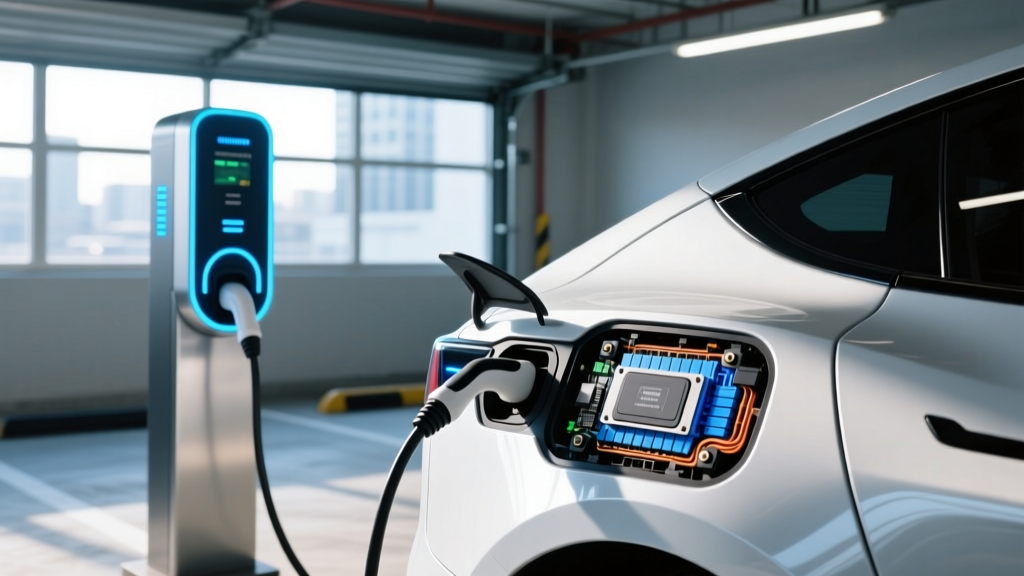
Every time you plug in your EV — whether to a 120V household outlet (Level 1), a 240V home wallbox (Level 2), or a public DC fast charger — lithium ions shuttle between the cathode and anode inside the battery cells. This electrochemical process is fully reversible by design. A typical EV battery pack in 2026 ranges from about 58 kWh (e.g., base Hyundai Ioniq 5 Standard Range) to 131 kWh (Ford F-150 Lightning Extended Range), and each full charge-discharge cycle counts toward the pack's total cycle life.
Here's the critical distinction most new EV buyers miss: kW (kilowatts) is power — the rate at which energy flows into the battery. kWh (kilowatt-hours) is energy — the total capacity of the battery. A 150 kW DC fast charger delivers energy faster than a 7.7 kW Level 2 home charger, but both are recharging the same kWh-rated battery pack.
Typical recharge speeds in 2026:
- Level 1 (120V): ~1.4 kW — adds roughly 3-5 miles of range per hour
- Level 2 (240V): 7.7–19.2 kW — adds 25–65 miles per hour depending on vehicle acceptance rate
- DC Fast Charging: 50–350 kW peak — can add 10–80% in 18–40 minutes depending on pack size, chemistry, and thermal management
Modern EVs actively manage charging through sophisticated battery management systems (BMS) that balance cells, control temperature via liquid cooling or heating loops, and taper charge speed above ~80% State of Charge to protect long-term health. That taper is why automakers advertise "10–80%" charge times rather than 0–100% — the final 20% can take as long as the first 80%.
How Long Do EV Batteries Actually Last?
The question isn't whether EV batteries can be recharged — they can, thousands of times. The real question is how much capacity they retain after years of cycling. Based on aggregated fleet data from sources like fueleconomy.gov and long-term owner studies, here's what real-world degradation looks like:
Typical EV Battery Degradation Curve (NMC Chemistry):
- Year 1 / 15,000 mi: ~2–4% capacity loss (initial formation period)
- Year 3 / 45,000 mi: ~5–8% total loss
- Year 5 / 75,000 mi: ~8–12% total loss
- Year 8 / 120,000 mi: ~10–15% total loss (still within most warranty thresholds)
- Year 10+ / 150,000+ mi: ~15–20% loss for well-maintained packs
LFP (lithium iron phosphate) batteries, now used in the Tesla Model 3 RWD, standard-range Model Y, and several BYD models sold globally, degrade even more slowly. Multiple fleet studies show LFP packs retaining 90%+ capacity after 200,000 miles. The trade-off is lower energy density — meaning a heavier, physically larger pack for the same kWh — which is why LFP tends to appear in standard-range trims rather than long-range or performance variants.
A concrete example: a 2023 Tesla Model 3 Long Range (NMC, ~78 kWh usable) with an original EPA range of 341 miles might realistically show ~300–310 miles of estimated range at 100% charge after 60,000 miles and three years of mixed use. That's roughly a 9–12% loss — noticeable but far from catastrophic, and the car remains entirely practical for daily driving and road trips.
LFP vs. NMC/NCA: Which Battery Chemistry Is Better?
Choosing between LFP and NMC/NCA isn't about one being universally superior — it's about matching chemistry to your driving pattern. Here's the detailed comparison:
| Factor | LFP (Lithium Iron Phosphate) | NMC/NCA (Nickel Manganese Cobalt / Nickel Cobalt Aluminum) |
|---|---|---|
| Energy Density | Lower (~160 Wh/kg cell-level) | Higher (~250–300 Wh/kg cell-level) |
| Cycle Life | 3,000–5,000+ full cycles | 1,000–2,000 full cycles |
| Degradation Rate | Slower; ~10% loss at 200k+ mi | Moderate; ~10–15% loss at 150k mi |
| Cold-Weather Performance | Weaker; more range loss below 32°F | Better low-temp conductivity |
| Cost | Lower ($100–115/kWh pack-level in 2026) | Higher ($120–140/kWh pack-level) |
| Charging to 100% | Recommended regularly for BMS calibration | Best kept at 80% daily; 100% for trips only |
| Typical Applications | Tesla Model 3/Y RWD, BYD models, base trims | Long Range, Performance trims, luxury EVs |
| Cobalt Content | None | Contains cobalt (supply-chain/ethical considerations) |
The practical takeaway: If you primarily drive under 250 miles per day, charge mostly at home, and want maximum longevity with minimal degradation anxiety, LFP is the stronger choice. If you need maximum range per charge for frequent road trips, live in a very cold climate, or want the lightest possible pack, NMC/NCA delivers — with the understanding that you should follow the 80% daily charge recommendation to maximize cycle life.
What Does the EV Battery Warranty Cover?
Federal law mandates a minimum 8-year/100,000-mile warranty on EV battery packs for emissions-related compliance, and most major automakers meet or exceed this threshold. Here's how warranty terms compare across popular 2026 models:
| Automaker / Model | Warranty Duration | Mileage Limit | Capacity Retention Threshold |
|---|---|---|---|
| Tesla Model 3 / Model Y (Long Range) | 8 years | 120,000 mi | 70% |
| Tesla Model 3 / Model Y (RWD / LFP) | 8 years | 100,000 mi | 70% |
| Hyundai Ioniq 5 / Ioniq 6 | 10 years | 100,000 mi | 70% |
| Ford Mustang Mach-E / F-150 Lightning | 8 years | 100,000 mi | 70% |
| Chevrolet Equinox EV / Blazer EV | 8 years | 100,000 mi | 60% (GM threshold) |
| BMW i4 / iX | 8 years | 100,000 mi | 70% |
| Rivian R1T / R1S | 8 years | 175,000 mi | 70% |
What "70% capacity retention" means in practice: If your 78 kWh pack degrades to below 54.6 kWh (70% of original) within the warranty period, the manufacturer is obligated to repair or replace the battery — typically by swapping in a refurbished pack with at least 70% capacity, not necessarily a brand-new one. The warranty covers defects and abnormal degradation, not damage from accidents, flooding, or unauthorized modifications.
It's worth noting that very few EV owners actually hit the warranty threshold. Based on data aggregated by IIHS and owner forums, the vast majority of EV battery packs retain well above 80% of original capacity at the 8-year mark under normal use patterns. The warranty is a safety net, not a prediction.
How Much Does an EV Battery Replacement Cost?
This is the question that generates the most fear — often fueled by viral stories of $20,000+ battery replacement invoices. The reality is more nuanced. Yes, a full out-of-warranty battery replacement is expensive, but it's also rare. Most packs outlive the vehicle's useful life, and when replacement is needed, it's usually a single module or cell group rather than the entire pack.
| Vehicle / Battery Size | Full Pack Replacement (Out of Warranty) | Module-Level Repair | Typical Replacement Timeline |
|---|---|---|---|
| Tesla Model 3 RWD (~60 kWh LFP) | $12,000–$16,000 | $2,000–$5,000 | Rarely before 200k+ mi |
| Tesla Model Y Long Range (~78 kWh NMC) | $14,000–$20,000 | $3,000–$6,000 | Rarely before 150k mi |
| Hyundai Ioniq 5 (~77.4 kWh) | $14,000–$18,000 | $2,500–$5,500 | Rarely before 150k mi |
| Ford F-150 Lightning Ext. Range (~131 kWh) | $22,000–$32,000 | $4,000–$8,000 | Rarely before 150k mi |
| Chevrolet Bolt EV (~65 kWh) | $14,000–$16,000 | $2,500–$5,000 | Earlier recall replacements aside |
Several important context points: battery pack prices have dropped from over $1,000/kWh in 2010 to roughly $110–$140/kWh at the pack level in 2026, according to BloombergNEF tracking. That downward trend continues. Third-party EV battery repair shops are also increasingly available, offering module-level repairs at a fraction of dealer replacement costs. And again — the overwhelming majority of EV owners never pay for a battery replacement out of pocket because the pack lasts the life of the car or is covered under warranty.
Factors That Accelerate (or Preserve) Battery Health
Not all miles and charges are created equal. How you use and charge your EV has a measurable impact on long-term degradation. Here's the battery-care framework based on current electrochemistry research and fleet data:
Habits that preserve battery health:
- Charge to 80% for daily use (NMC/NCA); 100% is fine for LFP
- Use Level 2 home charging as your primary method — slow, steady, low-heat
- Precondition the battery before DC fast charging (most EVs do this automatically when you navigate to a charger)
- Keep the vehicle plugged in during extreme cold so the thermal management system can maintain optimal cell temperature
- Drive moderately in extreme heat — high discharge rates in 100°F+ weather stress cells
- Store the vehicle at ~50% State of Charge if leaving it unused for weeks
Habits that accelerate degradation:
- Exclusive reliance on DC fast charging (350 kW sessions generate significant heat)
- Regularly sitting at 100% SoC for days (especially NMC/NCA)
- Regularly draining to 0% and leaving the pack empty
- Repeated high-performance launches (high C-rate discharge generates internal heat)
- Parking unplugged in extreme heat or cold for extended periods
The single most impactful thing you can do? Charge at home on Level 2 most of the time, and reserve DC fast charging for road trips. A study of Tesla fleet data showed that vehicles that fast-charged more than 90% of the time exhibited roughly 2–3% additional degradation at 100,000 miles compared to vehicles that primarily used Level 2. That's not catastrophic, but it compounds over time.
How to Check and Monitor Your Battery's State of Health
State of Health (SoH) is expressed as a percentage: 100% SoH means the pack holds its full original kWh capacity; 85% SoH means it holds 85% of original. Here's how to check it on popular 2026 EVs:
- Tesla: No native SoH display in the car. Use third-party apps like Tessie or Teslamate (reads data via the Tesla API) to track estimated SoH over time. You can also compare your displayed range at 100% charge against the original EPA figure — a rough but useful proxy.
- Hyundai / Kia: The infotainment system's EV diagnostics menu shows battery health percentage directly. Also accessible via the Hyundai/Kia app.
- Ford: The FordPass app and in-vehicle diagnostics display battery health status. A "Battery Health" report can be generated at a dealer.
- GM (Chevrolet/Cadillac): OnStar diagnostics can report battery health. Some models display it in the driver information center.
- Universal OBD-II method: Plug in an OBD-II dongle (like the OBDLink SX, ~$40) and use an app like LeafSpy (Nissan), ABRP (various), or Torque Pro to read live battery data including reported SoH, cell voltages, and pack temperature.
For buyers evaluating a used EV, a dealer pre-purchase inspection that includes a battery health report is strongly recommended. A SoH reading above 85% at 60,000 miles is typical and healthy; below 80% at that mileage would be unusual and worth investigating.
What's Next: Solid-State and Silicon-Anode Batteries
The next frontier in EV battery technology includes solid-state batteries (which replace the liquid electrolyte with a solid material, potentially doubling energy density and dramatically improving safety) and silicon-anode cells (which increase the amount of lithium the anode can store, boosting kWh per kilogram).
As of 2026, here's where these technologies stand:
- Toyota has announced a solid-state battery targeting 2027–2028 production, claiming 750+ km (~465 mi) range and 10-minute fast charging. This remains pre-production; independent verification is pending.
- Samsung SDI is sampling solid-state cells to automakers with a 2027 production target.
- Sila Nanotechnologies (silicon anode) is shipping cells for consumer electronics and has announced automotive partnerships targeting 2026–2028 production vehicles, with claims of 20% energy density improvement.
- QuantumScape (solid-state, backed by Volkswagen) continues testing but has not yet reached mass production.
Realistic timeline: Expect solid-state batteries in limited, premium-tier production vehicles by 2028–2029, with broader availability not until the early 2030s. Silicon-anode cells are closer and may appear in 2027 model-year vehicles. Neither technology is available in any production EV you can buy today.
Frequently Asked Questions
Can car batteries be recharged every day without damage?
Yes. EV traction batteries are designed for daily recharging. With NMC/NCA chemistry, charging to 80% daily is ideal; with LFP, daily 100% charges are recommended for cell balancing. Modern battery management systems protect against overcharging automatically.
How long do EV batteries last in years and miles?
Most EV batteries retain 80–90% of original capacity after 8–10 years and 100,000–150,000 miles. LFP packs often exceed 90% retention at 200,000 miles. The battery will likely outlast the vehicle's useful economic life.
How much does it cost to replace an EV battery?
Full pack replacement ranges from roughly $12,000 (smaller packs like the Model 3 RWD) to $32,000 (large packs like the F-150 Lightning Extended Range). Module-level repairs cost $2,000–$8,000. Most owners never need either because the battery is covered under warranty or outlasts the car.
What does the EV battery warranty actually cover?
Most warranties cover 8 years/100,000 miles (some extend to 10 years). They guarantee the battery will retain at least 60–70% of original capacity (varies by automaker). If it falls below that threshold, the manufacturer repairs or replaces it at no cost. Warranties do not cover accident damage, flood damage, or unauthorized modifications.
Is LFP better than NMC for daily driving?
For daily driving under 250 miles, LFP is generally better: it degrades more slowly, costs less, contains no cobalt, and can be charged to 100% daily without concern. NMC is better if you need maximum range per charge for road trips or live in consistently cold climates where its superior low-temperature performance matters.
Does fast charging damage my EV battery?
DC fast charging generates more heat than Level 2 charging, which marginally accelerates degradation. Fleet data suggests ~2–3% additional capacity loss at 100,000 miles for vehicles that exclusively fast-charge vs. those using primarily Level 2. For road trips, fast charging is perfectly fine — just don't rely on it as your only charging method if you can avoid it.
How do I check my EV battery health at home?
Methods vary by brand. Hyundai/Kia show SoH in the infotainment system. Tesla owners can use third-party API apps like Tessie. For any EV, an OBD-II dongle with an app like Torque Pro can read battery health data. Your dealer can also run a formal battery health diagnostic.
Sources: Range and efficiency data from fueleconomy.gov; warranty terms from manufacturer specification pages; IRS §30D tax credit rules at irs.gov.