Why Truck Owners Are Searching for '2017 Nissan Titan Battery' in an EV World
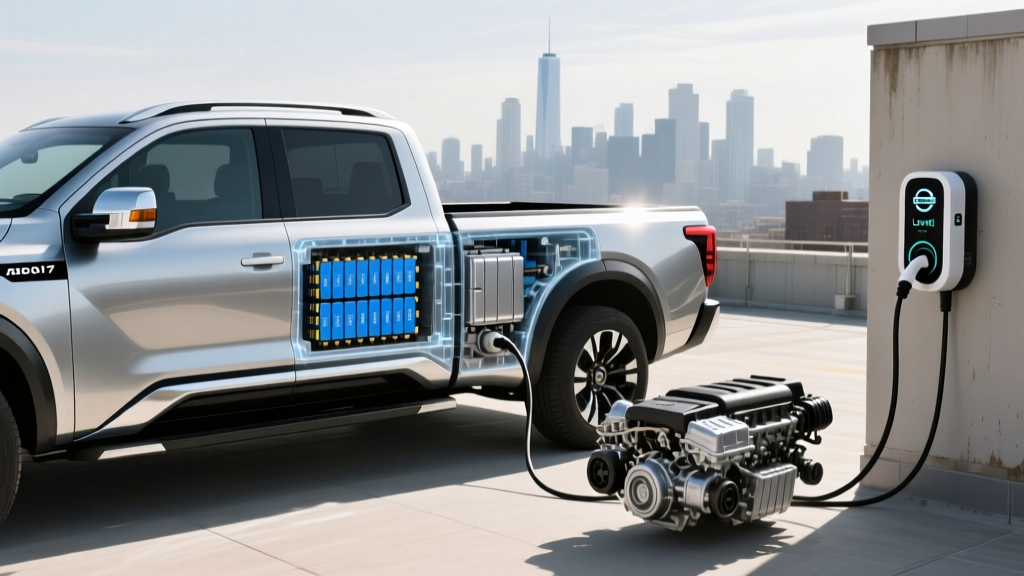
If you've landed here searching for a 2017 Nissan Titan battery, you're likely dealing with one of two things: your Titan's 12-volt lead-acid battery is failing after nearly a decade on the road, or you're weighing whether to trade that aging full-size truck for a modern electric pickup like the Ford F-150 Lightning, Rivian R1T, or Chevrolet Silverado EV. Either way, understanding the fundamental difference between a conventional truck's auxiliary battery and an EV's high-voltage traction battery is critical to making smart ownership decisions.
The 2017 Nissan Titan — available with a 5.6L V8 gasoline engine or the now-discontinued 5.0L Cummins turbodiesel — relies on a standard Group 24F or Group 35 12V lead-acid battery. That battery costs $120–$220 at an auto parts store, lasts 3–5 years, and handles starter cranking, lighting, and accessory power. It has nothing in common with the 100+ kWh lithium-ion traction batteries powering today's electric trucks, which are designed to last 15–20 years and cost $10,000–$25,000 to replace.
This guide covers everything EV buyers and truck upgraders need to know about modern EV battery technology — chemistry, degradation, warranties, replacement costs, and how to maximize longevity — while clarifying the key differences from the 2017 Titan's simple 12V system.
The 2017 Nissan Titan's 12V Battery vs. an EV Traction Battery
Before diving into EV battery specifics, let's establish what you're actually replacing on a 2017 Titan versus what powers an electric truck:
| Attribute | 2017 Nissan Titan (12V Battery) | EV Traction Battery (e.g., F-150 Lightning) |
|---|---|---|
| Type | Lead-acid (flooded or AGM) | Lithium-ion (NMC or LFP) |
| Voltage | 12V | 400V–800V |
| Capacity | ~0.7–1.0 kWh | 98–131 kWh (usable) |
| Purpose | Starter, lights, accessories | Propulsion, cabin HVAC, V2L/V2H |
| Replacement cost | $120–$220 | $10,000–$25,000+ |
| Typical lifespan | 3–5 years | 15–20+ years |
| Warranty | 1–3 years (parts store) | 8 years / 100,000 miles (federally mandated minimum) |
The distinction matters. When EV skeptics cite "battery replacement" as a deal-breaker, they're often conflating the frequent, cheap 12V swap they're used to with the rare, expensive traction battery replacement that most EV owners will never need during their ownership.
EV Battery Chemistry: LFP vs. NMC Explained
Modern EVs use one of two dominant lithium-ion chemistries: LFP (lithium iron phosphate) or NMC/NCA (nickel manganese cobalt / nickel cobalt aluminum). Your choice of chemistry affects range, longevity, cold-weather performance, and price.
| Factor | LFP (Lithium Iron Phosphate) | NMC/NCA (Nickel-Based) |
|---|---|---|
| Energy density | Lower (~160 Wh/kg cell-level) | Higher (~250–300 Wh/kg cell-level) |
| Cycle life | 3,000–5,000+ cycles | 1,000–2,000 cycles |
| Cold-weather performance | Moderate (greater range loss below freezing) | Better (less range loss in cold) |
| Cost | Lower (no cobalt or nickel) | Higher (commodity-priced metals) |
| Charging to 100% daily | Recommended (BMS needs full-SoC calibration) | Not recommended (accelerates degradation; 80% daily ideal) |
| Typical applications | Tesla Model 3/Y RWD, Ford F-150 Lightning Pro (standard range) | Long-range/performance trims, Rivian R1T, most luxury EVs |
Which is better? It depends on your use case. LFP excels for daily commuting, fleet use, and buyers who prioritize longevity and lower cost over maximum range. NMC/NCA is the choice for long-range road trips, cold climates, and performance-oriented vehicles. Neither chemistry is universally superior — they're engineering trade-offs.
How Long Do EV Batteries Actually Last?
Real-world degradation data from hundreds of thousands of EVs on the road shows that modern lithium-ion traction batteries are remarkably durable. The fear of needing a $20,000 battery swap at 80,000 miles is not supported by data.
Here's what the numbers actually show:
- Tesla fleet data (2023 Impact Report): Model S/X batteries showed approximately 12% degradation at 200,000 miles, retaining ~88% of original capacity.
- Geotab analysis (2024, 10,000+ EVs): Average annual degradation across all brands was approximately 1.8% per year, meaning a typical EV retains ~82% capacity after 10 years.
- Nissan Leaf (2011–2017, air-cooled 24/30 kWh): Early Leafs with passive air cooling showed 20–30% degradation at 80,000–100,000 miles — a cautionary tale about thermal management that modern liquid-cooled batteries have resolved.
- Chevrolet Bolt EV/EUV: Despite the 2021–2022 recall for manufacturing defects, unaffected Bolt batteries have shown strong longevity, with most owners reporting under 8% loss at 60,000+ miles.
For context, most EV owners sell or trade their vehicles before significant degradation becomes noticeable. A 2026-model-year EV with a liquid-cooled NMC or LFP pack, driven 12,000 miles per year, is statistically likely to retain 80–90% of its original range at the 10-year mark.
What Does the EV Battery Warranty Cover?
Under U.S. federal law, EV batteries must be warranted for a minimum of 8 years or 100,000 miles (whichever comes first). In California and states that have adopted CARB (California Air Resources Board) emissions standards, the warranty extends to 10 years or 150,000 miles.
| Manufacturer | Warranty Term | Capacity Retention Threshold |
|---|---|---|
| Tesla (Model 3/Y RWD — LFP) | 8 yr / 100,000 mi | 70% |
| Tesla (Model 3/Y LR/Perf — NMC) | 8 yr / 120,000 mi | 70% |
| Ford (F-150 Lightning) | 8 yr / 100,000 mi | 70% |
| Hyundai/Kia (Ioniq 5, EV6, EV9) | 10 yr / 100,000 mi | 70% |
| Chevrolet (Silverado EV, Blazer EV) | 8 yr / 100,000 mi | 60% (some trims 70%) |
| Rivian (R1T, R1S) | 8 yr / 175,000 mi | 70% |
| BMW (iX, i4) | 8 yr / 100,000 mi | 70% |
The warranty guarantees that if your battery's usable capacity drops below the stated threshold (typically 70% of original) within the warranty period, the manufacturer will repair or replace the battery at no cost. In practice, warranty claims are rare because degradation curves have flattened considerably since the early Leaf era.
Source: fueleconomy.gov — EV Battery Technology
EV Battery Replacement Cost: What You'll Actually Pay
If your EV battery fails outside of warranty — or if you're buying a used EV and want to budget for a worst-case scenario — here's what replacement costs look like in 2026:
| Vehicle | Battery Size (Usable kWh) | Replacement Cost Range (Parts + Labor) |
|---|---|---|
| Tesla Model 3 (LFP, RWD) | ~57 kWh | $12,000–$16,000 |
| Tesla Model Y (LR, NMC) | ~75 kWh | $14,000–$18,000 |
| Ford F-150 Lightning (extended range) | ~131 kWh | $20,000–$28,000 |
| Chevrolet Bolt EV | ~65 kWh | $14,000–$16,000 (post-recall packs) |
| Hyundai Ioniq 5 | ~77 kWh | $15,000–$19,000 |
| Rivian R1T (large pack) | ~128 kWh | $22,000–$28,000 |
| Nissan Leaf (40 kWh pack) | ~40 kWh | $8,000–$10,000 (remanufactured) |
Several important caveats:
- Module-level repair: Many shops can now replace individual battery modules rather than the entire pack, reducing cost to $2,000–$6,000 depending on how many modules are degraded.
- Remanufactured packs: Third-party suppliers offer refurbished battery packs at 40–60% of OEM new-pack pricing.
- Declining costs: Battery pack prices have fallen from ~$200/kWh in 2020 to approximately $100–$130/kWh in 2026, and this trend continues. A replacement in 2032 will likely cost significantly less than today's figures.
- Most owners never pay: Given typical degradation rates and ownership durations, the vast majority of EV batteries outlive their original owners' time with the vehicle.
Factors That Affect EV Battery Longevity
While modern EV batteries are robust, certain habits and conditions accelerate degradation. Understanding these factors helps you maximize your battery's useful life:
Battery Care Best Practices
- Avoid sustained 100% SoC: For NMC/NCA batteries, charge to 80% for daily use and reserve 100% for road trips. LFP batteries are the exception — charge to 100% at least weekly for BMS calibration.
- Minimize DC fast charging when possible: Occasional DCFC is fine; daily reliance on 150+ kW charging generates heat that accelerates cell wear. Level 2 home charging (7–11 kW) is gentler on the pack.
- Precondition before fast charging: Use your EV's navigation-based preconditioning (Tesla, Hyundai, Ford, Rivian all offer this) to warm the battery to optimal temperature before arriving at a DC fast charger. This reduces charging time and thermal stress.
- Avoid extreme SoC in extreme heat: Parking a fully charged EV in 100°F+ ambient heat for extended periods stresses the cells. If possible, charge to 60–70% before summer parking.
- Don't let it sit at 0%: Leaving an EV at very low SoC for weeks can cause copper dissolution in the anode. If storing, leave it at ~50% SoC.
- Use scheduled charging: Set your EV or charger to complete charging close to your departure time, minimizing time spent at high SoC.
The single biggest longevity factor is thermal management. Every modern EV sold in the U.S. in 2026 uses liquid-cooled battery packs, which maintain cells within the optimal 20–35°C range. This is a massive improvement over the passively cooled 2011–2017 Nissan Leaf, which suffered accelerated degradation in hot climates.
How to Check Your EV's Battery Health (SoH)
State of Health (SoH) is the percentage of your battery's original capacity that remains usable. Here's how to monitor it:
- In-car displays: Tesla, Hyundai/Kia, BMW, and Mercedes-Benz provide SoH estimates or degradation graphs in the vehicle's settings menu.
- OBD-II scanners with EV support: Tools like the OBDLink SX paired with apps such as LeafSpy (Nissan), Scan My Tesla, or ABRP's OBD integrations can read detailed pack data including individual cell voltages, pack voltage, and estimated SoH.
- Dealer diagnostics: Most manufacturers can run a battery health report during service visits. Request this before purchasing a used EV.
- Range tracking: The simplest method — compare your current full-charge projected range to the original EPA rating. A 2017 Tesla Model S rated at 335 miles EPA that now shows 295 miles at 100% has roughly 88% SoH.
- Recurrent Auto / Geotab: These fleet-data services offer battery health reports for many popular EV models based on aggregate fleet data.
For buyers considering a used EV — whether trading in a 2017 Nissan Titan or upgrading from an older Leaf — a battery health check should be part of any pre-purchase inspection, just as you'd check compression on a used gas truck.
Emerging Battery Tech: What's Coming Next
While today's lithium-ion batteries are mature and reliable, next-generation technologies are in development. Here's a realistic timeline — none of these are available in production vehicles as of 2026:
- Toyota solid-state batteries: Toyota has announced a target of 2027–2028 for limited production of solid-state battery EVs, claiming 750+ km (466+ miles) range and 10-minute fast charging. Mass production timing and pricing remain unconfirmed.
- Silicon anode batteries: Companies like Sila Nanotechnologies and Group14 are supplying silicon-dominant anode materials to automakers including Mercedes-Benz and Panasonic. Expect first commercial applications in 2026–2028, offering 20–40% higher energy density than current graphite anodes.
- Sodium-ion batteries: CATL and BYD have begun limited production of sodium-ion packs for budget Chinese-market EVs. Lower energy density makes these suitable for city cars and storage, not long-range trucks.
- LMFP (lithium manganese iron phosphate): An evolution of LFP that adds manganese for higher voltage and energy density. Expected in Tesla and Ford vehicles by 2027–2028.
Source: U.S. Department of Energy — Battery Pack Pricing Trends
These technologies are promising but not yet in showrooms. For anyone buying an EV in 2026, today's LFP and NMC packs represent proven, well-understood technology backed by extensive real-world data.
Frequently Asked Questions
Does the 2017 Nissan Titan have an EV battery?
No. The 2017 Nissan Titan is a conventional gasoline (5.6L V8) or diesel (5.0L Cummins V8) full-size pickup truck. It uses a standard 12V lead-acid battery for starting and accessories. Nissan does not offer an electric Titan as of 2026.
How long do EV batteries last compared to a gas truck battery?
A gas truck's 12V battery lasts 3–5 years. An EV traction battery is designed for 15–20+ years and 150,000–300,000+ miles before degrading to 70–80% of original capacity. Most EV batteries outlive the vehicle's first ownership period.
How much does an EV battery cost to replace?
Replacement costs range from approximately $8,000 for a small pack (Nissan Leaf 40 kWh, remanufactured) to $28,000 for a large pack (Ford F-150 Lightning extended range, 131 kWh). Module-level repairs can reduce this to $2,000–$6,000. Costs continue to decline as battery manufacturing scales.
What does the EV battery warranty cover?
Federal law mandates a minimum 8-year/100,000-mile warranty covering capacity loss below a specified threshold (typically 70% of original). In CARB states, the warranty extends to 10 years/150,000 miles. If your battery degrades below the threshold within the warranty period, the manufacturer repairs or replaces it at no cost.
Should I charge my EV to 100% every day?
For LFP batteries: yes, charge to 100% at least weekly for accurate BMS calibration. For NMC/NCA batteries: charge to 80% daily and reserve 100% for road trips to minimize degradation.
Is it worth buying a used EV with a high-mileage battery?
Often yes, if you verify SoH. A Tesla Model 3 with 80,000 miles and 90% SoH has hundreds of thousands of usable miles remaining. Always request a battery health report before purchase. Compare the full-charge range to the original EPA rating as a quick sanity check.