Why Truck Owners Are Searching '2012 Dodge Ram 1500 Battery' in an EV World
If you've owned a 2012 Dodge Ram 1500, you know the drill: every 3–5 years, that 12V lead-acid battery under the hood needs replacing. A standard Group 34 or H7 AGM battery for that truck runs $150–$280 at an auto parts store, and the swap takes ten minutes with a wrench. It's a routine ownership cost that generations of truck buyers have accepted without a second thought.
But as electrified trucks like the Ram 1500 REV, Ford F-150 Lightning, and Chevrolet Silverado EV enter the market, a new question surfaces: how does that simple $200 battery swap compare to the high-voltage traction battery powering a modern EV? The short answer is that they're fundamentally different systems — and understanding that difference is critical for anyone considering an electric truck or any EV.
This guide breaks down everything you need to know about modern EV battery technology in 2026 — chemistry, degradation, warranties, replacement costs, and care — using the familiar 2012 Dodge Ram 1500 battery as a baseline comparison for truck owners making the transition.
12V Auxiliary vs. High-Voltage Traction Battery: Know the Difference
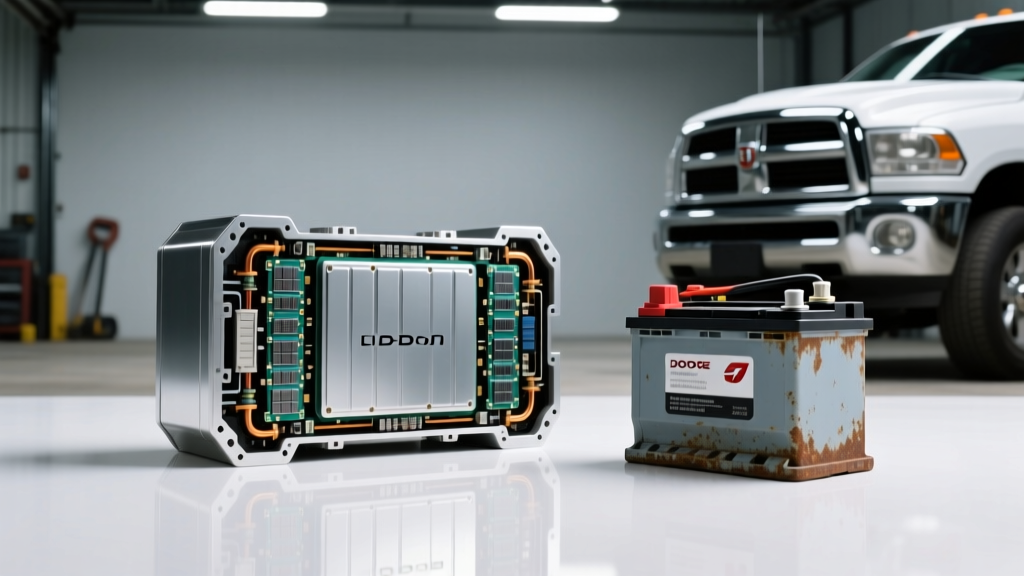
Before diving into EV-specific battery tech, let's eliminate the most common source of confusion. The 2012 Dodge Ram 1500 battery is a 12-volt lead-acid (or AGM) unit that powers the starter motor, lights, infotainment, and accessories. It has nothing to do with propulsion on a gas truck.
Modern EVs actually have two batteries:
- 12V auxiliary battery: Powers electronics, door locks, and the onboard computer. In many EVs (Tesla Model 3, Hyundai Ioniq 5), this is now a small lithium-ion 12V unit rather than lead-acid. Replacement cost: $100–$300.
- High-voltage traction battery: The large lithium-ion pack (typically 60–200+ kWh) that stores energy for the electric motors and actually moves the vehicle. This is what people mean when they discuss "EV batteries."
When this guide references EV battery degradation, warranties, and replacement costs, we're talking exclusively about the high-voltage traction battery — not the 12V auxiliary unit shared by all vehicles.
Battery Chemistry in 2026: LFP vs. NMC vs. NCA
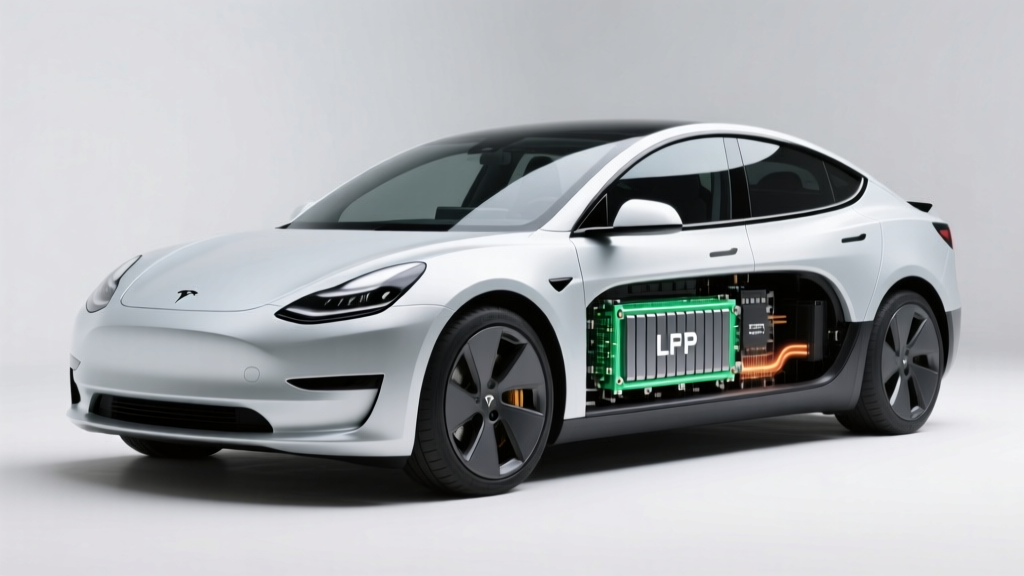
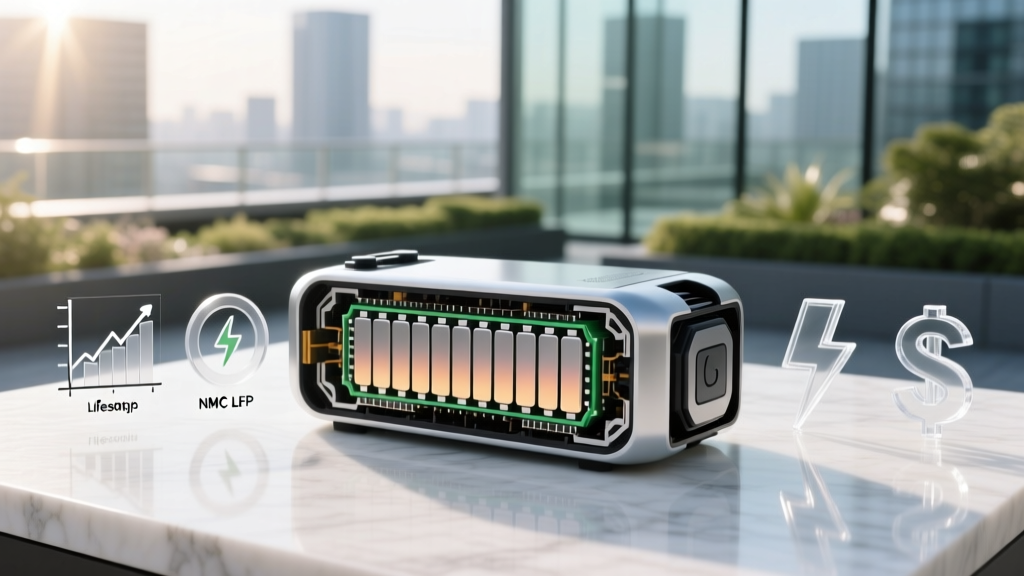
Not all EV batteries are the same. The two dominant lithium-ion chemistries in 2026 are LFP (lithium iron phosphate) and NMC/NCA (nickel manganese cobalt / nickel cobalt aluminum). The chemistry determines energy density, lifespan, cold-weather performance, and cost.
| Attribute | LFP (Lithium Iron Phosphate) | NMC / NCA (Nickel-based) |
|---|---|---|
| Energy Density | Lower (~160–180 Wh/kg cell-level) | Higher (~220–280 Wh/kg cell-level) |
| Typical Use | Standard-range models, fleet vehicles | Long-range and performance models |
| Cycle Life | 3,000–5,000+ full cycles | 1,500–2,500 full cycles |
| Cold-Weather Performance | Reduced — greater range loss below 32°F | Better — less range loss in freezing temps |
| Charging to 100% | Recommended regularly (helps BMS calibration) | 80% daily recommended; 100% for trips only |
| Cost (per kWh) | Lower — ~$90–$110/kWh pack-level | Higher — ~$120–$150/kWh pack-level |
| Cobalt Content | None (cobalt-free) | Contains cobalt and nickel |
| Examples (2026) | Tesla Model 3 RWD, Ford F-150 Lightning Standard Range, BYD models | Tesla Model Y Long Range, Rivian R1T Max Pack, Hyundai Ioniq 5 Long Range |
LFP vs. NMC — Which Is Better and Why?
Neither chemistry is universally superior. LFP wins on longevity and cost: if you plan to keep a vehicle 10+ years or drive high annual miles, LFP's cycle-life advantage is significant. The trade-off is lower energy density (meaning heavier packs for the same range) and worse cold-weather range retention.
NMC/NCA wins on range and cold performance: if you need maximum range per charge or live in northern climates with harsh winters, NMC-based packs deliver more miles in a lighter package and hold up better in freezing temperatures. The trade-off is a shorter cycle life and the recommendation to avoid sitting at 100% state of charge for extended periods.
For an electric truck buyer — the demographic most likely cross-shopping from a 2012 Dodge Ram 1500 — the choice often comes down to use case. Towing-heavy drivers benefit from NMC's higher energy density. Daily commuters who charge at home nightly benefit from LFP's superior cycle life and the ability to charge to 100% without degradation concerns.
How Long Do EV Batteries Last? Real Degradation Data
The most persistent fear among prospective EV buyers is that the battery will need a $20,000 replacement at 80,000 miles. The data tells a different story.
Observed EV Battery Degradation (Fleet & Owner Data)
| Vehicle / Source | Mileage | Capacity Retention | Notes |
|---|---|---|---|
| Tesla Model 3/S (fleet avg.) | 100,000 mi | ~90–92% | Per Tesla 2024 Impact Report; NMC packs |
| Tesla Model 3 LFP | 100,000 mi | ~93–95% | LFP chemistry advantage in cycle life |
| Nissan LEAF (2013–2017, air-cooled) | 100,000 mi | ~75–85% | Poor thermal management accelerated loss |
| Chevrolet Bolt EV (2017–2022) | 80,000 mi | ~90–94% | Active liquid cooling; strong performance |
| Hyundai/Kia E-GMP platform (Ioniq 5, EV6) | 60,000 mi | ~94–97% | Limited long-term data; early results strong |
| Ford F-150 Lightning (2022–2024) | 50,000 mi | ~95–97% | Early data; liquid-cooled NMC and LFP variants |
Sources: Tesla Impact Reports, Recurrent Auto battery degradation studies, fueleconomy.gov, owner forums.
Key takeaway: Modern liquid-cooled EV batteries from major manufacturers are losing roughly 5–10% of capacity over the first 100,000 miles. The catastrophic early-life failures that plagued the first-generation Nissan LEAF (which used passive air cooling) are largely a thing of the past. Most EV batteries in 2026 will outlast the vehicle's body and suspension components.
Factors That Accelerate Battery Degradation
Not all miles are equal when it comes to battery wear. The following factors have the greatest impact on long-term State of Health (SoH):
- Extreme heat exposure: Sustained battery temperatures above 95°F (35°C) accelerate chemical degradation. Vehicles parked outdoors in Arizona or Texas summers without thermal management active will degrade faster than garage-kept vehicles in moderate climates.
- Frequent DC fast charging at high power: Exclusive reliance on 150–350 kW DC fast charging generates significant heat. Owners who DC fast-charge daily (common in ride-share or delivery fleets) see measurably higher degradation than those who primarily use Level 2 home charging. That said, modern battery management systems (BMS) actively limit charge rates when temperatures are elevated, mitigating much of this risk.
- Extended time at high or low state of charge: Storing an NMC battery at 100% SoC for days or weeks accelerates degradation. Similarly, leaving any lithium-ion battery below 10% SoC for extended periods risks cell damage. LFP chemistry is more tolerant of high SoC storage.
- Deep discharge cycles: Regularly driving from 100% to near 0% puts more stress on cells than shallow cycles (e.g., 70% to 30%). This is why cycle life ratings are based on full equivalent cycles — partial cycles are gentler.
EV Battery Warranties: What's Actually Covered?
Federal law mandates a minimum 8-year/100,000-mile warranty on EV battery packs for emissions-related compliance, and most manufacturers meet or exceed this baseline. California and states adopting CARB standards require 10 years/150,000 miles.
| Manufacturer | Warranty Period | Capacity Retention Threshold | Notes |
|---|---|---|---|
| Tesla (Model 3/Y) | 8 yr / 100,000–120,000 mi | 70% | Varies by trim; Long Range = 120k mi |
| Ford (F-150 Lightning) | 8 yr / 100,000 mi | 70% | Covers battery and electric drivetrain components |
| Hyundai / Kia | 10 yr / 100,000 mi | 70% | Among the longest coverage in the industry |
| General Motors (Ultium platform) | 8 yr / 100,000 mi | 70% | Silverado EV, Blazer EV, Equinox EV |
| Rivian (R1T / R1S) | 8 yr / 175,000 mi | 70% | Higher mileage cap reflects truck/adventure use case |
| BMW / Mercedes-Benz | 8 yr / 100,000 mi | 70% | Standard across luxury EV lineup |
What the warranty covers: If your battery's usable capacity falls below the stated threshold (typically 70% of original capacity) within the warranty period, the manufacturer will repair or replace the battery pack at no cost. This covers cell-level degradation — not damage from accidents, flooding, or unauthorized modifications.
What it doesn't cover: Normal gradual degradation above the 70% threshold is expected and not warrantable. A battery at 75% capacity at year 7 is functioning within spec, even though you've lost 25% of original range. The 12V auxiliary battery is also covered separately under the standard vehicle warranty (typically 3 yr/36,000 mi), just like in your 2012 Dodge Ram 1500.
EV Battery Replacement Cost: What You'll Actually Pay
Replacement cost is the number that generates the most anxiety — and the most misinformation. Here's what the data shows in 2026:
| Vehicle | Battery Size (kWh) | Estimated Replacement Cost | Typical Replacement Timeline |
|---|---|---|---|
| Tesla Model 3 Standard Range (LFP) | ~60 kWh | $8,000–$12,000 | Rarely needed under 200,000 mi |
| Tesla Model Y Long Range (NMC) | ~75 kWh | $12,000–$16,000 | Rarely needed under 200,000 mi |
| Ford F-150 Lightning Extended Range | ~131 kWh | $20,000–$28,000 | Rarely needed under 150,000 mi |
| Chevrolet Bolt EV / EUV | ~65 kWh | $9,000–$14,000 | Some early units replaced under recall |
| Hyundai Ioniq 5 Long Range | ~77.4 kWh | $11,000–$16,000 | Rarely needed under 200,000 mi |
| Rivian R1T Max Pack | ~149 kWh | $22,000–$30,000 | Too new for replacement data |
| Nissan LEAF (2018+, 62 kWh) | ~62 kWh | $8,000–$12,000 | Some units replaced at 100,000–150,000 mi |
Context matters enormously here. Pack-level battery costs have fallen from over $1,000/kWh in 2010 to roughly $100–$140/kWh in 2026, according to BloombergNEF data. They're projected to drop further as LFP adoption expands and manufacturing scales. More importantly, full pack replacement is rare. Many out-of-warranty repairs involve replacing individual modules (a fraction of the full pack cost) rather than the entire assembly.
Compare this to the lifetime cost of 12V battery replacements on a 2012 Dodge Ram 1500. If you own that truck for 15 years and replace the battery every 4 years, you're spending roughly $800–$1,200 total on 12V batteries alone — a cost that EV owners also incur for their auxiliary batteries, on top of any traction battery concerns.
Maximizing Battery Health: A Practical Care Checklist
EV battery longevity isn't mysterious. The physics of lithium-ion cells are well understood, and a few habits make a measurable difference over a decade of ownership.
Daily & Weekly Habits
- Set a charge limit: For NMC/NCA batteries, set daily charging to 80% and only charge to 100% when you need full range for a trip. For LFP batteries, charge to 100% at least once a week to keep the BMS calibrated.
- Plug in when possible: Keeping the battery between 20–80% SoC and plugged into a Level 2 charger allows the thermal management system to maintain optimal cell temperature, especially in extreme weather.
- Use preconditioning: If your EV offers scheduled departure or preconditioning, use it. The car will warm or cool the battery to optimal temperature before you drive and before DC fast charging, improving both efficiency and charge speed.
Monthly & Seasonal Habits
- Minimize DC fast charging when Level 2 is available: DC fast charging isn't inherently damaging — modern BMS systems manage heat well — but exclusive reliance on it accelerates wear compared to slower Level 2 charging. Use DC fast charging for road trips; use Level 2 at home for daily needs.
- Avoid extended storage at extreme SoC: If leaving the vehicle for more than a week, aim for 50–60% SoC. Never store at 100% or below 10%.
- Garage parking in extreme climates: In regions with sustained summer heat above 100°F or winter cold below 0°F, covered or garage parking meaningfully reduces thermal stress on the pack.
Monitoring Battery Health
- In-car SoH display: Some manufacturers (Tesla, Rivian, BMW) provide a battery health or degradation estimate in the vehicle's settings menu. This shows current usable capacity as a percentage of original.
- OBD-II diagnostic tools: Devices like the OBDLink MX+ paired with apps such as EV Health or LeafSpy (for Nissan LEAF) can read detailed cell voltage data and estimate SoH from the battery management system.
- Dealer diagnostic check: Any authorized service center can run a full battery health report. Request this during routine service visits, especially as you approach warranty mileage thresholds — if degradation is approaching the 70% threshold, you want it documented.
- Third-party services: Companies like Recurrent Auto offer battery health reports based on connected-car data, providing comparisons against similar vehicles in their fleet.
How Does This Compare to Owning a 2012 Dodge Ram 1500?
For truck owners weighing an EV purchase against continuing with a familiar internal-combustion vehicle, the battery question is central. Here's a direct comparison of power source maintenance:
| Factor | 2012 Dodge Ram 1500 (Gas) | 2026 Electric Truck (e.g., F-150 Lightning, Ram 1500 REV) |
|---|---|---|
| Primary Energy Storage | 15–26 gallon fuel tank | 98–131 kWh traction battery |
| 12V Battery Replacement | $150–$280 every 3–5 years | $100–$300 every 5–8 years (lithium 12V) |
| Traction Battery Replacement | N/A | $12,000–$28,000; rarely needed under 150,000+ mi |
| Engine / Motor Maintenance | Oil changes, spark plugs, timing chain, transmission fluid — $500–$1,500/yr | No oil, no spark plugs, no transmission — minimal drivetrain maintenance |
| Fuel / Energy Cost (annual, 15k mi) | ~$2,200–$3,000 (gas at $3.20/gal, 17 MPG) | ~$600–$900 (home charging at $0.14/kWh, 2 mi/kWh) |
| Warranty on Energy Storage | Fuel tank: essentially lifetime (rarely fails) | Traction battery: 8 yr / 100,000 mi minimum |
The math favors EVs on operating costs, but the upfront battery replacement risk — however unlikely — is a psychological barrier that a $200 lead-acid swap never presents. The warranty exists specifically to mitigate that risk.
What's Next: Solid-State, Silicon Anodes, and Future Battery Tech
Battery technology continues to advance, but it's critical to separate laboratory breakthroughs from production reality.
Solid-State Batteries
Solid-state batteries replace the liquid electrolyte in current lithium-ion cells with a solid material (ceramic, sulfide, or polymer), promising higher energy density, faster charging, and improved safety. Toyota, Samsung SDI, and QuantumScape are leading development.
Realistic timeline: Limited production vehicles with solid-state batteries are expected from Toyota around 2027–2028, with broader commercial availability not likely until 2030+. Early units will be expensive and reserved for premium models. Do not delay an EV purchase waiting for solid-state — the technology will take years to reach mainstream pricing.
Silicon Anode Technology
Replacing graphite anodes with silicon can increase energy density by 20–40%. Companies like Sila Nanotechnologies and Group14 Technologies are supplying silicon-dominant anode materials to battery manufacturers.
Realistic timeline: Silicon anode blends are already appearing in some 2025–2026 EV cells (notably in the Mercedes G-Class EQ and select Porsche applications). Expect broader adoption by 2028–2029 as manufacturing costs decrease. This is an incremental improvement, not a revolution — it extends range without fundamentally changing charging or longevity characteristics.
Sodium-Ion Batteries
Sodium-ion chemistry uses abundant, inexpensive materials and is being deployed in some Chinese-market EVs (BYD, CATL). Energy density is lower than LFP, making it suitable primarily for short-range urban vehicles and energy storage.
Realistic timeline: US-market availability is uncertain and likely 2028+ at the earliest, limited to entry-level or fleet vehicles where cost matters more than range.
Frequently Asked Questions
How long do EV batteries last in years and miles?
Based on fleet data through 2026, most modern liquid-cooled EV batteries retain 85–95% of original capacity at 100,000 miles and 80–90% at 150,000 miles. In terms of years, degradation is more closely tied to charge cycles and thermal history than calendar age, but expect 15–20+ years of usable service from a well-maintained pack. Many EV batteries will outlast the vehicle's body, suspension, and interior.
How much does an EV battery cost to replace in 2026?
Full pack replacement ranges from approximately $8,000 for a ~60 kWh pack (Tesla Model 3 Standard Range) to $28,000+ for a ~130+ kWh pack (Ford F-150 Lightning Extended Range). However, full replacements are uncommon — many out-of-warranty repairs involve individual module replacement at $2,000–$5,000. Pack costs continue to decline as LFP adoption grows and manufacturing scales.
What does the EV battery warranty actually cover?
The federal minimum is 8 years/100,000 miles with a 70% capacity retention threshold. If your battery drops below 70% of its original usable capacity within that period, the manufacturer covers repair or replacement. Hyundai/Kia and Rivian offer extended terms (10 yr/100,000 mi and 8 yr/175,000 mi, respectively). Damage from accidents, flooding, or unauthorized modifications is excluded.
How do I check my EV battery's State of Health?
Check your vehicle's settings menu for a battery health display (available on Tesla, Rivian, BMW, and others). For more granular data, use an OBD-II adapter with an EV-specific app to read cell voltage variance and SoH estimates. Your dealer can also run a full diagnostic report. Third-party services like Recurrent Auto provide comparative health reports via connected-car data.
LFP vs NMC — which battery chemistry should I choose?
Choose LFP if you prioritize longevity, plan to keep the vehicle 10+ years, charge at home nightly (LFP tolerates daily 100% charges), and don't need maximum range. Choose NMC/NCA if you need the longest possible range per charge, live in a cold climate (better cold-weather performance), or tow frequently (higher energy density means less weight penalty for large packs). Both chemistries are proven and reliable in 2026.
Can I still drive my EV if the battery degrades to 70%?
Absolutely. A battery at 70% capacity simply has 70% of its original range. A vehicle that originally delivered 300 miles of EPA range would deliver roughly 210 miles — still sufficient for most daily driving. The 70% threshold is a warranty trigger, not a failure point. Many EVs continue operating safely well below 70% capacity.
Does the 2012 Dodge Ram 1500 have any EV battery components?
No. The 2012 Dodge Ram 1500 is a conventional internal-combustion truck with a single 12V lead-acid battery for starting and accessories. It has no high-voltage traction battery, no electric drive motor, and no regenerative braking system. The only battery it shares in common with EVs is the 12V auxiliary unit — which EVs also carry for low-voltage systems.
For official battery warranty terms, consult your vehicle manufacturer. For federal EV tax credit eligibility under IRS §30D, including battery sourcing and critical mineral requirements, visit irs.gov. Range and efficiency data sourced from fueleconomy.gov.