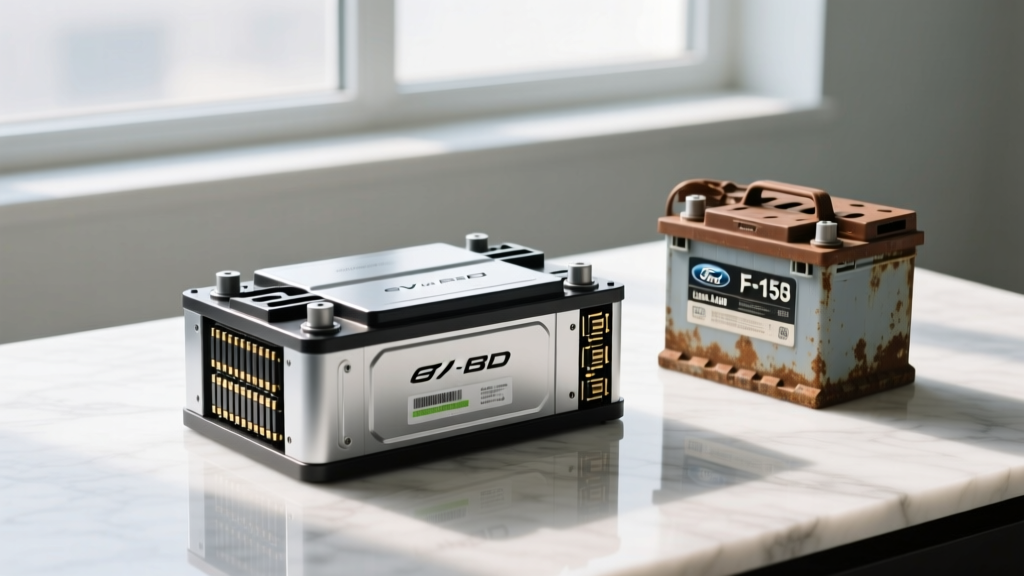
If you have ever replaced the 12V lead-acid battery in a 2003 Ford F-150, you know the drill: a $120-$180 trip to the auto parts store, a few wrench turns, and you are back on the road for another three to five years. That simple, well-understood component shapes how many buyers think about "the battery" when they consider an electric vehicle. The reality of a modern EV high-voltage traction battery is fundamentally different — in chemistry, cost, lifespan, and what it actually does.
This guide breaks down everything a current or prospective EV owner needs to know about the pack that actually propels the vehicle: the chemistries in use today, what the degradation data actually shows, what warranties cover (and what they do not), what a replacement really costs in 2026, and how to monitor and maximize the State of Health (SoH) of your pack over a decade or more of ownership.
Why the 2003 F150 Battery and an EV Traction Battery Are Not Comparable
The 2003 F150 battery is a 12-volt, lead-acid, SLI (Starting, Lighting, Ignition) unit. Its entire job is to crank a 4.6L or 5.4L V8 for a few seconds and run accessories when the alternator is not spinning. It stores roughly 0.6 to 0.8 kWh of usable energy, weighs about 40 pounds, and is designed as a consumable component with a 3- to 5-year service life.
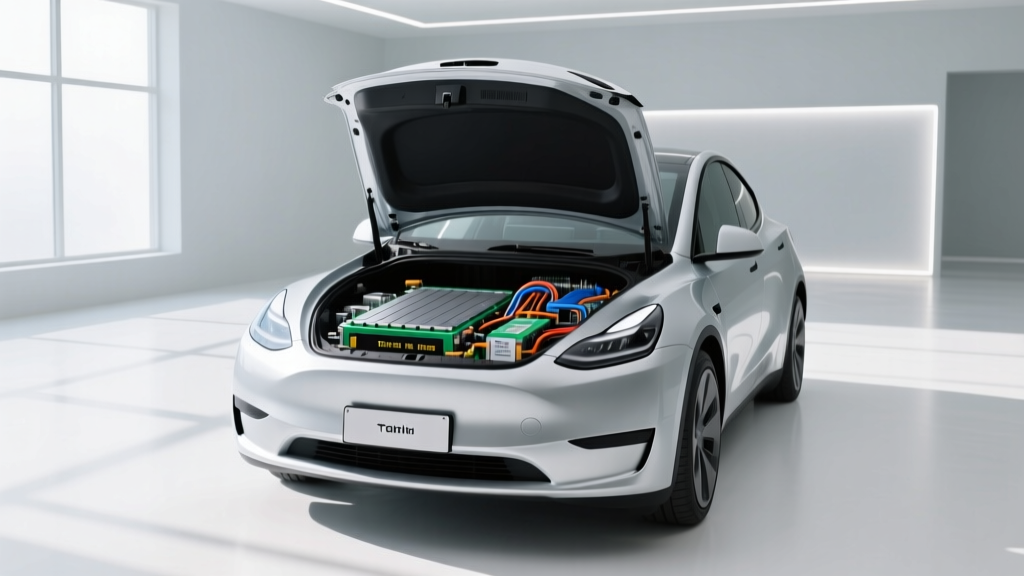
A modern EV traction battery is a completely different animal. A 2026 Tesla Model Y Long Range pack, for example, stores roughly 75 kWh of usable energy — about 100 times more than that F-150's lead-acid unit. It operates at 350-400 volts, weighs close to 1,000 pounds, uses lithium-ion cells with sophisticated thermal management, and is engineered to last the lifetime of the vehicle. Even a smaller pack like the 58 kWh unit in a base Chevrolet Equinox EV stores roughly 70 times the energy of that 2003 truck battery.
Yes, EVs also carry a separate 12V auxiliary battery (increasingly a small lithium-ion unit) that handles accessories and computer wake-up, much like the one in your old F-150. But when buyers ask about "the EV battery," they mean the high-voltage traction pack. That is what this guide covers.
Battery Chemistry in 2026: LFP vs NMC vs NCA
Two lithium-ion chemistries dominate the 2026 EV market: LFP (lithium iron phosphate, LiFePO₄) and NMC/NCA (nickel manganese cobalt / nickel cobalt aluminum). Understanding the trade-offs between them is the single most important chemistry decision you will make as a buyer, because it affects range, charging habits, longevity, and cold-weather performance.
| Attribute | LFP (Lithium Iron Phosphate) | NMC / NCA (Nickel-based) |
|---|---|---|
| Energy Density | Lower (~160-180 Wh/kg cell-level) | Higher (~220-280 Wh/kg cell-level) |
| Typical Use | Standard-range / base trims (Tesla Model 3 RWD, base Chevy Equinox EV) | Long-range / performance trims (Model Y LR, Rivian R1T Max Pack) |
| Cycle Life | 3,000-5,000+ full cycles to 80% SoH | 1,000-2,000 full cycles to 80% SoH |
| Recommended Daily SoC | 100% daily is fine; manufacturers recommend periodic full charges for BMS calibration | 80% daily; 100% only before long trips |
| Cold-Weather Performance | More range loss in cold (~30-40% at 20°F); slower cold fast-charging without preconditioning | Better cold performance (~20-30% loss at 20°F); more tolerant of cold fast-charging |
| Cost per kWh | Lower (~$85-$100/kWh pack-level in 2026) | Higher (~$110-$135/kWh pack-level in 2026) |
| Cobalt Content | Zero cobalt | Contains cobalt (supply-chain and ethical considerations) |
| Thermal Stability | Higher thermal runaway threshold (~270°C) | Lower thermal runaway threshold (~210°C); requires more robust BMS |
The practical takeaway: If your daily commute is under 60 miles and you have reliable home charging, an LFP-equipped base trim often makes more sense — you get a longer-lasting pack, can charge to 100% without guilt, and pay less upfront. If you regularly drive 200+ miles between charges, tow, or live in a cold climate, the higher energy density and better cold performance of NMC/NCA justify the premium.
How Long Do EV Batteries Actually Last? Degradation Data
This is the question that generates the most anxiety — and the most misinformation. Let's look at what the data actually shows rather than worst-case anecdotes.
EV battery degradation follows a characteristic curve: a steeper initial drop of roughly 2-5% in the first year or 20,000 miles, followed by a long, gradual linear decline. Most packs settle into losing about 1-2% of total capacity per year under normal use.
| Data Source / Fleet | Age / Mileage | Average Capacity Retained | Notes |
|---|---|---|---|
| Tesla 2025 Impact Report (Model 3/Y fleet) | 200,000 miles | ~85% | Aggregate fleet data; includes NMC and LFP packs |
| Geotab 2024 Fleet Study (6,300+ EVs, multiple brands) | 6.5 years average | ~86% (average annual loss ~2.3%) | Mixed chemistries; includes hot-climate fleets |
| Recurrent Auto (15,000+ EVs tracked) | 100,000 miles | ~90-93% | Shows strong LFP retention advantage |
| Nissan Leaf (passive-cooled, pre-2018 NMC) | 8 years / 80,000 miles | ~75-80% | Older chemistry without active thermal management; outlier for modern context |
The critical context: the early-generation Nissan Leaf, which used passive air cooling and older NMC chemistry, degraded noticeably faster. Nearly every EV sold since 2019 uses active liquid thermal management, and the degradation data reflects a substantial improvement. A 2026 EV with a liquid-cooled pack is highly likely to retain 80-90% of its original capacity at 150,000 miles.
For perspective, a Model 3 Long Range with an EPA range of 341 miles that degrades to 85% capacity at 200,000 miles still delivers roughly 290 miles of range — more than enough for the vast majority of daily driving and road trips.
What Does the Battery Warranty Actually Cover?
Federal law effectively mandates that EV manufacturers provide a minimum battery warranty of 8 years / 100,000 miles (10 years / 150,000 miles in CARB states like California, New York, and others). Most manufacturers meet or exceed these thresholds. Here is how the major warranties compare in 2026:
| Manufacturer | Warranty Term | Capacity Retention Threshold | What Triggers a Claim |
|---|---|---|---|
| Tesla (Model 3/Y) | 8 yr / 120,000 mi (LR/AWD); 8 yr / 100,000 mi (RWD) | 70% | SoH drops below 70% as measured by Tesla diagnostics |
| Hyundai / Kia (Ioniq 5, EV6) | 10 yr / 100,000 mi | 70% | Capacity below 70% confirmed by dealer diagnostic scan |
| Ford (Mustang Mach-E, F-150 Lightning) | 8 yr / 100,000 mi | 70% | SoH below 70% per Ford diagnostic tool |
| GM (Chevy Equinox EV, Blazer EV) | 8 yr / 100,000 mi | 70% | Verified degradation below 70% capacity |
| Rivian (R1T, R1S) | 8 yr / 175,000 mi | 70% | Capacity below 70% as determined by Rivian service |
Key points that buyers often misunderstand:
- The warranty covers degradation, not just defects. If your pack drops below the stated threshold (typically 70%) within the term, the manufacturer will repair or replace it — usually with a remanufactured pack of equivalent capacity.
- "70% capacity" does not mean the car is unusable. A 75 kWh pack at 70% still stores 52.5 kWh, which in a Model Y translates to roughly 240 miles of range. It means reduced range, not a dead vehicle.
- Physical damage is excluded. Bottoming out and puncturing the pack, flood damage, or aftermarket modifications that affect the battery system are not covered. This is where a good insurance policy matters.
- Warranty is transferable. The battery warranty follows the VIN, not the original owner — an important factor in used-EV resale value.
EV Battery Replacement Cost: What It Actually Takes
The headline numbers for EV battery replacements — $15,000, $20,000, even $30,000 — are technically accurate but misleading without context. Here is the full picture.
| Vehicle | Pack Size (kWh) | Chemistry | Estimated Replacement Cost (Parts + Labor) | Likelihood of Needing It |
|---|---|---|---|---|
| Tesla Model 3 RWD | ~57 kWh | LFP | $10,000 - $14,000 | Very low within 15 years |
| Tesla Model Y Long Range | ~75 kWh | NMC | $13,000 - $18,000 | Very low within 15 years |
| Ford F-150 Lightning (Extended Range) | ~131 kWh | NMC | $22,000 - $30,000 | Low; large pack degrades more slowly per cycle |
| Chevrolet Equinox EV | ~85 kWh | NMC | $14,000 - $19,000 | Low within 15 years |
| Hyundai Ioniq 5 | ~77.4 kWh | NMC | $13,000 - $17,000 | Low within 15 years |
The critical context most articles omit: the vast majority of EV owners will never need a full pack replacement. Based on current degradation data, a liquid-cooled 2026 EV pack is likely to retain 75-85% of its capacity at 200,000 miles. Most vehicles are scrapped, sold, or traded before the pack reaches a state that requires replacement. When replacements do occur, they are overwhelmingly covered under warranty.
Also worth noting: individual module or cell-group replacement is increasingly available. Rather than swapping the entire pack, a service center can identify and replace a single degraded or failed module for $2,000-$5,000, restoring the pack to near-original performance. This is especially common in modular pack designs like those from GM's Ultium platform and older Nissan Leaf architectures.
Compare this to the 2003 F-150's engine or transmission replacement: a remanufactured 5.4L V8 runs $3,500-$5,500 installed, and a transmission rebuild can hit $3,000-$4,500. The EV battery is more expensive, but it is also far less likely to need replacement in the vehicle's lifetime than a gas truck's major powertrain components.
Factors That Affect EV Battery Lifespan
Not all miles are created equal when it comes to battery wear. Here are the factors that measurably accelerate or slow degradation, ranked roughly by impact:
What Accelerates Degradation
- Frequent DC fast charging to high SoC without preconditioning. Repeatedly slamming 150+ kW into a cold pack causes lithium plating on the anode. Preconditioning (heating the pack before charging) mitigates this significantly — most 2026 EVs do this automatically when you navigate to a charger.
- Sustained high temperatures. Parking in 110°F Phoenix heat for weeks at a time, especially at high SoC, accelerates electrolyte decomposition. Liquid-cooled packs handle this far better than passively cooled ones, but heat is still the enemy of lithium-ion longevity.
- Consistently storing at 100% SoC (NMC/NCA packs). High voltage stresses the cathode. NMC/NCA owners should set daily charge limits to 80% and reserve 100% for trips. LFP owners can ignore this — full charges are recommended.
- Regularly draining to 0% SoC. Deep discharge below the buffer (the hidden reserve below the "0%" displayed on the dash) can cause copper dissolution in the anode current collector. The buffer exists to prevent this, but repeatedly hitting 0% and leaving the car sitting is still not ideal.
- High-mileage towing and track use. Sustained high-current discharge generates heat inside the cells. Occasional towing is fine; daily heavy towing in hot weather will accelerate wear.
What Extends Battery Life
- Level 2 home charging as your primary method. Gentle 7-11 kW charging generates minimal heat and stress. If 90% of your charging is at home on Level 2, your pack will outlast one that relies heavily on DC fast charging.
- Moderate SoC range (NMC/NCA): keeping between 20-80% daily. This is the sweet spot for nickel-based chemistry longevity.
- Preconditioning before DC fast charging. Always use the car's navigation to route to a fast charger — this triggers automatic pack heating.
- Garaging in extreme climates. A garage in Phoenix or Minneapolis significantly reduces thermal stress on the pack.
- Driving it. Batteries that cycle regularly (moderate depth, regular use) age more gracefully than batteries that sit at high SoC for weeks. A daily-driven EV is generally healthier than a weekend-only one stored at 100%.
How to Check and Monitor Battery State of Health (SoH)
State of Health (SoH) is expressed as a percentage: a pack at 92% SoH retains 92% of its original usable capacity. Here is how you can check it:
Built-in Vehicle Tools
Most 2026 EVs provide some form of battery health readout. Tesla owners can access detailed pack data through the service menu or third-party apps like Tessie or TeslaFi, which pull SoH estimates from the vehicle's API. Hyundai/Kia models display battery health in the dealer diagnostic scan. GM's Ultium-based vehicles report SoH through the MyChevrolet app and OnStar diagnostics.
OBD-II Diagnostic Apps
For a more granular look, an OBD-II dongle paired with an app like Leaf Spy (Nissan), Scan My Tesla, or Car Scanner ELM OBD2 can read individual cell voltages, pack temperature, and the BMS-reported SoH. These tools read the same data the manufacturer's service department sees.
The Manual Method
For a rough SoH estimate without any tools: fully charge the vehicle to 100%, note the displayed range, and compare it to the original EPA-rated range adjusted for your typical efficiency. If your Model 3 LR showed 341 miles when new and now shows 305 at 100%, your SoH is approximately 89%. This is imprecise (displayed range depends on recent driving efficiency) but gives a useful trend line over time.
Pre-Purchase Inspection for Used EVs
If you are buying a used EV, request a battery health report from the selling dealer or have an independent EV-savvy mechanic run a diagnostic scan. Some services, like Recurrent, offer battery health reports based on connected-car data. This is the single most important check on a used EV — more important than mileage or cosmetic condition.
Emerging Battery Technologies: What Is Real and What Is Not (Yet)
The EV battery landscape is evolving rapidly, but separating marketing from production reality is essential. Here is where next-generation technologies actually stand as of 2026:
Silicon-Dominant Anodes
Companies like Sila Nanotechnologies and Group14 are shipping silicon-enhanced anodes that replace some or all of the graphite in current cells. Silicon can store roughly 10 times more lithium ions per gram than graphite, promising 20-40% energy density gains. These are entering production in limited applications in 2025-2026, with broader automotive adoption expected by 2028-2030. The trade-off: silicon expands significantly during charging, requiring new binder and cell-engineering solutions that are still being validated at scale.
Solid-State Batteries
Solid-state cells replace the liquid electrolyte with a solid ceramic, polymer, or sulfide conductor. The theoretical benefits are substantial: higher energy density, faster charging, improved safety (no flammable liquid electrolyte), and longer cycle life. Toyota has announced solid-state-equipped vehicles for limited production in 2027-2028, and QuantumScape is working with Volkswagen on pilot programs. However, no mass-market vehicle with a solid-state pack is available for purchase in 2026. Manufacturing cost, yield challenges, and scaling remain significant hurdles. Realistic widespread availability is likely 2030 or beyond.
Sodium-Ion Batteries
CATL and other Chinese manufacturers have begun producing sodium-ion cells for entry-level EVs. Sodium is abundant and cheap, and these cells perform well in cold weather. The trade-off is lower energy density (~120-160 Wh/kg), making them best suited for city cars and short-range applications. Expect to see these in budget-oriented models, primarily in China, with possible US-market entry in fleet or urban vehicles by 2028-2029.
The bottom line: today's LFP and NMC chemistries are mature, well-understood, and proven at scale. They will power the vast majority of EVs sold through the end of this decade. Next-generation technologies will arrive incrementally, not as a sudden revolution that makes current packs obsolete.
Frequently Asked Questions
How long do EV batteries last in years and miles?
Based on fleet data from Tesla, Geotab, and Recurrent, a modern liquid-cooled EV battery will typically retain 80-90% of its original capacity at 150,000-200,000 miles over 10-15 years. Most packs will outlast the vehicle they are installed in. The federal warranty mandate of 8 years / 100,000 miles (with a 70% capacity floor) provides a strong safety net, and most manufacturers meet or exceed this standard.
How much does an EV battery cost to replace out of warranty?
Full pack replacement costs range from approximately $10,000 for a smaller LFP pack (Tesla Model 3 RWD) to $22,000-$30,000 for a large pack like the F-150 Lightning Extended Range. However, the vast majority of owners never need a replacement — degradation data shows most packs retain usable capacity well beyond 200,000 miles. When issues do arise, individual module replacement for $2,000-$5,000 is increasingly available as an alternative to a full pack swap.
What does the EV battery warranty actually cover?
The warranty covers both manufacturing defects and excessive capacity loss. If your battery's State of Health drops below the manufacturer's threshold (typically 70% of original capacity) within the warranty period (8-10 years / 100,000-175,000 miles depending on the brand), the manufacturer will repair or replace the pack at no cost. Physical damage from accidents, ground strikes, flooding, or unauthorized modifications is excluded. The warranty transfers to subsequent owners automatically.
How do I check my EV's battery health?
Most 2026 EVs provide SoH data through the vehicle's infotainment system, companion app, or service menu. Third-party OBD-II apps like Scan My Tesla, Leaf Spy, or Car Scanner can read detailed BMS data including individual cell voltages and pack-level SoH. For a quick estimate, compare your displayed range at 100% charge to the original EPA rating. If you are buying used, always request a dealer battery health report before purchase.
LFP vs NMC — which battery chemistry is better for me?
Neither is universally "better" — it depends on your use case. Choose LFP if: you have home charging, your daily driving is under 60-80 miles, you want the longest possible cycle life, and you prefer charging to 100% without worry. Choose NMC/NCA if: you need maximum range for road trips, you tow, you live in a cold climate (better cold-weather performance and faster cold-weather DC charging), or you regularly drive more than 200 miles between charges. Both chemistries are proven and will comfortably last the life of the vehicle with normal use.
Does fast charging damage my EV battery?
DC fast charging generates more heat and places more stress on cells than Level 2 charging, but modern battery management systems actively manage charge rates, temperatures, and cell balancing to minimize wear. Occasional DC fast charging (road trips, a few times per month) has a negligible impact on long-term degradation. The concern is primarily with exclusive reliance on DC fast charging without preconditioning — for example, daily fast-charging a cold pack in winter. If you have access to Level 2 home charging and use it as your primary method, your pack will age very gracefully regardless of occasional fast-charging.
How is an EV traction battery different from a 2003 F150 battery?
The 2003 F-150 uses a 12V lead-acid SLI battery that stores less than 1 kWh, costs $120-$180, and lasts 3-5 years. An EV traction battery stores 50-130+ kWh, operates at 350-400V, costs $10,000-$30,000 to replace, but is designed to last 15-20 years and 200,000+ miles with gradual, predictable degradation. They serve entirely different purposes and are not interchangeable or comparable in function. Modern EVs also carry a separate 12V auxiliary battery for accessories, similar in concept to the F-150's battery but often a smaller lithium-ion unit.
For authoritative data on EV efficiency and range, the EPA's fueleconomy.gov remains the best starting point. For battery warranty specifics on your particular vehicle, consult your owner's manual or the manufacturer's warranty guide directly. And for current federal tax credit eligibility under IRS §30D, remember that rules around MSRP caps, buyer income limits, and battery-sourcing requirements change — always verify your eligibility before purchasing.