When shoppers ask about the different types of car batteries in electric vehicles, they're usually trying to answer three questions: What chemistry is inside the pack, how long will it last, and what happens if it needs replacing? The answers matter more than horsepower or 0-60 times because the traction battery is the single most expensive component in any EV — typically representing 25-40% of the vehicle's build cost.
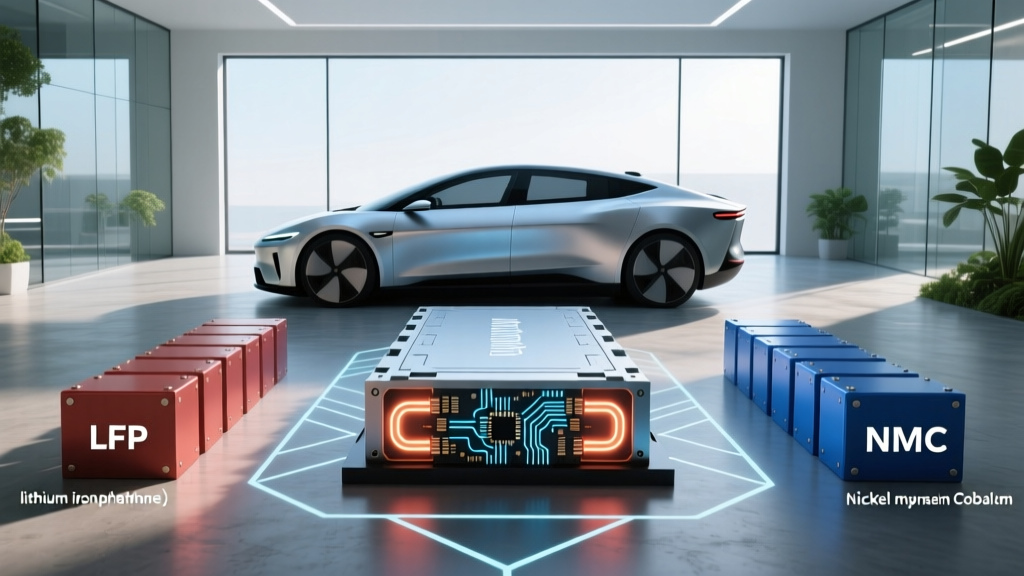
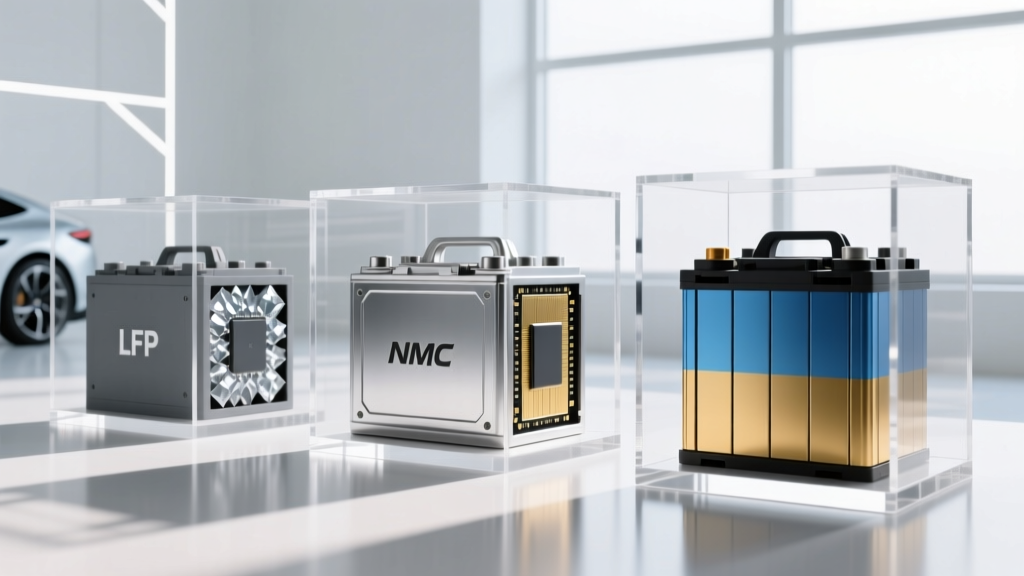
In 2026, two lithium-ion chemistries dominate the EV market: lithium iron phosphate (LFP) and nickel manganese cobalt (NMC), with nickel cobalt aluminum (NCA) appearing in select performance applications. Each has measurable trade-offs in energy density, cycle life, cold-weather behavior, and manufacturing cost. Understanding these differences — and how degradation, warranty coverage, and daily habits interact — is the fastest path to a confident EV purchase.
LFP vs NMC vs NCA: EV Battery Chemistry Compared
The cathode chemistry inside a lithium-ion cell determines its fundamental characteristics. Here is how the three mainstream chemistries stack up in real-world EV applications:
| Attribute | LFP (Lithium Iron Phosphate) | NMC (Nickel Manganese Cobalt) | NCA (Nickel Cobalt Aluminum) |
|---|---|---|---|
| Energy Density (cell-level) | 160-180 Wh/kg | 220-260 Wh/kg | 240-270 Wh/kg |
| Typical Cycle Life | 3,000-5,000+ cycles | 1,000-2,000 cycles | 800-1,500 cycles |
| Cold-Weather Performance | Moderate — greater range loss below 32°F | Better low-temp conductivity | Good low-temp conductivity |
| Cost per kWh (cell) | ~$60-80 | ~$90-120 | ~$95-130 |
| Cobalt Content | None | Varies (low-cobalt formulations increasing) | Low cobalt |
| Thermal Stability | Excellent — least prone to thermal runaway | Good with active management | Good with active management |
| State-of-Charge Recommendation | Can be charged to 100% daily | 80% daily recommended for longevity | 80% daily recommended for longevity |
| Notable 2026 Applications | Tesla Model 3 RWD, Ford Mustang Mach-E Select (LFP option), BYD Seal, Chevrolet Equinox EV (base) | Hyundai Ioniq 5/6, Kia EV6/EV9, BMW iX, Rivian R1S/R1T, VW ID.4 | Tesla Model S/X, Lucid Air |
LFP: The Longevity and Value Play
LFP cells sacrifice roughly 20-30% of energy density compared to NMC, which means automakers need either a heavier pack or must accept somewhat less range for the same physical volume. The payoff is cycle life: LFP cells routinely tolerate 3,000 to 5,000+ full charge-discharge cycles before reaching 80% of original capacity. For a vehicle averaging 12,000 miles per year with a 250-mile range, that translates to well over 500,000 miles of theoretical cycle life — far exceeding the mechanical lifespan of the car itself.
LFP also permits regular charging to 100% without the accelerated degradation penalties that NMC/NCA packs incur at high state of charge. Tesla explicitly recommends periodic 100% charges for its LFP-equipped Model 3 RWD to help the battery management system (BMS) recalibrate cell voltage estimates. The chemistry contains no cobalt or nickel, simplifying supply chains and reducing exposure to volatile commodity pricing — a factor that has kept LFP pack prices below $100/kWh in 2026.
NMC: The Range and Performance Standard
NMC remains the dominant chemistry for vehicles prioritizing maximum range and fast-charging speed within a given pack volume. Higher energy density lets automakers fit 75-100+ kWh of usable capacity without excessive weight, enabling EPA range ratings above 300 miles in sedans and crossovers. Modern NMC formulations (often labeled NMC 811 for their 8:1:1 nickel-manganese-cobalt ratio) have reduced cobalt content significantly compared to earlier generations.
The trade-off is cycle life and high-SoC sensitivity. Sustained operation above 90% SoC accelerates cathode surface degradation and electrolyte oxidation. Most NMC-equipped vehicles ship with a default daily charge limit of 80%, with 100% reserved for trip days. In practice, this means an NMC owner with a 310-mile EPA-rated vehicle is living with ~248 miles of daily usable range — still ample for the U.S. average commute of 37 miles round-trip, according to FHWA NHTS data.
How Long Do EV Batteries Actually Last?
Calendar age and cycle count both contribute to degradation. Based on aggregated fleet data from sources like Geotab's EV battery health study and manufacturer warranty claims, typical degradation follows a curve that is steepest in the first year and then flattens:
| Vehicle Age / Mileage | Average Capacity Retained (NMC/NCA) | Average Capacity Retained (LFP) |
|---|---|---|
| Year 1 / ~12,000 mi | 95-97% | 97-99% |
| Year 3 / ~36,000 mi | 90-93% | 94-97% |
| Year 5 / ~60,000 mi | 86-91% | 91-95% |
| Year 8 / ~100,000 mi | 80-88% | 88-93% |
| Year 10 / ~120,000 mi | 77-85% | 85-91% |
These figures represent averages; individual results vary with climate, charging habits, and thermal management quality. Vehicles with active liquid-cooled battery systems (standard on nearly all 2026 EVs from Hyundai, Tesla, BMW, Rivian, and Ford) consistently outperform passively air-cooled packs in long-term retention.
The practical takeaway: a well-maintained NMC pack at 100,000 miles typically retains 80-88% of its original capacity. On a vehicle with a 300-mile EPA range when new, that means roughly 240-264 miles of range at the 100,000-mile mark — still highly functional for daily use and road trips with minimal DC fast-charging stops.
What the Battery Warranty Covers — and What It Doesn't
Federal law mandates that EV battery warranties cover a minimum of 8 years / 100,000 miles (10 years / 150,000 miles for California Air Resources Board states and those adopting CARB standards). Here is how major automakers structure their coverage in 2026:
| Manufacturer | Warranty Period | Capacity Threshold | Notes |
|---|---|---|---|
| Tesla (Model 3/Y LFP) | 8 yr / 120,000 mi | 70% retention | Longer mileage on LFP trims |
| Tesla (Model 3/Y NMC, S/X) | 8 yr / 100,000-150,000 mi | 70% retention | Varies by model |
| Hyundai / Kia | 10 yr / 100,000 mi | 70% retention | Among the longest coverage |
| Ford (Mach-E, F-150 Lightning) | 8 yr / 100,000 mi | 70% retention | Standard across BEV lineup |
| GM (Ultium-based) | 8 yr / 100,000 mi | 70% retention | Covers battery and drive components |
| BMW | 8 yr / 100,000 mi | 70% retention | Includes high-voltage components |
| Rivian | 8 yr / 175,000 mi | 70% retention | Highest mileage threshold in class |
Critically, these warranties cover excessive degradation — meaning the battery falls below the stated retention threshold within the warranty period. They do not cover gradual, normal loss. If your 5-year-old NMC pack retains 82% capacity, it is functioning within expected parameters and no warranty claim applies. The warranty also typically excludes damage from collisions, flooding, unauthorized modifications, or improper charging equipment.
According to data compiled by fueleconomy.gov, the vast majority of EV batteries sold since 2018 have not required warranty replacement. Out-of-warranty failures are rare enough that most EV owners will sell or retire the vehicle before the pack needs service.
EV Battery Replacement Cost: What to Budget and When
Replacement cost is the number-one fear among prospective EV buyers. The reality in 2026 is more nuanced — and more favorable — than the headline figures suggest.
| Vehicle / Pack Size | Battery Capacity | Estimated Replacement Cost (Parts + Labor) | Typical Replacement Timeline |
|---|---|---|---|
| Chevrolet Equinox EV / compact crossovers | 65-75 kWh | $8,000 - $12,000 | Rarely needed before 200,000+ mi |
| Tesla Model 3 (LFP) | 60 kWh | $7,500 - $10,000 | 3,000+ cycle life makes replacement unlikely |
| Hyundai Ioniq 5 / Kia EV6 | 77.4 kWh | $11,000 - $15,000 | Typically 150,000-200,000+ mi if needed |
| Ford F-150 Lightning (extended) | 131 kWh | $18,000 - $25,000 | Largest packs command premium pricing |
| Tesla Model S / Lucid Air | 100-118 kWh | $15,000 - $22,000 | Premium segment; labor-intensive access |
Context matters: the average age of a vehicle scrapped in the U.S. is roughly 15 years, according to S&P Global Mobility. An EV battery that retains 80%+ capacity at 150,000 miles and 10+ years will, for most owners, outlast the vehicle's economic life. The scenarios where replacement is financially justified typically involve manufacturing defects caught under warranty, not wear-out.
Cell-level pricing has also continued its downward trend. Average pack prices crossed below $130/kWh at the cell level in 2025, with LFP packs approaching $100/kWh. This means a replacement pack in 2030 will cost materially less than today's estimates — an important consideration for buyers planning long-term ownership.
Factors That Accelerate — or Slow — Battery Degradation
Not all miles and charges are created equal. The following factors have the most measurable impact on long-term battery health:
- Avoid sustained high SoC (NMC/NCA): Set daily charge limit to 80%. Reserve 100% for road-trip departure days.
- Minimize DC fast-charging frequency: Occasional DCFC is fine; daily reliance on 150+ kW chargers accelerates degradation by an estimated 1-3% over 5 years compared to Level 2 home charging.
- Precondition before fast charging: Most 2026 EVs do this automatically when a Supercharger or DCFC is set as the navigation destination. Cold cells forced to accept high current suffer lithium plating — a permanent capacity loss mechanism.
- Avoid extreme SoC storage: If storing an EV for weeks, target 50-60% SoC. Never store at 100% or below 10% for extended periods.
- Use a heat pump and garage when possible: Vehicles parked in temperature-moderate environments (garages, shaded areas) show measurably lower calendar degradation. Heat pumps reduce the energy wasted on cabin heating, indirectly reducing battery stress in cold climates.
- Don't fear LFP at 100%: If your vehicle has an LFP pack, regular 100% charges are recommended and do not harm longevity.
The single most impactful habit is charging discipline. A 2024 study by Recurrent Auto found that EVs charged primarily on Level 2 (home/work) with 80% daily limits showed an average of 2-4 percentage points less degradation at the 60,000-mile mark compared to vehicles frequently DC fast-charged to 100%. Over a 10-year ownership period, that gap compounds into meaningful range retention.
Temperature extremes also play a role. Sustained exposure to ambient temperatures above 95°F accelerates electrolyte decomposition, while repeated charging in sub-freezing conditions without preconditioning can cause lithium plating on the anode. Active thermal management systems in 2026 EVs mitigate both risks substantially, but garage parking in Phoenix summers or Minnesota winters still provides a measurable advantage.
How to Check Your EV Battery's State of Health (SoH)
State of Health (SoH) is a percentage representing current maximum capacity relative to the battery's original capacity. A new battery is 100% SoH; one that can only hold 85 kWh of its original 100 kWh is at 85% SoH.
Owners can monitor SoH through several methods:
- In-vehicle displays: Tesla's app shows estimated range at 100% charge, which owners can compare to original EPA figures. BMW's iDrive includes a battery health indicator. Hyundai's Bluelink app provides state-of-charge and health data.
- OBD-II diagnostic tools: Devices like the OBDeleven or dedicated EV apps (e.g., TeslaFi, Tessie, ABRP with OBD dongle) can read BMS-reported capacity figures directly.
- Dealer diagnostic reports: Requesting a battery health check during routine service gives a manufacturer-certified SoH reading, useful for pre-purchase inspections on used EVs.
- Third-party services: Companies like Recurrent Auto offer free battery health reports that compare your pack's degradation to a fleet baseline of identical vehicles.
For used-EV buyers, SoH verification is essential. A 3-year-old EV with 45,000 miles showing 92% SoH is performing normally; one showing 84% may indicate abusive charging patterns or a defective module and warrants a dealer inspection before purchase.
Emerging Battery Technologies: What's Real and What's Next
Two technologies dominate forward-looking battery discussion, but neither is available in production consumer EVs as of 2026:
Solid-state batteries replace the liquid electrolyte with a solid ceramic, polymer, or sulfide conductor. The promised advantages — 2-3x energy density, faster charging, reduced fire risk — are significant. Toyota has announced pilot production for limited fleet vehicles, with consumer availability targeted for 2028-2030. Samsung SDI and QuantumScape are pursuing similar timelines. However, manufacturing yield, cost, and scalability challenges have repeatedly delayed commercialization. Treat any "solid-state EV" claim before 2028 with skepticism.
Silicon-dominant anodes replace graphite with silicon to increase lithium-ion storage capacity per unit volume. Companies like Sila Nanotechnologies and Group14 Technologies are supplying silicon-carbon composite anode materials to battery manufacturers, with incremental adoption expected in 2027-2029 model-year vehicles. Early implementations will likely appear in premium segments where cost tolerance is higher.
Both technologies represent genuine progress, but the current LFP and NMC chemistries — refined over a decade of mass production — offer proven reliability, declining costs, and warranty-backed longevity that make them the rational choice for today's buyers. Waiting for solid-state is not a practical purchase strategy.
LFP vs NMC: Which Battery Type Should You Choose?
There is no universally "better" chemistry — the right choice depends on your ownership pattern:
- You plan to own the vehicle 8+ years and want maximum cycle life
- Your daily driving is under 200 miles and you don't need peak EPA range
- You want to charge to 100% regularly without worrying about degradation
- You prioritize lower purchase price and cobalt-free sourcing
- You live in a moderate climate (LFP's cold-weather penalty matters less)
- You need maximum range (300+ miles EPA) for frequent road trips
- You live in a cold climate and want better low-temperature performance
- You prioritize the lightest possible vehicle weight for efficiency
- You plan to own the vehicle 5-7 years and are comfortable with 80% daily charge limits
- Fast-charging speed is a priority (NMC packs typically sustain higher kW longer)
Frequently Asked Questions
How long do EV batteries last in years and miles?
Most modern EV batteries (2020 and newer) with liquid thermal management retain 80-88% capacity at 100,000 miles and 8 years. LFP packs trend higher, often retaining 88-93% at the same interval. Full pack failure before 150,000 miles is statistically rare. Many packs will outlast the vehicle's useful life.
How much does an EV battery cost to replace?
Replacement costs in 2026 range from approximately $7,500 for a 60 kWh LFP pack (Tesla Model 3 RWD) to $25,000 for a 131 kWh pack (Ford F-150 Lightning Extended Range). Mid-size crossovers with 75-80 kWh packs typically fall in the $11,000-$15,000 range including labor. Cell prices continue declining, making future replacements cheaper.
What does the EV battery warranty actually cover?
Federal minimum coverage is 8 years / 100,000 miles against capacity loss below 70% of original. CARB states extend this to 10 years / 150,000 miles. The warranty covers excessive degradation and manufacturing defects, not normal gradual capacity loss, collision damage, or abuse from improper charging. Some automakers (Rivian, Hyundai/Kia) exceed the federal minimum.
Can I check my EV battery health myself?
Yes. Most EV apps show estimated range at full charge, which you can compare to original EPA figures. OBD-II tools and apps like TeslaFi or Tessie provide direct BMS SoH readings. Dealers can run certified diagnostics. Third-party services like Recurrent Auto offer free fleet-comparison reports. Always verify SoH before buying a used EV.
Is LFP really better than NMC for daily driving?
For owners who drive under 200 miles daily, charge at home, and plan long ownership, LFP offers superior cycle life, the ability to charge to 100% without penalty, and lower cost. NMC wins for buyers who need maximum EPA range for road trips, live in cold climates, or prioritize lighter vehicle weight. Both chemistries are proven and reliable in 2026.
Does fast charging damage my EV battery?
Occasional DC fast charging (1-2 times per week) has a minimal impact on long-term health — perhaps 1-2 percentage points of additional degradation over 5 years compared to exclusive Level 2 charging. Daily DC fast charging, especially without preconditioning in cold weather, accelerates wear. For daily needs, Level 2 home charging at 7-11 kW is the longevity-optimal choice.