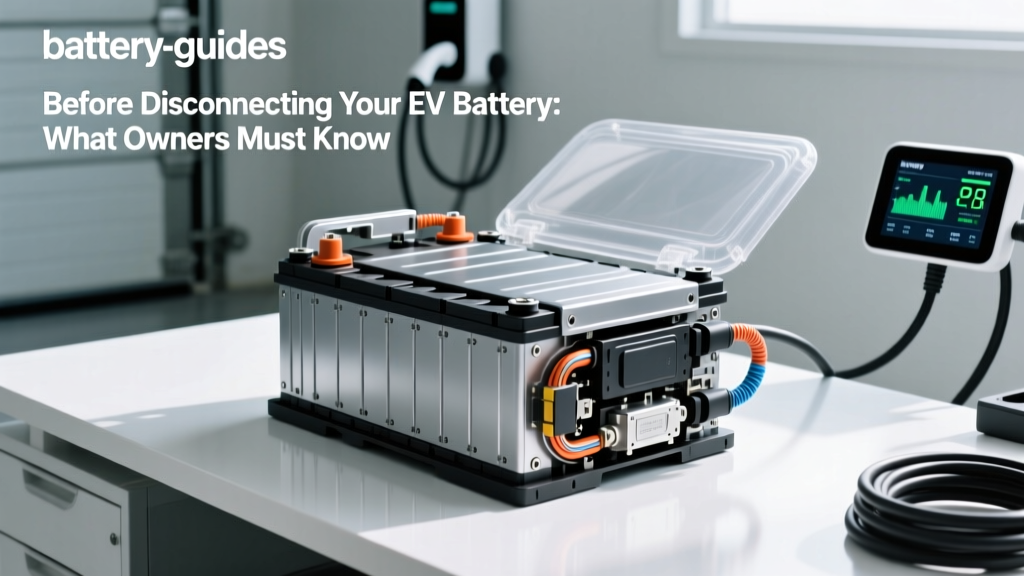
Search for "battery tender for AGM" and you'll find dozens of smart chargers designed to maintain lead-acid and Absorbent Glass Mat 12-volt batteries at full charge. For EV owners, these devices serve a real but narrow purpose: keeping the auxiliary 12V battery alive when the car sits for weeks. But conflating that small lead-acid pack with the 60–100+ kWh high-voltage traction battery underneath your EV is a costly misunderstanding. This guide separates the two systems and gives you exact data on EV battery longevity, degradation, warranty coverage, replacement economics, and the care habits that actually move the needle on traction battery health.
The Two Batteries in Your EV: AGM Auxiliary vs. High-Voltage Traction
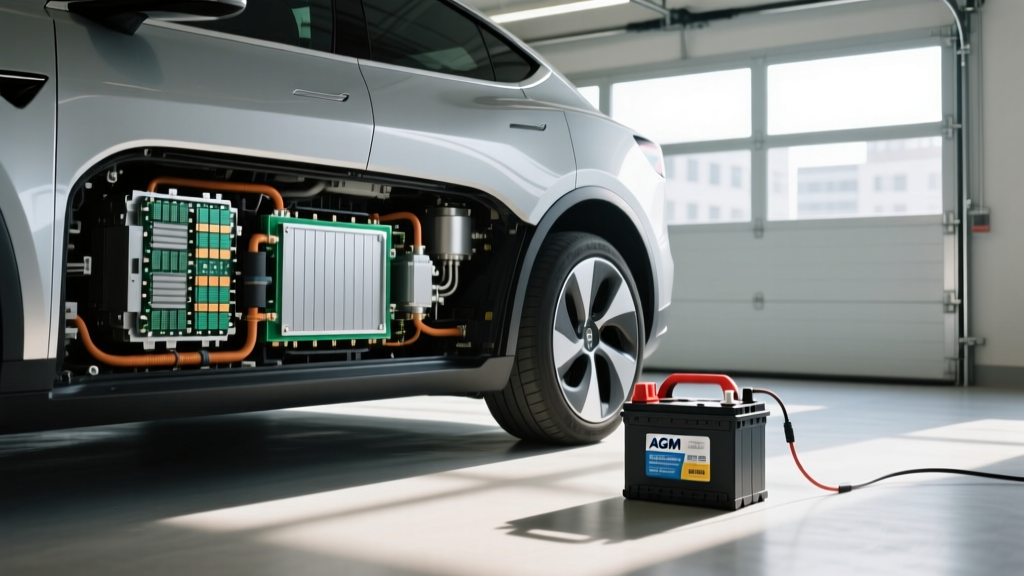
Every production EV sold in the US in 2026 still carries two distinct battery systems:
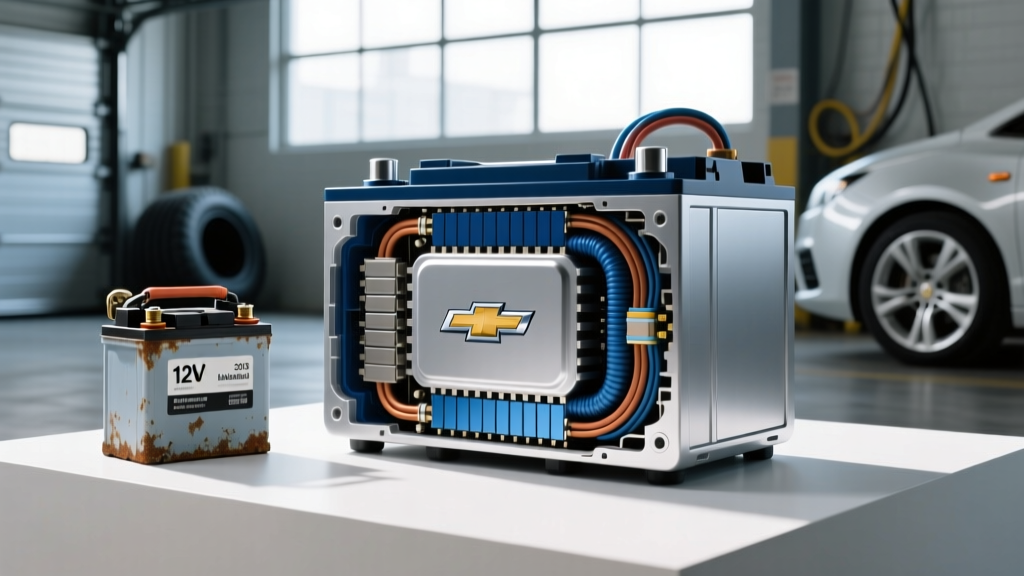
- 12V auxiliary battery (often AGM or lithium-iron-phosphate): Powers lights, infotainment, door locks, and the DC-DC converter startup sequence. Typical capacity: 12–16 Ah (roughly 0.15–0.2 kWh). A battery tender for AGM cells maintains this pack during long storage, preventing sulfation that kills lead-acid chemistry below 12.0V.
- High-voltage traction battery: The main energy store that drives the electric motor(s). Capacity ranges from ~40 kWh (Nissan Leaf S) to over 130 kWh (GMC Hummer EV, Cadillac Escalade IQ). Chemistry is either NMC/NCA (nickel-based) or LFP (lithium iron phosphate). This battery is managed entirely by the vehicle's Battery Management System (BMS) and requires zero external tender or maintainer.
Plugging a 12V AGM battery tender into any high-voltage circuit is impossible by design — the connectors, voltages (400V or 800V nominal), and safety interlocks are entirely separate. Your traction battery's longevity depends on chemistry, thermal management, charge habits, and BMS sophistication, not on a $35 trickle charger.
LFP vs. NMC/NCA: Chemistry Trade-Offs That Define Battery Life
The two dominant lithium-ion chemistries in 2026 EVs behave differently across every metric that matters to owners. Here is a direct comparison based on manufacturer data and independent testing:
| Attribute | LFP (Lithium Iron Phosphate) | NMC/NCA (Nickel-based) |
|---|---|---|
| Energy density (cell-level) | 160–180 Wh/kg | 250–300 Wh/kg |
| Cycle life (to 80% SoH) | 3,000–5,000+ cycles | 1,000–2,000 cycles |
| Calendar life | 15–20+ years typical | 10–15 years typical |
| Cold-weather performance | Moderate loss; slower charge acceptance below 32°F | Better low-temp discharge; preconditioning helps |
| Cost per kWh (pack-level, 2026) | ~$90–$110 | ~$120–$150 |
| Recommended daily SoC | 100% is fine; periodic full charges help BMS calibration | 80% daily; 100% only before long trips |
| Thermal runaway risk | Very low | Low but higher than LFP |
| Typical 2026 applications | Tesla Model 3/Y RWD, Ford Mustang Mach-E Select (LFP option), BYD models | Tesla Long Range/Performance, Hyundai Ioniq 5/6, Rivian, most premium/long-range trims |
Which is better? It depends on your use case. If you commute daily, charge at home, and want maximum calendar life with minimal babysitting, LFP is the stronger pick — charge to 100% every night and don't think about it. If you need maximum range per charge (300+ miles EPA) and frequently road-trip in cold climates, NMC/NCA's higher energy density is worth the slightly tighter SoC management. Neither chemistry is fragile; both routinely outlast 150,000 miles with under 10–15% capacity loss in real-world fleet data.
How Long Do EV Batteries Actually Last? Degradation Data by the Numbers
The fear that EV batteries die at 60,000 miles is a relic of early-2010s Nissan Leaf ownership (passive air cooling, no thermal management). Modern liquid-cooled packs tell a very different story:
Observed degradation benchmarks (fleet and owner-reported data):
- Tesla Model 3/Y (NMC, 2019–2023): Median ~5–7% loss at 100,000 miles; ~10–12% at 200,000 miles (source: Tesla Impact Reports, Recurrent Auto fleet data).
- Chevrolet Bolt EV/EUV (NMC, 2017–2023): ~6–8% loss at 80,000 miles; most packs retain 88–92% SoH at 100,000 miles (Recurrent Auto).
- Hyundai Ioniq 5 (NMC, 2022–2025): Early data shows ~3–5% loss at 50,000 miles; 800V architecture and aggressive thermal management contribute to slow fade.
- Tesla Model 3 RWD (LFP, 2021–2025): Under 2% loss reported at 50,000 miles in multiple fleet samples; LFP's cycle-life advantage is measurable early.
- Porsche Taycan (NMC, 800V): ~3–4% loss at 40,000 miles in European fleet data; strong preconditioning and conservative BMS buffers help.
For context, the average US driver covers ~13,500 miles per year (FHWA). At the degradation rates above, most modern EV traction batteries will retain 80–90% of original capacity at the 10-year, 135,000-mile mark — well within federal warranty minimums and the typical ownership cycle.
What Does the Battery Warranty Actually Cover?
Federal law (EPA emissions-related warranty provisions and CARB requirements adopted by multiple states) effectively mandates that EV manufacturers warrant the traction battery for a minimum of 8 years / 100,000 miles. Many exceed this. Here is what current 2026 model-year warranties look like:
| Manufacturer | Warranty Term | Capacity Retention Threshold | What Triggers a Claim |
|---|---|---|---|
| Tesla (Model 3/Y RWD – LFP) | 8 yr / 100,000 mi | 70% | SoH below 70% as measured by Tesla diagnostic |
| Tesla (Model 3/Y LR/Perf – NMC) | 8 yr / 120,000 mi | 70% | Same |
| Hyundai / Kia (Ioniq 5/6, EV6) | 10 yr / 100,000 mi | 70% | BMS-reported SoH below threshold |
| GM (Ultium-based: Equinox EV, Blazer EV, Silverado EV) | 8 yr / 100,000 mi | 70% | Diagnostic-confirmed degradation |
| Ford (Mach-E, F-150 Lightning) | 8 yr / 100,000 mi | 70% | Same |
| Rivian (R1T, R1S) | 8 yr / 175,000 mi | 70% | Same; notably higher mileage cap |
| Volkswagen (ID.4) | 8 yr / 100,000 mi | 70% | Same |
The 70% threshold is critical: it means a warranty claim requires the battery to have lost more than 30% of its original usable capacity. Given the degradation data above, the vast majority of owners will never approach this threshold within the warranty period. Warranty claims are overwhelmingly triggered by manufacturing defects (bad cell groups, BMS faults, coolant intrusion) rather than gradual wear.
EV Battery Replacement Cost: What the Numbers Say in 2026
Out-of-warranty replacement is the nightmare scenario, but it's rarer than most buyers assume. When it does happen, costs have dropped substantially since 2020:
| Vehicle / Battery Size | Approximate Replacement Cost (Parts + Labor, 2026) | Typical Trigger |
|---|---|---|
| Nissan Leaf (40 kWh, NMC) | $6,500–$9,000 | Aged-out pack at 120k+ mi; increasingly rare |
| Chevrolet Bolt EV (65 kWh, NMC) | $9,000–$14,000 | Most replaced under recall/warranty |
| Tesla Model 3 (50–75 kWh) | $10,000–$16,000 | Collision damage or rare cell failure |
| Hyundai Ioniq 5 (77.4 kWh) | $12,000–$18,000 | Collision or extreme defect |
| Ford F-150 Lightning (131 kWh Extended Range) | $20,000–$28,000 | Large pack; mostly under warranty still |
| GMC Hummer EV (200+ kWh Ultium) | $30,000–$40,000+ | Collision; virtually all claims under warranty |
Key context: according to IIHS and insurer data, the most common cause of traction battery replacement is collision damage, not degradation. For a 2022–2026 model-year EV, the battery will almost certainly still be under its 8-year warranty for any wear-related failure. The vehicles most likely to need an out-of-pocket replacement today are 2011–2017 Leafs, early Bolts (pre-recall fix), and high-mileage early Teslas — all of which are now well past their warranty windows.
Five Factors That Actually Accelerate Battery Degradation
Not all miles are equal. Research from the National Renewable Energy Laboratory (NREL), Argonne National Lab, and fleet operators like Recurrent Auto consistently identifies these degradation accelerators:
- Frequent DC fast charging above 80% SoC: The charge curve tapers sharply above 80% because the BMS reduces current to protect cell voltage. Consistently pushing to 100% on DCFC adds heat stress. Occasional use is fine; daily 100% DCFC sessions measurably increase degradation over 3+ years.
- Extreme heat exposure without preconditioning: Sustained battery temperatures above 104°F (40°C) accelerate electrolyte decomposition. Parking in direct desert sun without thermal management active is worse than any charging habit. Liquid-cooled packs (virtually all 2020+ EVs) mitigate this significantly.
- Storing at 100% SoC for extended periods: For NMC/NCA, sitting at full charge for weeks (especially in heat) stresses the cathode. LFP tolerates this far better. If storing an NMC vehicle for 2+ weeks, target 50–60% SoC.
- Deep discharges to 0%: Dropping below the BMS buffer (typically 2–5% displayed) risks copper dissolution in the anode. The car will shut down before true 0%, but repeatedly running the pack to shutdown is unnecessary wear.
- Aggressive driving in extreme cold without preconditioning: Lithium plating can occur when charging or drawing high current from a cold NMC cell. Using the vehicle's scheduled departure preconditioning (plugged in) eliminates this risk entirely.
How to Check and Monitor Your Traction Battery's State of Health
State of Health (SoH) is the percentage of original usable capacity the battery retains. Most owners can check it without a dealership visit:
- Tesla: Service menu (hold the model badge on the About screen for ~3 seconds) shows a "Battery Health" test. Third-party apps like Tessie or TeslaFi log SoH estimates from BMS data over time.
- Hyundai/Kia: The infotainment EV diagnostics screen shows estimated SoH. Dealership scan tools provide a precise reading.
- GM (Ultium): The myChevrolet/myCadillac app includes a battery health indicator; OnStar diagnostics can pull a detailed report.
- Ford: FordPass provides a battery state-of-health estimate; the dealer IDS tool gives cell-level voltage delta data.
- Universal OBD-II method: Apps like Car Scanner or LeafSpy (for Nissan) read BMS-reported SoH, cell voltages, and pack temperature via a standard OBD-II dongle. This is the most granular DIY option.
Track SoH quarterly, not weekly — BMS estimates fluctuate with temperature and recent charge cycles, so short-term noise is meaningless. A steady downward trend of more than ~2% per year after the first year (initial "formation" loss is normal) warrants a dealership diagnostic.
Where Your AGM Battery Tender Actually Fits In
The 12V auxiliary battery remains a real maintenance item. EVs draw parasitic load from the 12V system even when "off" — telematics, key-fob detection, and BMS monitoring consume 20–50 mA continuously. A standard AGM 12V battery (45–60 Ah) can be depleted in 4–8 weeks of non-use, which bricks the car's ability to close the high-voltage contactors and start normally.
A quality battery tender for AGM chemistry (such as the Battery Tender Plus 1.25A, NOCO Genius 5, or CTEK MXS 5.0) connected to the 12V terminals or a pigtail during extended storage prevents this. It does not touch the traction battery, and it is unnecessary if you drive the vehicle at least once every two weeks — the DC-DC converter recharges the 12V pack whenever the high-voltage system is active.
Some 2025–2026 models (including newer Teslas and Hyundai/Kia EVs) have switched to 12V lithium-iron-phosphate auxiliary batteries, which self-discharge far more slowly and don't need a tender. Check your owner's manual before purchasing one.
What's Next: Solid-State and Silicon-Anode Batteries (Forward-Looking)
Two emerging technologies are frequently cited as the next leap in EV battery performance:
- Solid-state batteries: Replace the liquid electrolyte with a solid ceramic, polymer, or sulfide conductor. Promised benefits include 2x energy density, faster charging, and near-zero thermal runaway risk. As of early 2026, Toyota has announced limited production in select 2027–2028 models, and QuantumScape is shipping prototype cells to VW for testing. No mass-market US-spec EV currently on sale uses solid-state cells. Realistic broad availability: 2029–2032.
- Silicon-dominant anodes: Companies like Sila Nanotechnologies and Group14 are producing silicon-carbon composite anodes that increase energy density by 20–40% over graphite. The 2025–2026 Mercedes G-Class 580e (PHEV) uses a silicon-anode cell from Sila. Expect gradual adoption in premium BEVs by 2027–2028, with cost parity around 2030.
Neither technology is available to consumers today in a production BEV at scale. Any model listing "solid-state" in 2026 press materials should be treated as announced/preliminary until EPA certification and delivery confirm otherwise.
Frequently Asked Questions
Can I use a battery tender for AGM on my EV's main battery?
No. A battery tender for AGM is a 12V smart charger designed exclusively for the small auxiliary lead-acid or AGM battery. The high-voltage traction battery (400V–800V, 40–200+ kWh) is managed entirely by the vehicle's onboard BMS and charges only through the J1772/NACS/CCS charge port or the onboard DC-DC converter. There is no safe or functional way to connect a 12V tender to it.
How long do EV batteries last in years and miles?
Modern liquid-cooled EV traction batteries (2020 and newer) routinely last 150,000–200,000+ miles and 12–20 years before reaching 70–80% State of Health. LFP chemistry tends toward the longer end of that range. Most batteries outlast the vehicle's economic life; the car's body, suspension, or electronics typically reach end-of-life before the pack does.
How much does it cost to replace an EV battery out of warranty?
Out-of-warranty replacement ranges from ~$6,500 for a smaller pack (40 kWh Nissan Leaf) to $28,000+ for a large pack (131 kWh Ford F-150 Lightning Extended Range). However, the vast majority of 2020–2026 EVs are still within their 8-year/100,000-mile federal battery warranty, and most replacements that occur are covered under warranty or insurance (collision damage).
What does the EV battery warranty actually cover?
All major manufacturers warrant the traction battery for at least 8 years/100,000 miles against capacity loss below 70% of original and against manufacturing defects. Hyundai/Kia and Rivian extend to 10 years or higher mileage caps. The warranty covers the full pack replacement or module repair at no cost if the threshold is met. It does not cover damage from collision, flood, or unauthorized modification.
Is LFP better than NMC for daily driving?
For most daily-driving use cases, LFP offers practical advantages: you can charge to 100% regularly without degradation concern, cycle life is 2–3x longer, and cost per kWh is lower. The trade-off is lower energy density (less range for the same pack weight) and slightly reduced cold-weather fast-charging speed. If your commute is under 200 miles round-trip and you charge at home, LFP is the easier chemistry to live with.
How often should I check my EV battery's State of Health?
Check SoH quarterly using your vehicle's built-in diagnostics or an OBD-II app like Car Scanner. Ignore week-to-week fluctuations — temperature and recent charge patterns cause noise. If you observe a consistent decline exceeding ~2% per year after the initial first-year settling, schedule a dealership diagnostic to rule out a defective cell module.
Does frequent DC fast charging really damage the battery?
Occasional DC fast charging (1–2 times per week) has a minimal measurable effect on modern packs with active liquid cooling. Daily DCFC, especially sessions pushed to 100% SoC, does accelerate degradation by 1–3% over several years compared to predominantly Level 2 home charging. The charge curve taper above 80% exists specifically to protect cells — respecting it by ending DCFC sessions at 80% largely eliminates the risk.
Sources: fueleconomy.gov (EPA range and efficiency data); IRS §30D Clean Vehicle Credit (tax credit eligibility); manufacturer warranty documentation (Tesla, Hyundai, GM, Ford, Rivian, VW); Recurrent Auto fleet degradation reports; NREL battery lifecycle studies.