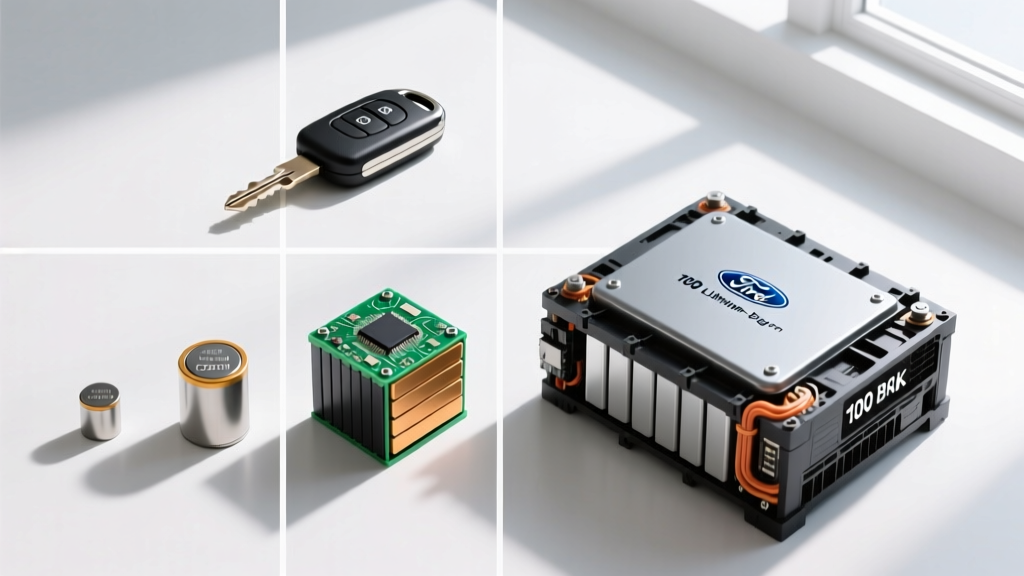
Note: This guide covers high-voltage EV traction batteries. If you landed here looking for how to change battery in Ford Fusion key fob, that involves a small CR2032 3V coin cell in the remote — not the vehicle's main battery. We cover that briefly in the FAQ, but the focus below is the technology powering modern electric vehicles.
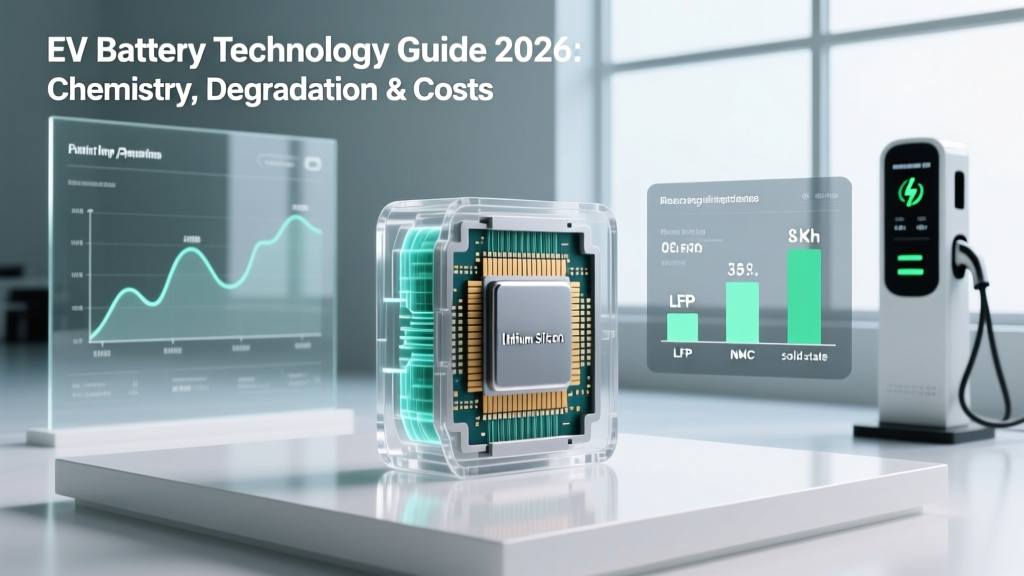
EV Battery Chemistry in 2026: LFP vs NMC vs NCA
The single biggest determinant of how an EV ages, charges, and performs in cold weather is the chemistry inside its battery pack. In 2026, virtually every mainstream EV uses one of three lithium-ion variants: LFP (lithium iron phosphate), NMC (nickel manganese cobalt), or NCA (nickel cobalt aluminum). Tesla, Ford, and Rivian have shifted many standard-range models to LFP, while long-range and performance variants still lean on NMC/NCA for energy density.
kWh (kilowatt-hours) measures the energy stored in the pack — think of it as the "tank size." kW (kilowatts) measures the rate at which energy flows in or out — the "fill speed." Chemistry affects both.
| Attribute | LFP | NMC | NCA |
|---|---|---|---|
| Energy density | ~160-180 Wh/kg (lower) | ~220-260 Wh/kg (high) | ~250-280 Wh/kg (highest) |
| Cycle life | 3,000-5,000+ cycles | 1,000-2,000 cycles | 1,000-1,500 cycles |
| Cold-weather performance | Weaker; ~25-35% range loss at 20°F | Better; ~15-25% loss | Better; ~15-25% loss |
| DC fast-charge tolerance | Excellent; can charge to 100% regularly | Best kept 20-80% for longevity | Best kept 20-80% for longevity |
| Thermal stability / safety | Very high | Good with BMS | Good with BMS |
| Cost (2026) | Lowest (~$90-110/kWh pack) | Mid (~$120-145/kWh) | Highest (~$135-160/kWh) |
| Typical applications | Tesla Model 3 RWD, Model Y RWD, Ford Mustang Mach-E Select SR, Rivian Standard | Hyundai Ioniq 5 Long Range, VW ID.4 Pro, Chevy Equinox EV | Tesla Model S/X, Lucid Air, high-performance trims |
Which is better? There is no universal winner. LFP is the pragmatic choice for daily commuting, ride-share use, and buyers who want a battery likely to outlast the car. NMC/NCA wins for buyers prioritizing maximum range per pound and cold-weather usability. If you garage your car in Minnesota, NMC is worth the premium; if you live in Southern California and charge at home nightly, LFP is hard to beat.
How Long Do EV Batteries Last? Real-World Degradation Data
The fear that EV batteries need replacement at 100,000 miles is not supported by fleet data. Most modern packs lose capacity slowly and predictably, with the steepest drop in year one, then a long, flat tail.
Typical degradation curve (NMC, liquid-cooled pack, mixed use):
- Year 1 / 15,000 mi: ~95% State of Health (SoH) — roughly 5% loss
- Year 3 / 45,000 mi: ~91% SoH
- Year 5 / 75,000 mi: ~88% SoH
- Year 8 / 120,000 mi: ~83% SoH
- Year 10 / 150,000 mi: ~78-80% SoH
LFP packs typically lose 1-2% less over the same interval, while early-generation air-cooled packs (e.g., 2011-2017 Nissan Leaf) degraded far faster — sometimes 30%+ by year 8. Source: aggregated fleet data from Recurrent Auto and Tesla Impact Reports.
Translation: a 2026 Hyundai Ioniq 5 Long Range with an EPA-rated 318 miles and a 77.4 kWh NMC pack will realistically deliver ~295 miles when new in mild conditions, ~275 miles after five years, and ~260 miles at year eight — still well within daily usability for most drivers. Cold weather (below 30°F) and sustained highway speeds (75+ mph) knock an additional 15-30% off those numbers temporarily; that's not degradation, it's physics.
EV Battery Warranty Terms: What's Actually Covered
Federal law mandates a minimum 8-year/100,000-mile warranty on EV battery packs, and California Air Resources Board (CARB) states extend that to 10 years/150,000 miles. Most manufacturers exceed the floor, and every warranty defines a capacity retention threshold — typically 70% of original capacity — below which the pack is considered defective.
| Model | Warranty Term | Capacity Threshold | Notes |
|---|---|---|---|
| Tesla Model 3/Y (LFP RWD) | 8 yr / 100,000 mi | 70% | Transferable |
| Tesla Model 3/Y Long Range | 8 yr / 120,000 mi | 70% | NMC pack |
| Hyundai Ioniq 5 / 6 | 10 yr / 100,000 mi | 70% | Among the longest |
| Ford Mustang Mach-E | 8 yr / 100,000 mi | 70% | LFP on Select SR |
| Chevrolet Equinox EV / Blazer EV | 8 yr / 100,000 mi | 60% (GM Ultium) | Lower threshold — read fine print |
| Rivian R1T / R1S | 8 yr / 175,000 mi | 70% | High-mileage leader |
| BMW i4 / iX | 8 yr / 80,000 mi | 70% | Shorter mileage cap |
Warranties cover defects and excessive degradation, not damage from accidents, flooding, or aftermarket modifications. Keep records of DC fast-charging sessions and SoH readings — they help if you ever need a claim.
How Much Does an EV Battery Replacement Cost in 2026?
Out-of-warranty pack replacement is real but rare. Most EVs are retired or traded in before the pack fails, and the failure rate on 2020+ liquid-cooled packs is well under 2% over the first decade, per Consumer Reports analysis.
| Vehicle Class / Example | Pack Size | Typical Cost Range |
|---|---|---|
| Compact / city EV (Chevy Bolt, Nissan Leaf 60 kWh) | 40-65 kWh | $6,500 – $9,500 |
| Mainstream crossover (Mach-E, Ioniq 5, Model Y) | 70-85 kWh | $10,000 – $16,000 |
| Premium sedan / SUV (Model S, Lucid Air, BMW iX) | 90-118 kWh | $16,000 – $24,000 |
| Heavy-duty truck (F-150 Lightning Ext, R1T Max) | 130-149 kWh | $20,000 – $32,000 |
Refurbished packs and module-level repairs (replacing only failed modules, not the entire pack) can cut these figures by 40-60%. Independent EV shops are increasingly offering module replacement for $3,500-$7,000 on popular models. For context, a typical gas vehicle spends $9,000-$14,000 on fuel over the same 150,000-mile span — so even a worst-case replacement roughly breaks even vs. gasoline.
Factors That Actually Kill (or Preserve) Battery Life
Not all miles age a battery equally. Five habits dominate longevity:
- State of charge habits: For NMC/NCA, daily charge to 80% and avoid sitting above 90% for more than a few hours. LFP owners should charge to 100% at least weekly to keep the BMS calibrated.
- DC fast-charging frequency: Occasional 150-350 kW DCFC is fine; daily DCFC accelerates degradation by roughly 0.3-0.5% per year vs. Level 2 home charging, per Recurrent data.
- Extreme temperatures: Precondition the pack before fast charging in cold weather (most EVs do this automatically when you navigate to a charger). Avoid leaving the car at 100% SoC in 95°F+ heat.
- Deep discharges: Don't regularly run the pack below 10%. The low-SoC buffer is real but stressing it nightly shortens life.
- Storage: If the car will sit for 2+ weeks, leave it at ~50% SoC in a cool, shaded spot.
How to Check and Monitor Battery Health (SoH)
State of Health (SoH) is the percentage of original capacity your pack can still hold. Most 2026 EVs surface this data in one of three ways:
- In-car diagnostics: Tesla, Rivian, Hyundai, and BMW expose a SoH percentage or estimated range-vs-new figure in the service menu.
- OBD-II + app: Tools like OBDeleven, LeafSpy (Nissan), or TeslaFi pull raw BMS data. A $40 OBD-II dongle plus a $10/month app gives dealer-level insight.
- Dealer health check: Request a printed SoH report during annual service — useful for resale and warranty claims.
Track SoH quarterly. A sudden drop of more than 2% in a single quarter warrants a dealer visit; it may indicate a weak module or cooling-system issue rather than normal aging.
Emerging Tech: Solid-State and Silicon-Anode Batteries
Forward-looking context — not yet available in production vehicles as of 2026.
Solid-state batteries replace the liquid electrolyte with a ceramic or sulfide solid, promising 30-40% higher energy density, faster charging, and reduced fire risk. Toyota has announced a 2027-2028 launch in limited models; Samsung SDI and QuantumScape are targeting 2028-2030 production. Realistic volume availability for mainstream EVs is 2030+.
Silicon-anode cells (used in limited form in the 2026 Porsche Taycan and Mercedes EQG) increase energy density 10-20% and improve charge acceptance. Expect this tech to trickle into mid-market EVs by 2028-2029.
Neither technology changes today's buying decision. Buy on the merits of today's LFP/NMC packs — they're already good enough to outlast most ownership cycles.
EV Battery FAQ
How long do EV batteries last in years and miles?
Most 2020+ liquid-cooled packs reach 200,000-300,000 miles before hitting the 70% SoH warranty threshold. Calendar life is typically 15-20 years. First-generation air-cooled packs (early Leaf, early Bolt) age faster — expect 120,000-150,000 miles to 70% SoH.
What does the battery warranty actually cover?
Defects in materials/workmanship and capacity loss below the stated threshold (usually 70%) during the term. Damage from accidents, flooding, improper charging equipment, or unauthorized modifications is excluded. Warranties are transferable to second owners.
How do I maximize EV battery health long-term?
Charge NMC/NCA to 80% daily, LFP to 100% weekly. Prefer Level 2 home charging over daily DCFC. Precondition in cold weather. Avoid storage at 100% or below 10% SoC. Keep the pack cooling system serviced per the owner's manual.
LFP vs NMC — which should I buy?
Choose LFP if you want lowest cost, longest cycle life, and don't need max cold-weather range. Choose NMC/NCA if you need 300+ miles of EPA range, tow frequently, or live in sub-freezing climates. Both chemistries will outlast the average ownership period.
Is it true that EV battery replacement costs $20,000+?
Only for large premium packs (Lucid Air, F-150 Lightning Ext Range, Model S). Mainstream crossovers like the Mach-E or Ioniq 5 run $10,000-$16,000 out of warranty, and module-level repairs can halve that. In practice, fewer than 2% of 2020+ EVs have needed pack replacement as of 2026.
How do I change the battery in a Ford Fusion key fob?
That's the 12V coin cell in the remote, not the car's traction battery (and note: the Ford Fusion was discontinued after the 2020 model year and was never sold as a full EV — only as a gas, hybrid, and plug-in hybrid). To replace it: (1) pry the fob halves apart with a small flathead, (2) remove the old CR2032 3V lithium coin cell, (3) insert a fresh CR2032 with the + side facing up, (4) snap the halves back together. Total cost: ~$3 and 60 seconds. This is unrelated to the high-voltage traction batteries discussed in this guide.
Where can I verify EPA range and efficiency figures?
The official source is fueleconomy.gov, maintained by the U.S. Department of Energy. Manufacturer spec pages and IRS.gov are authoritative for tax-credit eligibility on new EVs.