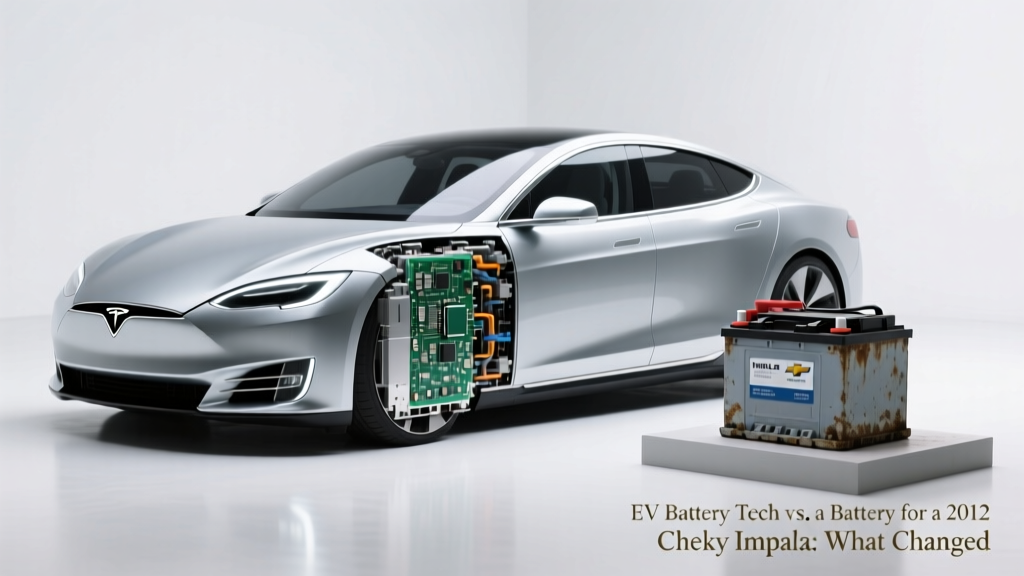
Why Someone Searching for a Battery for a 2012 Chevy Impala Lands on EV Tech
If you've ever replaced the 12V lead-acid battery in a 2012 Chevrolet Impala — a Group 48 or Group 78 AGM unit costing roughly $150–$250 installed — you already understand one side of automotive energy storage. But the high-voltage traction batteries powering today's EVs operate in an entirely different universe of chemistry, thermal management, and longevity. This guide bridges that gap: what EV batteries actually are, how long they last, what they cost, and why the conversation is fundamentally different from swapping a dying 12V cell in a decade-old sedan.
| Attribute | 12V Battery (e.g., 2012 Impala) | Modern EV Traction Battery (2025–2026) |
|---|---|---|
| Chemistry | Lead-acid / AGM | LFP or NMC/NCA lithium-ion |
| Voltage | 12V nominal | 400V–800V nominal |
| Energy capacity | ~0.7–1.0 kWh | 50–130 kWh usable |
| Weight | 35–50 lbs | 700–1,500 lbs |
| Typical lifespan | 3–5 years | 15–20+ years / 200,000+ miles |
| Replacement cost | $150–$250 | $5,000–$20,000+ |
| Warranty | 2–4 years | 8 years / 100,000 mi minimum (federal mandate) |
Battery Chemistry Explained: LFP vs. NMC/NCA
Modern EV traction batteries use lithium-ion cells, but not all lithium-ion is the same. The two dominant chemistries in 2026 are LFP (lithium iron phosphate) and NMC/NCA (nickel manganese cobalt / nickel cobalt aluminum). Each has distinct trade-offs that affect range, longevity, cost, and cold-weather behavior.
| Factor | LFP (Lithium Iron Phosphate) | NMC / NCA (Nickel-based) |
|---|---|---|
| Energy density | Lower (~160–180 Wh/kg cell-level) | Higher (~220–300 Wh/kg cell-level) |
| Cycle life | 3,000–5,000+ cycles to 80% SoH | 1,000–2,000 cycles to 80% SoH |
| Cold performance | Reduced; slower charging below 32°F | Better low-temp charge acceptance |
| Cost (per kWh) | ~$70–$90 (2025–2026 pack-level trend) | ~$100–$130 |
| Cobalt content | None (cobalt-free) | Contains cobalt (supply-chain/ethical concerns) |
| Thermal stability | Excellent; higher runaway threshold | Good but requires robust BMS/cooling |
| Typical use cases | Tesla Model 3/Y RWD, Ford Mustang Mach-E Select, BYD models | Long-range/AWD variants, Hyundai Ioniq 5/6, Rivian, GM Ultium |
| Charging to 100% | Recommended periodically for BMS calibration | Best kept at 80% daily; 100% for trips only |
Which is better? Neither is universally superior. LFP wins on cycle life, cost, and safety — ideal for standard-range daily drivers. NMC/NCA wins on energy density and cold-weather charging — ideal for long-range and performance models. Tesla's dual-chemistry strategy (LFP for RWD Standard Range, NMC for Long Range/Performance) exemplifies this segmentation. According to IEA Global EV Outlook data, LFP market share in global EV battery production surpassed 40% by 2025, up from under 15% in 2020.
How Long Do EV Batteries Actually Last?
The short answer: most EV traction batteries will outlast the vehicle they're installed in. But "last" needs definition. A battery doesn't die suddenly — it degrades gradually, losing capacity over time and charge cycles.
| Vehicle / Study | Timeframe | Mileage | Capacity Retained (SoH) | Source |
|---|---|---|---|---|
| Tesla Model 3/Y (fleet average) | Year 5 | ~100,000 mi | ~88–92% | Tesla Impact Report 2024 |
| Nissan Leaf (24/30 kWh, passive cooling) | Year 5 | ~60,000 mi | ~78–85% | Recurrent Auto fleet data |
| Chevrolet Bolt EV (60 kWh, NMC) | Year 4 | ~50,000 mi | ~93–96% | Recurrent Auto 2024 report |
| Hyundai Ioniq 5 (77.4 kWh, NMC) | Year 3 | ~40,000 mi | ~95–97% | Owner surveys, InsideEVs |
| Aggregate fleet average (all brands) | Year 8 | ~120,000 mi | ~82–88% | Recurrent Auto |
Key takeaways from degradation data:
- Year 1–2: Most batteries lose 2–5% capacity relatively quickly as the solid-electrolyte interphase (SEI) layer forms.
- Year 3–10: Degradation slows significantly, typically 0.5–1.5% per year for liquid-cooled packs.
- After 150,000+ miles: Many packs still retain 80%+ of original capacity, which is the threshold most manufacturers use for warranty coverage.
For context, a 2012 Chevy Impala's 12V battery was likely replaced 2–4 times during the car's life. An EV traction battery is designed as a lifetime component — not a consumable.
Battery Warranty Terms: What's Actually Covered
U.S. federal law mandates a minimum EV battery warranty of 8 years / 100,000 miles (whichever comes first) for emissions-related components, which the EPA classifies EV batteries under. Many manufacturers exceed this minimum.
| Manufacturer | Warranty Period | Mileage Limit | Capacity Threshold | Notes |
|---|---|---|---|---|
| Tesla (Model 3/Y RWD, LFP) | 8 years | 100,000 mi | 70% retention | Long Range/Performance: 8yr/120,000mi |
| Hyundai / Kia | 10 years | 100,000 mi | 70% retention | Among the longest in the industry |
| GM (Ultium platform) | 8 years | 100,000 mi | 70% retention | Covers battery and electric drive components |
| Ford (Mach-E, F-150 Lightning) | 8 years | 100,000 mi | 70% retention | Battery component coverage only |
| Rivian | 8 years | 175,000 mi | 70% retention | Higher mileage limit for adventure-use vehicles |
| Volkswagen (ID.4) | 8 years | 100,000 mi | 70% retention | Standard across ID. family |
What does the warranty cover? If your battery's State of Health (SoH) drops below the stated threshold (typically 70% of original capacity) within the warranty period, the manufacturer must repair or replace the battery at no cost. This covers cell-level degradation and manufacturing defects. It does not cover damage from collisions, flooding, improper modifications, or neglect (such as leaving the vehicle at 0% SoC for extended periods in extreme heat).
EV Battery Replacement Cost: Numbers and Context
This is where the comparison to a battery for a 2012 Chevy Impala becomes stark. Replacing an EV traction battery is a major service event — but it's also one that most owners will never need.
| Vehicle | Battery Size (kWh) | Chemistry | Estimated Replacement Cost | When Typically Needed |
|---|---|---|---|---|
| Tesla Model 3 RWD | ~60 kWh | LFP | $8,000–$12,000 | Rare before 200,000 mi |
| Tesla Model Y Long Range | ~75 kWh | NMC | $12,000–$16,000 | Rare before 200,000 mi |
| Chevrolet Bolt EV | 65 kWh | NMC | $10,000–$14,000 | GM recall replaced many proactively |
| Ford Mustang Mach-E ER | 91 kWh | NMC | $15,000–$20,000 | Rare before 150,000 mi |
| Hyundai Ioniq 5 | 77.4 kWh | NMC | $11,000–$15,000 | Rare before 150,000 mi |
| Rivian R1T (Large Pack) | ~135 kWh | NMC | $18,000–$25,000 | Rare before 175,000 mi |
| Nissan Leaf (early, 24 kWh) | 24 kWh | LMO/NMC | $5,000–$8,000 | Some needed at 80,000–120,000 mi (passive cooling) |
Context that prevents fear-mongering:
- Per Recurrent Auto's 2024 fleet study, fewer than 2% of EVs in their dataset required battery replacement outside of recalls.
- Battery pack prices have fallen from ~$400/kWh in 2012 to ~$90–$130/kWh in 2025–2026 (BloombergNEF data), and continue declining.
- Many early degradation issues (Nissan Leaf passive cooling, early Bolt fire recall) were engineering lessons that informed today's liquid-cooled, actively managed packs.
- If your EV is under warranty and SoH drops below 70%, replacement is free.
Factors That Affect EV Battery Life (and How to Maximize It)
While modern battery management systems (BMS) do most of the heavy lifting, owner habits still influence long-term health.
Battery Care Best Practices
- Daily charging limit: Set to 80% for NMC/NCA batteries. LFP batteries benefit from periodic 100% charges (weekly) for BMS cell-balancing calibration.
- Avoid prolonged 0% or 100% SoC: Storing a battery at extremes accelerates chemical degradation. If leaving the car for a week+, aim for ~50% SoC.
- DC fast charging: Occasional use is fine. Daily DCFC (especially at 150+ kW) on a hot battery accelerates wear slightly. Preconditioning before charging helps — most modern EVs do this automatically when you navigate to a charger.
- Extreme heat: The biggest enemy of lithium-ion longevity. Liquid-cooled packs (standard on virtually all 2020+ EVs) mitigate this well, but parking in shade and avoiding repeated 100% charges in 100°F+ weather helps.
- Extreme cold: Cold reduces range temporarily (20–30% loss at 20°F) but doesn't cause permanent damage. Always precondition before driving and charging in winter.
- Regenerative braking: Using moderate regen settings is fine. Max regen doesn't harm the battery — the BMS limits charge current when the pack is cold or near-full.
How to Check Your EV Battery's State of Health (SoH)
State of Health (SoH) is expressed as a percentage of the battery's original usable capacity. A new battery is 100% SoH; a battery that held 75 kWh usable when new and now holds 67.5 kWh is at 90% SoH.
Methods to check SoH:
- In-vehicle display: Some EVs (Tesla via Service Mode, Hyundai/Kia via diagnostic menus) show SoH directly. Tesla owners can access "Battery Health" in the service menu (tap Software → swipe right on model name).
- OBD-II diagnostic tools: Apps like LeafSpy (Nissan Leaf), ABRP OBD, or ScanMyTesla read real-time BMS data including SoH, cell voltages, and temperature.
- Dealer service visit: Any authorized service center can pull a battery health report. Request this during routine service or pre-purchase inspections on used EVs.
- Telematics / fleet apps: Services like Recurrent Auto or Geotab provide ongoing SoH tracking by comparing energy-in vs. energy-out over charge cycles.
When to be concerned: If SoH drops more than ~3% per year after the initial 2-year break-in period, or if individual cell voltage delta exceeds 200mV, consult a service center. Under warranty, a drop below 70% triggers free replacement.
Emerging Battery Tech: Solid-State, Silicon Anode, and What's Real
The battery landscape is evolving, but it's critical to separate shipping products from lab promises.
Silicon anode batteries (near-term, 2025–2027): Companies like Sila Nanotechnologies and Group14 are shipping silicon-dominant anode materials that increase energy density by 20–40% over graphite anodes. The Mercedes-AMG G-Class (2025) uses a silicon-anode battery from Sila. Expect broader adoption in performance and long-range models by 2027.
Sodium-ion batteries (2025–2028): CATL and BYD have begun shipping sodium-ion packs in Chinese-market budget EVs. Sodium-ion offers lower cost, no lithium or cobalt, and better cold performance — but ~30% lower energy density. Likely destined for urban commuter vehicles and stationary storage, not long-range highway EVs.
Solid-state batteries (2028–2032+, forward-looking): Toyota, Samsung SDI, and QuantumScape continue to announce breakthroughs. Toyota targets limited production in 2027–2028 with a claimed 750 km (466 mi) range and 10-minute fast charging. However, manufacturing scale, cost, and yield remain unsolved challenges. Solid-state should not be a reason to delay an EV purchase today — commercial availability at scale is likely 2030+ for most buyers.
LFP improvements (ongoing): CATL's "Shenxing" LFP cells claim 400+ km range with 10-minute 10–80% DCFC capability, narrowing the gap with NMC on charging speed while retaining LFP's cost and longevity advantages.
Frequently Asked Questions
Can I put an EV traction battery in a 2012 Chevy Impala?
No. The 2012 Impala uses a conventional 12V lead-acid or AGM battery (Group 48/78) to start the engine and run accessories. EV traction batteries are 400–800V lithium-ion packs weighing 700–1,500 lbs, integrated into a dedicated EV platform with inverters, motors, and thermal management. They are not interchangeable.
How long do EV batteries last in years and miles?
Based on fleet data from Recurrent Auto and manufacturer reports, most modern liquid-cooled EV batteries retain 80%+ capacity after 8–10 years and 100,000–150,000 miles. Many are projected to last 15–20 years or 200,000+ miles before dropping below the 70% warranty threshold. Early-generation passively-cooled batteries (pre-2018 Nissan Leaf) degraded faster.
How much does an EV battery cost to replace out of warranty?
Replacement costs range from approximately $5,000 for a small early-gen pack (24 kWh Nissan Leaf) to $25,000 for a large pack (135 kWh Rivian). Mainstream 60–80 kWh packs (Tesla Model 3, Hyundai Ioniq 5) typically cost $10,000–$16,000 including labor. However, fewer than 2% of EVs have required out-of-warranty battery replacement as of 2024–2025 fleet data.
What does the EV battery warranty actually cover?
Federal law mandates a minimum 8-year/100,000-mile warranty covering capacity loss below 70% of original. Some manufacturers (Hyundai, Kia) extend to 10 years/100,000 miles. Coverage includes cell degradation and manufacturing defects but excludes collision damage, flooding, unauthorized modifications, and abuse (e.g., prolonged storage at 0% SoC in extreme heat).
LFP vs NMC — which chemistry should I choose?
Choose LFP if you prioritize longevity (3,000–5,000+ cycle life), lower cost, cobalt-free sourcing, and don't need maximum range. Choose NMC/NCA if you need long range (higher energy density), better cold-weather fast charging, or are buying a performance/AWD variant. For most daily commuters with home charging, LFP is the pragmatic choice.
Does fast charging damage my EV battery?
Occasional DC fast charging (1–3 times per week) causes negligible additional degradation on modern liquid-cooled packs. Daily DCFC at peak rates (150–350 kW) on a hot pack may accelerate degradation by ~1–2% over several years versus Level 2 charging only. The BMS manages charge rates and thermal limits automatically. Preconditioning the battery before fast charging (automatic when navigating to a charger on most EVs) significantly mitigates any impact.
How do I check my EV battery health before buying used?
Request a battery health report from the seller's dealer, or use an OBD-II tool (LeafSpy, ScanMyTesla, ABRP) to read SoH directly from the BMS. Compare the displayed range at 100% SoC to the original EPA rating — a 10% range reduction roughly corresponds to 10% capacity loss. Factor remaining warranty coverage into your purchase decision.