If you've ever replaced the 12V lead-acid battery in an 08 Jeep Liberty, you know the drill: pop the hood, disconnect the terminals, drop $130-$180 at an auto parts store, and you're back on the road. That familiar maintenance ritual raises a fair question for anyone considering an electric vehicle: what happens when an EV battery wears out?
The short answer is that modern high-voltage traction batteries are engineered to outlast the vehicles they power — but the details on chemistry, degradation curves, warranty coverage, and replacement costs matter enormously when you're making a five-figure purchase decision. This guide breaks down exactly what's inside today's EV battery packs, how long they last with real data, and what you can do to maximize their lifespan.
First: The 08 Jeep Liberty Battery vs. an EV Traction Battery
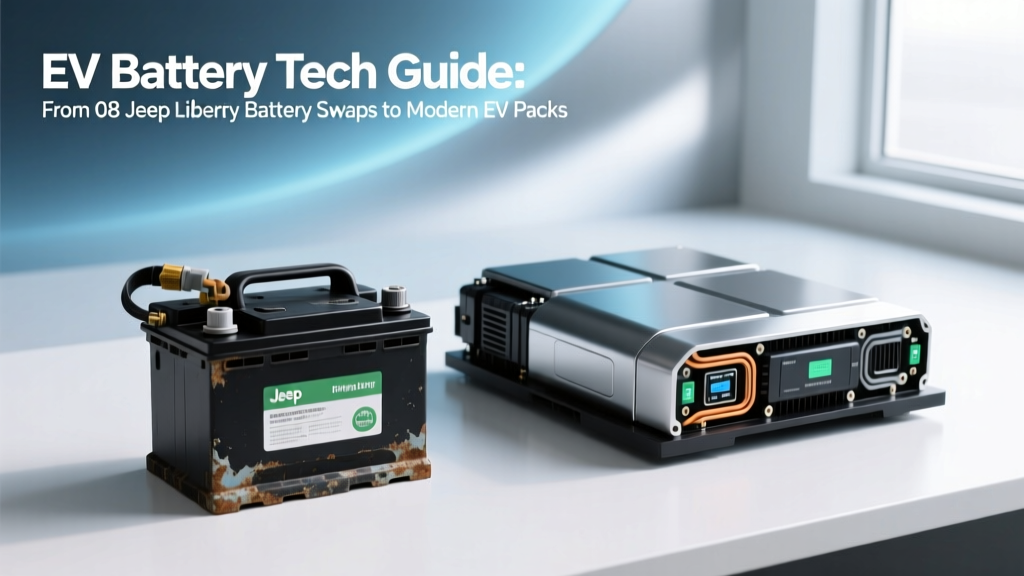
Let's clear up the most common source of confusion. The battery in an 08 Jeep Liberty (a Group 34 or Group 75 lead-acid unit, roughly 0.6 kWh of capacity) serves one job: cranking the engine and running accessories when the alternator isn't spinning. It's a 12V auxiliary battery — the same type found in every EV on the road today, including Teslas, Rivians, and Hyundais.
An EV's high-voltage traction battery is an entirely different animal. It stores between 40 kWh and 130+ kWh of energy at 400V to 800V, weighs 600 to 1,500 pounds, and costs between $6,000 and $22,000 to replace. This is the battery that propels the vehicle and defines its range. When we talk about "EV battery life" in this guide, we mean the traction battery — not the small 12V unit that powers the electronics.
LFP vs. NMC vs. NCA: Choosing Your Battery Chemistry
Not all EV batteries use the same chemistry. The two dominant types in 2026 are LFP (lithium iron phosphate) and NMC/NCA (nickel manganese cobalt / nickel cobalt aluminum). The chemistry choice affects range, longevity, cold-weather performance, and price — and automakers are increasingly splitting their lineups between the two.
| Attribute | LFP (Lithium Iron Phosphate) | NMC / NCA (Nickel-Based) |
|---|---|---|
| Energy density | Lower (~160-180 Wh/kg cell-level) | Higher (~230-280 Wh/kg cell-level) |
| Typical range impact | Shorter range for same pack weight | Longer range for same pack weight |
| Cycle life | 3,000-5,000+ cycles to 80% SoH | 1,500-2,500 cycles to 80% SoH |
| Cold-weather performance | More range loss below 32°F; slower charging in cold | Better cold-weather discharge; faster cold charging |
| Charging habit | Can be charged to 100% daily without harm | Best kept at 80% daily; 100% only for trips |
| Cost | ~15-25% cheaper per kWh | Higher raw material cost (cobalt, nickel) |
| Thermal stability | Excellent; lower runaway risk | Good with active thermal management |
| Common in (2026) | Tesla Model 3/Y RWD, Ford Mustang Mach-E Select, BYD models | Tesla Long Range, Hyundai Ioniq 5/6, Rivian, GM Ultium vehicles |
The practical trade-off: If you prioritize maximum range and live in a cold climate, NMC/NCA delivers more miles per kilogram and charges faster in winter. If you want a battery that tolerates daily 100% charging, costs less upfront, and offers a longer cycle life (ideal for high-mileage drivers or fleet use), LFP is the stronger pick. Tesla's standard-range models switched to LFP in late 2021, and by 2026, Ford, Hyundai, and several others offer LFP variants in their lineups.
How Long Do EV Batteries Actually Last?
The fear that EV batteries need frequent replacement is one of the most persistent myths in the industry — largely because people mentally map the 08 Jeep Liberty battery experience (replace every 3-5 years) onto traction batteries. The data tells a very different story.
According to a large-scale analysis by Geotab tracking over 10,000 EVs in real-world fleet use, the average EV battery loses approximately 2.3% of its capacity per year under normal driving conditions. That translates to roughly 87-90% State of Health (SoH) after 5 years, and about 75-80% SoH after 10 years.
Real-world degradation data points by model:
- Tesla Model 3/Y (NMC): Tesla's 2025 Impact Report states the fleet retains ~88% capacity at 150,000 miles — consistent with independent data from Recurrent Auto.
- Tesla Model 3/Y (LFP): Early fleet data shows slightly better retention, with many units above 92% SoH at 80,000 miles, though cold-climate LFP packs show wider variance.
- Hyundai Ioniq 5 (NMC, 77.4 kWh): Owner-reported data on Ioniq forums and Recurrent shows ~90-93% SoH at 50,000 miles.
- Chevrolet Bolt EV/EUV (NMC, 65 kWh): Post-recall replacement batteries show excellent retention; original packs averaged ~88% at 80,000 miles before the recall program.
- Nissan Leaf (passive air cooling): An outlier — earlier Leafs with passive cooling showed accelerated degradation in hot climates, losing 15-25% over 5 years. Modern Leafs with improved thermal management perform significantly better.
The critical takeaway: most EV batteries will retain 70-80% of original capacity at 150,000-200,000 miles, which means a vehicle with an original EPA range of 300 miles will still deliver 210-240 miles of range. For the vast majority of owners, the battery will outlast their ownership of the vehicle.
What Does the EV Battery Warranty Cover?
Federal law mandates a minimum battery warranty of 8 years / 100,000 miles for EVs sold in the United States, with several states (those following California's CARB standards) requiring 10 years / 150,000 miles. Here's how major manufacturers structure coverage in 2026:
| Manufacturer | Warranty Period | Mileage Limit | Capacity Threshold | Notes |
|---|---|---|---|---|
| Tesla (Model 3/Y) | 8 years | 100,000-120,000 mi | 70% retention | Varies by trim; LFP and NMC covered equally |
| Hyundai / Kia | 10 years | 100,000 mi | 70% retention | Among the most generous in the industry |
| GM (Ultium platform) | 8 years | 100,000 mi | 70% retention | Covers battery and drive unit |
| Ford (Mach-E, F-150 Lightning) | 8 years | 100,000 mi | 70% retention | Transferable to second owner |
| Rivian | 8 years | 175,000 mi | 70% retention | Higher mileage cap reflects adventure-use positioning |
| Volkswagen (ID.4) | 8 years | 100,000 mi | 70% retention | Standard CARB and federal compliance |
The 70% capacity retention threshold means the manufacturer will repair or replace the battery if it degrades below 70% of its original capacity within the warranty period. In practice, warranty claims for battery replacement remain rare — most degradation follows a curve that flattens after the initial 10-15% loss in the first 2-3 years, then slows considerably.
What's typically covered: Cell failure, module imbalance beyond BMS correction, excessive degradation below the stated threshold, and manufacturing defects. What's excluded: Damage from accidents, flooding, improper modifications, or use outside manufacturer guidelines (such as sustained storage at 0% SoC for extended periods).
EV Battery Replacement Costs: What the Numbers Say
If your battery does fall outside warranty coverage and needs replacement, here's what you're looking at in 2026. Costs have declined steadily — the average pack price fell below $130/kWh at the cell level in 2025, but installed costs (including labor, modules, BMS recalibration, and coolant) remain higher.
| Vehicle | Battery Capacity | Estimated Replacement Cost | Typical Replacement Timeline |
|---|---|---|---|
| Tesla Model 3 RWD (LFP) | ~60 kWh | $8,000 - $12,000 | Rarely needed before 200k+ mi |
| Tesla Model Y Long Range (NMC) | ~82 kWh | $12,000 - $16,000 | Rarely needed before 200k+ mi |
| Hyundai Ioniq 5 (NMC) | 77.4 kWh | $10,000 - $15,000 | Rarely needed before 180k+ mi |
| Ford F-150 Lightning Ext. Range | 131 kWh | $18,000 - $25,000 | Rarely needed before 150k+ mi |
| Chevrolet Equinox EV | ~85 kWh | $10,000 - $14,000 | Rarely needed before 180k+ mi |
| Rivian R1T (Max Pack) | 149 kWh | $20,000 - $28,000 | Rarely needed before 175k+ mi |
For context, the average age of a vehicle scrapped in the US is about 15 years, and the average lifetime mileage is around 165,000 miles. Most EV batteries will retain enough capacity to remain functional well past that point. The replacement cost is a real number worth budgeting for on a 12-15 year ownership horizon — but it is not the frequent, imminent expense that anti-EV narratives suggest.
Factors That Accelerate (or Preserve) Battery Life
Battery degradation is not purely a function of time. How you charge, drive, and store your EV has a measurable impact on how much capacity you retain over the years. Here are the factors that matter most, ranked by impact:
- Avoid sustained 100% SoC: For NMC/NCA batteries, set your daily charge limit to 80%. Charge to 100% only when you need the full range for a trip. LFP batteries are an exception — manufacturers like Tesla recommend periodic 100% charges to allow the BMS to recalibrate.
- Minimize DC fast charging when possible: Occasional fast charging (road trips) is fine, but daily use of 150+ kW DC chargers generates sustained heat that accelerates degradation. Level 2 home charging (7-11 kW) is gentler on cells.
- Don't store at 0% or 100%: If leaving your EV for more than a week, aim for 50-60% SoC. Extended storage at extreme states of charge stresses cell chemistry.
- Use preconditioning: In cold weather, precondition the battery (via your EV's app or scheduled departure) before fast charging. A cold battery charges slower and experiences more stress; preconditioning warms the pack to optimal temperature.
- Let the thermal management system work: Modern EVs actively cool and heat the battery pack. Avoid blocking underbody airflow or modifying cooling systems. In extreme heat, parking in shade or a garage reduces passive thermal load.
- Drive moderately when the battery is very cold or very hot: Hard acceleration draws high C-rates from the pack, which is more stressful when cells are outside their ideal 60-95°F temperature range.
Data from Recurrent Auto's fleet analysis shows that EVs primarily charged on Level 2 at home and kept between 20-80% SoC show roughly half the degradation rate of vehicles that rely heavily on DC fast charging and regularly charge to 100%.
How to Check Your EV Battery's State of Health
State of Health (SoH) is the percentage of original capacity your battery currently retains. A new battery is at 100% SoH; one that has degraded to hold only 85 kWh of its original 100 kWh is at 85% SoH. Here's how to monitor it:
In-vehicle displays: Many modern EVs (Tesla, Hyundai/Kia, GM Ultium vehicles) provide a battery health indicator in the settings menu or service screen, though some manufacturers keep this data accessible only through diagnostic tools.
Third-party apps and services: Platforms like Recurrent Auto (free for owners) connect to your vehicle's telematics and provide ongoing SoH reports, range tracking, and degradation trendlines. TesFi and Stats (Tesla-specific apps) pull detailed battery data including cell-level voltage imbalance.
Dealer diagnostic check: Requesting a battery health report during a service visit will give you a manufacturer-certified SoH reading. This is the most reliable method for warranty claim purposes.
OBD-II scanners with EV support: Tools like the OBDLink SX paired with apps such as Leaf Spy (Nissan Leaf) or ABRP's battery health tools can pull SoH data from the battery management system on many models.
If you're buying a used EV, a pre-purchase battery health check is as essential as a compression test was for your 08 Jeep Liberty. Ask the seller for a recent SoH report or arrange one through a dealer or Recurrent.
What's Coming Next: Solid-State and Silicon Anode Batteries
The next frontier in EV battery technology includes solid-state batteries (replacing liquid electrolyte with a solid conductor) and silicon anode cells (boosting energy density by using silicon instead of graphite at the anode). Here's where these technologies actually stand as of 2026:
Solid-state batteries: Toyota has announced limited production of solid-state EVs for 2027-2028, targeting 450+ mile range and 10-minute fast charging. Samsung SDI and QuantumScape are supplying prototype cells to select automakers. However, manufacturing scale-up remains the primary bottleneck — solid-state cells are currently produced in small batches at costs 3-5x higher than conventional lithium-ion. Realistic mass-market availability is 2029-2031 at the earliest.
Silicon anode batteries: Companies like Sila Nanotechnologies and Group14 are already supplying silicon-dominant anode materials to manufacturers. The Mercedes G-Class 580e (2025) was among the first production vehicles to use silicon anode cells from Group14. Expect broader adoption in premium EVs by 2027, with cost reduction enabling mainstream use by 2028-2029. Silicon anodes offer a 20-40% energy density improvement over graphite, translating directly to more range without increasing pack weight.
Sodium-ion batteries: CATL and BYD are producing sodium-ion cells for lower-cost, shorter-range EVs (primarily in China). These offer lower energy density than LFP but use no lithium, cobalt, or nickel — potentially reducing costs by 30-40%. US-market availability in affordable EV trims is possible by 2028.
None of these technologies are available in production EVs sold in the US today. If you're buying in 2026, current LFP and NMC chemistries are mature, well-understood, and backed by extensive real-world data.
Frequently Asked Questions
How long do EV batteries last in years and miles?
Based on fleet data from Geotab and Recurrent Auto, the average EV battery retains 75-80% of its original capacity after 10 years or 150,000 miles. Most batteries remain functional (above 70% SoH) for 15+ years and 200,000+ miles. Complete failure is rare; gradual capacity loss is the norm.
How much does an EV battery cost to replace?
Out-of-warranty replacement costs range from approximately $8,000 for smaller packs (Tesla Model 3 RWD, ~60 kWh) to $25,000+ for large packs (Ford F-150 Lightning Extended Range, 131 kWh). Most owners will never need a replacement, as batteries typically outlast the vehicle. Under warranty, replacement is free if capacity drops below the stated threshold (typically 70%).
What does the EV battery warranty cover?
Federal law requires a minimum 8-year/100,000-mile warranty on EV batteries. The warranty covers replacement or repair if capacity falls below a stated threshold (usually 70% of original capacity) or if a manufacturing defect causes failure. It does not cover damage from accidents, flooding, or improper use. CARB states may require 10-year/150,000-mile coverage.
How do I check my EV's battery health?
You can check State of Health through your vehicle's built-in diagnostics menu, third-party apps like Recurrent Auto or TesFi, an OBD-II scanner with EV support, or a dealer diagnostic report. For used EV purchases, always request a current SoH reading before committing.
LFP vs. NMC — which battery chemistry is better?
Neither is universally better. LFP offers longer cycle life, lower cost, better thermal safety, and the convenience of daily 100% charging — but sacrifices energy density and cold-weather performance. NMC/NCA delivers more range per kilogram and better cold-weather behavior, but requires 80% daily charge limits and has a shorter cycle life. Choose LFP for city commuting and high-mileage use; choose NMC for maximum range and cold-climate driving.
Is it true that fast charging damages the battery?
Occasional DC fast charging (road trips, a few times per month) has minimal impact on battery health. However, daily use of high-power DC fast chargers (150+ kW) does accelerate degradation due to sustained heat generation. Fleet data shows vehicles that primarily use Level 2 home charging degrade roughly half as fast as those relying on daily fast charging. Use fast charging when you need it, but make Level 2 your routine.
Does the 08 Jeep Liberty have anything in common with modern EV batteries?
Only the 12V auxiliary battery — which every EV still carries to power lights, infotainment, and control systems. The high-voltage traction battery in an EV is fundamentally different in chemistry, scale, cost, and lifespan. The good news: while your Liberty's lead-acid battery needed replacing every 3-5 years, an EV traction battery is designed to last 15+ years with proper care.