Why Searching for a "Battery for 2015 Dodge Dart" Leads to an EV Battery Education
If you've landed here after searching for a battery for 2015 Dodge Dart, you're likely shopping for a Group 47 (H5) or Group 48 (H6) 12-volt lead-acid or AGM starter battery — the kind that cranks a 2.0L or 2.4L Tigershark four-cylinder engine. That's a $150–$250 retail part with a 2–4 year warranty, and it has nothing to do with the high-voltage lithium-ion traction batteries powering modern electric vehicles.
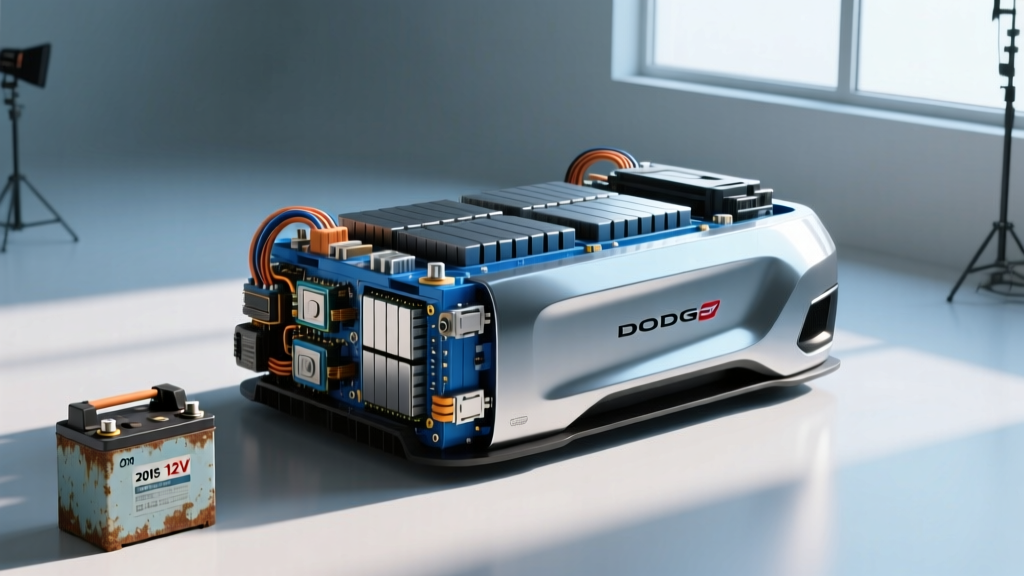
But that contrast is instructive. A conventional 12V starter battery stores roughly 0.6–0.8 kWh of energy, weighs ~35–45 lbs, and is considered disposable. A modern EV traction battery stores 60–100+ kWh (roughly 100× more energy), weighs 800–1,200 lbs, costs $8,000–$22,000 to replace, and is engineered to outlast the vehicle itself. Understanding how EV batteries work — their chemistry, degradation curves, warranties, and care requirements — is essential for anyone evaluating an electric vehicle purchase in 2026.
This guide covers everything an EV buyer or owner needs to know about traction battery technology, with real data points and no hype.
The 12V vs. Traction Battery Distinction (And Why It Matters)
Before diving into EV battery chemistry, let's clear up a confusion that trips up many new EV owners:
- 12V auxiliary battery — A small lead-acid or lithium 12V battery that powers lights, infotainment, door locks, and the computers that manage the high-voltage system. If it dies, the car won't "start" even though the main pack is full. Replacement cost: $150–$400. Lifespan: 3–5 years.
- High-voltage traction battery — The large lithium-ion pack (400V–800V architecture) that actually drives the electric motor(s). This is the battery that determines range, charging speed, and vehicle longevity. Replacement cost: $8,000–$22,000+. Designed lifespan: 150,000–300,000+ miles.
When we talk about "EV batteries" in this guide, we mean the traction battery. The 12V battery in your 2015 Dodge Dart and the 12V battery in a 2026 Tesla Model Y serve the same ancillary role — they just happen to sit in very different vehicles.
Battery Chemistry: LFP vs. NMC vs. NCA Trade-Offs
Not all lithium-ion batteries are the same. The cathode chemistry determines energy density, cycle life, thermal stability, cold-weather performance, and cost. In 2026, three chemistries dominate the EV market:
| Attribute | LFP (Lithium Iron Phosphate) | NMC (Nickel Manganese Cobalt) | NCA (Nickel Cobalt Aluminum) |
|---|---|---|---|
| Energy Density (cell-level) | ~160–180 Wh/kg | ~220–280 Wh/kg | ~250–300 Wh/kg |
| Typical Cycle Life | 3,000–6,000+ cycles | 1,000–2,500 cycles | 1,000–2,000 cycles |
| Thermal Stability | Excellent (resists thermal runaway) | Good (requires active management) | Moderate (requires robust BMS) |
| Cold-Weather Performance | Weaker below 32°F (~15–25% more range loss) | Better in cold (~10–20% range loss) | Better in cold (~10–20% range loss) |
| Cost per kWh (pack-level, 2026) | ~$80–$100/kWh | ~$110–$140/kWh | ~$115–$145/kWh |
| Recommended Daily SoC | 100% (can charge to full daily) | 80–90% daily; 100% for trips | 80–90% daily; 100% for trips |
| Cobalt Content | None | Yes (supply-chain concern) | Yes (minimal) |
| Example 2026 Vehicles | Tesla Model 3 RWD, BYD Seal, Ford Mustang Mach-E Select (LFP option) | Hyundai Ioniq 5, Kia EV6, VW ID.4, Chevrolet Equinox EV | Tesla Model S/X, Rivian R1T (some packs) |
Which Is Better?
There's no universal winner — it depends on your use case:
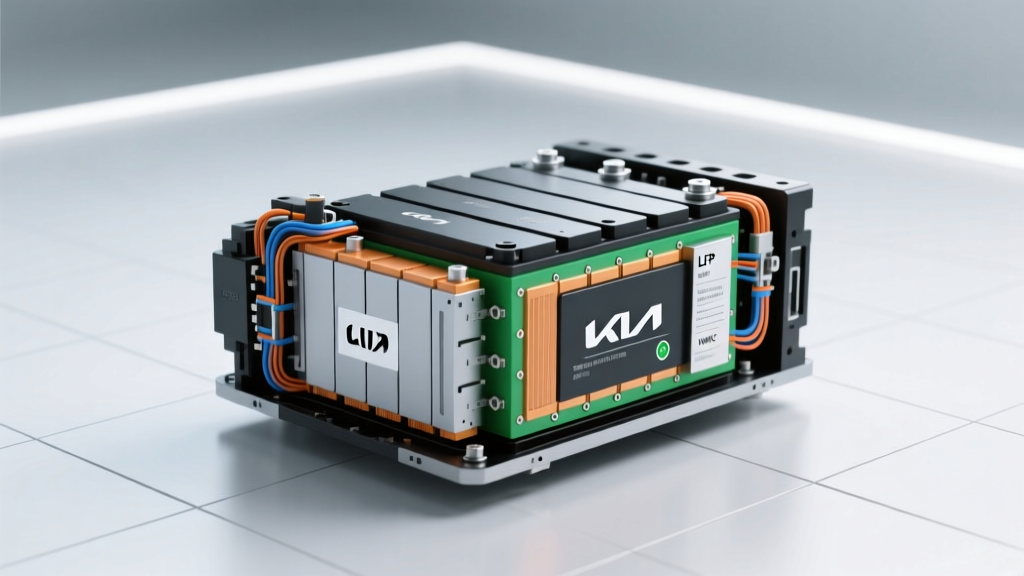
- Choose LFP if: You want maximum cycle life, can charge at home daily to 100%, don't need the longest possible single-charge range, and live in a moderate climate. LFP's ability to charge to full without accelerated degradation makes it ideal for daily commuters.
- Choose NMC/NCA if: You need maximum range per charge (road trips), live in a cold climate, or need the highest energy density in a smaller/lighter pack. Just follow the 80% daily SoC guideline.
How Long Do EV Batteries Last? Real Degradation Data
This is the question that generates the most anxiety — and the most misinformation. Let's look at actual data.
Real-World Degradation Data Points (Aggregated from fleet studies and owner reports through 2025–2026):
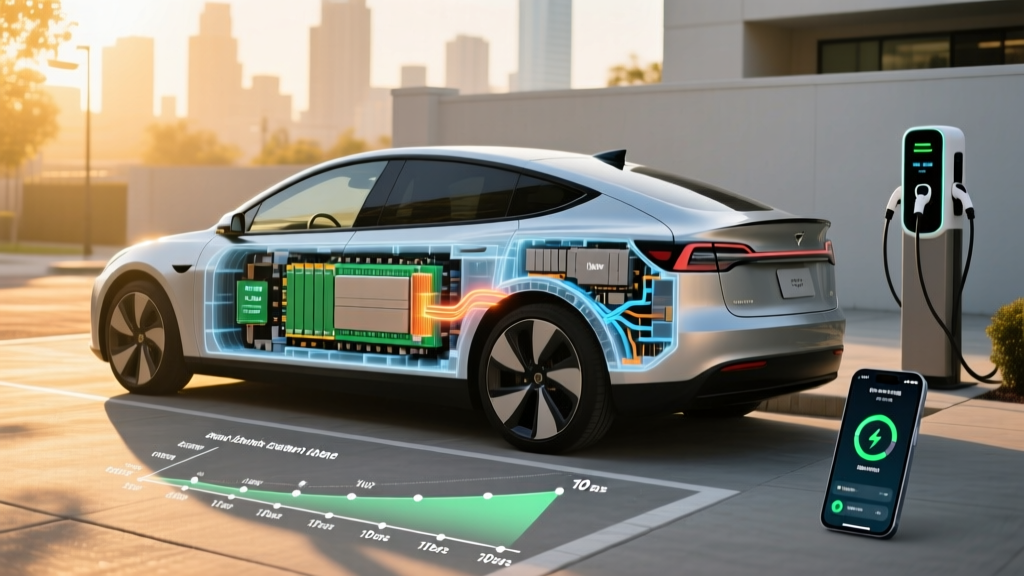
- Tesla Model 3/Y (NMC/NCA, 2018–2024 models): Average ~5% capacity loss at 50,000 miles, ~8–10% at 100,000 miles, ~10–13% at 150,000 miles. (Source: Tesla Impact Report)
- Nissan Leaf (2011–2017, passive air-cooled NMC): Notoriously higher degradation — 15–25% loss by 80,000–100,000 miles, especially in hot climates. A cautionary tale about thermal management.
- Chevrolet Bolt EV (2017–2022, NMC, liquid-cooled): ~8–12% loss at 100,000 miles under normal use. Recall-related battery replacements reset the clock for affected owners.
- LFP packs (Tesla Model 3 RWD 2021+, BYD vehicles): Early data shows ~3–5% loss at 100,000 miles — significantly slower degradation, consistent with LFP's higher cycle life.
- Hyundai/Kia E-GMP platform (Ioniq 5, EV6, NMC): Fleet data suggests ~6–9% at 100,000 miles with liquid cooling and good thermal management.
The pattern is clear: modern liquid-cooled EV batteries with proper thermal management lose roughly 1–2% capacity per year under typical use (10,000–15,000 miles/year). By 150,000–200,000 miles, most retain 80–88% of original capacity. At that point, the battery isn't dead — it just offers proportionally less range. A 300-mile EPA vehicle with 85% retention still delivers ~255 miles.
For context, the average US vehicle is driven ~14,000 miles/year (FHWA data) and kept for ~12 years — meaning most EV batteries will retain 75–88% capacity when the vehicle is retired.
EV Battery Warranties: What's Covered and for How Long
Federal regulations mandate a minimum EV battery warranty of 8 years / 100,000 miles (10 years / 150,000 miles in California Air Resources Board states). Most manufacturers exceed this baseline:
| Manufacturer | Warranty Term | Capacity Retention Threshold | Notes |
|---|---|---|---|
| Tesla (Model 3/Y RWD – LFP) | 8 yr / 100,000 mi | 70% | Long-range/AWD: 8 yr / 120,000 mi |
| Hyundai / Kia (E-GMP) | 10 yr / 100,000 mi | 70% | Among the longest terms |
| Chevrolet (Equinox EV, Blazer EV) | 8 yr / 100,000 mi | 70% | Bolt recall replacements carry 8/100k |
| Ford (Mustang Mach-E, F-150 Lightning) | 8 yr / 100,000 mi | 70% | Lightning extended: 8 yr / 100,000 mi |
| Rivian (R1T, R1S) | 8 yr / 175,000 mi | 70% | Highest mileage threshold |
| BMW (i4, iX) | 8 yr / 100,000 mi | 70% | Standard for luxury segment |
What triggers a warranty claim? If your battery's State of Health (SoH) drops below the threshold (typically 70%) within the warranty period, the manufacturer will repair or replace modules/pack to bring it above that threshold. This is not a full new-battery replacement in most cases — manufacturers typically swap degraded modules.
What voids coverage? Using the battery for stationary storage, extreme abuse (repeated 0% storage), unauthorized modifications, or failure to follow maintenance schedules. Normal fast-charging and daily use do not void the warranty.
EV Battery Replacement Cost: When and How Much
Most EV batteries will never need replacement during typical ownership. But if you're buying a used EV out of warranty, or planning to keep a vehicle 200,000+ miles, here's what replacement looks like in 2026:
| Vehicle / Pack Size | Battery Capacity | Replacement Cost (Parts + Labor) | Notes |
|---|---|---|---|
| Tesla Model 3 (LFP, ~60 kWh) | ~60 kWh | $10,000–$13,000 | Aftermarket/refurbished options emerging |
| Tesla Model Y LR (~75 kWh NMC) | ~75 kWh | $14,000–$18,000 | Structural pack complicates labor |
| Hyundai Ioniq 5 (~77.4 kWh NMC) | ~77.4 kWh | $13,000–$17,000 | Modular design allows partial replacement |
| Ford F-150 Lightning Ext. Range (~131 kWh) | ~131 kWh | $20,000–$28,000 | Largest consumer pack; highest cost |
| Chevrolet Bolt EV (65 kWh NMC) | ~65 kWh | $9,000–$14,000 | Post-recall replacement packs available |
| Nissan Leaf (40–62 kWh) | 40–62 kWh | $7,000–$10,000 | Older design; some third-party options |
When is replacement typically needed? For most modern liquid-cooled EVs, a full pack replacement due to degradation alone is unlikely before 200,000–300,000 miles. Most out-of-warranty replacements are due to physical damage (collision, flood) or rare manufacturing defects — not end-of-life degradation.
Pack-level pricing has dropped from ~$200/kWh in 2020 to roughly $100–$140/kWh in 2026 (BloombergNEF), and third-party refurbishment services are emerging for out-of-warranty vehicles. Module-level repair (replacing only degraded cells/modules) costs $2,000–$6,000 in many cases — far less than a full pack swap.
Factors That Affect EV Battery Life (And What You Can Control)
Battery degradation is driven by chemistry, temperature, and usage patterns. Here's what the data shows:
- State of Charge (SoC) habits: For NMC/NCA batteries, keep daily SoC between 20–80%. Avoid sitting at 100% for extended periods. LFP batteries can be charged to 100% daily without significant penalty.
- DC fast charging: Occasional fast charging is fine. Exclusive reliance on DCFC (150–350 kW) without Level 2 home charging can accelerate degradation by ~1–3% over 100,000 miles. Modern BMS systems manage this well, but home Level 2 is gentler.
- Temperature extremes: Battery degradation accelerates above 95°F and below 10°F sustained. Vehicles with active liquid cooling (nearly all 2022+ EVs) handle this far better than passively cooled packs (early Leafs). Garage parking helps in extreme climates.
- Preconditioning: Use your EV's preconditioning feature before fast charging in cold weather. This warms the battery to optimal temperature, improving charge speed and reducing lithium plating risk.
- Storage: If storing an EV for weeks, leave it at ~50% SoC. Never store at 0% or 100%.
- Avoid deep discharge: Don't regularly run the pack to 0%. The low-voltage buffer protects cells, but repeated deep cycles stress the chemistry.
Monitoring Battery Health: How to Check State of Health (SoH)
State of Health (SoH) is expressed as a percentage — 100% is brand-new capacity, and it declines over time. Here's how to monitor it:
- In-vehicle displays: Many EVs (Tesla, BMW, Mercedes) show estimated range at 100% SoC. Compare this to the original EPA range to estimate SoH. A 310-mile EPA vehicle showing 275 miles at 100% suggests ~89% SoH.
- OBD-II diagnostic tools: Third-party tools like LeafSpy (Nissan Leaf), TeslaFi, or generic OBD-II scanners with EV support can read battery management system (BMS) data for precise SoH, cell voltage variance, and temperature logs.
- Manufacturer apps: Tesla, Hyundai, Ford, and others provide battery health data in their companion apps or service menus.
- Dealer diagnostics: A service center can run a full battery health report, often required for warranty claims. Request this when buying a used EV.
- Third-party services: Companies like Recurrent Auto provide battery health reports using telematics data, increasingly available for pre-purchase inspections.
What SoH number should concern you? A used EV at 85–95% SoH is normal for 30,000–80,000 miles. Below 80% before 100,000 miles may indicate a warranty-eligible issue. Below 70% within the warranty period is a clear claim trigger.
Emerging Battery Technology: What's Next (And When)
Several next-generation battery technologies are in development. Here's a realistic timeline — none of these are available in production vehicles as of early 2026:
- Solid-state batteries: Replace the liquid electrolyte with a solid material, promising higher energy density (~350–500 Wh/kg cell-level), faster charging, and improved safety. Toyota has announced limited production for 2027–2028 models, but at very high cost and low volume. Widespread, affordable solid-state EVs are realistically a 2030+ proposition. Samsung SDI, QuantumScape, and Solid Power are also in advanced testing.
- Silicon-dominant anodes: Replacing graphite anodes with silicon can boost energy density 20–40%. Sila Nanotechnologies and Group14 are supplying early production cells. Expect limited deployment in 2026–2028 premium models (Mercedes G-Class EV has announced Sila cells). Challenges remain with silicon expansion during cycling.
- Sodium-ion batteries: Use abundant sodium instead of lithium, offering lower cost (~$40–60/kWh projected) but lower energy density (~120–160 Wh/kg). CATL and BYD are producing these for Chinese-market budget EVs and stationary storage. US-market adoption is uncertain before 2028–2029.
- LFP improvements: LMFP (lithium manganese iron phosphate) adds manganese to boost energy density ~15–20% over standard LFP while retaining cost and safety advantages. CATL's second-generation LMFP cells are entering production in 2026–2027.
Bottom line on future tech: If you're buying an EV in 2026, don't wait for solid-state. Current NMC and LFP batteries are mature, well-warranted, and cost-competitive. The next major leap will take years to reach volume production at accessible prices.
Frequently Asked Questions
How long do EV batteries last in years and miles?
Modern liquid-cooled EV batteries (2020+) typically retain 80–88% of original capacity at 150,000–200,000 miles (roughly 10–15 years of average driving). They don't "die" suddenly — they gradually lose range. Most will outlast the vehicle's useful life. Early EVs with passive cooling (2011–2017 Nissan Leaf) degraded faster, but that generation is no longer representative.
How much does an EV battery cost to replace?
Full pack replacement ranges from ~$7,000 (small packs like the Nissan Leaf 40 kWh) to ~$28,000 (large packs like the F-150 Lightning 131 kWh). Most common mid-size EVs (60–80 kWh) fall in the $10,000–$18,000 range. However, module-level repair often costs $2,000–$6,000, and most batteries never need replacement during typical ownership. Costs continue declining ~8–12% per year.
What does the EV battery warranty cover?
Federal law mandates at least 8 years / 100,000 miles of battery coverage (10/150k in CARB states). The warranty guarantees the battery will retain at least 70% of original capacity. If it drops below that threshold within the warranty period, the manufacturer repairs or replaces modules to restore capacity above 70%. Normal degradation, fast charging, and daily use are covered — abuse and physical damage are not.
How do I check and maximize my EV battery health?
Check SoH through your vehicle's app, the 100%-charge range estimate, or an OBD-II diagnostic tool. Maximize longevity by: keeping NMC/NCA batteries at 20–80% SoC for daily use (LFP can go to 100%), avoiding prolonged storage at 0% or 100%, using Level 2 home charging as your primary method, preconditioning before DC fast charging in cold weather, and avoiding repeated deep discharges to 0%.
LFP vs NMC — which is better for my situation?
LFP wins on cycle life (3,000–6,000 cycles vs. 1,000–2,500), cost (~$80–100/kWh vs. $110–140/kWh), safety, and the convenience of daily 100% charging. NMC wins on energy density (more range in a lighter pack), cold-weather performance, and availability in long-range AWD configurations. For a daily commuter who charges at home: LFP. For a road-tripper or cold-climate driver who needs maximum range: NMC/NCA.
Is a battery for 2015 Dodge Dart the same as an EV battery?
No. The 2015 Dodge Dart uses a conventional 12V lead-acid or AGM starter battery (Group 47/H5 or Group 48/H6, ~$150–$250, ~0.6–0.8 kWh). An EV traction battery is a high-voltage lithium-ion pack storing 60–130+ kWh — roughly 100× more energy. EVs do have a separate 12V auxiliary battery for accessories, which is similar in concept to the Dart's battery but serves a different role in the vehicle's electrical architecture.
Sources: EPA Fuel Economy, IRS §30D Tax Credit Guidance, manufacturer warranty documentation, BloombergNEF battery pricing surveys, Tesla Impact Reports, Recurrent Auto fleet degradation data.