Why a 1998 Honda Civic Battery Still Gets Searched — and What It Teaches Us About EV Packs
Every month, hundreds of shoppers still search for a 1998 Honda Civic battery — usually because the 12-volt lead-acid unit in a fifth-generation Civic died on a cold morning and needs a $140 replacement from any auto parts store. That search reflects a simple truth about legacy gas cars: their small auxiliary batteries are cheap, simple, and routinely swapped every three to five years.
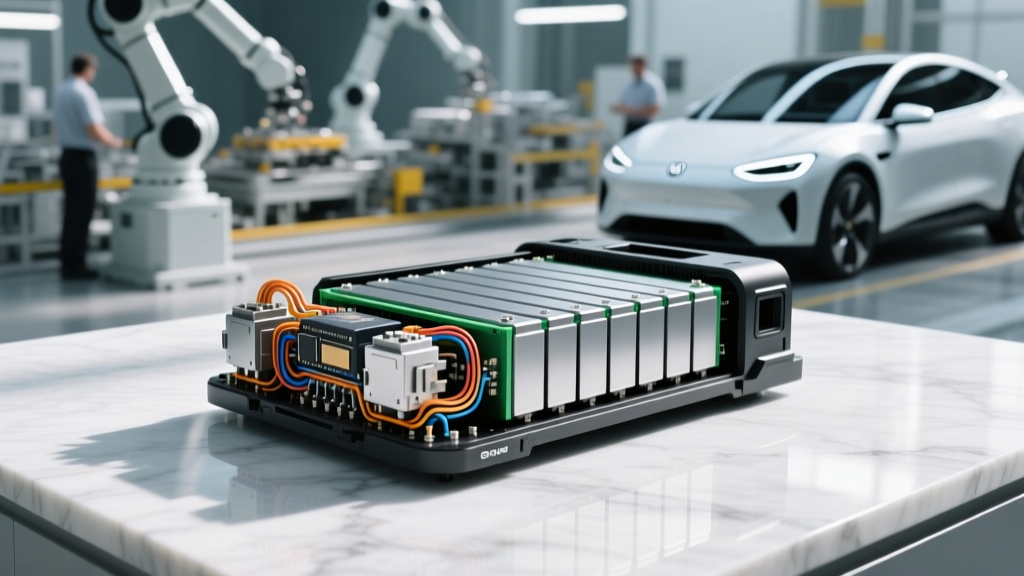
Modern electric vehicles carry two batteries: a familiar 12V auxiliary battery (which handles lights, infotainment, and contactor logic) and a massive high-voltage traction battery ranging from roughly 40 kWh to over 130 kWh that actually propels the car. This guide is about the latter — the expensive, complex, chemistry-dependent pack that defines an EV's range, longevity, and resale value. We'll cover the chemistry choices automakers make in 2026, what real-world degradation data actually shows, how warranties protect you, and what emerging tech like solid-state cells might deliver later this decade.
LFP vs NMC vs NCA: The Chemistry Decision That Shapes Your EV
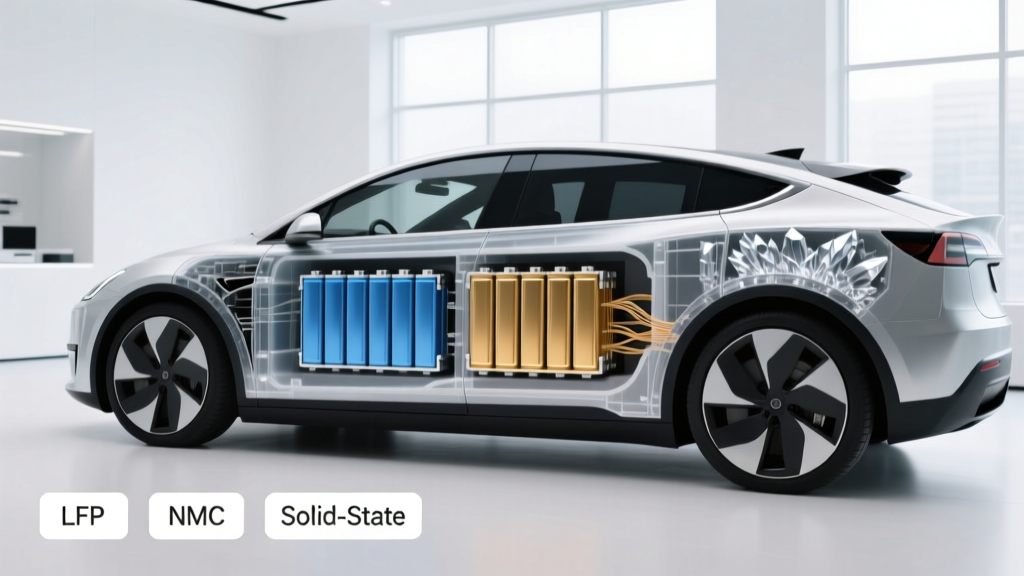
Not all lithium-ion batteries are built alike. In 2026, three cathode chemistries dominate the EV market, and the choice between them affects range, longevity, cold-weather behavior, and price. Understanding this is critical before you buy.
| Attribute | LFP (Lithium Iron Phosphate) | NMC (Nickel Manganese Cobalt) | NCA (Nickel Cobalt Aluminum) |
|---|---|---|---|
| Energy density | Lower (~160 Wh/kg cell-level) | Higher (~220–260 Wh/kg) | Highest (~260–290 Wh/kg) |
| Cycle life | 3,000–5,000+ cycles to 80% SoH | 1,000–2,000 cycles to 80% SoH | 1,000–1,500 cycles to 80% SoH |
| Cold-weather performance | Weaker — larger range loss below freezing | Better low-temp discharge | Good, with active thermal management |
| Cobalt/nickel content | None — lower supply-chain risk | Moderate to high | High nickel, some cobalt |
| Cost per kWh | Lowest (~$90–110/kWh pack-level) | Mid (~$120–140/kWh) | Higher (~$130–150/kWh) |
| Typical 2026 applications | Tesla Model 3 RWD, Model Y RWD, base Ford Mustang Mach-E, BYD models | Hyundai Ioniq 5/6, VW ID.4, BMW iX, many long-range trims | Tesla long-range/Performance, Rivian, Lucid |
| Charging to 100% daily OK? | Yes — Tesla and others recommend it for BMS calibration | No — 80% daily, 100% for trips | No — 80% daily, 100% for trips |
Which is better? There is no universal winner. LFP wins on cost, cycle life, and ethical sourcing but sacrifices range-per-kilogram and cold-weather punch. NMC and NCA deliver the longest single-charge range and better winter behavior but degrade faster if routinely charged to 100% or DC-fast-charged in extreme heat. If you commute short distances and charge at home, LFP is arguably the smarter long-term play. If you road-trip 400 miles regularly or live in Minnesota, NMC/NCA earns its premium.
How Long Do EV Batteries Actually Last? Real Degradation Data
The fear that an EV battery will "die" like a phone battery after two years is the single biggest misconception in the EV space. Real-world fleet data tells a very different story.
According to long-term tracking by Recurrent Auto across more than 15,000 vehicles, the average EV battery in 2026 retains roughly:
- ~95% State of Health (SoH) at 1 year / 15,000 miles
- ~90% SoH at 3 years / 45,000 miles
- ~85–88% SoH at 5 years / 75,000 miles
- ~80–85% SoH at 8 years / 120,000 miles
Geotab's fleet study of over 10,000 EVs found an average annualized degradation rate of 1.8% per year, meaning a typical pack would retain about 82% capacity after a decade. That's a far cry from the catastrophic failure many shoppers fear.
For context: a 250-mile EPA-rated EV losing 15% capacity over 8 years still delivers ~212 miles of range. For most daily commutes, that's imperceptible.
EV Battery Warranty Terms: What's Actually Covered
Federal law in the U.S. mandates that EV batteries carry a minimum warranty of 8 years / 100,000 miles (10 years / 150,000 miles in California and states adopting CARB standards). Most manufacturers meet or exceed this baseline.
| Manufacturer | Duration | Capacity Threshold | Notes |
|---|---|---|---|
| Tesla (Model 3/Y RWD — LFP) | 8 yr / 100,000 mi | 70% retention | Long-range trims: 8 yr / 120,000 mi |
| Hyundai / Kia (Ioniq 5, EV6) | 10 yr / 100,000 mi | 70% retention | Among the longest coverage |
| Ford (Mustang Mach-E, F-150 Lightning) | 8 yr / 100,000 mi | 70% retention | Covers battery + powertrain components |
| GM (Ultium platform — Equinox EV, Blazer EV) | 8 yr / 100,000 mi | 70% retention | Module-level replacement available |
| Rivian (R1T, R1S) | 8 yr / 175,000 mi | 70% retention | Highest mileage cap in class |
| BMW (iX, i4) | 8 yr / 100,000 mi | 70% retention | Transferable to second owner |
The key phrase is "capacity retention threshold" — typically 70%. If your pack drops below 70% of its original kWh within the warranty period, the manufacturer must repair or replace it at no cost. Importantly, this covers defects and abnormal degradation, not damage from accidents, flooding, or unauthorized modifications. Always read the fine print in your owner's manual.
How Much Does an EV Battery Cost to Replace?
This is the question that haunts forums and comment sections. The honest answer: out-of-warranty replacement is expensive, but it's rarely needed during a vehicle's useful life.
| Vehicle | Battery Size | Chemistry | Estimated Replacement Cost |
|---|---|---|---|
| Tesla Model 3 RWD | ~60 kWh | LFP | $8,000–$12,000 |
| Tesla Model Y Long Range | ~75 kWh | NCA/NMC | $12,000–$16,000 |
| Hyundai Ioniq 5 | 77.4 kWh | NMC | $11,000–$15,000 |
| Ford F-150 Lightning (extended) | 131 kWh | NMC | $18,000–$25,000 |
| Chevrolet Equinox EV | ~85 kWh | NMC (Ultium) | $12,000–$16,000 |
| Nissan Leaf (40 kWh pack) | 40 kWh | NMC | $6,500–$9,000 |
These figures include parts and labor at OEM service centers. Independent EV shops and refurbished packs can reduce costs by 20–40%. Critically, most EV batteries outlive the vehicles they're installed in. According to data from fueleconomy.gov and manufacturer filings, the rate of complete pack failure before 150,000 miles is well under 2% across major brands. Module-level repairs (replacing individual cell groups rather than the whole pack) are increasingly common and far cheaper — often $2,000–$5,000.
Also worth noting: battery pack prices have fallen from over $1,000/kWh in 2010 to roughly $100–140/kWh at the pack level in 2026, per BloombergNEF. If you do need a replacement in 2035, it will almost certainly cost less than today's estimates.
What Kills an EV Battery Faster — and How to Maximize Longevity
Lithium-ion cells degrade from two primary mechanisms: calendar aging (time and temperature) and cycle aging (charge-discharge use). You can't stop the clock, but you can dramatically slow cycle-related wear.
- Avoid sustained 100% SoC: For NMC/NCA packs, set your daily charge limit to 80%. Charge to 100% only when you're leaving within hours for a long trip. LFP packs are the exception — charge to 100% at least weekly for BMS calibration.
- Don't let it sit at 0%: Storing an EV at very low SoC for weeks stresses cells. If parking for a month, leave it plugged in at 50–60%.
- Minimize DC fast charging in extreme heat: Repeated 150+ kW sessions on a 95°F day without preconditioning accelerate degradation. Use your car's preconditioning feature before arriving at a charger.
- Precondition in cold weather: Warming the battery before driving or charging reduces lithium plating risk and improves regen effectiveness.
- Level 2 home charging is ideal: Slow 7–11 kW AC charging generates far less heat than DC fast charging. Daily Level 2 top-ups between 20–80% are the gold standard.
- Park in shade or a garage when possible: Sustained high ambient temperatures (above 90°F for weeks) contribute to calendar aging. A garage in Phoenix is worth more than a garage in Seattle for battery health.
- Don't obsess — drive it: Modern battery management systems (BMS) actively protect the pack with thermal management, buffers, and charge-rate limiting. The biggest risk is paralysis by overthinking.
The factors that hurt batteries most, ranked by impact:
- Extreme heat + high SoC sustained over time (worst case: 100% charge parked in 110°F Arizona sun for weeks)
- Frequent DC fast charging without preconditioning (especially above 150 kW on hot days)
- Deep cycling to near 0% regularly (running the pack to empty repeatedly)
- Cold-weather fast charging without warmup (risk of lithium plating on the anode)
How to Check Your EV's Battery Health (State of Health)
State of Health (SoH) is the percentage of original capacity your battery retains. A new 75 kWh pack at 90% SoH effectively holds ~67.5 kWh. Here's how to monitor it:
- In-car displays: Tesla's service mode (accessible via the software menu) shows a battery health test result. Hyundai/Kia's EV menu displays SoH percentage. Ford's Sync system provides a battery health indicator.
- OBD-II dongles + apps: Tools like OBDLink SX paired with apps such as Leaf Spy (Nissan), TeslaFi, or ABRP's OBD integration pull real-time SoH, cell voltage variance, and degradation curves.
- Dealer diagnostic reports: Request a battery health printout during service visits. This is especially valuable before buying a used EV — insist on seeing the SoH number, not just "passes inspection."
- Third-party services: Companies like Recurrent and Car and Driver's long-term fleet tests publish SoH benchmarks by model and mileage, letting you compare your pack against fleet averages.
When shopping for a used EV, a SoH reading above 90% at under 50,000 miles is excellent. Between 80–90% at 50,000–100,000 miles is normal and still well within warranty. Below 75% on a vehicle still under warranty should trigger a warranty claim.
What's Next: Solid-State, Silicon Anodes, and Realistic Timelines
Every year, headlines promise that solid-state batteries will "change everything next year." The reality in 2026 is more measured — and more interesting.
Solid-state batteries replace the liquid electrolyte with a solid ceramic, glass, or polymer separator. The theoretical benefits are substantial: higher energy density (potentially 400+ Wh/kg at the cell level), faster charging (10–80% in under 10 minutes), reduced fire risk, and longer cycle life. Toyota has announced a solid-state EV for limited production around 2027–2028, and Samsung SDI is targeting 2027 for mass production. Nissan and Honda have similar timelines.
However, manufacturing challenges remain significant. Solid-state cells require new production lines, and yield rates are still far below those of conventional lithium-ion. Expect initial solid-state packs in limited, premium vehicles — not affordable mass-market EVs — through at least 2030.
Silicon-dominant anodes are closer to reality. Companies like Sila Nanotechnologies and Group14 are supplying silicon-composite anode materials to manufacturers including Mercedes-Benz (for the G-Class electric) and others. Silicon can store roughly 10x more lithium ions than graphite, boosting energy density by 20–40%. These cells are entering production in 2025–2026 model-year vehicles and represent a meaningful near-term improvement rather than a distant promise.
Sodium-ion batteries from CATL and BYD are entering the market in smaller, lower-cost EVs — primarily in China — offering lower energy density but dramatically reduced cost and no lithium, cobalt, or nickel. These are unlikely to appear in US-market vehicles before 2028 due to supply chain and regulatory factors.
Frequently Asked Questions
How long do EV batteries last in years and miles?
Based on fleet data, most EV batteries retain 80–88% of original capacity at 8 years / 120,000 miles. With proper care, many packs exceed 200,000 miles before reaching the 70% warranty threshold. Catastrophic failure is rare — under 2% of packs require full replacement before 150,000 miles across major manufacturers.
How much does it cost to replace an EV battery in 2026?
Out-of-warranty replacement ranges from roughly $6,500 for a small pack (Nissan Leaf 40 kWh) to $25,000 for a large pack (Ford F-150 Lightning 131 kWh). Most owners never pay this — warranty coverage spans 8–10 years, and packs typically outlast the vehicle. Module-level repairs cost $2,000–$5,000.
What does the EV battery warranty actually cover?
Federal minimum is 8 years / 100,000 miles with a capacity retention threshold (usually 70%). If your battery degrades below that threshold within the warranty period, the manufacturer replaces or repairs it free of charge. Coverage includes defects and abnormal degradation but excludes accident damage, flooding, and unauthorized modifications.
How do I check and maximize my EV battery health?
Use your car's built-in battery health display, an OBD-II diagnostic app, or request a dealer SoH report. To maximize longevity: charge NMC/NCA to 80% daily (LFP to 100%), avoid prolonged storage at extreme SoC, precondition before DC fast charging, and rely on Level 2 home charging for daily use.
LFP vs NMC — which chemistry should I choose?
Choose LFP if you prioritize lower cost, longer cycle life, cobalt-free sourcing, and mostly commute with home charging. Choose NMC or NCA if you need maximum range per charge, live in a cold climate, or take frequent long road trips. Neither is universally "better" — the right choice depends on your driving pattern.
Is a 1998 Honda Civic battery the same as an EV battery?
No. A 1998 Honda Civic uses a standard 12-volt lead-acid battery (Group 51R, ~$100–$150) that powers the starter and accessories. Modern EVs also carry a 12V auxiliary battery for similar low-voltage functions, but their main propulsion comes from a high-voltage lithium-ion traction battery (40–131+ kWh) costing thousands of dollars. They are entirely different systems.
Do EV batteries need to be replaced like gas car batteries?
The 12V auxiliary battery in an EV may need replacement every 3–5 years, just like a gas car's battery. The high-voltage traction battery is designed to last the life of the vehicle — typically 15–20 years or 200,000+ miles with gradual capacity loss. Routine replacement is not expected.
Sources: fueleconomy.gov (EPA range and efficiency data), Recurrent Auto battery degradation studies, IRS §30D clean vehicle credit guidelines.