Whether you're researching a Rad bike battery replacement for your electric bicycle or trying to understand what a full traction-battery swap might cost on a Tesla Model Y, the underlying question is the same: how long do lithium-ion batteries really last, and what happens when they don't? This guide covers the full spectrum — from small e-bike packs to the 75+ kWh batteries in modern electric vehicles — with real degradation data, warranty terms, replacement pricing, and the chemistry trade-offs that determine how your battery ages.
Before we get into the numbers, a critical distinction: this article focuses on high-voltage traction batteries — the large packs that propel EVs and e-bikes. It does not cover the 12V auxiliary battery found in most cars (which powers lights, infotainment, and computers and is a separate, far cheaper replacement). Confusing the two is one of the most common mistakes new EV owners make.
LFP vs NMC/NCA: The Chemistry That Defines Your Battery's Life
Not all lithium-ion batteries are built the same. The cathode chemistry determines energy density, cycle life, thermal stability, cold-weather performance, and cost. In 2026, two chemistries dominate the EV and e-bike market:
| Attribute | LFP (Lithium Iron Phosphate) | NMC/NCA (Nickel Manganese Cobalt / Nickel Cobalt Aluminum) |
|---|---|---|
| Energy Density | Lower (~160 Wh/kg cell-level) | Higher (~250-300 Wh/kg cell-level) |
| Typical Cycle Life | 3,000-5,000+ full cycles | 1,000-2,000 full cycles |
| Cold-Weather Performance | More range loss below 32°F | Better low-temp discharge capability |
| Thermal Stability | Excellent — very low thermal runaway risk | Good but requires more active cooling |
| Cost (per kWh) | Lower — no cobalt or nickel | Higher — commodity-sensitive metals |
| Recommended Daily SoC | Can charge to 100% daily | Best kept at 80-90% for daily use |
| Common Applications | Tesla Model 3/Y Standard Range, Ford Mustang Mach-E Select (2025+), many e-bikes | Long-range EVs, performance trims, premium e-bikes |
Which is better? It depends on your use case. If you prioritize longevity and plan to keep a vehicle 10+ years, LFP's superior cycle life is a significant advantage — Tesla's LFP-equipped Standard Range models are explicitly cleared for 100% daily charging, which simplifies ownership. If you need maximum range in a smaller, lighter package (or ride an e-bike in cold climates), NMC's higher energy density and better cold performance make it the pragmatic choice. Most premium e-bikes, including several Rad Power Bikes models, use NMC cells for weight and range reasons.
How Long Do EV and E-Bike Batteries Actually Last?
The short answer: far longer than most buyers fear. According to data aggregated from fleet vehicles by the National Renewable Energy Laboratory (NREL) and real-world owner telemetry, modern EV traction batteries typically lose 5-10% of their original capacity over the first 100,000 miles, with degradation slowing significantly after the initial break-in period (roughly the first 20,000-30,000 miles).
Typical EV Battery Degradation Curve (NMC Chemistry, Liquid-Cooled):
| Mileage / Time | Average Capacity Retention | Notes |
|---|---|---|
| New | 100% | — |
| 20,000 mi / ~1.5 yr | ~95-97% | Initial steeper drop (calendar + cycle) |
| 50,000 mi / ~4 yr | ~92-95% | Curve flattens significantly |
| 100,000 mi / ~7-8 yr | ~88-92% | Most still above warranty threshold |
| 150,000 mi / ~12 yr | ~82-88% | Noticeable range reduction but usable |
| 200,000+ mi | ~75-85% | Varies widely by climate and charging habits |
LFP packs tend to flatten even earlier and retain 90%+ capacity at 100,000 miles in many fleet datasets. E-bike batteries, which are typically smaller (0.4-0.7 kWh vs. 60-100+ kWh for cars) and often air-cooled, see slightly faster calendar degradation — expect 80-90% retention at 3-5 years depending on storage habits.
Key insight: The vast majority of EV batteries outlast the vehicles they're installed in. Complete battery failure (sudden, catastrophic) is rare. What owners experience is gradual range loss — a 310-mile EPA-rated vehicle might realistically deliver 265-275 miles at 150,000 miles. That's inconvenient but rarely a reason to replace.
EV and E-Bike Battery Replacement Costs: What You'll Actually Pay
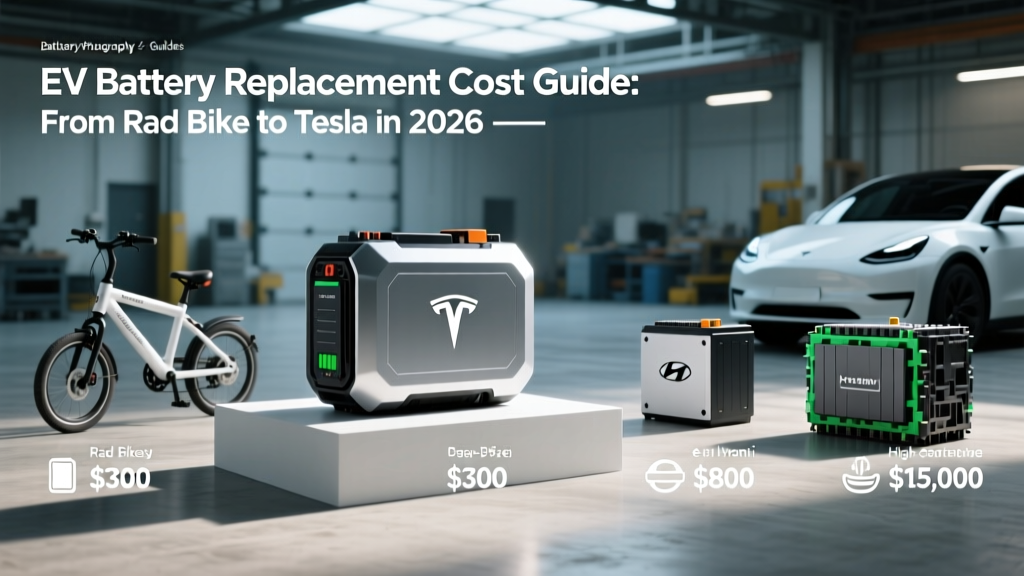
Replacement cost is the single biggest anxiety for prospective EV buyers. Here's the reality across vehicle categories in 2026:
| Vehicle / Category | Battery Size | Replacement Cost (Parts + Labor) | Typical Replacement Trigger |
|---|---|---|---|
| Rad Power Bikes (e.g., RadCity 5 Plus, RadTrike) | 0.48-0.67 kWh (48V) | $499-$699 (direct from Rad) | Capacity below ~60-70% after 3-5 years, or physical damage |
| Other e-bikes (Trek, Specialized, Lectric) | 0.35-0.75 kWh | $400-$900 | Same — degradation or crash damage |
| Tesla Model 3 Standard Range (LFP) | ~60 kWh | $10,000-$13,000 (out of warranty) | Rarely needed — most covered under 8yr/100k-mi warranty |
| Tesla Model Y Long Range (NMC) | ~75-82 kWh | $12,000-$16,000 | Same |
| Ford Mustang Mach-E Extended Range | ~91 kWh (usable) | $14,000-$18,000 | Same |
| Hyundai Ioniq 5 / Kia EV6 | ~77.4 kWh | $11,000-$15,000 | Same |
| Chevrolet Bolt EV/EUV (2022-2025) | ~65 kWh | $9,000-$12,000 | Recall replacements were free; out-of-warranty cost applies to future failures |
| Nissan LEAF (air-cooled, NMC) | 40-62 kWh | $6,500-$9,000 (remanufactured) | More common — air cooling accelerates degradation in hot climates |
Rad bike battery replacement specifically: Rad Power Bikes sells replacement batteries directly through their website and authorized service centers. As of 2026, a replacement 48V 14Ah (672 Wh) battery for a RadCity 5 Plus costs approximately $599. Installation is straightforward — most Rad batteries are frame-mounted with a keyed lock and a single connector — and can be done at home in under 10 minutes. Third-party compatible packs exist at lower prices ($300-$450) but vary in cell quality and BMS (battery management system) sophistication.
For full-size EVs: out-of-pocket replacement is uncommon. Most failures occur within the federally mandated 8-year/100,000-mile warranty window (California and states adopting CARB standards require 10 years/150,000 miles). When out-of-warranty replacement is needed, remanufactured packs and module-level repairs (replacing only the degraded modules rather than the entire pack) are increasingly available and can cut costs by 30-50%.
What Does the Battery Warranty Actually Cover?
Federal law (EPA emissions-related warranty requirements, which encompass EV batteries as emissions-relevant components) mandates a minimum 8-year/100,000-mile warranty on EV traction batteries. CARB-adopting states extend this to 10 years/150,000 miles. Here's how major manufacturers structure their coverage:
| Manufacturer | Warranty Period | Capacity Retention Threshold | What Triggers a Claim |
|---|---|---|---|
| Tesla (Model 3/Y Standard Range — LFP) | 8 yr / 100,000 mi | 70% | SoH drops below 70% as measured by Tesla diagnostics |
| Tesla (Model 3/Y Long Range, Model S/X) | 8 yr / 120,000-150,000 mi | 70% | Same |
| Hyundai / Kia | 10 yr / 100,000 mi | 70% | Battery SoH below 70% confirmed by dealer scan tool |
| Ford (Mach-E, F-150 Lightning) | 8 yr / 100,000 mi | 70% | Same |
| GM (Chevrolet, Cadillac EVs) | 8 yr / 100,000 mi | 70% | Same |
| Volkswagen / BMW / Mercedes | 8 yr / 100,000 mi | 70% | Same |
| Rad Power Bikes | 1 year (battery) | N/A — defect coverage | Manufacturing defects; degradation not explicitly warrantied beyond 1 yr |
The 70% threshold is industry-standard and means the manufacturer will repair or replace the battery if its maximum capacity falls below 70% of its original rated capacity within the warranty window. In practice, very few liquid-cooled EV batteries hit this threshold within 8 years/100,000 miles under normal use. Air-cooled batteries (older Nissan LEAF, some early compliance EVs) are more likely to trigger warranty claims in hot climates.
For e-bikes like Rad Power Bikes, the warranty landscape is fundamentally different. Most e-bike batteries carry a 1-year warranty against defects, and some premium brands (Bosch-equipped bikes, Specialized) offer 2-year coverage. Degradation is generally not warrantied — it's considered normal wear. This is why understanding care habits matters more for e-bike owners who won't have a warranty safety net after year one.
Factors That Accelerate (or Preserve) Battery Life
Battery degradation is driven by three mechanisms: calendar aging (time and temperature), cycle aging (charge-discharge cycles), and abuse conditions (extreme heat, deep discharge, physical damage). Here's what actually moves the needle:
What Hurts Your Battery
- Frequent DC fast charging above 150 kW: The heat generated during high-power charging accelerates electrolyte decomposition. Occasional fast charging on road trips is fine; daily fast charging can add 1-3% extra degradation over 100,000 miles.
- Storing at 100% SoC in heat: A fully charged battery sitting in a 95°F+ garage degrades faster than one stored at 50%. This is the single worst thing you can do for long-term health.
- Regularly discharging to 0%: Deep discharges stress the anode. Most BMS systems have a buffer (the car's "0%" isn't truly empty), but habitually running the pack to near-empty still adds wear.
- Extreme cold charging without preconditioning: Charging a frozen battery (below ~32°F) without thermal preconditioning can cause lithium plating on the anode — permanent capacity loss. Most modern EVs precondition automatically when you navigate to a charger; e-bikes generally do not.
What Preserves Your Battery
- Daily charging to 80% (NMC) or 100% (LFP): Follow the manufacturer's recommendation. LFP batteries actually benefit from regular 100% charges for cell balancing.
- Level 2 home charging as your primary method: The slower charge rate generates far less heat than DC fast charging.
- Storing at 40-60% SoC if the vehicle won't be used for weeks: This is the ideal storage voltage for lithium-ion chemistry.
- Parking in shade or a garage in hot climates: Calendar aging roughly doubles for every 18°F increase in average storage temperature.
- Using preconditioning in cold weather: Set a departure time in your EV's app so the battery warms before you drive or charge.
For e-bike owners — including those who may eventually need a Rad bike battery replacement — the most impactful habits are: don't leave the battery on the charger overnight after it reaches full, store it indoors (not in a hot garage or freezing shed), and charge it to ~60% if you won't ride for a month or more. Rad Power Bikes recommends charging the battery at least once every 3 months during storage to prevent the BMS from draining cells below their safe voltage floor.
How to Check Your Battery's State of Health (SoH)
State of Health (SoH) is the percentage of your battery's original capacity that remains usable. Monitoring it helps you predict range, plan for warranty claims, and assess a used EV's value.
For full-size EVs:
- Tesla: The in-car service menu (or the Tesla app under "Battery Health" on newer software versions) displays SoH. Third-party tools like TeslaFi or Scan My Tesla (via OBD-II) provide more granular data including individual module voltages.
- Hyundai/Kia: The dealer can pull a detailed SoH report via the factory scan tool. Some owners use OBD-II dongles with apps like Car Scanner to read BMS data directly.
- Ford, GM, VW: Similar dealer-level diagnostics. The FordPass and myChevrolet apps display estimated range, which indirectly reflects SoH when compared to original EPA figures.
- Universal method: Track your real-world range over time. If your EV consistently delivers 10% less range than when new (controlling for weather and driving style), that's a reasonable SoH proxy.
For e-bikes (including Rad Power Bikes):
- Most e-bike batteries lack a built-in SoH readout. The practical method is tracking range per charge — if your RadCity 5 Plus used to deliver 40 miles on pedal-assist level 2 and now delivers 30, your battery is likely around 75% SoH.
- Some advanced riders use a watt-meter (inline between battery and controller) to measure actual Wh delivered per charge and compare to the pack's rated Wh capacity.
- If your e-bike uses a Bosch, Shimano, or Brose mid-drive system, authorized dealers can pull SoH data from the motor's diagnostic port.
When Is Replacement Actually Necessary?
Most EV owners will never need a battery replacement. The data from fueleconomy.gov and manufacturer warranty claim rates consistently show that fewer than 2-5% of EV batteries require replacement under warranty, and the majority of those are due to manufacturing defects (bad cells, BMS failures, coolant leaks) rather than degradation.
Consider replacement when:
- Your battery falls below the 70% warranty threshold and is still within the coverage window — file a claim, don't pay out of pocket.
- Range loss materially impacts your daily needs — for example, your commute is 80 miles round-trip and your degraded battery can no longer complete it reliably in winter.
- A physical defect is diagnosed — coolant intrusion, swollen modules, or BMS failure. These are safety issues, not just range issues.
- For e-bikes: when range drops below what you need for your typical rides, or when the battery no longer holds a charge overnight (a sign of cell imbalance or BMS failure).
For Rad bike battery replacement specifically, most owners report needing a new battery between years 3 and 6, depending on mileage and storage habits. At $499-$699, this is comparable to replacing a set of premium tires on a conventional bicycle — a known maintenance cost, not a catastrophic expense.
Emerging Battery Technology: What's Coming (and When)
Several next-generation technologies promise to reshape battery longevity, cost, and performance. Here's a realistic timeline based on current industry announcements and production roadmaps:
- Silicon-dominant anodes: Companies like Sila Nanotechnologies and Group14 are already shipping silicon-blend anodes that increase energy density by 10-20% without sacrificing cycle life. These are appearing in premium EVs in 2025-2026 and will trickle down to mainstream models by 2028-2029. For e-bikes, expect adoption in the 2027-2028 timeframe.
- Solid-state batteries: Toyota has announced solid-state cells for limited production vehicles in 2027-2028, with claims of 750+ km range and 10-minute fast charging. Samsung SDI and QuantumScape are pursuing similar timelines. However, mass-market availability at affordable price points is unlikely before 2030-2032. Solid-state should not be a reason to delay an EV or e-bike purchase today.
- Sodium-ion batteries: CATL and BYD are producing sodium-ion cells for low-cost, short-range EVs in China. These offer lower energy density but dramatically lower cost and excellent cold performance. US-market adoption depends on supply-chain development and is likely 2028+ for passenger vehicles. E-bikes could adopt sodium-ion sooner due to smaller pack sizes.
- LFP improvements: Ongoing refinements to LFP chemistry (including LMFP — lithium manganese iron phosphate) are closing the energy-density gap with NMC while maintaining LFP's cost and longevity advantages. Expect LMFP in mainstream EVs by 2027.
None of these technologies are currently available in production vehicles sold in the US (as of early 2026). Any claims otherwise should be treated as preliminary or limited-market announcements.
Frequently Asked Questions
How long do EV batteries last in years and miles?
Modern liquid-cooled EV batteries (NMC or LFP) typically retain 85-92% of their original capacity at 100,000 miles and 7-8 years. Many remain functional at 200,000+ miles with 75-85% capacity. E-bike batteries (including Rad Power Bikes) typically last 3-6 years / 500-1,000 charge cycles before noticeable range reduction prompts replacement.
How much does an EV battery cost to replace?
Full-size EV batteries cost $9,000-$18,000 out of warranty depending on pack size and vehicle. E-bike batteries (Rad bike battery replacement and similar) cost $400-$900. However, most EV battery replacements are covered under the 8-year/100,000-mile federal warranty at no cost to the owner.
What does the battery warranty cover?
Federal law requires EV manufacturers to warrant the traction battery for at least 8 years/100,000 miles against capacity loss below 70% of original. CARB states extend this to 10 years/150,000 miles. The warranty covers defects and excessive degradation but not damage from accidents, modifications, or improper use. E-bike batteries typically carry 1-2 year defect warranties with no degradation coverage.
How do I check and maximize my battery's health?
Check SoH through your vehicle's app, dealer diagnostics, or OBD-II tools (EVs), or by tracking range-per-charge over time (e-bikes). Maximize health by: charging to 80% daily (NMC) or 100% (LFP), avoiding frequent DC fast charging, preconditioning in cold weather, storing at 40-60% SoC, and avoiding extreme heat exposure.
LFP vs NMC — which is better for me?
Choose LFP if you want maximum cycle life, plan to keep the vehicle long-term, don't need maximum range, and prefer the simplicity of 100% daily charging. Choose NMC if you need maximum range per kWh (longer trips, cold climates), prioritize lighter weight (important for e-bikes), or need the performance characteristics of higher energy-density cells.
Is a Rad bike battery replacement worth it, or should I buy a new e-bike?
If the rest of the bike (motor, frame, brakes, wheels) is in good condition, a $499-$699 battery replacement is almost always more economical than a new e-bike ($1,500-$2,500+). The motor and frame have no meaningful wear limit. Replace the battery and ride for another 3-5 years.
Can I upgrade to a larger battery when I replace?
For e-bikes: only if the manufacturer offers a compatible higher-capacity pack with the same voltage, connector, and physical dimensions. Rad Power Bikes batteries are model-specific — you cannot put a RadMission battery in a RadCity. For EVs: no — battery packs are vehicle-specific and integrated into the chassis. Aftermarket "range upgrades" do not exist for production EVs.
Sources: Battery degradation data from NREL transportation research; EV range and efficiency figures from fueleconomy.gov; warranty terms from manufacturer specification pages (Tesla, Hyundai, Ford, GM). Tax credit and incentive eligibility varies — consult IRS.gov §30D guidelines for current rules. E-bike battery pricing from manufacturer retail listings as of early 2026.