The Second Life of an EV Battery: Why Recycling Matters Now
By 2026, the first major wave of electric vehicles is hitting the 100,000-mile mark and beyond. Most of those high-voltage traction batteries are still going strong — degradation data from the field shows typical capacity loss of just 10–15% over eight years for liquid-cooled packs. But when a battery does reach end-of-life, whether from age, accident damage, or rare catastrophic cell failure, a growing network of EV battery recycling companies stands ready to recover up to 95% of the critical minerals inside.
This guide covers what actually happens to EV batteries at end-of-life, who the major recyclers are, and — more importantly for current owners — everything you need to know about battery chemistry, degradation, warranties, replacement costs, and daily care habits that maximize pack longevity.
LFP vs. NMC/NCA: Understanding Your Battery Chemistry
Every EV sold in 2026 uses one of two dominant lithium-ion chemistries for its high-voltage traction battery. The chemistry affects range, longevity, charging behavior, cold-weather performance, and — critically — how recyclable the pack is at end-of-life.
| Factor | LFP (Lithium Iron Phosphate) | NMC / NCA (Nickel Manganese Cobalt / Nickel Cobalt Aluminum) |
|---|---|---|
| Energy Density | ~160–180 Wh/kg (lower) | ~230–280 Wh/kg (higher) |
| Cycle Life | 3,000–5,000+ cycles | 1,000–2,000 cycles |
| Cold Performance | Greater range loss below 32°F | Better low-temp discharge |
| Cost per kWh | ~$90–110/kWh (2026 cell-level) | ~$120–150/kWh |
| State of Charge Ceiling | Can charge to 100% daily | Best kept ≤80% daily |
| Recyclability | Lower-value materials (Fe, P); less economic incentive for recyclers | High-value Ni, Co, Mn — primary target for EV battery recycling companies |
| Common in 2026 | Tesla Model 3/Y RWD, Ford Mustang Mach-E Select, Rivian Standard | Hyundai Ioniq 5/6, Chevy Equinox EV, BMW iX, most long-range trims |
Which is better? It depends on your use case. If you charge at home nightly and want a battery that tolerates daily 100% charges with minimal degradation, LFP is the longevity winner. If you need maximum range in a smaller, lighter pack and regularly drive in cold climates, NMC/NCA delivers higher energy density and better winter performance. From a recycling standpoint, NMC packs contain nickel and cobalt — high-value metals that make recovery economically attractive for recyclers like Redwood Materials and Li-Cycle.
How Long Do EV Batteries Actually Last?
Based on aggregated fleet data published by sources including Geotab's EV battery health study and manufacturer warranty claims, here is what real-world degradation looks like for modern liquid-cooled packs:
- Year 1 (~12,000 mi): 2–4% capacity loss (initial formation loss)
- Year 3 (~36,000 mi): 6–8% total loss
- Year 5 (~60,000 mi): 8–12% total loss
- Year 8 (~100,000 mi): 10–15% total loss
- Year 10 (~120,000 mi): 12–18% total loss (still above 80% SoH for most packs)
LFP packs generally show slower degradation — often 8–10% total loss at the 100,000-mile mark — but start from a lower energy-density baseline, so usable range may be similar.
The critical takeaway: a 15% degradation on a 320-mile EPA-rated EV still leaves ~272 miles of range. For most owners, the battery outlasts the car's body, suspension, and interior.
Factors That Accelerate Degradation
- Frequent DC fast charging above 150 kW — heat is the primary enemy; packs charged primarily on Level 2 at home degrade slower than those relying on 350 kW public chargers daily.
- Sustained high State of Charge (NMC) — storing an NMC pack at 100% for days accelerates calendar aging. LFP packs are more tolerant of 100% SoC.
- Extreme heat exposure — prolonged parking in 100°F+ ambient without thermal management active.
- Deep discharges below 10% — regularly draining to near-zero stresses cell chemistry.
- Cold charging without preconditioning — charging a frozen pack at high kW causes lithium plating on the anode, a permanent capacity loss mechanism.
Battery Warranty Terms: What's Covered and for How Long
Federal law mandates a minimum 8-year / 100,000-mile warranty on EV battery packs (10 years / 150,000 miles in CARB states like California, New York, and Massachusetts). But the details vary by manufacturer, and the capacity-retention threshold matters enormously.
| Manufacturer | Warranty Period | Capacity Threshold | Notes |
|---|---|---|---|
| Tesla (Model 3/Y LFP) | 8 yr / 120,000 mi | 70% SoH | Long-range NMC: 8 yr / 120,000 mi |
| Hyundai / Kia | 10 yr / 100,000 mi | 70% SoH | Among the most generous terms |
| Ford (Mach-E, F-150 Lightning) | 8 yr / 100,000 mi | 70% SoH | Covers battery and hybrid components |
| GM (Ultium platform) | 8 yr / 100,000 mi | 70% SoH | Module-level replacement available |
| Rivian | 8 yr / 175,000 mi | 70% SoH | Higher mileage cap for commercial use |
| BMW | 8 yr / 100,000 mi | 70% SoH | Covers cell, module, and pack level |
What triggers a warranty claim? If your battery's State of Health drops below the threshold (typically 70%) within the warranty window, the manufacturer will repair or replace enough modules to bring capacity back above the threshold. Importantly, this is not a full pack swap in most cases — modern modular designs allow individual module replacement, reducing cost and waste.
EV Battery Replacement Costs: The Real Numbers
Out-of-warranty replacement is the scenario most feared by prospective EV buyers. Here is what it actually costs in 2026, based on manufacturer parts pricing and independent shop data:
| Vehicle / Battery Size | Chemistry | Full Pack Replacement | Module-Level Repair | Typical Need Timeline |
|---|---|---|---|---|
| Tesla Model 3 RWD (60 kWh) | LFP | $12,000–$14,000 | $1,500–$3,000 per module | Rarely before 200,000 mi |
| Hyundai Ioniq 5 (77.4 kWh) | NMC | $15,000–$18,000 | $2,000–$4,000 per module | 150,000–200,000+ mi |
| Ford F-150 Lightning Ext. Range (131 kWh) | NMC | $22,000–$28,000 | $3,000–$5,500 per module | 150,000+ mi |
| Chevy Equinox EV (85 kWh) | NMC (Ultium) | $14,000–$17,000 | $2,000–$3,500 per module | 150,000+ mi |
| Rivian R1S Dual-Motor (128 kWh) | NMC | $20,000–$25,000 | $3,000–$5,000 per module | 175,000+ mi |
Two critical points: First, full pack replacement is rare. Most out-of-warranty failures involve a single degraded or defective module, not the entire pack. Second, cell prices have fallen roughly 50% since 2020, and continue declining — replacement costs in 2030 will likely be significantly lower than today's figures.
How to Check and Maximize Your Battery's State of Health
Monitoring your battery's State of Health (SoH) is straightforward in 2026. Here are the methods available to most EV owners:
Built-In Vehicle Displays
Many 2026 models — including Teslas (via the Service menu), Hyundai/Kia (in the EV settings panel), and BMWs (iDrive battery health screen) — show a battery health percentage or degradation indicator. This is derived from the BMS (Battery Management System) tracking charge/discharge cycles and internal resistance.
OBD-II Diagnostic Tools
Third-party apps like EV Health, LeafSpy (Nissan), and Scan My Tesla read detailed BMS data through an OBD-II dongle, including individual cell voltages, pack internal resistance, and precise SoH percentage. A $30–50 Bluetooth OBD-II adapter plus a $10–20 app subscription gives dealership-level data.
Dealer Diagnostic Reports
Any authorized service center can pull a full battery health report during routine service. Request this annually or before a warranty claim.
Daily Habits That Maximize Longevity
- Charge NMC packs to 80% daily; reserve 100% for road trips. LFP packs can and should be charged to 100% at least weekly for BMS calibration.
- Use Level 2 home charging (7–11 kW) as your primary method; limit DC fast charging to road trips.
- Precondition the battery before fast charging in cold weather — most EVs do this automatically when a charger is set as your navigation destination.
- Avoid parking at 0% or 100% SoC for extended periods; 40–60% is ideal for long-term storage.
- In extreme heat, plug in when parked so the thermal management system can actively cool the pack using grid power rather than battery energy.
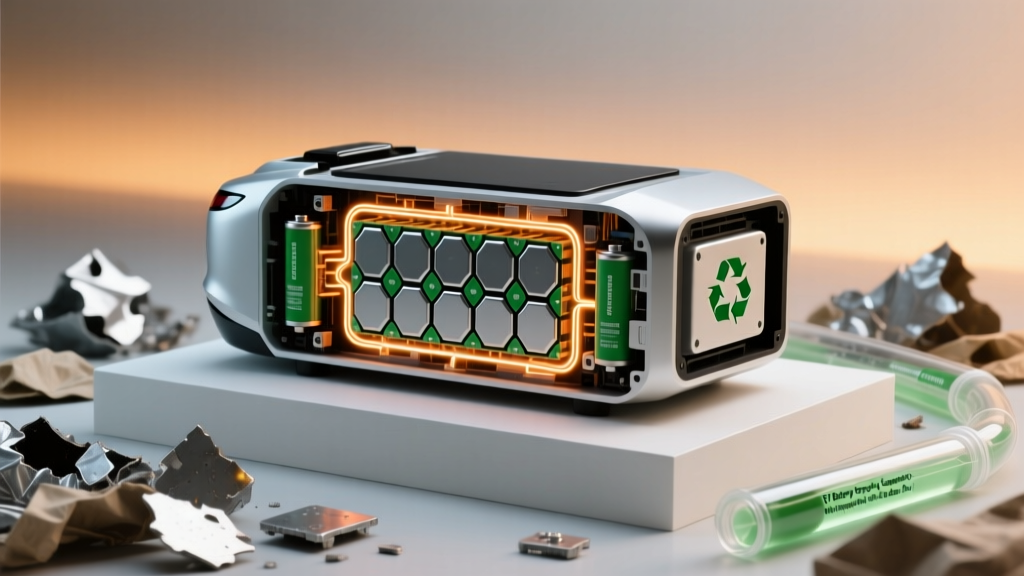
The Role of EV Battery Recycling Companies at End-of-Life
When a pack is no longer viable for automotive use — typically below 70% capacity after 150,000+ miles, or damaged in a collision — it enters one of two pathways:
Second-Life Applications
Packs retaining 70–80% capacity are repurposed for stationary energy storage: grid-scale battery farms, commercial backup power, and residential solar storage systems. A retired 80 kWh EV battery still holds ~60 kWh of usable capacity — enough to power an average home for nearly two days. Companies like B2U Storage Solutions and BlueOval SK (a Ford/SK On joint venture) are building second-life storage facilities using retired EV packs.
Material Recovery by EV Battery Recycling Companies
When packs are too degraded or damaged for second life, specialized recyclers recover the raw materials. The major players in 2026 include:
- Redwood Materials (Nevada) — founded by Tesla co-founder JB Straubel, recovers nickel, cobalt, lithium, and copper using hydrometallurgical processes. Claims 95%+ recovery rates. Supplies recovered cathode material directly back to battery manufacturers including Panasonic and Ford.
- Li-Cycle (Toronto, with US facilities in Arizona and New York) — uses a "Spoke & Hub" model: regional Spoke facilities shred batteries into "black mass," which is shipped to a central Hub for refined mineral recovery. Processes both NMC and LFP chemistries.
- Cirba Solutions (formerly Retriev Technologies) — one of the oldest lithium-ion recyclers in North America, with facilities in Ohio and British Columbia. Handles collection, sorting, and processing for OEM warranty returns and end-of-life packs.
- Ascend Elements (Georgia) — uses a patented "Hydro-to-Cathode" process that converts recycled battery material directly into new cathode precursor, closing the loop with battery cell manufacturers.
According to the U.S. Department of Energy, current recycling technology recovers 80–95% of critical minerals from lithium-ion packs, and the recovered material meets battery-grade purity standards. This is significant for reducing dependence on mined cobalt and nickel, and it's a factor in how IRS §30D tax credit battery-sourcing requirements are being met by automakers using recycled content.
Emerging Battery Technology: What's on the Horizon
Several next-generation battery technologies are in advanced development, though none are commercially available in production EVs as of 2026:
Solid-state batteries replace the liquid electrolyte with a solid ceramic or polymer, promising higher energy density (~400 Wh/kg), faster charging, and improved safety. Toyota has announced limited solid-state production for 2027–2028, initially in low-volume models. Samsung SDI and QuantumScape are targeting similar timelines. Realistic mass-market availability remains 2029–2030 at the earliest.
Silicon-dominant anodes (from companies like Sila Nanotechnologies and Group14) replace graphite anodes with silicon composites, boosting energy density by 20–40% without changing the cathode chemistry. These are beginning to appear in limited applications and are expected in production EVs by 2027–2028.
Sodium-ion batteries use abundant sodium instead of lithium, offering lower cost (~$50–70/kWh projected) and excellent cycle life, but significantly lower energy density. CATL has begun production for Chinese-market EVs; US-market adoption for entry-level models may follow by 2028.
Frequently Asked Questions
How long do EV batteries last in years and miles?
Most modern liquid-cooled EV batteries retain 80–85% of original capacity at 100,000 miles and 8 years. Based on current degradation data, a well-maintained pack should deliver usable service for 150,000–200,000+ miles (12–15 years) before dropping below 70% capacity. Many will outlast the vehicle's other major components.
How much does it cost to replace an EV battery?
Full pack replacement ranges from $12,000–$28,000 depending on battery size and chemistry. However, most out-of-warranty repairs involve module-level replacement at $1,500–$5,500 per module. Full pack swaps are rare. Cell costs continue declining, and replacement costs in the 2030s will be substantially lower.
What does the EV battery warranty actually cover?
Federal law mandates a minimum 8-year / 100,000-mile warranty. Most manufacturers guarantee the battery will retain at least 70% of its original capacity within that window. If it falls below the threshold, the manufacturer repairs or replaces modules at no cost. The warranty covers defects and abnormal degradation, not damage from accidents, flooding, or aftermarket modifications.
How do I check my EV battery's State of Health?
Use the vehicle's built-in battery health display (available on most 2026 models), connect an OBD-II diagnostic tool with an EV-compatible app for detailed cell-level data, or request a battery health report from your dealer during service. Check SoH at least annually.
LFP vs. NMC — which chemistry is better for me?
Choose LFP if you charge at home daily, want to charge to 100% without concern, prioritize maximum cycle life, and live in a moderate climate. Choose NMC/NCA if you need maximum range per kWh, drive frequently in cold weather, or take regular road trips where energy density matters. Both chemistries are well-proven and will outlast the vehicle with proper care.
What happens to my EV battery when the car is totaled or retired?
EV battery recycling companies like Redwood Materials, Li-Cycle, Cirba Solutions, and Ascend Elements recover 80–95% of critical minerals from retired packs. Packs with 70–80% remaining capacity are often repurposed for stationary energy storage before eventual recycling. The recycling infrastructure is scaling rapidly to meet the growing volume of end-of-life packs.
Does fast charging damage my EV battery?
Occasional DC fast charging has minimal impact on modern packs with active liquid cooling. However, daily reliance on 150–350 kW chargers generates cumulative heat stress that accelerates degradation compared to primarily Level 2 home charging (7–11 kW). For maximum longevity, use DC fast charging for road trips and Level 2 for daily needs.