Every EV owner eventually asks the same question: how do I keep my battery healthy over the long haul? The answer isn't a single trick — it's a combination of chemistry awareness, charging habits, and temperature management. This guide breaks down exactly how to recharge batteries in your electric vehicle for maximum longevity, backed by real degradation data and manufacturer warranty terms.
Before we get into strategy, a quick but critical distinction: kW (kilowatts) measures power — the rate at which energy flows into your battery. kWh (kilowatt-hours) measures energy — the total capacity your battery stores. Think of kW as the width of a hose and kWh as the size of the bucket. Both matter for how you recharge.
LFP vs NMC: Your Battery Chemistry Determines Your Recharge Strategy
The single biggest factor in how you should recharge your EV battery is its chemistry. Nearly every EV on the road in 2026 uses one of two lithium-ion chemistries: LFP (lithium iron phosphate) or NMC/NCA (nickel manganese cobalt / nickel cobalt aluminum). They behave differently, age differently, and demand different charging habits.
| Attribute | LFP (Lithium Iron Phosphate) | NMC / NCA (Nickel-Based) |
|---|---|---|
| Energy Density | Lower (~160–180 Wh/kg cell-level) | Higher (~220–300 Wh/kg cell-level) |
| Typical Vehicles | Tesla Model 3/Y RWD, Ford Mustang Mach-E Select (2025+), base Rivian R1S/R1T Standard | Tesla Long Range, Hyundai Ioniq 5/6, BMW i4/iX, most luxury EVs |
| Cycle Life | 3,000–5,000+ full cycles to 80% capacity | 1,000–2,000 full cycles to 80% capacity |
| Cold-Weather Performance | Moderate — more range loss below 32°F; slower charge acceptance when cold | Better low-temp performance; thermal management mitigates loss |
| Optimal Daily SoC | Can and should be charged to 100% regularly | Best kept at 80% for daily use; 100% only before trips |
| Cost per kWh (pack-level) | ~$100–$115 (2026 estimates) | ~$125–$150 (2026 estimates) |
| Cobalt Content | Zero — no cobalt or nickel | Contains cobalt and/or nickel (sourcing implications for §30D credit) |
| Safety / Thermal Stability | Higher — more resistant to thermal runaway | Good, but requires more active thermal management |
Which Is Better and Why?
Neither chemistry is universally superior. LFP wins on longevity and daily simplicity: you can charge to 100% every night without accelerating degradation, and the cells will typically outlast the vehicle's useful life. The trade-off is less range per pound and more sensitivity to freezing temperatures. NMC wins on range density and cold-weather usability, making it the default for long-range trims and performance models — but it demands more disciplined charging habits (staying under 80% for daily use).
If you're buying an EV primarily for commuting and home charging, an LFP-equipped model lets you recharge without overthinking it. If you need maximum range for road trips or live in a cold climate, NMC's energy density and cold tolerance justify the extra care.
How Long Do EV Batteries Actually Last?
The short answer: almost certainly longer than you'll keep the car. Data from fleet operators, manufacturer reports, and independent testing consistently shows that modern EV traction batteries lose roughly 5–10% of total capacity in the first 50,000 miles, then degradation slows significantly to a nearly linear rate of about 1–2% per year thereafter.
Typical Battery Degradation Curve (NMC Chemistry, Temperate Climate)
| Milestone | Typical Capacity Retained | Notes |
|---|---|---|
| New | 100% | Factory fresh |
| 25,000 miles / ~2 years | 94–96% | Initial "break-in" loss; most noticeable early drop |
| 50,000 miles / ~4 years | 91–94% | Curve flattens considerably after this point |
| 100,000 miles / ~8 years | 87–92% | Within warranty threshold for nearly all manufacturers |
| 150,000 miles / ~12 years | 83–89% | Still well above the 70% warranty floor |
| 200,000 miles / ~15 years | 80–86% | Projected; real-world data still emerging for 2020+ packs |
Sources: Geotab fleet battery health study, Tesla Impact Reports, Recurrent Auto battery data. LFP batteries typically show even slower degradation with higher cycle-life tolerance.
A Tesla Model 3 Long Range with an 82 kWh (usable) NMC pack that degrades to 90% after 50,000 miles still delivers roughly 295 miles of EPA-rated range from its original 330 — a difference most drivers barely notice day-to-day. A Chevrolet Equinox EV with LFP chemistry may show even less loss over the same period.
The key insight: battery replacement due to degradation is extremely rare. The vast majority of EV batteries outlive the vehicle's economic lifespan. Replacements that do occur are overwhelmingly due to manufacturing defects caught under warranty, not wear-out.
What Does the Battery Warranty Actually Cover?
Federal law mandates that EV battery warranties cover a minimum of 8 years / 100,000 miles (10 years / 150,000 miles in California Air Resources Board states). But the details matter enormously.
| Manufacturer | Warranty Period | Capacity Retention Threshold | What's Covered |
|---|---|---|---|
| Tesla (Model 3/Y LWD) | 8 yr / 100,000 mi | 70% | Defects + degradation below threshold |
| Tesla (Model 3/Y LR & Perf) | 8 yr / 120,000 mi | 70% | Defects + degradation below threshold |
| Hyundai / Kia | 10 yr / 100,000 mi | 70% | Defects + degradation below threshold |
| Ford (Mach-E, F-150 Lightning) | 8 yr / 100,000 mi | 70% | Defects + degradation below threshold |
| GM (Ultium-based EVs) | 8 yr / 100,000 mi | 70% (60% for Bolt-era) | Defects + degradation below threshold |
| BMW | 8 yr / 100,000 mi | 70% | Defects + degradation below threshold |
| Rivian | 8 yr / 175,000 mi (Large Pack) | 70% | Defects + degradation below threshold |
Note: "70% threshold" means the manufacturer will repair or replace the battery if its usable capacity drops below 70% of original within the warranty period. This is a very conservative floor — most packs retain 85%+ at this mileage. Always verify current terms at the manufacturer's site, as warranty details can change by model year. See fueleconomy.gov for general EV technology and efficiency data.
Important nuance: warranties cover the battery reaching the threshold, not normal gradual loss above it. If your 82 kWh pack drops to 78 kWh (95% retention) at 60,000 miles, that's normal and not a warranty claim. If it drops to 55 kWh (67% retention) at the same mileage, you're covered.
How to Recharge Batteries for Maximum Lifespan
How you recharge your EV battery day-to-day has a measurable impact on its long-term health. Here are the factors that matter most, ranked by impact:
Battery Care Checklist: Daily Habits
- Avoid sustained 100% SoC (NMC only): If your EV has an NMC/NCA battery, set your daily charge limit to 80%. Charge to 100% only when you're leaving within a few hours for a long trip. LFP owners can charge to 100% daily without concern — in fact, LFP batteries benefit from regular full charges for cell balancing and accurate state-of-charge calibration.
- Don't let it sit at very low SoC: Storing your EV below 10% SoC for extended periods (days or weeks) stresses the cells. If you're leaving for vacation, set the charge limit to 50% and leave it plugged in — the battery management system (BMS) will maintain optimal levels.
- Minimize DC fast charging when possible: DC fast charging (Level 3, typically 50–350 kW) generates significant heat inside the cells. Occasional road-trip fast charging is fine — modern thermal management systems are excellent. But if you have access to Level 2 home charging (7–19 kW), use it as your primary method. Data from Recurrent Auto shows that frequent exclusive DCFC use correlates with slightly higher degradation, though the gap has narrowed with 2023+ thermal systems.
- Precondition before fast charging: Most EVs will automatically precondition the battery when you navigate to a DC fast charger. This warms the cells to the optimal temperature (~95–105°F) for charge acceptance, reducing stress and improving speed. Always use the car's built-in navigation to chargers rather than just driving there cold.
- Extreme temperature awareness: In summer, avoid charging to 100% and then letting the car sit in direct heat. In winter, plug in when possible so the BMS can use grid power for thermal management rather than draining the battery. Garage parking helps enormously in both extremes.
- Use scheduled charging: Most EVs and Level 2 chargers let you schedule charging during off-peak hours. This is cheaper (if your utility offers time-of-use rates) and often means the battery finishes charging closer to when you'll drive, reducing time spent at high SoC.
Understanding the Charge Curve
When you recharge at a DC fast charger, the battery doesn't accept power at a constant rate. The charge curve starts at a moderate rate, ramps to peak kW (typically between 10–30% SoC), sustains near-peak until roughly 50–60% SoC, then tapers significantly above 80%. A Hyundai Ioniq 5 that peaks at 240 kW may sustain ~180 kW from 15–55% SoC, then drop to 90 kW by 70% and 40 kW by 90%.
This taper exists specifically to protect battery health — the BMS reduces current as cells approach full charge to prevent lithium plating and excess heat. Sitting at a charger from 80–100% is both slow and marginally more stressful on the pack. For road trips, the optimal strategy is to charge from roughly 10% to 80% and then drive on, rather than topping off completely.
How Much Does an EV Battery Replacement Cost?
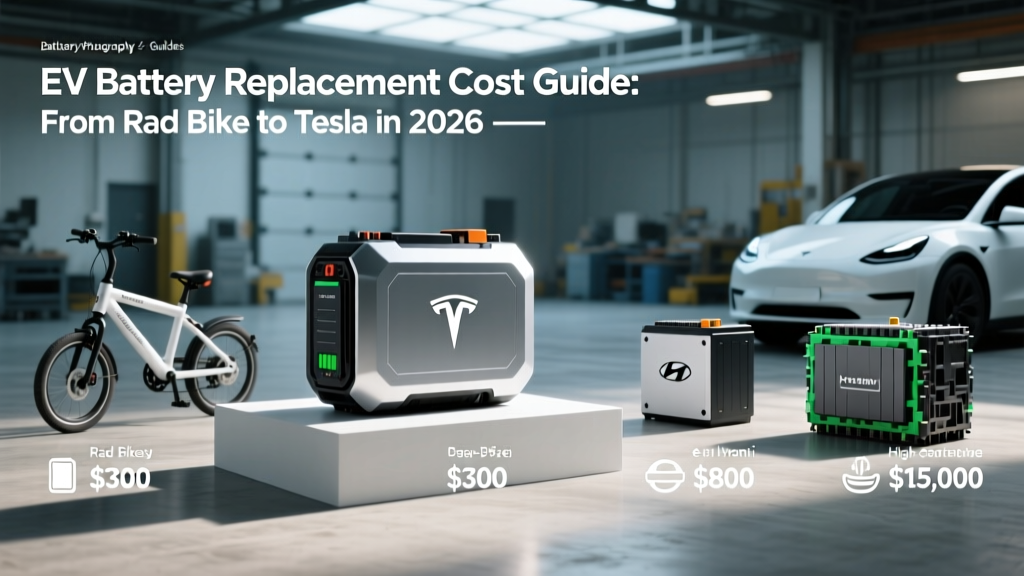
This is the question that generates the most anxiety — and the most misinformation. Let's ground it in actual numbers.
| Vehicle / Pack Size | Battery Capacity (Usable) | Estimated Replacement Cost (Parts + Labor) | When Is Replacement Typically Needed? |
|---|---|---|---|
| Tesla Model 3 RWD (LFP) | ~57 kWh | $8,000–$12,000 | Rarely before 200,000+ mi; most outlive the car |
| Tesla Model Y Long Range | ~75 kWh | $12,000–$16,000 | Rarely before 200,000+ mi |
| Hyundai Ioniq 5 | ~77.4 kWh | $11,000–$15,000 | Rarely before 200,000+ mi |
| Ford F-150 Lightning Ext. Range | ~131 kWh | $18,000–$25,000 | Rarely before 150,000+ mi |
| Chevrolet Equinox EV | ~85 kWh | $12,000–$16,000 | Rarely before 200,000+ mi |
| BMW iX xDrive50 | ~105 kWh | $18,000–$24,000 | Rarely before 200,000+ mi |
Costs are out-of-warranty estimates including labor. Prices have been declining ~8–12% annually as pack manufacturing scales. Individual module replacement (rather than full pack) is increasingly possible and significantly cheaper — often $2,000–$5,000 for a single module swap.
Context matters: the average age of a vehicle scrapped in the US is roughly 21 years. If your EV battery retains 80% capacity at 200,000 miles (a conservative estimate based on current data), it has served you well past the point where most gas cars have been junked due to transmission or engine failure. And unlike an engine replacement, battery costs continue to fall.
Module-level repair is an increasingly viable middle ground. Rather than replacing the entire pack, specialized EV shops can identify and swap individual degraded modules for a fraction of the cost. This is especially common on older Nissan Leafs and early Tesla Model S vehicles, and the practice is expanding to newer platforms.
How to Check and Monitor Battery Health (SoH)
State of Health (SoH) is the percentage of your battery's original usable capacity that remains. A new battery is 100% SoH; one that has degraded from 82 kWh to 74 kWh usable is at roughly 90% SoH.
Here's how to monitor it:
Built-In Vehicle Tools
- Tesla: The mobile app shows estimated range at 100% charge. Compare this to the original EPA range to approximate SoH. Third-party apps like Tessie or Stats provide more granular SoH estimates.
- Hyundai/Kia: The EV menu in the infotainment system displays a battery health indicator. The dealer can pull detailed BMS logs via diagnostic tools.
- GM (Ultium): The myChevrolet/myCadillac app provides battery health status. OnStar diagnostics can provide deeper SoH data on request.
- Ford: The FordPass app shows battery health status. Dealership diagnostics provide module-level detail.
- BMW: The iDrive system and My BMW app provide battery health status. BMW also offers a certified battery health report for resale.
Third-Party and OBD-II Tools
For more precise SoH readings, OBD-II dongles paired with apps like Car Scanner or ABRP (A Better Route Planner) can read the BMS directly, pulling real usable capacity figures, cell voltage variance, and cycle counts. This is especially useful when evaluating a used EV purchase — a 5-minute OBD scan tells you more than the seller's anecdotal range estimate.
Services like Recurrent Auto offer free battery health reports that compare your pack's degradation to a database of thousands of identical vehicles, giving you a percentile ranking. This is invaluable context: a 93% SoH at 40,000 miles might be perfectly average for your model, not a cause for concern.
What's Next: Solid-State and Silicon Anode Batteries
Emerging battery technologies promise significant leaps, but it's important to separate announcements from availability.
Solid-state batteries replace the liquid electrolyte with a solid material, potentially offering 30–50% higher energy density, faster charging, and improved safety. Toyota, Samsung SDI, and QuantumScape have all announced solid-state programs with prototype demonstrations. However, as of 2026, no mass-production EV ships with a solid-state pack. Realistic timelines from industry analysts place limited commercial availability in 2028–2030 for premium models, with broader adoption not expected until the early 2030s. Manufacturing yield and cost remain significant hurdles.
Silicon anode batteries (sometimes called silicon-dominant anodes) are closer to market. Companies like Sila Nanotechnologies and Group14 Technologies are supplying silicon-carbon anode materials that boost energy density by 15–25% over conventional graphite anodes. The Mercedes-Benz G-Class electric (announced for 2025–2026) was among the first to incorporate silicon anode technology. Expect this to proliferate through 2027–2028 model-year vehicles as supply scales.
Sodium-ion batteries are entering the market at the budget end, particularly from Chinese manufacturers like CATL. They offer lower energy density than LFP but use abundant, inexpensive materials. While primarily appearing in Chinese-market vehicles in 2026, they may reach US-market entry-level EVs or stationary storage by 2028–2029.
For current buyers: today's LFP and NMC batteries are mature, well-understood, and backed by strong warranties. Waiting for solid-state means waiting years with uncertain pricing. The battery in a 2026 EV is already extraordinarily durable.
Frequently Asked Questions
How long do EV batteries last in years and miles?
Based on fleet data and manufacturer reports, most modern EV batteries retain 85–92% of their original capacity at 100,000 miles (~8 years). At 200,000 miles (~15 years), projected retention is 80–86% for NMC and potentially higher for LFP. The federal warranty minimum is 8 years / 100,000 miles, with CARB states requiring 10 years / 150,000 miles. In practice, most EV batteries will outlast the vehicle's economic life without needing replacement.
How much does an EV battery cost to replace?
Full pack replacement costs range from roughly $8,000 for a smaller LFP pack (Tesla Model 3 RWD, ~57 kWh) to $25,000 for a large NMC pack (Ford F-150 Lightning Extended Range, ~131 kWh), including labor. However, full replacement is rare — most warranty claims involve module-level repairs at $2,000–$5,000. Costs continue to decline approximately 8–12% per year as manufacturing scales and pack designs become more modular.
What does the battery warranty cover?
EV battery warranties cover manufacturing defects and capacity degradation below a specified threshold — typically 70% of original capacity — within the warranty period (usually 8 years / 100,000 miles). The warranty does not cover normal gradual degradation above the threshold, cosmetic issues, or damage from accidents, flooding, or unauthorized modifications. If your battery falls below the threshold, the manufacturer will repair or replace it (potentially with a refurbished pack of equivalent capacity) at no cost. Check IRS.gov for how battery sourcing also affects §30D tax credit eligibility — warranty and credit rules are separate but both tied to battery specifications.
How do I check my EV's battery health?
Start with your vehicle's built-in battery health display or companion app (Tesla app, FordPass, My BMW, etc.). For more precise readings, use an OBD-II dongle with apps like Car Scanner or ABRP to pull BMS data directly — this gives you actual usable kWh, cell voltage spread, and cycle count. Free services like Recurrent Auto compare your pack to a fleet database for percentile-based health rankings. For used EV purchases, always request a dealer diagnostic report or run an OBD scan before buying.
LFP vs NMC — which battery chemistry is better for me?
Choose LFP if you want maximum cycle life, simpler daily charging habits (charge to 100% freely), lower cost, and you don't need the absolute longest range. It's ideal for commuters and home-chargers in moderate climates. Choose NMC/NCA if you need maximum range per charge, better cold-weather performance, or you're buying a performance-oriented model. NMC requires more disciplined charging (80% daily limit) but delivers higher energy density. Both chemistries are proven, safe, and backed by strong warranties — the "better" choice depends on your driving pattern and climate.
Does fast charging damage my EV battery?
Occasional DC fast charging does not meaningfully harm modern EV batteries. The battery management system actively controls charge rate and temperature to prevent damage. However, exclusive reliance on DCFC (never using Level 2) has been correlated with slightly higher degradation in fleet studies — roughly 1–3% additional loss over 100,000 miles. If you have home Level 2 access, use it as your primary charging method and reserve DCFC for road trips. Always precondition the battery by navigating to the charger through the car's built-in system.
Should I leave my EV plugged in when not driving?
Yes — with the right settings. Leaving your EV plugged in allows the BMS to maintain optimal battery temperature using grid power rather than draining the pack. Set the charge limit to 50% for extended storage (weeks) or 80% for normal daily use (NMC). For LFP vehicles, 100% is acceptable. Never let the car sit unplugged at very low SoC (below 10%) for extended periods, especially in hot weather.
How you recharge batteries in your EV isn't complicated, but it is chemistry-dependent. Know whether you're driving LFP or NMC, follow the appropriate daily habits, lean on Level 2 charging when you can, and let the warranty be your safety net. The data is clear: today's EV batteries are built to last, and a few simple practices will ensure yours delivers reliable range for the life of the car.