When you buy an electric vehicle, you're not just buying a car—you're buying into a battery program. That program includes the chemistry inside your pack, the manufacturer's warranty coverage, the degradation curve you'll experience over years of ownership, and the eventual replacement economics if something goes wrong. Most EV buyers focus on range and price but overlook the single most expensive component in the vehicle: the high-voltage traction battery.
This guide breaks down exactly what you're getting into with modern EV battery programs in 2026, from lithium iron phosphate (LFP) to nickel manganese cobalt (NMC), with real degradation data, warranty terms by manufacturer, and actionable care strategies.
LFP vs NMC/NCA: The Chemistry Choice That Defines Your Ownership
Every EV sold in the US in 2026 uses one of two dominant lithium-ion chemistries for its traction battery. Which one your car uses affects range, longevity, charging behavior, and cold-weather performance.
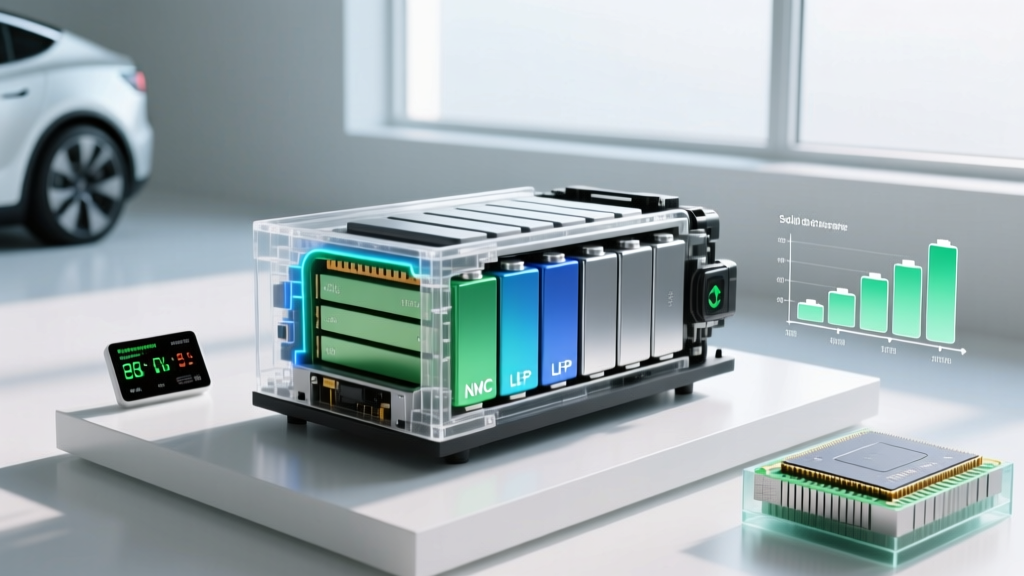
LFP (Lithium Iron Phosphate) has become the standard for standard-range models from Tesla (Model 3/Y RWD), Ford (base Mustang Mach-E), and Rivian (Standard pack). Its advantages are substantial: LFP cells tolerate being charged to 100% daily without accelerated degradation, offer 3,000–5,000+ charge cycles before significant capacity loss, and cost roughly 20–30% less per kWh to manufacture than NMC. Tesla and Ford both recommend LFP owners charge to 100% at least weekly to keep the battery management system (BMS) calibrated.
NMC (Nickel Manganese Cobalt) and NCA (Nickel Cobalt Aluminum) remain the chemistry of choice for long-range and performance models. The higher energy density (roughly 250–300 Wh/kg at the cell level vs. LFP's 160–200 Wh/kg) means more range in the same physical space. A 75 kWh NMC pack weighs significantly less than a 75 kWh LFP pack would. The trade-off: NMC degrades faster when held at high states of charge, and manufacturers typically recommend a daily charge limit of 80%.
| Attribute | LFP (Lithium Iron Phosphate) | NMC / NCA |
|---|---|---|
| Energy Density (cell-level) | 160–200 Wh/kg | 250–300 Wh/kg |
| Typical Cycle Life | 3,000–5,000+ cycles | 1,500–2,500 cycles |
| Daily Charge Recommendation | 100% OK (weekly minimum) | 80% daily, 100% for trips |
| Cold-Weather Performance | Weaker below 32°F; greater range loss | Better low-temp discharge efficiency |
| Cost per kWh (pack-level) | ~$100–$120 | ~$130–$160 |
| Common Applications | Standard-range, fleet, daily commuter | Long-range, performance, towing-heavy |
| Thermal Stability | Excellent (higher runaway threshold) | Good (requires robust thermal mgmt) |
The practical upshot: if you drive fewer than 250 miles per week, have reliable home charging, and live in a moderate climate, LFP is arguably the better long-term choice due to its cycle-life advantage and tolerance for full charges. If you regularly need 300+ miles of range, tow frequently, or live in cold-weather regions, NMC's energy density and cold performance justify the slightly more careful charging habits.
How Long Do EV Batteries Actually Last? Real Degradation Data
The question every prospective EV buyer asks: how long until the battery dies? The honest answer, backed by fleet data and owner reports, is that most EV batteries outlast the vehicle they're installed in.
According to data aggregated from Tesla's Impact Reports and independent fleet analyses, the average EV battery loses approximately 5–8% of its original capacity in the first 50,000 miles. After that initial break-in degradation, the curve flattens significantly, with roughly 1–2% additional loss per 50,000 miles under normal use patterns.
Typical EV Battery Degradation Curve (NMC Chemistry, Moderate Use):
- 0–25,000 miles: ~3–5% capacity loss (steeper initial drop as cell chemistry stabilizes)
- 25,000–50,000 miles: ~2–3% additional loss (total ~5–8% from new)
- 50,000–100,000 miles: ~2–4% additional loss (total ~8–12% from new)
- 100,000–150,000 miles: ~2–5% additional loss (total ~10–17% from new)
- 150,000–200,000 miles: ~3–6% additional loss (total ~13–23% from new)
Sources: Tesla 2024 Impact Report fleet data, Recurrent Auto battery degradation studies, fueleconomy.gov range tracking tools.
LFP batteries tend to show a more linear degradation pattern without the pronounced initial drop, but their lower energy density means you start with less range to lose. A Tesla Model 3 RWD with a ~60 kWh LFP pack rated at 272 miles EPA might realistically show 255–260 miles of usable range at 50,000 miles, while a Model 3 Long Range with a ~75 kWh NMC pack rated at 341 miles might show 315–325 miles at the same mileage.
The critical threshold for most owners isn't when the battery "dies"—it's when range drops below what your daily life requires. A 300-mile-range EV that degrades to 250 miles is still perfectly functional for most commutes. It only becomes a problem if your routine demands that original 300 miles.
What Does the Battery Warranty Actually Cover?
Federal law in the United States mandates that EV battery warranties cover a minimum of 8 years or 100,000 miles (whichever comes first). In California and states that have adopted CARB (California Air Resources Board) emissions standards—now including Colorado, Maine, Massachusetts, New York, Oregon, Vermont, Virginia, Washington, and others—the mandate extends to 10 years or 150,000 miles.
But the warranty isn't a promise of zero degradation. It's a guarantee that the battery will retain a minimum percentage of its original capacity. In most 2026 EV battery programs, that threshold is 70% capacity retention. If your 80 kWh pack drops below 56 kWh of usable capacity within the warranty period, the manufacturer must repair or replace it.
| Manufacturer | Warranty Period | Mileage Limit | Capacity Threshold | Chemistry Notes |
|---|---|---|---|---|
| Tesla (Model 3/Y RWD, LFP) | 8 years | 100,000 mi | 70% | LFP cells; 100% charging permitted |
| Tesla (Model 3/Y LR/Perf) | 8 years | 120,000 mi | 70% | NMC/NCA; 80% daily recommended |
| Hyundai / Kia (E-GMP) | 10 years | 100,000 mi | 70% | NMC; covers Ioniq 5/6, EV6, EV9 |
| Ford (Mustang Mach-E, F-150 Lightning) | 8 years | 100,000 mi | 70% | NMC (extended range); LFP (standard) |
| GM (Ultium platform) | 8 years | 100,000 mi | 70% | NMC Ultium; covers Equinox EV, Blazer EV, Silverado EV |
| Rivian (R1T, R1S) | 8 years | 175,000 mi | 70% | NMC (Large/Max); LFP (Standard) |
| BMW (Neue Klasse / iX) | 8 years | 100,000 mi | 70% | NMC cylindrical cells |
A few critical nuances that most buyers miss:
- Warranty claims require diagnostic verification. The dealer or service center will perform a capacity test. If your BMS reports 71% but a controlled discharge test shows 69%, the warranty applies.
- Physical damage and misuse void coverage. Flooding, undercarriage impacts, aftermarket modifications to the charging system, or operating the vehicle outside published temperature limits can void the warranty.
- The warranty covers the traction battery only. The 12V auxiliary battery (which powers lights, infotainment, and the contactor that connects the main pack) is covered under the standard bumper-to-bumper warranty, typically 3–5 years.
- CARB-state residents get extended coverage. If you register your EV in a CARB state, you're entitled to the 10-year/150,000-mile term regardless of where you purchased the vehicle.
EV Battery Replacement Cost: What to Budget and When You'll Need It
The fear of a $20,000+ battery replacement hangs over many prospective EV buyers. Let's put that fear in proper context with current pricing and realistic timelines.
As of 2026, battery pack replacement costs vary dramatically by vehicle, pack size, and chemistry. A full pack replacement (out of warranty) for a mainstream EV typically ranges from $8,000 to $22,000 including parts and labor. But here's the critical context: most EV batteries never need full replacement during the vehicle's useful life.
| Vehicle | Pack Size | Chemistry | Est. Replacement Cost | Typical Need Timeline |
|---|---|---|---|---|
| Tesla Model 3 RWD | ~60 kWh | LFP | $8,000–$12,000 | 200,000+ mi (rarely needed) |
| Tesla Model Y Long Range | ~75 kWh | NMC | $12,000–$16,000 | 175,000–200,000+ mi |
| Hyundai Ioniq 5 (Long Range) | 77.4 kWh | NMC | $14,000–$18,000 | 150,000–200,000 mi |
| Ford F-150 Lightning (Extended) | ~131 kWh | NMC | $18,000–$22,000 | 150,000–200,000 mi |
| Chevrolet Equinox EV | ~85 kWh | NMC (Ultium) | $12,000–$16,000 | 150,000–200,000 mi |
| Rivian R1T (Large Pack) | ~109 kWh | NMC | $16,000–$20,000 | 175,000+ mi |
Several factors are driving replacement costs down:
- Module-level repairs: Many packs allow individual module replacement rather than the full pack. A single degraded module in a Tesla Model 3 pack might cost $1,500–$3,000 to swap instead of $12,000 for the whole pack.
- Pack-level cost declines: Battery pack prices have fallen from over $200/kWh in 2020 to approximately $100–$130/kWh in 2026 for high-volume manufacturers, according to BloombergNEF tracking.
- Third-party repair networks: Companies like Electrified Garage and independent EV specialists now offer out-of-warranty battery diagnostics and module-level repairs at 30–50% below dealer pricing.
The realistic scenario for most owners: you'll sell or trade the vehicle before the battery needs replacement. The average American keeps a car for about 8.4 years and drives roughly 14,000 miles per year—that's 117,600 miles, well within the battery's functional lifespan and warranty coverage.
Five Factors That Accelerate Battery Degradation (and How to Avoid Them)
Not all EV battery programs are created equal in practice. Your charging and driving habits determine whether your pack hits 200,000 miles at 85% capacity or 75%. Here are the five biggest degradation accelerators, ranked by impact:
1. Sustained High State of Charge (SoC)
Storing an NMC battery at 100% for extended periods accelerates electrolyte decomposition and cathode structural degradation. For NMC packs, set your daily charge limit to 80% and only charge to 100% when you'll drive within a few hours. LFP packs are exempt from this concern—charge to 100% freely.
2. Frequent DC Fast Charging at High Power
DC fast charging generates significant heat inside the cells. While modern thermal management systems mitigate most of this, daily use of 150+ kW chargers does measurably accelerate degradation. Data from Recurrent Auto shows that Teslas that fast-charge more than 90% of the time show roughly 1–2% additional degradation at 100,000 miles compared to predominantly L2-charged vehicles. Use DC fast charging for road trips; rely on Level 2 for daily needs.
3. Extreme Temperature Exposure
Batteries degrade faster when exposed to sustained heat above 95°F or cold below 10°F without preconditioning. If you live in Phoenix or Minneapolis, garage parking meaningfully extends battery life. Always use your vehicle's preconditioning feature (available in Tesla, Hyundai, Ford, GM, and Rivian apps) to bring the battery to optimal temperature before fast charging or hard driving.
4. Deep Discharge Cycles (Below 10% SoC)
Regularly draining the battery below 10% stresses the anode and can cause copper dissolution in the cell. Try to keep the pack above 15–20% for daily use. The BMS maintains a small buffer (typically 2–5 kWh) below the displayed 0%, but relying on this buffer regularly is not advisable.
5. High-Performance Driving and Towing
Sustained high-current discharge (track driving, heavy towing, repeated hard acceleration) generates internal cell heat and accelerates degradation. This is why performance-oriented trims often show slightly higher degradation rates. If you tow frequently, consider the impact on your long-term range expectations.
How to Monitor Your Battery's State of Health (SoH)
State of Health (SoH) is the percentage of your battery's original capacity that remains available. A new EV has an SoH of 100%; a vehicle that has degraded to 72 kWh from an original 80 kWh pack sits at 90% SoH.
Monitoring SoH has become more accessible in recent model years:
- Tesla: The Tesla app and in-car service menu display a battery health percentage. Third-party tools like Tessie and Teslamate provide more granular SoH tracking by logging charge/discharge data over time.
- Hyundai/Kia: The MyHyundai/Kia Connect apps include battery health reporting. The in-car diagnostic menu (accessible through a hidden service screen) shows detailed cell voltage data.
- GM (Ultium): The myChevrolet/myCadillac apps report battery health metrics. OnStar diagnostics can provide detailed SoH data on request.
- Ford: FordPass includes battery health status. The OBD-II port can be used with third-party scanners like OBDLink to read detailed pack data.
- OBD-II Scanners (all brands): Tools like the OBDLink MX+ paired with apps such as ABRP (A Better Route Planner) or Car Scanner can read real-time battery data including individual cell voltages, pack temperature, and estimated capacity.
A practical approach: check your SoH quarterly by comparing a full charge (or 100% to known-SoC discharge for LFP) against your vehicle's original rated range. If your 341-mile Model 3 Long Range shows 320 miles at 100% after 30,000 miles, that's approximately 94% SoH—entirely normal. If it shows 280 miles at 100% after 30,000 miles (~82% SoH), that's abnormally fast degradation worth a service visit.
What's Next: Solid-State and Silicon Anode Batteries
Emerging battery technologies promise step-change improvements, but realistic timelines matter. Here's where things stand as of 2026:
Solid-State Batteries replace the liquid electrolyte with a solid material, theoretically doubling energy density, enabling faster charging, and dramatically improving safety (no flammable electrolyte). Toyota has announced solid-state cells for limited production in 2027–2028, initially in small volumes for premium models. Samsung SDI and QuantumScape are targeting similar timelines. However, manufacturing scale-up remains the bottleneck—expect solid-state to be a niche, high-cost option through at least 2030, reaching mainstream pricing around 2032–2035.
Silicon Anode Batteries replace the graphite anode with silicon, which can store roughly 10x more lithium ions per unit mass. Companies like Sila Nanotechnologies (supplying Mercedes-Benz for the G-Class electric) and Group14 (supplying Porsche) have begun limited production in 2025–2026. These cells offer 15–25% energy density improvements over current NMC and are expected to reach broader availability by 2028–2029.
Sodium-Ion Batteries from CATL and BYD are entering the Chinese market in low-cost city cars, offering lower energy density but dramatically lower material costs and better cold performance. US availability remains unlikely before 2028–2029 due to supply chain buildout requirements.
The practical takeaway: today's lithium-ion battery programs (LFP and NMC) are mature, well-understood, and sufficient for the vast majority of drivers. Waiting for solid-state is not a rational purchase strategy unless your timeline extends beyond 2030.
Frequently Asked Questions
How long do EV batteries last in years and miles?
Most EV batteries retain 70–85% of their original capacity at 150,000–200,000 miles, which translates to 12–15+ years of average use (14,000 miles/year). Full failure is rare; gradual range loss is the norm. The IRS §30D tax credit eligibility has no bearing on battery longevity, but the 8-year/100,000-mile minimum federal warranty provides a safety net.
How much does an EV battery cost to replace out of warranty?
Replacement costs range from approximately $8,000 for a compact LFP pack (Tesla Model 3 RWD) to $22,000 for a large NMC pack (Ford F-150 Lightning Extended Range). Module-level repairs, when possible, can cost $1,500–$5,000. Pack prices continue to decline, and third-party repair options are expanding.
What does the EV battery warranty cover, exactly?
Federal minimum coverage is 8 years/100,000 miles with a 70% capacity retention threshold. CARB states extend this to 10 years/150,000 miles. The warranty covers defects and abnormal degradation but not physical damage, misuse, or the 12V auxiliary battery. Always review your specific manufacturer's warranty booklet for exact terms.
How do I check my EV battery's State of Health?
Use your manufacturer's app (Tesla, FordPass, MyHyundai, etc.) for a quick SoH percentage. For deeper analysis, use an OBD-II scanner like OBDLink MX+ with apps like Car Scanner or ABRP to read cell-level voltage data, pack temperature, and estimated remaining capacity.
Is LFP or NMC better for my EV battery program?
Neither is universally better. LFP offers longer cycle life, lower cost, and tolerance for 100% daily charging—ideal for commuters with home charging in moderate climates. NMC offers higher energy density, better cold-weather performance, and more range in the same package—ideal for long-distance drivers, tow-heavy use, and cold climates. Choose based on your driving pattern, not marketing.
Does DC fast charging damage my EV battery?
Not significantly in moderation. Modern thermal management systems keep cells within safe temperature ranges during fast charging. However, exclusive reliance on DC fast charging (90%+ of all charges) can add 1–2% extra degradation over 100,000 miles compared to predominantly Level 2 charging. Use DCFC for road trips and L2 for daily charging.
Will my EV battery need replacing before I sell the car?
Statistically, no. The average American keeps a vehicle for 8.4 years and drives ~117,600 miles in that time. Most EV batteries at that mileage retain 75–88% of original capacity—well above the warranty threshold and entirely functional. Battery replacement during typical ownership is uncommon.