The high-voltage traction battery is the single most expensive component in any electric vehicle. It defines your range, your charging speed, your winter usability, and — eventually — your resale value. Yet for most buyers, battery chemistry and longevity remain the murkiest part of the EV purchase decision. This guide cuts through the marketing to give you the exact numbers on degradation, warranty coverage, replacement costs, and the emerging chemistries that will define the next generation of EVs.
LFP vs NMC vs NCA: Which Chemistry Should You Care About?
Every EV sold in the US today uses a lithium-ion battery, but not all lithium-ion cells are built the same. The cathode chemistry determines energy density, cycle life, cold-weather performance, and cost. The three chemistries you'll encounter are:
- NMC (Nickel Manganese Cobalt): The workhorse of long-range EVs. Used in most Hyundai/Kia E-GMP vehicles, Ford Mustang Mach-E, BMW iX, and VW ID.4. High energy density (~250-300 Wh/kg at the cell level) enables 300+ mile ranges in manageable pack sizes.
- NCA (Nickel Cobalt Aluminum): Tesla's primary chemistry for Long Range and Performance models (Panasonic cells). Similar energy density to NMC with slightly higher specific energy, enabling the Model 3 LR's ~75 kWh usable pack to deliver 341 miles EPA.
- LFP (Lithium Iron Phosphate): The cost leader. Used in Tesla Model 3/Y Standard Range, Ford F-150 Lightning Standard Range, and many Chinese-market vehicles. Lower energy density (~160-200 Wh/kg) means heavier packs for the same range, but dramatically longer cycle life and zero cobalt.
| Attribute | LFP (LiFePO₄) | NMC / NCA |
|---|---|---|
| Energy density (cell) | 160–200 Wh/kg | 250–300 Wh/kg |
| Typical cycle life | 3,000–5,000+ cycles | 1,000–2,500 cycles |
| Cold performance (−10°C) | Moderate loss; needs preconditioning | Better low-temp conductivity |
| Thermal runaway risk | Very low | Higher; requires robust BMS |
| Cobalt content | None | Present (NMC); minimal (NCA) |
| Cost per kWh (2026 est.) | ~$80–$100 | ~$110–$140 |
| Recommended SoC ceiling | 100% (charge to full regularly) | 80% daily; 100% for trips only |
| Best for | Daily commuters, standard-range, fleet | Long-range road-trippers, performance |
The practical takeaway: If you're buying a Tesla Model 3 Standard Range or a base F-150 Lightning, you're getting LFP — and you should charge it to 100% regularly to keep the battery management system (BMS) calibrated. If you're in a Long Range or Performance trim, you're on NMC/NCA, and daily charging should stop at 80% to minimize cathode stress.
How Long Do EV Batteries Actually Last?
The fear of a $20,000 battery swap at 100,000 miles is the most persistent myth in EV ownership. Real-world data from high-mileage fleets and owner tracking tells a different story.
According to data compiled by Recurrent Auto, which tracks over 15,000 EVs in real-world use, the average EV battery retains approximately 90–95% of its original capacity after 5 years / 100,000 miles. Degradation follows a curve that is steepest in the first 1–2 years (roughly 2–5% loss as the solid electrolyte interphase stabilizes), then flattens significantly.
- Year 1 / 15,000 mi: ~97–98% capacity retained
- Year 3 / 45,000 mi: ~93–95% capacity retained
- Year 5 / 75,000 mi: ~90–93% capacity retained
- Year 8 / 120,000 mi: ~85–90% capacity retained
- Year 10 / 150,000 mi: ~80–88% capacity retained
LFP packs in similar conditions show even slower degradation, with many Tesla Model 3 Standard Range owners reporting 95%+ retention at 60,000 miles.
For context, the US average vehicle is driven ~13,500 miles/year per FHWA data. A battery retaining 85% of its capacity at 150,000 miles — roughly 11 years of driving — still provides usable range. A 300-mile EPA vehicle at 85% health delivers ~255 real-world miles. That's not a crisis; it's a modest reduction.
The critical insight: most EV batteries will outlast the vehicle they're installed in. Total-loss battery failures before 150,000 miles are rare — typically under 1.5% of vehicles, per Recurrent's dataset. When premature failures do occur, they're almost always covered under warranty.
What the Battery Warranty Actually Covers
Federal law mandates that EV battery warranties cover a minimum of 8 years / 100,000 miles. In California Air Resources Board (CARB) states — which include CA, CO, CT, MA, MD, ME, MN, NJ, NY, OR, RI, VA, VT, and WA — the mandate extends to 10 years / 150,000 miles for certain components.
But the warranty doesn't guarantee zero degradation. It guarantees that capacity won't fall below a specified threshold. Here's what major manufacturers commit to:
| Manufacturer | Duration | Mileage | Capacity Threshold |
|---|---|---|---|
| Tesla (Model 3/Y NMC) | 8 years | 120,000 mi | 70% retention |
| Tesla (Model 3/Y LFP) | 8 years | 100,000 mi | 70% retention |
| Hyundai / Kia | 10 years | 100,000 mi | 70% retention |
| Ford | 8 years | 100,000 mi | 70% retention |
| GM (Ultium) | 8 years | 100,000 mi | 70% retention |
| BMW | 8 years | 100,000 mi | 70% retention |
| Rivian | 8 years | 175,000 mi | 70% retention |
What triggers a warranty claim: If your battery's State of Health (SoH) drops below the threshold — typically 70% of original capacity — within the warranty period, the manufacturer must repair or replace the battery at no cost. In practice, most manufacturers will first attempt module-level repair (replacing individual degraded modules within the pack) rather than a full pack swap.
What voids the warranty: Modifications to the battery system, use of non-OEM charging equipment that causes damage, physical damage from collisions or flooding, and (in some cases) consistent DC fast-charging exclusively without any Level 2 use. Read your specific warranty booklet — the terms vary.
EV Battery Replacement Cost: The Real Numbers
When a battery does need replacement outside warranty — typically at very high mileage (200,000+ miles) or due to physical damage — the cost is significant but often overstated in media coverage.
| Vehicle | Pack Size | Chemistry | Estimated Cost (parts + labor) |
|---|---|---|---|
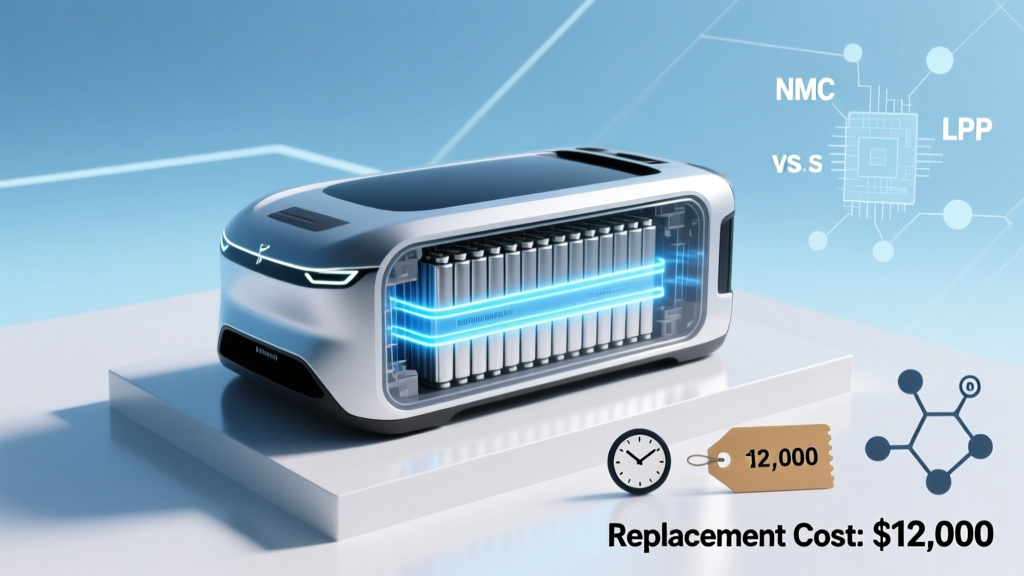
| Tesla Model 3 Standard Range | ~60 kWh | LFP | $10,000 – $14,000 |
| Tesla Model 3 Long Range | ~75 kWh | NCA | $13,000 – $18,000 |
| Hyundai Ioniq 5 | 77.4 kWh | NMC | $14,000 – $19,000 |
| Ford F-150 Lightning Extended | ~131 kWh | NMC | $20,000 – $30,000 |
| Chevrolet Equinox EV | ~85 kWh | NMC | $14,000 – $18,000 |
| BMW iX xDrive50 | ~111.5 kWh | NMC | $22,000 – $28,000 |
These figures include the battery pack and installation labor but can vary by region and service center. Several important caveats:
- Module-level repair is increasingly common. A single degraded or failed module can often be replaced for $2,000–$5,000 without swapping the entire pack.
- Battery prices continue to fall. Pack-level pricing has dropped from ~$200/kWh in 2020 to roughly $110–$130/kWh in 2026, per BloombergNEF tracking. By the time most current EVs need an out-of-warranty replacement (2035+), costs will likely be substantially lower.
- Refurbished packs are an emerging option. Third-party companies now offer remanufactured packs at 30–50% below new OEM pricing for popular models.
Five Factors That Accelerate (or Slow) Battery Degradation
Battery chemistry sets the ceiling, but your habits determine where your pack lands on the degradation curve. Here are the five factors with the largest measured impact, ranked by influence:
- State of Charge (SoC) extremes: Sitting at 100% SoC for extended periods stresses NMC/NCA cathodes through elevated voltage. Sitting near 0% risks copper dissolution in the anode. The 20–80% daily window is the longevity sweet spot for NMC/NCA. LFP is the exception — it tolerates 100% well and actually benefits from periodic full charges for BMS calibration.
- Temperature exposure: Battery degradation accelerates significantly above 35°C (95°F) and below −10°C (14°F). Vehicles with active liquid thermal management (Tesla, Hyundai E-GMP, GM Ultium, BMW) handle this far better than passively cooled packs. Garage parking in hot climates measurably extends pack life.
- DC fast-charging frequency: Occasional DC fast charging (1–2 times/week) has minimal impact. Daily exclusive DC fast charging at 150+ kW increases degradation by roughly 1–3% over 100,000 miles compared to Level 2 charging, per Recurrent data. The real risk is high-power charging on a hot battery without preconditioning.
- Depth of discharge cycles: Shallow cycles (e.g., 40%–70%) cause less wear than deep cycles (10%–90%). If your commute uses only 20% of the pack, you're accumulating very low cycle wear.
- Calendar aging: Even a parked EV battery degrades over time. A vehicle sitting at 50% SoC in moderate temperatures loses roughly 1–2% capacity per year from calendar aging alone. Storing at 100% SoC in heat accelerates this to 3–5% annually.
- ☐ Set daily charge limit to 80% (NMC/NCA) or 100% (LFP)
- ☐ Enable scheduled departure / preconditioning to warm the battery before driving and charging
- ☐ Use Level 2 home charging as your primary method; reserve DCFC for road trips
- ☐ Avoid leaving the vehicle at 0% or 100% SoC for more than 24 hours
- ☐ Park in shade or a garage in hot climates when possible
- ☐ If storing for 2+ weeks, set SoC to ~50% and disable Sentry Mode / vampire-drain features
How to Check Your Battery's State of Health
State of Health (SoH) is the percentage of original capacity your battery currently holds. Unlike a fuel tank, you can't measure it by looking at the range estimate — that number fluctuates with temperature, driving style, and BMS estimation drift.
OEM methods:
- Tesla: No native SoH display in the app or vehicle. Third-party tools like Tessie or the Scan My Tesla OBD2 reader can pull SoH from the BMS. Tesla service centers can run a battery health test on request.
- Hyundai / Kia: The infotainment system (on 2024+ models) includes a battery health screen under EV settings. The Hyundai/Kia app also surfaces SoH on newer model years.
- GM (Ultium vehicles): The myChevrolet / myCadillac app includes a battery health indicator for 2024+ models.
- Ford: FordPass provides a battery health status, though it's less granular than a percentage — typically showing "normal" or flagging when service is needed.
- BMW: The iDrive system and My BMW app include a battery health certificate that can be generated for resale.
Third-party methods: OBD2 dongles paired with apps like ABRP (A Better Route Planner), OBDeleven, or Car Scanner can read SoH directly from the BMS on most vehicles. For a definitive measurement, a controlled capacity test — charging from 0% to 100% at a known rate and measuring actual kWh delivered — gives the most accurate SoH figure. Some independent EV shops offer this service for $50–$150.
When to check: Pull your SoH reading once per quarter. If you notice an unexpected drop of more than 2–3% in a single quarter, schedule a service visit — it may indicate a module imbalance rather than normal degradation.
What's Next: Solid-State, Silicon Anodes, and Sodium-Ion
The current generation of lithium-ion batteries is mature and reliable, but several next-generation technologies are moving from lab to production. Here's where each stands as of 2026, with realistic timelines:
Solid-state batteries: These replace the liquid electrolyte with a solid ceramic or polymer separator, promising higher energy density (potentially 400–500 Wh/kg at the cell level), faster charging, and reduced fire risk. Toyota has announced a solid-state battery targeting 2027–2028 production in limited volumes, initially in hybrid applications. Samsung SDI and QuantumScape (backed by VW) are also pursuing solid-state cells, but commercial-scale manufacturing remains the primary bottleneck. Realistic timeline for widespread EV adoption: 2029–2032. Early solid-state packs will likely debut in premium vehicles at high cost before reaching mainstream pricing.
Silicon-dominant anodes: Current lithium-ion cells use graphite anodes. Replacing graphite with silicon can increase anode capacity by up to 10x, boosting overall cell energy density by 20–40%. Companies like Sila Nanotechnologies and Group14 are supplying silicon anode materials to battery manufacturers now. The Mercedes-Benz G-Class electric (announced) is expected to feature silicon anode cells from Factorial Energy. This technology is arriving incrementally through 2026–2028, blended into existing NMC cells rather than as a standalone revolution.
Sodium-ion (Na-ion): CATL and BYD have begun producing sodium-ion cells for low-cost, short-range EVs in China. Sodium is abundant and cheap, but energy density is ~30% lower than LFP — limiting Na-ion to city cars and micro-EVs with 150–200 mile ranges. US-market availability is uncertain and likely 2028+ at the earliest, dependent on supply chain buildout.
LFP improvements: LMFP (lithium manganese iron phosphate) adds manganese to LFP, boosting energy density by ~15–20% while retaining LFP's cost and safety advantages. CATL's second-generation LMFP cells are expected in vehicles by 2027. This is arguably the most impactful near-term development for mainstream EVs, as it narrows the energy-density gap between LFP and NMC without adding cobalt.
Frequently Asked Questions
How long do EV batteries last in years and miles?
Based on fleet data from Recurrent Auto, most EV batteries retain 85–90% of original capacity at 150,000 miles (roughly 11 years of average US driving). Total battery failure before 150,000 miles is rare — under 1.5% of vehicles. With proper care, a modern EV battery should last the lifetime of the vehicle.
How much does an EV battery cost to replace?
Out-of-warranty replacement costs range from ~$10,000 for a 60 kWh LFP pack (Tesla Model 3 Standard Range) to ~$25,000–$30,000 for a 130+ kWh NMC pack (F-150 Lightning Extended Range). However, most replacements are covered under the 8-year/100,000-mile federal warranty mandate, and module-level repairs ($2,000–$5,000) are increasingly common. Battery pack costs are declining ~8–10% annually.
What does the EV battery warranty cover?
Federal law requires a minimum 8-year/100,000-mile warranty on EV batteries, with a capacity retention threshold (typically 70% of original capacity). If your battery's SoH drops below this threshold within the warranty period, the manufacturer must repair or replace it at no cost. In CARB states, coverage extends to 10 years/150,000 miles. Warranties do not cover physical damage from accidents or modifications.
How do I check my EV battery's health?
Methods vary by brand. Hyundai/Kia and BMW offer SoH displays in-vehicle or via their apps. Tesla requires third-party OBD2 tools or a service center visit. For the most accurate measurement, an independent EV shop can perform a controlled capacity test ($50–$150). Check SoH quarterly; flag any drop exceeding 2–3% in a single quarter.
LFP vs NMC — which battery chemistry is better?
Neither is universally better; they serve different use cases. LFP offers longer cycle life (3,000–5,000 cycles vs 1,000–2,500), lower cost, zero cobalt, and can be charged to 100% daily — but it's heavier and loses more range in extreme cold. NMC/NCA delivers higher energy density for longer range in a lighter pack, making it the right choice for 300+ mile vehicles and cold-climate drivers. If you prioritize longevity and daily commuting, LFP is the stronger pick. If you need maximum range and road-trip capability, NMC/NCA is the answer.
Does frequent DC fast charging damage the battery?
Occasional DC fast charging has minimal impact on battery health. However, exclusive reliance on DCFC (no Level 2 charging) can increase degradation by 1–3% over 100,000 miles compared to primarily Level 2 charging, per fleet data. The biggest risk factor is high-power DC charging on a hot battery without preconditioning. Always use your vehicle's battery preconditioning feature before fast-charging sessions.
Will solid-state batteries make my current EV obsolete?
Not anytime soon. Solid-state batteries are targeting limited production in 2027–2028 for premium vehicles, with mainstream availability unlikely before 2029–2032. Even when available, early solid-state EVs will carry a significant price premium. Your current NMC or LFP battery will remain competitive in range and usability for years, and its proven track record is an advantage over first-generation solid-state packs.