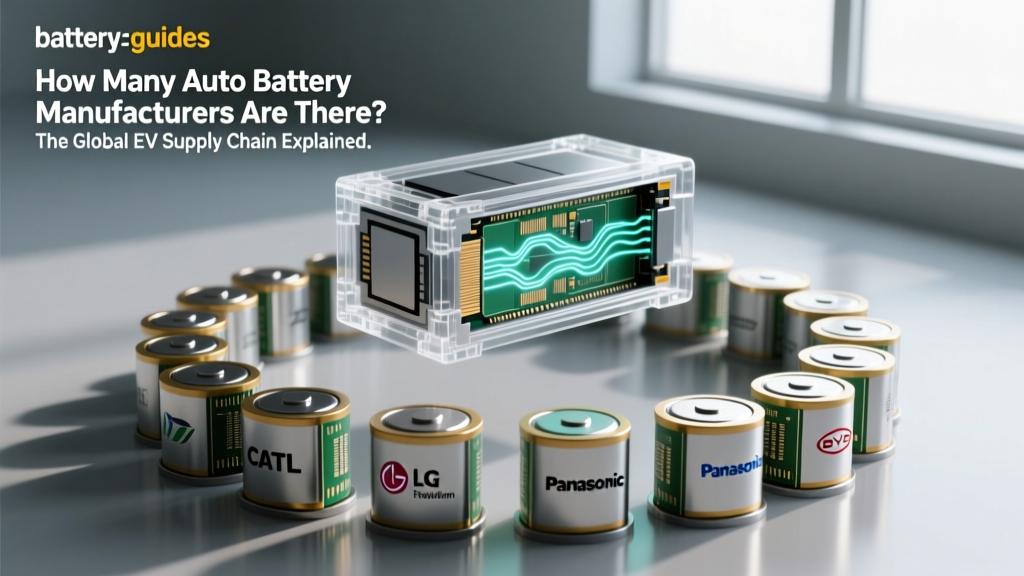
If you've ever wondered who actually builds the battery pack inside your electric vehicle, the answer is more complex—and more concentrated—than most buyers realize. The question how many auto battery manufacturers are there doesn't have a single neat number, because it depends on whether you're counting cell producers, pack assemblers, or the automakers who vertically integrate their own production. What we can say with confidence: roughly a dozen companies dominate global EV battery cell output, with the top six controlling over 85% of the market as of 2026.
But understanding the battery landscape isn't just an industry trivia exercise. The manufacturer behind your cells influences chemistry choice (LFP vs. NMC), long-term degradation behavior, warranty structure, and eventual replacement cost. This guide maps the major players, then dives into what actually matters for owners: how long these batteries last, what they cost to replace, and how to maximize their lifespan.
The Major EV Battery Manufacturers in 2026
Global EV battery cell production is dominated by Asian conglomerates, though North American and European capacity is expanding rapidly due to IRA-driven manufacturing incentives. Here are the key players supplying cells to vehicles sold in the U.S. market:
- CATL (China) — The world's largest battery maker by volume. Supplies Tesla, Ford, BMW, Volkswagen, and many others. A leader in LFP (lithium iron phosphate) cell production and developing condensed-matter battery tech.
- BYD (China) — Vertically integrated automaker and cell maker. Its Blade Battery (LFP) is used in its own vehicles and supplied to Tesla, Toyota, and others.
- LG Energy Solution (South Korea) — Major supplier to GM, Ford, Stellantis, Volvo, and Tesla. Operates joint-venture plants in the U.S. (Ultium Cells with GM).
- Panasonic (Japan) — Longtime Tesla partner, producing 2170 and 4680-format cylindrical cells at the Nevada Gigafactory and new Kansas facility.
- SK On (South Korea) — Supplies Ford and Hyundai/Kia. Operates U.S. joint ventures (BlueOval SK with Ford).
- Samsung SDI (South Korea) — Supplies BMW, Stellantis, and Rivian. Investing heavily in solid-state R&D.
- AESC (Japan/China-owned, Envision) — Original Nissan Leaf battery supplier, now expanding in the U.S. and UK.
- Gotion High-Tech (China) — Backed by Volkswagen. Building LFP plants in the U.S. (Illinois) for domestic supply.
- Northvolt (Sweden) — European-focused, supplying BMW, Volvo, and Scania. Operating in Sweden with a planned Canadian gigafactory.
- Redwood Materials (U.S.) — Founded by ex-Tesla CTO JB Straubel. Focused on recycling and domestic cathode/anode material production rather than raw cell output.
Beyond these, there are dozens of smaller or regional cell producers (EVE Energy, CALB, Farasis, SVOLT) and a growing number of automaker-led cell ventures (Tesla's in-house 4680 line, GM's Ultium Cells JV, VW's PowerCo). If you count every entity producing lithium-ion cells for passenger EVs globally, the number exceeds 40—but the top ten supply the overwhelming majority of vehicles on American roads.
LFP vs. NMC/NCA: Which Chemistry Is in Your EV?
The cell manufacturer often dictates which chemistry your EV uses. The two dominant lithium-ion chemistries in 2026 are LFP (lithium iron phosphate) and NMC/NCA (nickel manganese cobalt / nickel cobalt aluminum). Each has distinct trade-offs that affect range, longevity, and cost.
| Attribute | LFP (Lithium Iron Phosphate) | NMC / NCA (Nickel-Based) |
|---|---|---|
| Energy Density | Lower (~160–180 Wh/kg cell-level) | Higher (~220–300 Wh/kg cell-level) |
| Typical Use Case | Standard-range / affordable trims | Long-range / performance trims |
| Cycle Life | 3,000–5,000+ cycles to 80% SoH | 1,000–2,500 cycles to 80% SoH |
| Cold-Weather Performance | Weaker; greater range loss below freezing | Better low-temp discharge capability |
| Thermal Stability | Excellent; very low thermal runaway risk | Good, but requires more robust BMS/cooling |
| Cost (per kWh) | ~$80–100/kWh at cell level | ~$110–140/kWh at cell level |
| Recommended Charge Habit | Can charge to 100% daily without harm | Best kept at 80% daily; 100% for trips only |
| Key Manufacturers | CATL, BYD, Gotion | LG, Panasonic, Samsung SDI, SK On |
Which is better? Neither is universally superior. LFP wins on cost, cycle life, and safety—making it ideal for daily commuting and budget-friendly trims (Tesla Model 3 RWD, Ford Mustang Mach-E Select, base Chevrolet Equinox EV). NMC wins on energy density, enabling 300+ mile ranges in smaller, lighter packs—critical for long-range variants and larger vehicles like the Rivian R1S or GMC Sierra EV. If you live in a cold climate and need maximum winter range, NMC still holds an edge. If you want a battery that will outlast the car with minimal degradation, LFP is hard to beat.
How Long Do EV Batteries Actually Last?
The short answer: almost certainly longer than you'll own the vehicle. Modern EV batteries are engineered for 15–20 years of service or 200,000+ miles before reaching end-of-life (typically defined as 70% of original capacity).
Here's what real-world degradation data shows across popular platforms:
| Vehicle / Platform | Chemistry | Typical Degradation at 100k Miles | Source / Notes |
|---|---|---|---|
| Tesla Model 3/Y (NMC) | NMC (2170 cells, Panasonic/LG) | ~8–12% loss at 100,000 mi | Tesla Impact Report 2024; fleet data |
| Tesla Model 3 RWD (LFP) | LFP (CATL) | ~4–7% loss at 100,000 mi | Fleet telemetry aggregations |
| Chevrolet Bolt EV/EUV | NMC (LG) | ~6–10% loss at 100,000 mi | Recurrent Auto fleet data |
| Hyundai Ioniq 5 / Kia EV6 | NMC (SK On) | ~7–10% loss at 100,000 mi | Owner-reported; Recurrent |
| Ford Mustang Mach-E | NMC (LG/SK On) | ~8–11% loss at 100,000 mi | Ford warranty data; fleet studies |
| Nissan Leaf (40/62 kWh) | NMC (AESC) | ~12–18% loss at 100,000 mi | Leaf Spy community data; passive cooling limitation |
The Nissan Leaf's higher degradation is a known outlier, largely attributed to its passive air-cooling system (no active liquid thermal management). Every mainstream EV sold in the U.S. since roughly 2018 uses liquid-cooled packs, which dramatically slows degradation.
Key takeaway: Expect roughly 8–12% capacity loss over 100,000 miles for a modern liquid-cooled NMC pack, and 4–8% for LFP. At 200,000 miles, most packs will retain 75–88% of original capacity—well above the 70% threshold that defines "end of life" for most warranty purposes.
What Does the Battery Warranty Actually Cover?
Federal law in the U.S. mandates that EV batteries carry a minimum warranty of 8 years or 100,000 miles (whichever comes first). In California Air Resources Board (CARB) states, that extends to 10 years or 150,000 miles. Most automakers meet or exceed these minimums.
| Automaker | Warranty Period | Capacity Retention Threshold | Notes |
|---|---|---|---|
| Tesla | 8 yr / 120,000 mi (Model 3/Y LR); 8 yr / 100,000 mi (RWD) | 70% | Transferable to subsequent owners |
| General Motors (Chevy, Cadillac, GMC) | 8 yr / 100,000 mi | 70% | Ultium platform; covers battery and EV-specific components |
| Hyundai / Kia / Genesis | 10 yr / 100,000 mi | 70% | Among the most generous terms in the industry |
| Ford | 8 yr / 100,000 mi | 70% | Covers high-voltage battery and hybrid/EV components |
| BMW | 8 yr / 100,000 mi | 70% | Includes battery conditioning system |
| Rivian | 8 yr / 175,000 mi | 70% | Higher mileage cap reflects adventure-use positioning |
| Volkswagen / Audi | 8 yr / 100,000 mi | 70% | MEB and PPE platforms |
What's covered: Capacity loss below the stated threshold (e.g., if your 82 kWh pack drops below 57.4 kWh usable within the warranty window). Also covered: defects in materials, manufacturing, and the battery management system (BMS).
What's typically NOT covered: Gradual degradation above the threshold, damage from accidents, improper charging (e.g., using non-compliant equipment), or modifications. Always read your specific warranty booklet—terms vary.
EV Battery Replacement Cost: What to Expect
This is the question that haunts prospective EV buyers. The honest answer: full battery replacement is rare, usually unnecessary within the vehicle's practical lifespan, and costs have been falling steadily. But when it is needed, here's what you're looking at in 2026:
| Vehicle | Battery Size (usable kWh) | Chemistry | Estimated Replacement Cost (parts + labor) |
|---|---|---|---|
| Tesla Model 3 RWD | ~57 kWh | LFP | $10,000–$13,000 |
| Tesla Model Y Long Range | ~75 kWh | NMC | $13,000–$16,000 |
| Chevrolet Equinox EV | ~85 kWh | NMC (Ultium) | $14,000–$17,000 |
| Hyundai Ioniq 5 | ~77.4 kWh | NMC | $13,000–$16,000 |
| Ford F-150 Lightning (Extended) | ~131 kWh | NMC | $20,000–$28,000 |
| Rivian R1T (Max Pack) | ~149 kWh | NMC | $22,000–$30,000 |
| GMC Hummer EV | ~212 kWh | NMC (Ultium, dual-layer) | $30,000–$40,000 |
These figures represent full pack replacement at current pricing. Several important caveats:
- Module-level repair is increasingly common. Many shops (and automakers) can replace individual modules rather than the entire pack, reducing costs to $2,000–$6,000 for a partial repair.
- Refurbished packs are becoming available through OEM and third-party channels at 40–60% of new-pack cost.
- Most batteries outlive the car. According to data from Recurrent Auto, fewer than 5% of EVs on the road have needed a battery replacement as of 2025—and the vast majority of those were due to manufacturing defects covered under warranty, not wear-out.
- Cell prices continue to fall. Pack-level pricing has dropped below $130/kWh for NMC and under $90/kWh for LFP at scale. A replacement in 2035 will almost certainly cost significantly less than today.
Factors That Accelerate (or Slow) Battery Degradation
Your battery's lifespan isn't purely a function of time and miles. How you use it matters enormously. Here are the primary factors, ranked by impact:
High-Impact Factors
- Sustained high State of Charge (SoC): Storing an NMC battery at 100% for days or weeks accelerates electrolyte decomposition. Keep daily charge at 80% unless departing on a trip. LFP is more tolerant of 100% storage—follow your manufacturer's guidance.
- Extreme heat exposure: Prolonged operation or storage above 104°F (40°C) without active cooling degrades cells faster. If you live in Arizona or Texas, garage parking and preconditioning help significantly.
- Frequent DC fast charging at high power: Occasional fast charging is fine. But daily use of 150+ kW chargers, especially without proper battery preconditioning, adds stress. Tesla's own data shows vehicles that fast-charge >90% of the time exhibit ~1–2% additional degradation over 100k miles compared to primarily Level 2 charging.
Moderate-Impact Factors
- Deep discharges to 0%: Letting the battery sit at or near 0% SoC for extended periods causes copper dissolution in the anode. Charge to at least 20% if storing.
- Cold-weather fast charging without preconditioning: Charging a cold battery at high power causes lithium plating on the anode—permanent capacity loss. Always use your vehicle's navigation-to-charger preconditioning feature (available on Tesla, GM Ultium, Hyundai E-GMP, Ford, Rivian, and most modern platforms).
Low-Impact Factors
- Normal highway driving and regenerative braking: These have negligible impact on long-term health.
- Moderate ambient temperatures: Operating between 50–85°F is the battery's sweet spot and causes minimal extra wear.
How to Check and Monitor Your Battery's State of Health
State of Health (SoH) is the percentage of your battery's current maximum capacity relative to its original capacity when new. A brand-new EV has 100% SoH; at 70%, most warranties consider it "end of life." Here's how to monitor it:
- In-vehicle displays: Tesla shows estimated range and, on newer software, a battery health percentage in Settings → Battery. Hyundai/Kia provide SoH readouts in the EV menu. GM's Ultium vehicles display battery health via the myChevrolet/myCadillac app.
- OBD-II diagnostic tools: Devices like the OBDLink MX+ paired with apps such as Leaf Spy (Nissan), Scan My Tesla, or ABRP can read SoH directly from the BMS. This is the most accurate consumer-accessible method.
- Third-party services: Companies like Recurrent offer battery health reports that compare your pack's degradation to fleet averages for your specific model.
- Dealer diagnostic checks: Most service centers can pull a detailed SoH report during routine service. Request this before purchasing a used EV.
Practical tip: Check SoH every 6–12 months, or before and after extreme seasons. A sudden drop (more than 2–3% in a short period) warrants a dealer inspection—it may indicate a failing module rather than normal degradation.
Emerging Battery Technology: What's Next?
The battery landscape is evolving rapidly. Here's what's on the horizon—marked with realistic timelines based on current production announcements:
- Solid-state batteries: Promise 30–50% higher energy density, faster charging, and improved safety by replacing the liquid electrolyte with a solid ceramic or polymer. Toyota has announced limited production in select 2027–2028 models; Samsung SDI targets 2027 mass production. Realistically, widespread availability in mainstream U.S. EVs is a 2029–2032 prospect. Expect early adoption in premium segments first.
- Silicon-dominant anodes: Companies like Sila Nanotechnologies and Group14 are replacing graphite anodes with silicon composites, boosting energy density by 20–40%. Already appearing in limited applications (Mercedes G-Wagen, certain Panasonic cells). Broader rollout expected 2026–2028.
- Sodium-ion batteries: CATL has begun shipping sodium-ion cells in Chinese-market vehicles. Lower energy density than LFP but cheaper and free of lithium/cobalt. U.S. market availability remains uncertain—likely 2028+ for low-cost urban EVs.
- LMFP (lithium manganese iron phosphate): An evolution of LFP with ~15–20% higher energy density while retaining LFP's cost and safety advantages. CATL and Gotion are ramping production. Expected in U.S.-market vehicles by 2027–2028.
None of these technologies are available in vehicles you can buy today in the U.S. market. If you're shopping now, current LFP and NMC chemistries from the manufacturers listed above are mature, reliable, and backed by extensive warranty coverage. Waiting for solid-state means waiting years—and early versions will carry premium pricing.
Frequently Asked Questions
How many auto battery manufacturers supply the U.S. EV market?
Approximately 10–12 major cell manufacturers supply the vast majority of EVs sold in the United States, including CATL, BYD, LG Energy Solution, Panasonic, SK On, Samsung SDI, AESC, and Gotion. Including smaller and regional players, over 40 companies produce EV battery cells globally.
How long do EV batteries last in years and miles?
Modern liquid-cooled EV batteries are designed to last 15–20 years or 200,000+ miles before dropping below 70% of original capacity. Real-world fleet data from fueleconomy.gov and Recurrent Auto shows most packs retain 80–90% capacity at 100,000 miles.
How much does it cost to replace an EV battery?
Full replacement costs range from roughly $10,000 for smaller LFP packs (Tesla Model 3 RWD) to $30,000–$40,000 for very large packs (GMC Hummer EV, Rivian Max Pack). However, fewer than 5% of EVs have required battery replacement, and most failures are covered under warranty. Module-level repairs cost $2,000–$6,000.
What does the EV battery warranty cover?
Federal minimum is 8 years / 100,000 miles (10 years / 150,000 miles in CARB states). Coverage applies if capacity drops below 70% of original. Some automakers, like Hyundai/Kia and Rivian, offer more generous terms. Warranties cover defects and premature degradation but not damage from accidents, misuse, or normal wear above the threshold.
How do I maximize my EV battery's lifespan?
For NMC batteries: charge to 80% daily, avoid storing at 100% or 0% for extended periods, use DC fast charging sparingly, and always precondition before fast charging in cold weather. For LFP batteries: follow your manufacturer's guidance—many recommend charging to 100% at least weekly for accurate BMS calibration. Garage parking in extreme heat helps all chemistries.
LFP vs. NMC—which battery chemistry should I choose?
Choose LFP if you prioritize longevity, lower cost, and daily commuting with home charging. Choose NMC if you need maximum range, live in a cold climate, or frequently road-trip. LFP batteries tolerate 100% charging better and last more cycles; NMC batteries pack more energy into a smaller, lighter space and perform better in freezing temperatures.