The high-voltage traction battery is the single most expensive component in any electric vehicle, yet most buyers spend more time debating paint colors than understanding what's inside the pack. The global supply chain for EV batteries has consolidated around a handful of major electric vehicle battery manufacturers — CATL, BYD, LG Energy Solution, Panasonic, SK On, and Samsung SDI — each supplying different chemistries and cell formats to the automakers you know. Understanding who makes your battery, what chemistry it uses, and how that chemistry ages is the difference between confident ownership and expensive surprises.
This guide breaks down the major manufacturers, the LFP versus NMC/NCA chemistry decision that now defines the market, real-world degradation data, warranty structures, and the actual cost of replacement if you ever need one.
Who Are the Major Electric Vehicle Battery Manufacturers?
Six companies dominate global EV battery cell production as of the 2026 model year. Each supplies multiple automakers and often produces both LFP and nickel-based chemistries depending on the application:
- CATL (Contemporary Amperex Technology Co. Limited): The world's largest battery maker by volume, headquartered in China. Supplies Tesla (Model 3/Y Standard Range with LFP), Ford (Mustang Mach-E LFP variants), BMW, Mercedes-Benz, and numerous Chinese OEMs. Known for pioneering LFP at scale and developing sodium-ion cells for budget segments.
- BYD (Build Your Dreams): Vertically integrated Chinese automaker and battery supplier. Produces the proprietary Blade Battery (LFP in a cell-to-pack configuration). Supplies its own vehicles and has begun external supply to Tesla and Toyota for select models.
- LG Energy Solution: South Korean manufacturer and a primary supplier for GM (Ultium platform), Ford, Hyundai/Kia, Stellantis, and Volvo. Specializes in NMC pouch and cylindrical cells with high energy density. Operates joint-venture plants in the US (Ultium Cells with GM).
- Panasonic: Longtime Tesla partner, producing 2170 and 4680 cylindrical NCA/NMC cells at Gigafactory Nevada and newer Kansas facilities. Also supplies Toyota. Known for consistent quality and high energy density in cylindrical format.
- SK On: South Korean firm supplying Ford (F-150 Lightning, BlueOvalSK JV), Hyundai, and Mercedes-Benz. Focuses on NMC pouch cells and is scaling US production aggressively.
- Samsung SDI: Supplies BMW, Stellantis, and Rivian. Produces both NMC prismatic and cylindrical cells, and is investing heavily in solid-state development.
The automaker brand on the badge rarely makes its own cells. Tesla, for instance, sources LFP cells from CATL for Standard Range models and NCA cells from Panasonic for Long Range and Performance trims. The chemistry and cell supplier vary by trim, model year, and production batch — which is why checking your specific vehicle's battery label matters.
LFP vs. NMC/NCA: The Chemistry Trade-Off Explained
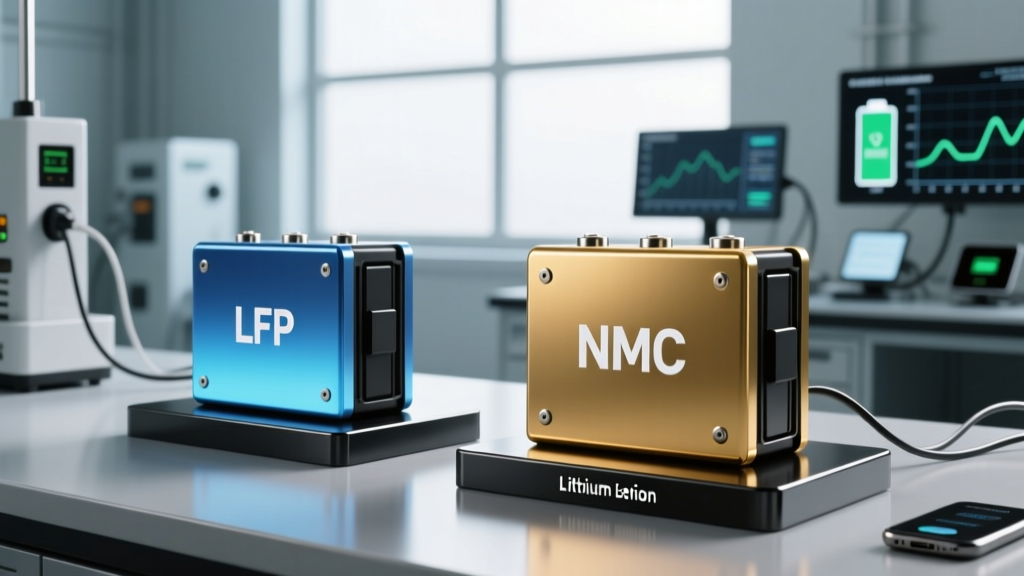
The two dominant lithium-ion chemistries in 2026 EVs are LFP (lithium iron phosphate) and NMC/NCA (nickel manganese cobalt / nickel cobalt aluminum). Neither is universally "better" — the right choice depends on your driving patterns, climate, and budget. Here's how they compare on the metrics that matter:
| Attribute | LFP (Lithium Iron Phosphate) | NMC / NCA (Nickel-Based) |
|---|---|---|
| Energy Density | Lower (~160-180 Wh/kg cell-level) | Higher (~220-300 Wh/kg cell-level) |
| Typical EPA Range (same vehicle platform) | 10-15% less range than NMC equivalent | Maximum range for the platform |
| Cycle Life | 3,000-5,000+ full cycles to 80% SoH | 1,000-2,000 full cycles to 80% SoH |
| Cold-Weather Performance | More range loss in freezing temps (20-30% reduction common) | Better cold performance (15-25% reduction typical) |
| DC Fast Charge Tolerance | Handles frequent 100% charging well; can charge to 100% daily | Best kept between 20-80% daily; 100% for trips only |
| Cost (cell-level) | ~15-25% cheaper per kWh than NMC | Higher due to nickel/cobalt commodity pricing |
| Thermal Stability | Excellent — very resistant to thermal runaway | Good but requires more robust BMS and cooling |
| Common in These Trims | Standard Range / base models (Tesla Model 3 RWD, Mach-E Select LFP) | Long Range, Performance, AWD trims |
The practical takeaway: If you charge at home daily, drive under 250 miles per day, and live in a moderate climate, LFP offers superior longevity and lower cost. If you need maximum range for road trips, live in a cold climate, or want the performance variant, NMC/NCA is the better fit — with the trade-off of slightly faster degradation if you habitually charge to 100%.
Real Degradation Data: What the Numbers Actually Show
EV battery degradation is not linear. Most packs lose 5-10% of their original capacity in the first 2-3 years (the "break-in" period), then degradation slows to roughly 1-2% per year afterward. Here's what aggregated fleet data shows for popular platforms:
| Vehicle / Platform | Chemistry | Avg. Degradation at 50K Miles | Avg. Degradation at 100K Miles | Source |
|---|---|---|---|---|
| Tesla Model 3/Y (LFP, CATL) | LFP | ~5-7% | ~8-12% | Tesla Impact Report 2025; Recurrent fleet data |
| Tesla Model 3/Y LR (Panasonic NCA) | NCA | ~5-8% | ~10-14% | Tesla Impact Report 2025 |
| Hyundai Ioniq 5 / Kia EV6 (SK On/LG) | NMC | ~4-6% | ~9-13% | Recurrent fleet data 2025 |
| GM Ultium (Lyriq, Blazer EV — LG) | NMC | ~4-7% | ~8-12% (projected) | Early fleet data; limited 100K-mile samples |
| Nissan Leaf (AESC, older NMC/LMO) | NMC/LMO | ~8-12% (passive cooling) | ~15-22% | Recurrent; owner surveys |
Key observations from this data:
- LFP packs are outlasting NMC in cycle count, but the real-world calendar-year difference is smaller than the cycle-life numbers suggest because most drivers don't cycle the full pack daily.
- Thermal management is critical. The Nissan Leaf's historically higher degradation is largely attributable to its passive air-cooling design versus the active liquid cooling used by Tesla, Hyundai, and GM. Liquid-cooled packs maintain more consistent cell temperatures, reducing stress.
- "Range loss" at 100K miles on a modern liquid-cooled pack typically means 270 EPA miles becomes ~235-245 miles — still functional for most daily driving.
How Long Do EV Batteries Last?
For liquid-cooled packs from major electric vehicle battery manufacturers, the realistic lifespan is 150,000 to 250,000 miles before capacity drops below 70-80% of original. In calendar years, that translates to 12-20 years for the average US driver (~13,500 miles/year per FHWA data). The battery will likely outlast the rest of the vehicle's mechanical and cosmetic life.
Catastrophic failure (sudden, total pack death) is rare on modern platforms. Most end-of-life scenarios involve gradual capacity loss that makes the vehicle less practical for long trips but still usable for commuting. Full pack replacement due to degradation alone is uncommon before 150K miles on liquid-cooled vehicles.
What Does the Battery Warranty Cover?
Federal law mandates a minimum 8-year/100,000-mile warranty on EV battery packs for emissions-related compliance, and most automakers match or exceed this for capacity retention. Here's how the major warranties compare for 2026 models:
| Automaker | Warranty Period | Capacity Retention Threshold | What's Covered |
|---|---|---|---|
| Tesla | 8 yr / 100K-120K mi (varies by model) | 70% minimum | Defects + degradation below threshold |
| Hyundai / Kia | 10 yr / 100K mi | 70% minimum | Defects + degradation below threshold |
| GM (Chevrolet, Cadillac) | 8 yr / 100K mi | 70% minimum (some models 60% stated) | Defects + degradation below threshold |
| Ford | 8 yr / 100K mi | 70% minimum | Defects + degradation below threshold |
| BMW | 8 yr / 100K mi | 70% minimum | Defects + degradation below threshold |
| Rivian | 8 yr / 175K mi (Commercial) or 120K mi | 70% minimum | Defects + degradation below threshold |
What this means in practice: If your pack drops below 70% of its original usable kWh within the warranty window, the manufacturer will repair or replace it (often with a refurbished pack, not brand-new). Most warranty claims involve individual module or cell replacement rather than full-pack swaps. The warranty does not cover damage from accidents, flooding, or unauthorized modifications.
EV Battery Replacement Cost: What You'll Actually Pay
Outside of warranty, a full high-voltage battery pack replacement is a significant expense — but it's also one that most owners will never face. Here are current replacement cost ranges for common platforms in 2026:
| Vehicle | Battery Size (kWh Usable) | Full Pack Replacement Cost (Parts + Labor) | Notes |
|---|---|---|---|
| Tesla Model 3 (LFP, ~60 kWh) | ~60 | $8,000 - $12,000 | Refurbished packs available for less |
| Tesla Model Y LR (~75 kWh) | ~75 | $12,000 - $16,000 | 4680 structural pack is labor-intensive |
| Hyundai Ioniq 5 (~77.4 kWh) | ~77.4 | $10,000 - $15,000 | Modular design allows partial replacement |
| Ford F-150 Lightning Std (~98 kWh) | ~98 | $15,000 - $22,000 | Largest packs cost most; extended range is higher |
| Chevrolet Bolt EV/EUV (~65 kWh) | ~65 | $7,000 - $10,000 | Post-recall replacement packs; competitive pricing |
| Nissan Leaf (40 or 62 kWh) | 40-62 | $6,500 - $9,000 | Older platform; third-party options available |
Several factors moderate these numbers:
- Module-level repair: Many shops can replace individual degraded modules for $1,500-$4,000 rather than swapping the entire pack.
- Refurbished/remanufactured packs: A growing aftermarket offers tested used packs at 40-60% of new-pack cost.
- Cell price deflation: Pack-level pricing has fallen from ~$180/kWh in 2022 to roughly $110-$130/kWh in 2026 (per BloombergNEF), and replacement costs track this trend downward.
- Most owners never pay this: According to Recurrent's fleet analysis, fewer than 5% of EVs in their 15,000-vehicle dataset have required out-of-warranty battery replacement.
Factors That Accelerate (or Preserve) Battery Life
Not all miles are equal when it comes to battery wear. The following factors have the most measurable impact on long-term State of Health (SoH):
Habits That Accelerate Degradation
- Frequent DC fast charging to 100%: Sustained high SoC combined with heat from rapid charging stresses cells. Occasional road-trip fast charges are fine; daily 100% DC fills are not.
- Leaving NMC/NCA packs at 100% SoC for extended periods: Parking at full charge for days (especially in heat) accelerates calendar aging. Charge to 100% shortly before departure, not days in advance.
- Repeated deep discharges to 0%: Dropping below 10% regularly strains cells. The low-SoC buffer (typically 2-5% below the displayed 0%) protects against bricking, but routinely hitting it isn't ideal.
- Extreme heat exposure: Parking in direct sun in 100°F+ climates without thermal management activation degrades cells faster. Garage parking or preconditioning helps.
- Aftermarket modifications: Non-OEM charging equipment or firmware tweaks that override the BMS charge limits can void warranty coverage.
Habits That Maximize Longevity
- Daily charge to 80% (NMC/NCA) or 100% (LFP): Follow the manufacturer's recommended daily limit. LFP actually benefits from periodic 100% charges for cell balancing.
- Use Level 2 home charging as your primary method: Gentle, slower charging generates less heat and stress than DC fast charging.
- Precondition the battery before fast charging: Most EVs do this automatically when you navigate to a DC charger. Preconditioning warms the cells to optimal charging temperature (~70-95°F), improving charge speed and reducing lithium plating risk.
- Keep SoC between 20-80% for daily driving (NMC/NCA): This is the lowest-stress window for nickel-based chemistry.
- Drive moderately in extreme cold: Allow the battery to warm via preconditioning before demanding heavy acceleration or regen in sub-freezing temps.
How to Check and Monitor Battery Health (SoH)
State of Health (SoH) is the percentage of your battery's original usable capacity that remains available. A new pack is 100% SoH; at 70% SoH, a 75 kWh pack effectively delivers ~52.5 kWh. Here's how to monitor it:
- In-vehicle displays: Tesla shows battery health indirectly through range estimates at 100% charge. Hyundai/Kia's infotainment includes an EV battery health screen on newer models. GM's Ultium vehicles display estimated range that reflects degradation.
- OBD-II diagnostic tools: Devices like the OBDLink SX paired with apps such as EVNotify or LeafSpy (for Nissan) can read the BMS-reported SoH directly. This is the most accurate consumer-accessible method.
- Third-party fleet services: Recurrent offers free battery health tracking by connecting to your vehicle's telematics data, providing degradation curves compared to similar vehicles.
- Dealer diagnostic scan: A service center can pull a detailed SoH report showing individual module voltage variance, which reveals whether a single weak module (rather than uniform degradation) is causing range loss.
If your SoH is dropping unevenly (one module significantly weaker than the rest), a targeted module replacement may restore capacity without a full pack swap.
Emerging Battery Technology: What's Next (and When)
Several next-generation technologies are in development from major electric vehicle battery manufacturers, but timelines matter — most are years from mass production:
- Solid-state batteries: Toyota, Samsung SDI, and QuantumScape are the most vocal developers. Solid-state cells promise 30-50% higher energy density, faster charging, and improved safety by replacing the liquid electrolyte with a solid material. Toyota has announced limited production in select models by 2027-2028, with broad availability not expected before 2030. Samsung SDI targets 2027 for initial production. These are announced timelines and subject to delay — solid-state manufacturing at scale remains unproven.
- Silicon-dominant anodes: Companies like Sila Nanotechnologies and Group14 are replacing graphite anodes with silicon composites, boosting energy density 10-20% within existing cell formats. Mercedes-Benz's next-generation G-Class EV is expected to feature silicon-anode cells. This technology is closer to production (2026-2027) and can be integrated into existing NMC manufacturing lines.
- Sodium-ion batteries: CATL has begun low-volume production of sodium-ion cells for budget EVs in China. Sodium-ion offers lower cost and no lithium/cobalt dependency but significantly lower energy density (~120-150 Wh/kg), limiting it to short-range urban vehicles. US-market availability is uncertain before 2028.
- LMFP (lithium manganese iron phosphate): An evolution of LFP that adds manganese for ~15-20% higher energy density while retaining LFP's safety and cycle-life advantages. CATL and BYD are developing LMFP cells targeting 2026-2027 production. This could become the dominant "standard range" chemistry within a few years.
None of these technologies are available in vehicles you can buy today. If you're shopping now, LFP and NMC are mature, proven chemistries with extensive real-world track records.
Frequently Asked Questions
How long do EV batteries last in years and miles?
Modern liquid-cooled EV batteries from major manufacturers typically last 150,000-250,000 miles (12-20 years) before dropping below 70-80% of original capacity. LFP chemistries tend to outlast NMC/NCA in cycle count, though real-world calendar-year differences are modest for average drivers.
How much does it cost to replace an EV battery?
Full pack replacement ranges from approximately $7,000 for a Chevrolet Bolt to $22,000 for a Ford F-150 Lightning extended-range pack, including labor. However, fewer than 5% of EVs require out-of-warranty replacement, and module-level repairs cost significantly less ($1,500-$4,000). Cell pricing continues to decline year over year.
What does the EV battery warranty cover?
Most 2026 EV battery warranties cover 8 years/100,000 miles (Hyundai/Kia: 10 years/100,000 miles) against defects and capacity loss below 70% of original. If your pack falls below the threshold within the warranty period, the manufacturer repairs or replaces it — often with a refurbished unit. Warranties do not cover accident damage, flooding, or unauthorized modifications.
Is LFP or NMC better for my EV?
LFP is better if you want maximum cycle life, lower cost, and can charge to 100% daily — ideal for commuters and home-charging owners in moderate climates. NMC/NCA is better if you need maximum range, live in a cold climate, or want the performance/AWD variant. Both are proven and reliable; the choice depends on your use case.
Does fast charging damage my EV battery?
Occasional DC fast charging (road trips, a few times per month) has minimal impact on modern liquid-cooled packs. Daily DC fast charging to 100%, especially without preconditioning, does accelerate degradation measurably. The EPA and fueleconomy.gov note that following manufacturer charging recommendations — primarily Level 2 for daily use — optimizes battery longevity.
Can I check my EV battery health myself?
Yes. Many EVs display SoH or effective range data in the infotainment system. For more detailed readings, an OBD-II scanner with EV-specific software can pull BMS data showing exact SoH percentage and individual module voltages. Services like Recurrent offer free telematics-based tracking that benchmarks your pack against similar vehicles.
Will solid-state batteries make current EVs obsolete?
Not anytime soon. Solid-state production is expected to begin in limited volumes around 2027-2028, with broad market availability unlikely before 2030. Current LFP and NMC packs are mature, well-understood, and declining in cost. Buying an EV today does not mean you're purchasing into obsolete technology.