The Companies Behind Your EV's Most Expensive Component
The high-voltage traction battery is the single most valuable part of any electric vehicle, often representing 25–40% of the total vehicle cost. Yet most buyers focus on the badge on the hood rather than the badge on the battery pack. In 2026, a handful of global battery makers dominate EV supply chains, and their chemistry choices directly determine your real-world range, charging speed, long-term degradation, and eventual replacement cost.
This guide maps the major battery manufacturers supplying US-market EVs, breaks down the two dominant lithium-ion chemistries they produce (LFP and NMC/NCA), provides real degradation and warranty data, and explains what you'll actually pay if a replacement is ever needed.
The Major EV Battery Makers Supplying the US Market
Five companies account for the vast majority of battery cells found in EVs sold in the United States:
- CATL (Contemporary Amperex Technology Co. Limited) — China-based, the world's largest EV battery maker by volume. Supplies Tesla (LFP cells for Model 3/Y Standard Range), Ford (LFP for Mustang Mach-E and F-150 Lightning standard-range variants), and numerous global OEMs. CATL also pioneered the cell-to-pack (CTP) and structural-pack designs now spreading across the industry.
- LG Energy Solution (LGES) — South Korean manufacturer with major US production facilities in Michigan, Ohio (Ultium Cells JV with GM), and Tennessee. Supplies General Motors (Ultium platform), Hyundai/Kia, Volkswagen, and others. Primarily NMC chemistry in pouch and cylindrical formats.
- Panasonic — Japan-based, Tesla's longest-standing cell supplier. Produces 2170 and 4680 cylindrical NCA cells at the Nevada and Texas Gigafactories. NCA (nickel-cobalt-aluminum) chemistry offers high energy density for long-range Tesla models.
- SK On — South Korean firm operating US plants through the BlueOval SK joint venture with Ford (Kentucky and Tennessee). Supplies Ford F-150 Lightning extended-range packs and other OEMs. NMC pouch cells.
- Samsung SDI — South Korean manufacturer supplying BMW, Stellantis, and others. Produces both NMC pouch and prismatic cells. Expanding US production in Indiana.
Several OEMs — notably Tesla, BYD (with its Blade LFP cell), and Rivian — also design or co-engineer their own packs, sometimes sourcing cells from multiple makers. The key takeaway: knowing your battery maker and its chemistry tells you more about your EV's long-term behavior than the EPA sticker alone.
LFP vs NMC/NCA: The Chemistry That Defines Your Battery
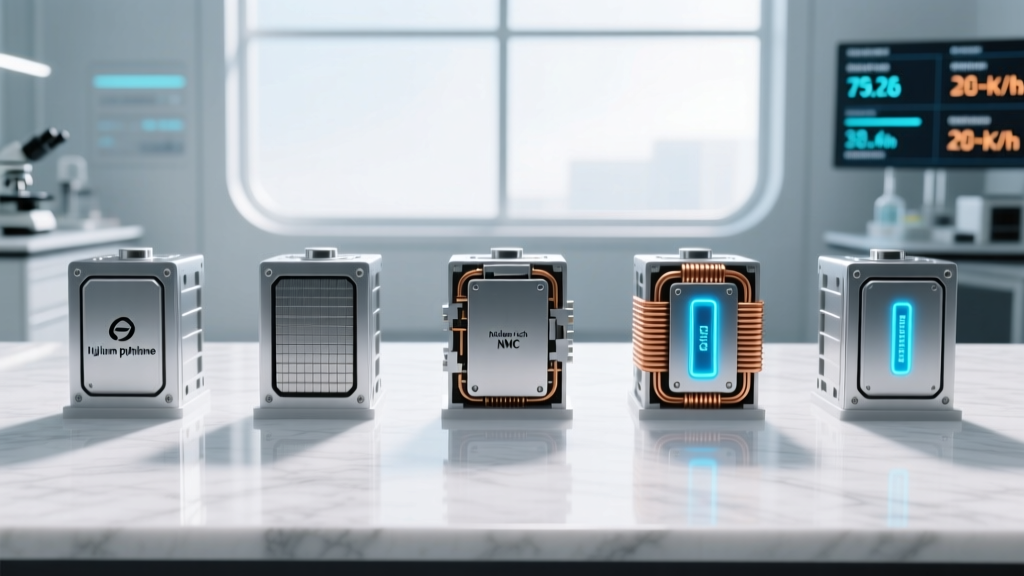
Every EV battery sold in the US in 2026 uses one of two dominant lithium-ion chemistries. The choice between them isn't about one being universally "better" — it's about which trade-offs match your driving pattern.
| Attribute | LFP (Lithium Iron Phosphate) | NMC / NCA (Nickel Manganese Cobalt / Nickel Cobalt Aluminum) |
|---|---|---|
| Energy Density (Wh/kg, cell-level) | 160–200 Wh/kg | 230–300 Wh/kg |
| Typical Use | Standard-range, fleet, urban-commuter models | Long-range, performance, large-SUV/truck models |
| Cycle Life (to 80% capacity) | 3,000–6,000+ cycles | 1,000–2,500 cycles |
| Cold-Weather Performance | Greater range loss below freezing (~35–40% at 20°F) | Better cold performance (~25–30% loss at 20°F) |
| Charging to 100% SoC Regularly | Recommended — LFP BMS needs periodic 100% for calibration | Not ideal — daily 80% limit recommended for longevity |
| Cobalt Content | Zero cobalt | Contains cobalt (NMC) or none (NCA) |
| Cost per kWh (cell-level, 2026 est.) | $70–$90/kWh | $100–$130/kWh |
| Thermal Stability | Higher — less prone to thermal runaway | Lower — requires more robust thermal management |
| Key US Examples (2026) | Tesla Model 3/Y RWD, Ford Mach-E Select, base F-150 Lightning | Tesla LR/Performance, GM Ultium vehicles, Hyundai Ioniq 5/6 LR, Rivian R1T/R1S |
Which is better for you? If you primarily commute under 60 miles daily, charge at home, and want maximum calendar life with minimal degradation anxiety, LFP is the pragmatic pick. If you regularly drive 200+ miles between charges, tow, live in a cold climate, or need maximum range from a single charge, NMC/NCA's energy density advantage is worth the trade-off. Neither chemistry is "fragile" — both routinely outlast 150,000 miles with proper care.
Real-World Degradation: What the Data Actually Shows
Battery degradation follows a nonlinear curve: a steeper initial drop in the first 1–2 years (roughly 2–5% loss), then a long, gradual plateau. Most owners never experience the steep late-life decline because it occurs well beyond typical ownership periods.
Degradation Data Points (Fleet & Longitudinal Sources):
- Tesla Model 3/Y (NMC/NCA, 2018–2023 fleet data): Average ~12% capacity loss at 150,000 miles, with most vehicles retaining 85–90% at 100,000 miles. (Tesla Impact Report)
- Nissan LEAF (NMC, passively cooled, 2011–2023): Historically higher degradation due to lack of active thermal management — 20–30% loss at 80,000–100,000 miles in hot climates. A cautionary example of why thermal management matters.
- Chevrolet Bolt EV/EUV (NMC, LG cells, 2017–2023): Post-recall replacement packs showed minimal degradation; original packs averaged ~8–10% loss at 80,000 miles with liquid cooling.
- LFP-equipped Tesla Model 3 RWD (2021–2025): Early fleet data suggests ~5–8% loss at 100,000 miles, consistent with LFP's superior cycle life. Long-term data still maturing.
- Hyundai Ioniq 5 (NMC, 2022–2025): Owner-reported data clusters around 6–9% loss at 60,000 miles with active liquid cooling and heat-pump preconditioning.
The pattern is clear: modern liquid-cooled packs from major battery makers consistently retain 85–92% of original capacity at 100,000 miles. The days of dramatic early-life battery failure are largely behind us — provided the pack has active thermal management.
Battery Warranties: What's Covered and What Isn't
Federal law mandates a minimum 8-year/100,000-mile warranty on EV battery packs for emissions-related compliance, and nearly every manufacturer meets or exceeds this baseline. Here's how the major warranties stack up for 2026 model-year vehicles:
| Manufacturer | Warranty Term | Capacity Retention Threshold | Notes |
|---|---|---|---|
| Tesla (Model 3/Y RWD — LFP) | 8 yr / 100,000 mi | 70% | Covers defects + capacity below threshold |
| Tesla (Model 3/Y LR/Performance) | 8 yr / 120,000 mi | 70% | Higher mileage for LR variants |
| GM (Ultium platform: Equinox EV, Blazer EV, Silverado EV) | 8 yr / 100,000 mi | 70% | Module-level replacement where possible |
| Hyundai / Kia (Ioniq 5, Ioniq 6, EV6, EV9) | 10 yr / 100,000 mi | 70% | Among the longest coverage terms |
| Ford (Mach-E, F-150 Lightning) | 8 yr / 100,000 mi | 70% | Covers battery components + capacity loss |
| Rivian (R1T, R1S) | 8 yr / 120,000 mi | 70% | Samsung SDI NMC cells |
| BMW (i4, iX, i7) | 8 yr / 100,000 mi | 70% | Samsung SDI / CATL depending on model |
Key warranty nuances: The 70% threshold means the manufacturer only owes you a repair or replacement if your pack drops below 70% of its original usable kWh within the warranty window. Normal degradation from 100% down to, say, 88% over 8 years is considered expected wear and is not a warranty claim. Warranties cover manufacturing defects and abnormal degradation — not damage from accidents, flooding, or aftermarket modifications. Always review the specific warranty language in your purchase agreement.
EV Battery Replacement Costs: The Honest Numbers
This is where fear-mongering runs rampant, so let's anchor the conversation in data. Full battery pack replacement is rare — most EVs are scrapped or sold with their original pack still functional. But if you do face an out-of-warranty replacement, here's what 2026 pricing looks like:
| Vehicle | Battery Size (usable kWh) | Chemistry | Estimated Pack Cost (parts) | Labor + Total Estimate |
|---|---|---|---|---|
| Tesla Model 3 RWD | ~57 kWh | LFP (CATL) | $5,500–$8,000 | $8,000–$12,000 |
| Tesla Model Y Long Range | ~75 kWh | NMC/NCA (Panasonic) | $9,000–$13,000 | $13,000–$18,000 |
| Ford F-150 Lightning Ext. Range | ~131 kWh | NMC (SK On) | $18,000–$25,000 | $24,000–$32,000 |
| Hyundai Ioniq 5 Long Range | ~77.4 kWh | NMC (SK On/LGES) | $9,000–$14,000 | $13,000–$19,000 |
| Chevrolet Equinox EV | ~85 kWh | NMC (Ultium/LGES) | $10,000–$15,000 | $14,000–$20,000 |
| Rivian R1T (Dual Motor, Max Pack) | ~141 kWh | NMC (Samsung SDI) | $20,000–$28,000 | $27,000–$36,000 |
Context that matters: Cell prices have declined roughly 80% since 2013 (from ~$500/kWh to ~$80–$130/kWh at the cell level in 2026, per BloombergNEF tracking). Additionally, many shops and OEMs now offer module-level repair — replacing only the degraded modules within a pack rather than the entire assembly — which can cut costs by 50–70%. A single module replacement on a Chevy Bolt or GM Ultium pack might run $2,000–$5,000 instead of a full-pack swap. The vast majority of EVs on the road today will never need a battery replacement during their useful life.
Factors That Accelerate (or Preserve) Battery Life
Battery longevity isn't purely a function of time and miles — your habits measurably influence the degradation curve. Here's what the electrochemistry actually cares about:
Battery Care Checklist — Maximize Your Pack's Lifespan
- Avoid sustained 100% SoC (NMC/NCA only): Daily charging to 80% dramatically reduces stress. Set your charge limit to 80% for daily use and 100% only for road trips. LFP owners: charge to 100% at least weekly for BMS calibration.
- Minimize DC fast charging when possible: Occasional fast charging is fine; daily 150+ kW sessions accelerate degradation by an estimated 1–3% over 5 years vs. Level 2 home charging. Use Level 2 as your primary method.
- Precondition before fast charging: Cold batteries charge slower and experience more stress. Use your vehicle's preconditioning feature (navigate to a charger, and most EVs auto-warm the pack) before DC sessions.
- Avoid extreme SoC storage: If parking for weeks, leave the battery at ~50% SoC. Storing at 100% or near 0% for extended periods accelerates calendar degradation.
- Park in shade/garage when possible: Sustained high ambient heat (100°F+) is harder on batteries than cold. Thermal management systems use energy to cool parked packs in extreme heat.
- Don't obsess over regen settings: Aggressive regenerative braking does not meaningfully harm the battery — the BMS manages charge acceptance. Drive naturally.
Monitoring Your Battery's State of Health (SoH)
State of Health (SoH) is the percentage of your battery's current maximum capacity relative to its original factory capacity. A new EV has 100% SoH; a 92% SoH at 60,000 miles is typical and healthy.
How to check SoH:
- In-vehicle displays: Tesla's app and service menu show estimated range vs. original; Hyundai/Kia provides a battery-condition indicator in the EV system menu. GM's Ultium vehicles display battery health through the infotainment system and myChevrolet/myCadillac apps.
- OBD-II diagnostic tools: Third-party apps like EV Health, LeafSpy (Nissan-specific), and Scan My Tesla read BMS data through an OBD-II dongle, providing cell-level voltage variance, internal resistance, and precise SoH percentages.
- Dealer/service center readouts: Any authorized service center can pull a full battery health report. Request this at every annual service visit — it creates a paper trail useful for warranty claims and resale value.
- Third-party services: Companies like Recurrent Auto offer free battery health reports by connecting to your vehicle's telematics (with permission), benchmarking your pack against fleet averages.
When to act: If your SoH drops below 80% within the warranty period, contact the manufacturer — you may qualify for a module or pack replacement under warranty. A sudden, non-gradual drop (e.g., 5% in a single month) warrants immediate service attention, as it may indicate a cell or module fault rather than normal degradation.
What's Next: Solid-State, Silicon Anodes, and Realistic Timelines
Battery makers are actively developing next-generation chemistries, but none are available in US-market production vehicles as of 2026. Here's where things stand:
- Solid-state batteries: Replace the liquid electrolyte with a solid ceramic or polymer layer, promising higher energy density (400+ Wh/kg projected), faster charging, and improved safety. Toyota has announced a solid-state EV for ~2027–2028, and Samsung SDI targets 2027 production. However, manufacturing scale-up remains the bottleneck — expect limited availability in premium models first, with mainstream adoption not before 2030.
- Silicon-dominant anodes: Replacing graphite anodes with silicon can boost energy density by 20–40%. Companies like Sila Nanotechnologies and Group14 are supplying early production cells for niche applications (e.g., Mercedes-Benz G-Class EV). Broader EV adoption is expected in the 2027–2029 timeframe.
- Sodium-ion batteries: CATL has begun mass-producing sodium-ion cells for lower-cost, shorter-range EVs in China. These eliminate lithium entirely but sacrifice energy density (~140 Wh/kg). US-market availability is uncertain and likely limited to fleet/city cars if it arrives at all.
- LMFP (lithium manganese iron phosphate): An evolution of LFP with ~15–20% higher energy density. CATL and Gotion are producing LMFP cells, expected in select 2027 model-year vehicles.
The honest assessment: current lithium-ion technology (both LFP and NMC/NCA) is mature, reliable, and cost-effective. Next-generation chemistries will arrive incrementally, not as sudden disruptions. Buying an EV today does not mean buying obsolete technology.
Frequently Asked Questions
How long do EV batteries actually last?
Based on fleet data from Tesla, Hyundai, GM, and third-party analysts, modern liquid-cooled EV batteries routinely last 150,000–200,000+ miles before reaching 70–80% of original capacity. In calendar years, that's typically 15–20 years of average use. Most EV batteries outlive the vehicle they're installed in. The Nissan LEAF's passive-cooling design was a notable exception — active thermal management is now standard across all major battery makers for good reason.
How much does it cost to replace an EV battery in 2026?
Full pack replacement ranges from roughly $8,000 (smaller LFP packs like the Tesla Model 3 RWD) to $36,000 (large NMC packs like the Rivian R1T Max Pack), including labor. However, module-level repairs can reduce costs to $2,000–$5,000 for a single failed module. The vast majority of EV owners never pay for a battery replacement — the pack outlasts the car, or the vehicle is covered under the 8–10 year/100,000+ mile warranty.
What does the EV battery warranty actually cover?
Standard warranties cover manufacturing defects and abnormal capacity loss below a stated threshold (typically 70% of original capacity) within 8–10 years or 100,000–120,000 miles, whichever comes first. They do not cover damage from collisions, flooding, improper charging equipment, or aftermarket modifications. Normal gradual degradation (e.g., dropping from 100% to 88% over 8 years) is expected behavior and not a warranty claim.
LFP vs NMC — which battery chemistry should I choose?
Choose LFP if you commute under 80 miles daily, charge at home, want maximum cycle life (3,000–6,000+ cycles), and don't mind slightly reduced range in extreme cold. Choose NMC/NCA if you need maximum range (250–400+ miles), tow frequently, live in a cold climate, or regularly road-trip. Both chemistries are proven and durable — the right choice depends on your driving pattern, not on one being inherently superior.
Does frequent DC fast charging damage my battery?
Exclusive reliance on DC fast charging (150+ kW) can accelerate degradation by an estimated 1–3% over 5 years compared to primary Level 2 home charging. However, occasional fast charging during road trips has a negligible impact. The bigger risk is frequent fast charging combined with high ambient temperatures and no preconditioning. Use Level 2 as your daily method and fast charge when needed — your battery will be fine.
How do I check my EV battery's health?
Most modern EVs display battery health or estimated range degradation through the infotainment system or companion app. For more granular data, OBD-II dongles paired with apps like Scan My Tesla or LeafSpy provide cell-level voltage readings and precise State of Health percentages. Your dealer can also pull a comprehensive battery health report at any service visit.