Spotting a battery light on dash in an electric vehicle triggers a different calculus than it does in a gas car. In an ICE vehicle, that icon almost always points to a failing 12V alternator or accessory battery. In an EV, you have two completely separate batteries: a high-voltage traction pack (400V or 800V, typically 50–120 kWh) that moves the car, and a small 12V auxiliary battery that runs the lights, infotainment, and contactors that close the high-voltage circuit. The warning light's color, symbol, and accompanying message tell you which system is unhappy — and the implications are wildly different.
This guide decodes the dash warnings, then digs into what actually determines whether your traction battery will outlast the car: chemistry, degradation curves, warranty fine print, replacement economics, and the daily habits that move the needle on State of Health (SoH).
What the Battery Light on Dash Actually Means in an EV
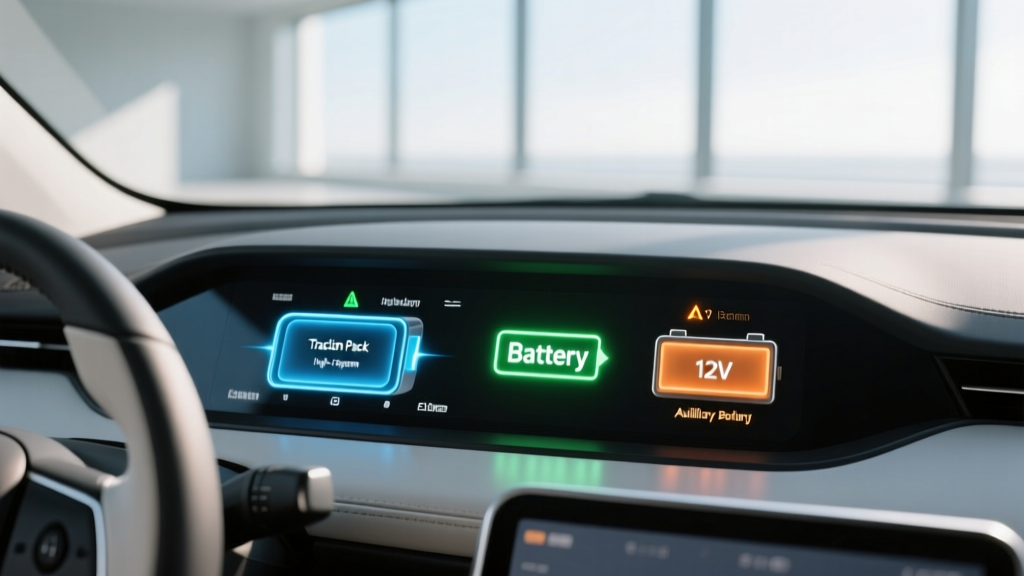
Modern EVs cluster battery warnings into three tiers. Read the symbol and color carefully before panicking:
- Yellow/amber 12V battery icon (looks like a traditional battery with +/- terminals): The auxiliary 12V system is undercharged or failing. The DC-DC converter (the EV equivalent of an alternator) may not be keeping it topped up. The car usually remains drivable short-term, but if the 12V dies, the contactors can't close and the car won't start — even with a full traction pack.
- Red high-voltage battery warning (often a battery with an exclamation mark, or text like "Traction Battery Fault," "HV Battery Service Required"): This is serious. Expect reduced power, limited speed, or a "stop safely now" directive. Pull over.
- Thermal/temperature warnings (thermometer-in-battery icon): Pack is too hot or too cold for normal operation. Power is derated until the thermal management system catches up — usually a preconditioning or cooling issue, not permanent damage.
The critical distinction: the 12V battery is a wear item, typically a $150–$350 AGM or lithium-12V replacement every 4–6 years. The traction pack is engineered to outlast the vehicle in most cases. Don't let a 12V warning convince you the main battery is dying.
Traction Battery Chemistry: LFP vs NMC vs NCA
The chemistry inside your pack is the single biggest determinant of longevity, usable capacity, cold-weather behavior, and cost. Three chemistries dominate 2026 production EVs:
| Attribute | LFP (Lithium Iron Phosphate) | NMC (Nickel Manganese Cobalt) | NCA (Nickel Cobalt Aluminum) |
|---|---|---|---|
| Energy density (cell-level) | ~160–180 Wh/kg | ~230–270 Wh/kg | ~250–280 Wh/kg |
| Typical cycle life to 80% SoH | 2,500–4,000+ cycles | 1,000–2,000 cycles | 1,000–1,800 cycles |
| Cold-weather range retention | Worse — more resistive below ~32°F | Better with active thermal mgmt | Similar to NMC |
| Recommended daily SoC | 100% OK (and helpful for cell balancing) | ~80% daily, 100% before trips | ~80% daily, 100% before trips |
| Cobalt/critical-mineral exposure | None | Moderate cobalt, high nickel | Low cobalt, high nickel |
| Cost per kWh (pack-level, 2026) | ~$90–$115 | ~$120–$150 | ~$125–$155 |
| Example 2026 models | Tesla Model 3/Y RWD, base Ford Mustang Mach-E Select, Rivian Standard | Hyundai Ioniq 5/6 Long Range, VW ID.4 Pro, BMW i4 | Tesla Long Range/Performance, Lucid Air |
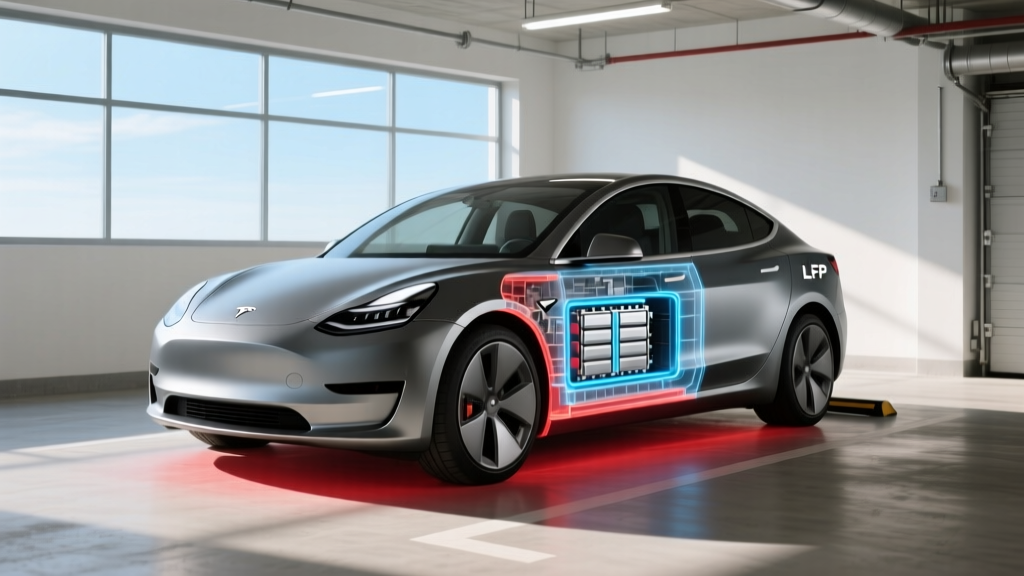
Which is better? There's no universal winner. LFP wins on cycle life, cost, and daily convenience (charge to 100% without guilt) — ideal for commuters and fleet duty. NMC/NCA win on energy density and cold-weather performance — the right call for 300+ mile range targets and northern climates. Tesla's split — LFP in RWD trims, NCA in Long Range — reflects this trade-off precisely.
How Long Do EV Batteries Actually Last?
The fear that EV packs need replacement at 100,000 miles is not supported by fleet data. Here's what the degradation curves actually show:
Typical capacity retention by age/mileage (2024–2026 fleet data):
- Year 1 / 15,000 mi: ~95–98% SoH (initial "break-in" drop)
- Year 3 / 45,000 mi: ~92–95% SoH
- Year 5 / 75,000 mi: ~89–93% SoH
- Year 8 / 120,000 mi: ~85–90% SoH (most packs)
- Year 10 / 150,000 mi: ~80–88% SoH (well-maintained NMC); ~88–94% (LFP)
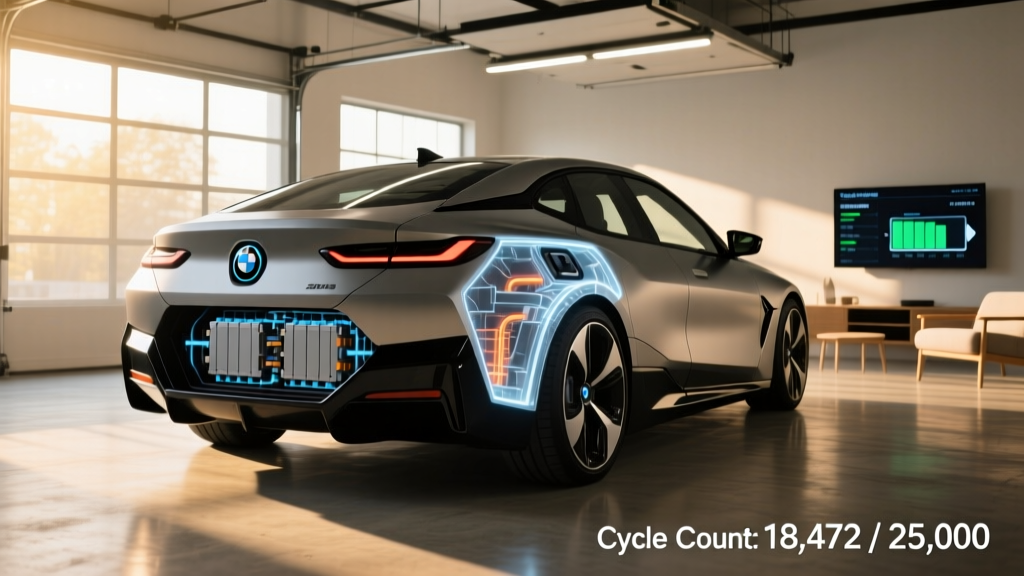
Recurrent, Geotab, and Tesla's own impact reports all converge on a similar finding: average annual degradation after the first year settles in at roughly 1–1.5% per year for liquid-cooled packs. Tesla's 2023 Impact Report (still the largest longitudinal dataset) reported ~12% average degradation at 200,000 miles for Model 3/Y — meaning ~88% capacity retained, well above the 70% warranty floor.
The takeaway: for a 250-mile EPA-rated EV, losing 12% over 200,000 miles means ~220 miles remaining. Annoying, not catastrophic. Most packs will outlast the car's body, suspension, and interior.
What the Battery Warranty Actually Covers
Federal law (per the EPA's green-vehicle framework and CARB-derived rules) mandates a minimum 8-year / 80,000-mile warranty on EV traction batteries for emissions-related compliance in many states, but manufacturers typically exceed this. The standard floor in 2026:
| Brand | Term | Capacity threshold | Notes |
|---|---|---|---|
| Tesla (Model 3/Y) | 8 yr / 100,000 mi (120k for LR/Perf) | 70% retention | Transferable to second owner |
| Hyundai / Kia | 10 yr / 100,000 mi | 70% retention | Among the longest in the industry |
| Ford (Mach-E, F-150 Lightning) | 8 yr / 100,000 mi | 70% retention | Components + capacity |
| GM (Ultium-based) | 8 yr / 100,000 mi | 70% retention | Covers module-level repair |
| Rivian | 8 yr / 175,000 mi | 70% retention | High mileage cap for adventure use |
| BMW | 8 yr / 100,000 mi | 70% retention | Module replacement strategy |
The fine print matters. Warranties cover capacity below the threshold and defects — they do not cover damage from accidents, flooding, improper charging, or modifications. Most manufacturers now perform module-level replacements (swapping 1–2 degraded modules rather than the whole pack), which is faster and cheaper. Always document your charging habits and keep service records; a pattern of daily 100% charges on an NMC pack stored in Phoenix heat could complicate a claim.
How Much Does an EV Battery Replacement Cost?
Out-of-warranty traction pack replacement is expensive — but also statistically rare. Most packs don't need full replacement within the typical ownership window. When they do:
| Vehicle class | Pack size | Full pack cost (parts + labor) | Module repair cost |
|---|---|---|---|
| Compact EV (Chevy Bolt, Nissan Leaf) | 40–65 kWh | $6,500–$11,000 | $1,500–$4,000 |
| Midsize crossover (Model Y, Ioniq 5, Mach-E) | 72–88 kWh | $10,000–$16,000 | $2,500–$6,000 |
| Large SUV / truck (F-150 Lightning, Rivian) | 100–135 kWh | $15,000–$25,000 | $4,000–$9,000 |
| Luxury sedan (Lucid Air, Model S) | 100–118 kWh | $18,000–$30,000 | $5,000–$12,000 |
Context: pack prices per kWh have fallen roughly 90% since 2010 (per BloombergNEF). By 2026, pack-level pricing hovers around $110–$150/kWh for NMC and $90–$115/kWh for LFP. A full pack swap is usually a last resort; module-level repair is the standard service path. And again — the data shows most packs don't reach this point within the first 15 years.
Five Factors That Actually Move the Needle on Battery Life
- State of charge habits: For NMC/NCA, keep daily SoC between ~20% and 80%. LFP owners can (and should) charge to 100% regularly to help the BMS balance cells. Avoid parking any EV at 100% or below 10% for days at a time.
- DC fast-charging frequency: Occasional road-trip DCFC is fine. Daily 150–350 kW fast charging does accelerate degradation — studies from Idaho National Lab showed ~0.3% additional annual loss for packs that DC fast-charged daily vs. Level 2 only. Use Level 2 overnight as the default.
- Temperature management: Extreme heat is the long-term enemy; extreme cold is a short-term range killer. Always use preconditioning (scheduled departure or nav-to-charger) to bring the pack to ~68–85°F before fast charging or hard driving. Garage parking in summer pays dividends.
- Storage: If leaving the car for weeks, set SoC to ~50% and plug into Level 1 or Level 2 so the thermal system and 12V maintainer can run. Never store at 100% in heat.
- Regen and driving style: Aggressive acceleration and frequent high-C-rate discharges (track days, heavy towing) add up. Moderate driving with regen-on extends both range and pack life.
How to Check and Monitor Battery Health (SoH)
State of Health is the percentage of original capacity the pack still holds. Here's how to track it:
- In-car BMS readout: Tesla, Rivian, Hyundai, and some others expose a SoH or "battery health" percentage in the service menu or app. Tesla's 2024+ software added a dedicated health screen.
- OBD-II + app method: Tools like OBDeleven, Leaf Spy (Nissan), or Scan My Tesla pull raw BMS data — including individual cell voltages, internal resistance, and true SoH — more granular than the dash shows.
- Third-party reports: Services like Recurrent Auto (free for members) aggregate your telematics into a degradation report and compare you to a like-vehicle fleet. Useful before buying used.
- The DIY math check: Charge to 100%, note the displayed range, divide by the original EPA range, and multiply by 100. Crude (displayed range is affected by recent driving), but a useful sanity check. A 2022 Model 3 LR that shows 285 miles at 100% vs. its 358-mile EPA sticker is at roughly ~80% SoH — warranty territory.
When the battery light on dash appears alongside a sudden range drop (say, 15%+ in a month), that's the signal to pull SoH data and schedule a diagnostic. Slow, steady 1–2% annual loss is normal; step changes indicate a module or BMS fault.
On the Horizon: Solid-State and Silicon-Anode Batteries
Forward-looking context, not buying advice: solid-state batteries (which replace the liquid electrolyte with a solid) promise ~40% higher energy density, faster charging, and longer cycle life. Toyota, Nissan, and Samsung SDI have announced 2027–2028 production targets for limited-run vehicles. QuantumScape is shipping prototype cells to OEM partners. But volume production at automotive scale remains unproven, and costs will be high for the first several model years.
Silicon-anode cells (used in limited form in some 2025–2026 packs, including GM's Ultium variants) are the nearer-term upgrade — boosting energy density 10–20% without a full chemistry revolution. Expect these to proliferate through the late 2020s. Neither technology changes today's buying decision; current LFP and NMC packs are mature, well-understood, and backed by warranties that cover the realistic risk.
Frequently Asked Questions
Is it safe to drive with a yellow battery light on the dash?
Usually yes, short-term — a yellow/amber light typically indicates a 12V auxiliary battery issue, not a traction pack fault. Have the DC-DC converter and 12V battery tested within a few days. A red high-voltage warning, by contrast, means pull over safely and call for service.
How long do EV batteries last in years and miles?
Liquid-cooled packs in 2026 EVs routinely last 15–20 years and 200,000+ miles before falling to 80% capacity. Fleet data from Tesla, Geotab, and Recurrent all support this. Catastrophic failure is rare; gradual capacity loss is the norm.
Does fast charging ruin the battery?
Occasional DC fast charging is fine. Daily reliance on 150+ kW chargers does measurably accelerate degradation — roughly 0.2–0.5% extra annual loss in controlled studies. Default to Level 2 home charging, use DCFC for road trips.
What does the federal battery warranty mandate require?
Federal emissions-related rules effectively enforce an 8-year / 80,000-mile minimum on EV traction batteries in CARB states, and most automakers voluntarily apply it nationwide. The retention threshold is typically 70% of original capacity. Check your specific brand's terms.
LFP vs NMC — which should I choose?
Choose LFP if you commute daily, want to charge to 100% without worry, live in a mild climate, and prioritize longevity. Choose NMC/NCA if you need maximum range per pound, regularly drive in sub-freezing weather, or tow frequently. Both are proven; the right answer depends on your use case.
Can I replace just one module instead of the whole pack?
Yes, on most modern packs (Tesla, GM Ultium, Hyundai E-GMP, Rivian). Module-level repair is now the standard service path and typically costs $1,500–$9,000 depending on the vehicle and number of modules, vs. $10,000–$30,000 for a full pack.
That battery light on your dash is information, not a verdict. Read the color, check SoH with real tools, follow the care checklist, and the traction pack will likely outlast your ownership of the car — the way the data says it should.