Why Tesla Bet Big on LFP Chemistry
If you've shopped for a base Model 3 or Model Y in the last few years, you've likely encountered a spec-sheet footnote: "LFP battery." That acronym stands for lithium iron phosphate (LiFePO₄), and it represents a deliberate engineering trade-off Tesla made to lower vehicle cost while maximizing battery cycle life. Since 2021, Tesla has equipped rear-wheel-drive (RWD) variants of the Model 3 and Model Y with LFP packs sourced primarily from CATL, while reserving nickel-manganese-cobalt (NMC) and nickel-cobalt-aluminum (NCA) chemistries for Long Range and Performance trims.
For buyers, this matters more than almost any other spec on the window sticker. LFP changes how you charge, how the car behaves in winter, and how much range degradation you'll see at 100,000 miles. Let's break down exactly what's inside the pack, what the data says about longevity, and how to get the most out of it.
LFP vs NMC/NCA: The Chemistry Trade-Offs
Every lithium-ion cell uses a cathode material that defines its characteristics. Tesla currently deploys three main cathode chemistries across its fleet:
- LFP (Lithium Iron Phosphate): Used in Model 3 RWD and Model Y RWD. No nickel or cobalt.
- NMC (Nickel Manganese Cobalt): Used in some Long Range models and the Cybertruck. Higher energy density.
- NCA (Nickel Cobalt Aluminum): Used in Model S and Model X. Panasonic-manufactured, highest energy density in Tesla's lineup.
| Attribute | LFP (LiFePO₄) | NMC / NCA |
|---|---|---|
| Energy Density (cell-level) | ~160–180 Wh/kg | ~230–270 Wh/kg |
| Typical Cycle Life | 3,000–5,000+ cycles | 1,000–2,000 cycles |
| Cold-Weather Performance | Greater range loss below 32°F | Better low-temp discharge |
| Peak DC Fast Charge Rate | ~170 kW (Model 3 RWD) | ~250 kW (Long Range) |
| Recommended Daily SoC | 100% (charge to full regularly) | 80–90% daily, 100% for trips |
| Cobalt/Nickel Content | None | Significant |
| Cost per kWh (cell-level) | Lower (~$60–80/kWh) | Higher (~$100–130/kWh) |
| Thermal Stability | Excellent (less prone to thermal runaway) | Good (requires more active management) |
The headline trade-off: LFP gives you longer cycle life and lower cost, but sacrifices energy density and cold-weather performance. That's why LFP appears in RWD trims with smaller battery packs (~57.5 kWh usable in the refreshed Model 3 RWD) while Long Range models carry larger NMC packs (~75–82 kWh usable) to hit EPA ratings above 330 miles.
Real-World Degradation: What the Data Shows
Battery degradation — the gradual, irreversible loss of usable capacity — is the number one concern among prospective EV buyers. Here's what real-world telemetry and aggregated fleet data tell us about LFP specifically.
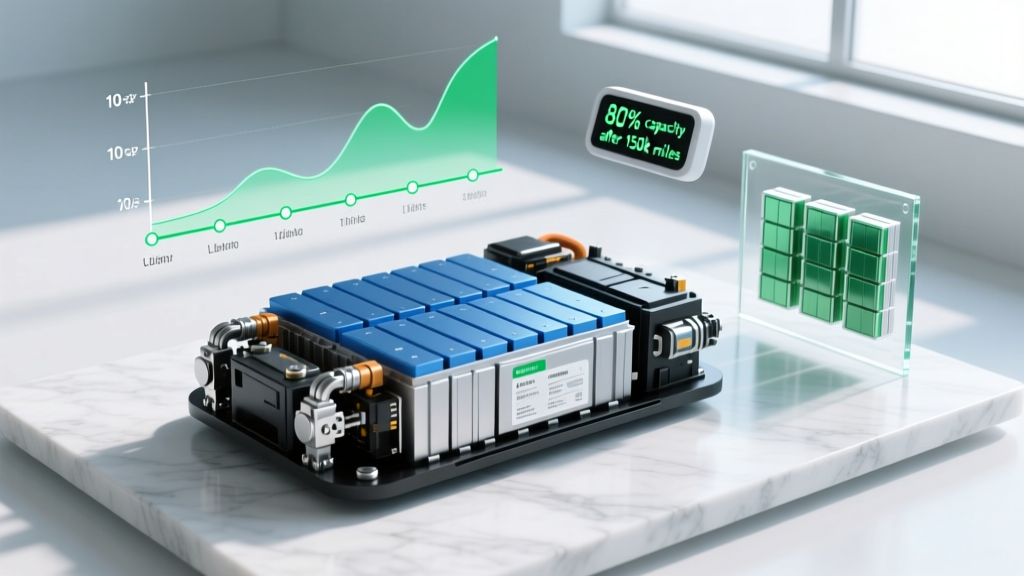
Typical LFP Degradation Curve (Tesla Model 3 RWD):
- Year 1 / 15,000 miles: ~2–3% capacity loss (initial formation period)
- Year 3 / 45,000 miles: ~4–6% total loss
- Year 5 / 75,000 miles: ~6–8% total loss
- Year 8 / 120,000 miles: ~8–12% total loss (projected based on fleet averages)
For comparison, NMC/NCA packs in Tesla Long Range vehicles typically show ~5–8% loss at 100,000 miles, with a steeper early-life drop but comparable mid-life plateau. Data aggregated from sources including Tesla's Impact Report and independent fleet analyses by Recurrent Auto show that the majority of Tesla batteries retain above 85% capacity at 150,000 miles.
The key insight: LFP degrades more slowly per cycle than NMC, but because LFP packs are physically smaller (fewer kWh total), the same percentage loss translates to fewer lost miles of range. A 10% loss on a 57.5 kWh pack costs you about 27 miles of the Model 3 RWD's EPA-rated 272-mile range. The same 10% on a 75 kWh Long Range pack costs about 36 miles off its 363-mile rating.
Cold Weather Hits LFP Harder
LFP's Achilles' heel is low-temperature performance. In sub-freezing conditions (below 32°F / 0°C), LFP cells experience higher internal resistance, which reduces both available range and regenerative braking strength. Expect 20–35% range reduction in LFP-equipped Teslas at 20°F, compared to roughly 15–25% for NMC packs. Tesla's heat pump (standard on all current models) helps, but preconditioning the battery before driving is essential in winter to recover regen and efficiency.
Tesla's Battery Warranty: What's Actually Covered
Tesla's battery and drive unit warranty is one of the longest in the industry, but the fine print matters.
| Model / Trim | Warranty Period | Mileage Limit | Minimum Capacity Retention |
|---|---|---|---|
| Model 3 RWD (LFP) | 8 years | 100,000 miles | 70% |
| Model Y RWD (LFP) | 8 years | 100,000 miles | 70% |
| Model 3 Long Range / Performance | 8 years | 120,000 miles | 70% |
| Model Y Long Range / Performance | 8 years | 120,000 miles | 70% |
| Model S / Model X | 8 years | 150,000 miles | 70% |
The warranty guarantees that the battery will retain at least 70% of its original usable capacity for the stated period or mileage, whichever comes first. If capacity drops below that threshold, Tesla will replace or refurbish the pack to bring it back to at least 70%. Note: the warranty covers defects and abnormal degradation, not gradual, normal wear that stays above the 70% line. According to Tesla's official warranty documentation, the battery warranty is transferable to subsequent owners.
Battery Replacement Cost: Reality vs. Fear
Headlines about $20,000 battery replacements are misleading for most owners. Here's why, along with the actual numbers.
| Battery Pack | Approximate Replacement Cost (2025–2026) | Typical Failure Timeline |
|---|---|---|
| Model 3 RWD LFP (~57.5 kWh) | $12,000–$16,000 (out of warranty) | Rarely needed before 200,000+ miles |
| Model 3/Y Long Range NMC (~75–82 kWh) | $14,000–$20,000 (out of warranty) | Rarely needed before 200,000+ miles |
| Model S/X NCA (~100 kWh) | $18,000–$25,000 (out of warranty) | Some early packs replaced at 120k–160k miles |
Critical context: complete battery failure outside of warranty is rare. Tesla's own fleet data indicates that fewer than 1% of vehicles have required a full pack replacement, and most of those occurred under warranty coverage. LFP packs, with their 3,000–5,000+ cycle life, are statistically even less likely to need replacement during typical ownership. A cycle is one full 0–100% discharge; at one cycle per day, 3,000 cycles equals over 8 years of daily full use. Most owners charge partially, extending cycle life further.
How to Maximize Your LFP Battery's Lifespan
LFP has a unique care profile compared to NMC. Follow these guidelines to minimize degradation:
- Charge to 100% regularly. Unlike NMC, LFP cells benefit from periodic full charges. Tesla recommends setting your charge limit to 100% and charging to full at least once per week. This helps the Battery Management System (BMS) accurately calibrate SoC estimation — LFP's voltage curve is extremely flat, making SoC harder to gauge without a full-charge reference.
- Avoid prolonged storage at very low SoC. Don't let the car sit below 10% for days. LFP cells are robust, but deep discharge combined with heat accelerates degradation.
- Use DC fast charging in moderation. Frequent Supercharging (multiple times per week) at 170 kW peak generates sustained heat. For daily driving, Level 2 home charging at 7–11.5 kW is gentler. When you do Supercharge, precondition the battery (the car does this automatically when you navigate to a Supercharger).
- Precondition in cold weather. Use the Tesla app to start climate and battery preconditioning 15–30 minutes before driving in freezing temps. This restores regen braking and improves efficiency.
- Minimize exposure to extreme heat while parked. Garage parking in summer reduces thermal stress. Sentry Mode and cabin overheat protection draw power and generate heat; use judiciously in hot climates.
- Keep tires properly inflated. Under-inflated tires increase rolling resistance, forcing the battery to work harder and generate more heat per mile.
Monitoring Battery Health (State of Health)
Tesla doesn't expose a direct State of Health (SoH) percentage in the car's UI. Here's how owners can assess battery condition:
- Tesla App / In-Car Energy Display: Track your rated range over time. If your Model 3 RWD showed 272 miles at 100% when new and now shows 250 miles at 100%, that's roughly 8% degradation.
- Third-party tools: Services like Recurrent Auto (free enrollment) connect to your Tesla's telematics and provide detailed degradation tracking, SoH estimates, and comparisons to similar vehicles in their fleet.
- OBD-II diagnostics: Tools like Scan My Tesla (via an OBD-II dongle) can read cell-level voltage data and pack health metrics directly from the CAN bus.
- Tesla Service Center: Request a battery health report during routine service. Tesla can pull detailed cell-balance and capacity data.
What's Next: Solid-State and Silicon Anode Batteries
The battery industry is pursuing two major next-generation technologies that could eventually reach Tesla vehicles:
Solid-state batteries replace the liquid electrolyte with a solid ceramic or polymer, promising higher energy density (~400+ Wh/kg at the cell level), faster charging, and improved safety. Companies like Toyota, QuantumScape, and Samsung SDI are in advanced testing, but mass production for consumer vehicles is not expected before 2028–2030. Tesla has not announced a solid-state timeline.
Silicon anode batteries replace graphite anodes with silicon, which can store roughly 10x more lithium ions per gram. This boosts energy density by 20–40%. Sila Nanotechnologies and Group14 are shipping early silicon-anode cells, and Tesla's 4680 cell design may incorporate incremental silicon content in future iterations. Expect gradual adoption in 2026–2028 model years, not a sudden generational leap.
For current buyers: these technologies are forward-looking and should not factor into a purchase decision today. LFP and NMC chemistries are mature, well-understood, and backed by extensive real-world data.
Frequently Asked Questions
How long do Tesla LFP batteries last?
Based on current fleet data, LFP packs in the Model 3 and Model Y RWD are projected to retain above 80% capacity at 150,000–200,000 miles. At a typical degradation rate of 1.5–2% per year, most LFP batteries will outlast the vehicle's useful economic life. The 3,000–5,000 cycle life means you could fully discharge and recharge the pack daily for 8–13 years before reaching end-of-life capacity thresholds.
Should I charge my Tesla LFP to 100% every day?
Tesla recommends charging LFP-equipped vehicles to 100% at least once per week. Many owners set the daily limit to 100% because LFP chemistry tolerates full charges better than NMC, and the flat voltage curve requires regular full-charge calibration for accurate range estimation. Charging to 100% daily on LFP does not meaningfully accelerate degradation the way it would on NMC.
How much does it cost to replace a Tesla LFP battery?
Out-of-warranty replacement for a Model 3 RWD LFP pack currently ranges from $12,000 to $16,000, including parts and labor. However, full pack replacement is rare — fewer than 1% of Tesla vehicles have ever required it, and most replacements occur under the 8-year/100,000-mile warranty at no cost to the owner.
Does Supercharging damage the LFP battery?
Occasional Supercharging has minimal impact. However, daily DC fast charging at 170 kW generates sustained heat that accelerates degradation over time. Tesla's BMS actively manages thermal load during Supercharging, and preconditioning helps. For lowest long-term degradation, rely on Level 2 home charging for daily needs and reserve Supercharging for road trips.
Is LFP better than NMC for a Tesla?
It depends on your priorities. LFP is better if you want maximum cycle life, lower cost, cobalt-free sourcing, and the simplicity of charging to 100% daily. NMC is better if you need maximum range (Long Range trims), faster DC charging (250 kW peak), and better cold-weather performance. Neither is universally "better" — they serve different use cases within Tesla's lineup.
What does Tesla's battery warranty cover?
Tesla warrants the LFP battery in Model 3 and Model Y RWD for 8 years or 100,000 miles (whichever comes first), guaranteeing at least 70% capacity retention. If the pack degrades below 70% within that window, Tesla will repair or replace it. The warranty covers manufacturing defects and abnormal degradation, and it transfers to subsequent owners. Details are available at Tesla's warranty page.
How do I check my Tesla battery health?
Monitor your rated range at 100% charge over time to estimate degradation. For detailed analysis, connect a service like Recurrent Auto (free) to your Tesla account, or use an OBD-II tool like Scan My Tesla to read cell-level data. Tesla Service can also generate a battery health report on request.