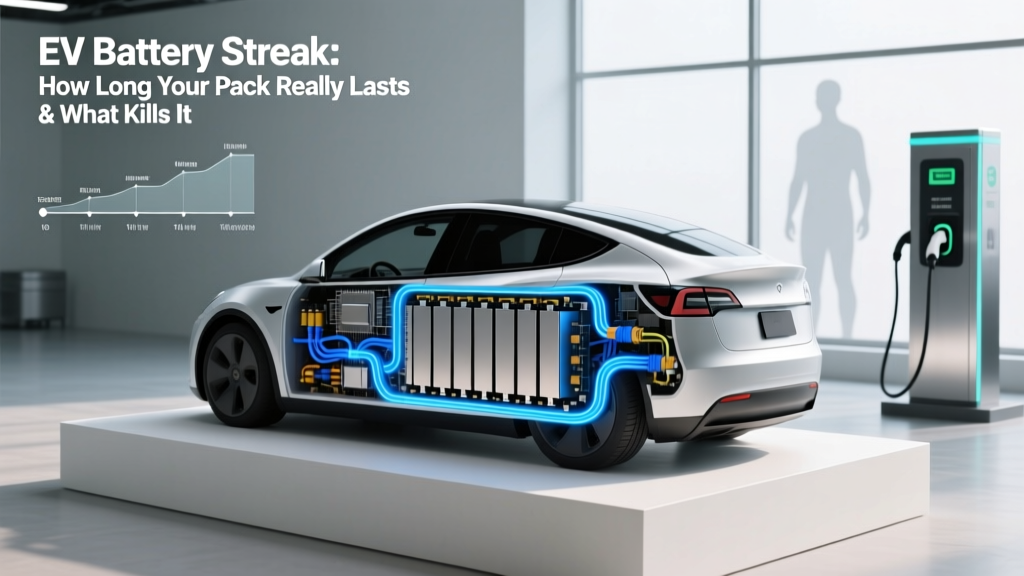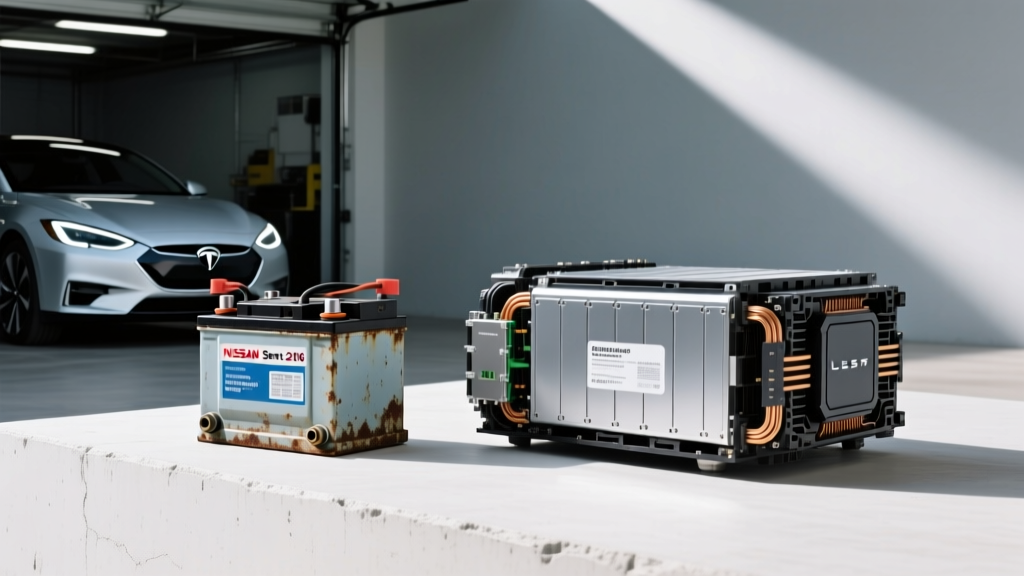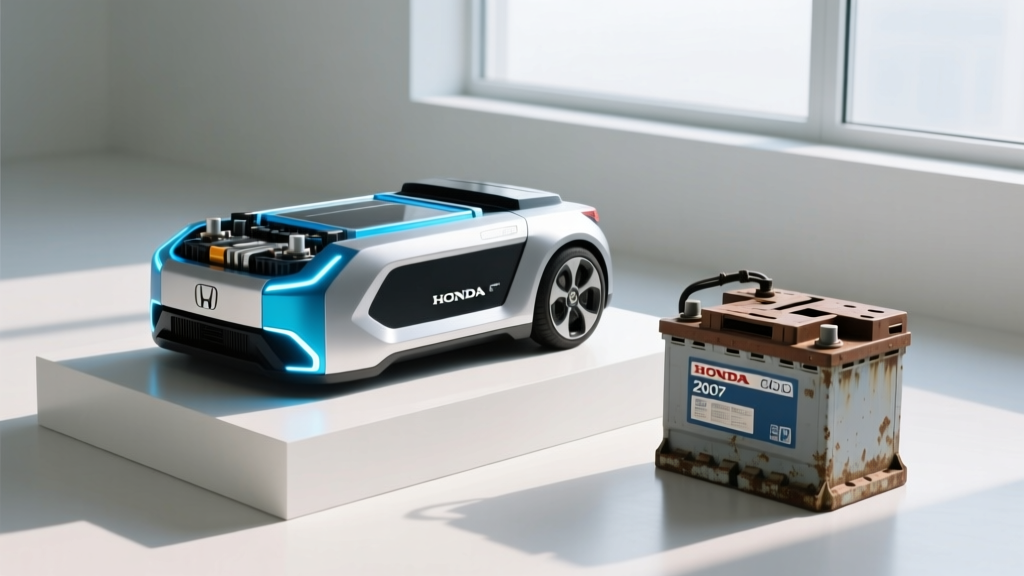
If you've ever replaced the 12-volt lead-acid battery in a 2007 Honda CR-V — typically a Group 51R costing around $150-$220 and lasting 3-5 years — you might wonder how today's high-voltage EV traction batteries stack up in lifespan, cost, and reliability. The short answer: modern EV batteries routinely outlast the vehicles they power, with degradation data showing 85-95% capacity retention after 150,000+ miles. But the details matter enormously depending on chemistry, charging habits, and climate.
This guide covers everything a current or prospective EV owner needs to know about battery longevity, from LFP vs NMC chemistry trade-offs to real-world degradation curves, warranty protections, replacement costs, and the emerging solid-state technology on the horizon.
EV Traction Batteries vs. Conventional 12V Batteries: A Fundamental Difference
Before diving into EV battery specifics, it's critical to distinguish the two battery systems in any electric vehicle:
- 12V auxiliary battery: Powers lights, infotainment, door locks, and control computers. This is the same type of lead-acid or AGM battery you'd find in a 2007 Honda CR-V. It typically lasts 3-5 years and costs $100-$300 to replace.
- High-voltage traction battery: The large lithium-ion pack (typically 50-130 kWh) that stores energy for the electric motor and determines your vehicle's range. This is the battery that defines EV ownership economics.
When we discuss "EV battery life" in this guide, we're referring exclusively to the high-voltage traction battery. The 12V battery in an EV is a maintenance item identical to what you'd service in any conventional vehicle, including that 2007 CR-V still running in driveways across America.
LFP vs NMC/NCA: Which Battery Chemistry Is Right for You?
Modern EV batteries use one of two dominant lithium-ion chemistries, each with distinct trade-offs that affect range, longevity, cost, and daily usability.
| Attribute | LFP (Lithium Iron Phosphate) | NMC/NCA (Nickel Manganese Cobalt / Nickel Cobalt Aluminum) |
|---|---|---|
| Energy Density | Lower (~160-180 Wh/kg cell-level) | Higher (~220-300 Wh/kg cell-level) |
| Typical Cycle Life | 3,000-6,000+ cycles to 80% capacity | 1,000-2,500 cycles to 80% capacity |
| Cold-Weather Performance | Reduced — greater range loss below 32°F | Better low-temperature discharge capability |
| Charging to 100% Regularly | Recommended — no degradation penalty | Not recommended — accelerates wear above 80-90% |
| Cost per kWh (pack-level, 2025-2026) | ~$90-$110/kWh | ~$120-$150/kWh |
| Cobalt Content | Zero — lower supply-chain risk | Contains cobalt — ethical/supply concerns |
| Common Vehicles (2026 MY) | Tesla Model 3/Y RWD, Ford Mustang Mach-E Select (LFP option), BYD models | Hyundai Ioniq 5, Kia EV6, Chevrolet Equinox EV, Tesla Long Range/Performance |
Which Is Better?
There's no universal winner — it depends on your usage pattern:
- Choose LFP if: You want maximum cycle life, plan to own the vehicle 10+ years, primarily drive in moderate climates, and don't need the absolute longest single-charge range. LFP's tolerance for daily 100% charging makes it ideal for commuters who need predictable full-range every morning.
- Choose NMC/NCA if: You prioritize maximum range per charge, frequently drive in cold climates, need the lightest possible pack for performance applications, or regularly take road trips where energy density matters more than cycle count.
Tesla's shift to LFP in standard-range Model 3 and Model Y vehicles is a strong market signal: for the majority of drivers, LFP's longevity and cost advantages outweigh its energy-density penalty. According to Tesla's own guidance, LFP-equipped vehicles should be charged to 100% at least weekly for optimal battery management system calibration.
Real-World Degradation: What the Data Actually Shows
The fear that EV batteries degrade like smartphone batteries — losing 20-30% capacity within 2-3 years — is not supported by fleet data. Here's what large-scale studies and owner-reported data reveal:
Key Degradation Data Points:
- Tesla fleet data (2025 Impact Report): Model S/X batteries retain approximately 88% capacity at 200,000 miles. Model 3/Y (including LFP variants) show similar or better retention curves.
- Geotab fleet study (2024, 10,000+ vehicles): Average annual degradation across all EV models was 1.8% per year, meaning a typical EV retains ~82% capacity after 10 years.
- Nissan Leaf (passively cooled, NMC): Earlier-generation Leafs (2011-2017) with passive thermal management showed higher degradation — some 20-25% loss at 100,000 miles — underscoring the importance of active liquid cooling.
- Chevrolet Bolt EV/EUV (NMC, liquid-cooled, 65 kWh): Owner reports cluster around 5-10% degradation at 80,000-100,000 miles.
The degradation curve is not linear. Most EV batteries experience a steeper initial drop (2-4% in the first year or 20,000 miles), then settle into a long, slow decline of roughly 1-2% per year. This means a 300-mile EPA-rated EV might realistically deliver 270-285 miles after five years — still entirely usable for daily driving.
Factors That Accelerate Degradation
Not all miles are equal when it comes to battery wear. The following factors measurably increase degradation rates:
- Frequent DC fast charging above 150 kW: Occasional fast charging is fine, but daily use of 250-350 kW chargers generates sustained heat that stresses cells. Data from Recurrent Auto suggests vehicles that fast-charge more than 3x per week show 1-3% additional degradation over 100,000 miles compared to primarily Level 2-charged vehicles.
- Consistent 100% state of charge (NMC/NCA only): Storing an NMC battery at 100% SoC for extended periods accelerates electrolyte decomposition. LFP chemistry does not share this vulnerability.
- Extreme heat exposure: Vehicles regularly parked in 100°F+ ambient temperatures without thermal management preconditioning show elevated degradation. Liquid-cooled packs mitigate this significantly.
- Deep discharge cycles: Regularly driving below 10% SoC stresses cells. Most manufacturers buffer the bottom of the pack (typically 2-5 kWh below the displayed 0%) to prevent true deep discharge.
- High-mileage rapid cycling: Fleet vehicles that cycle from 10-90% daily accumulate wear faster than personal vehicles charged once overnight.
Battery Warranties: What's Actually Covered
Federal law mandates a minimum 8-year/100,000-mile warranty on EV battery packs for emissions-related compliance, and most manufacturers meet or exceed this standard. Here's how major brands structure their coverage as of the 2026 model year:
| Manufacturer | Warranty Period | Mileage Cap | Capacity Retention Threshold |
|---|---|---|---|
| Tesla (Model 3/Y LFP) | 8 years | 120,000 miles | 70% |
| Tesla (Model S/X, LR/Perf) | 8 years | 150,000 miles | 70% |
| Hyundai / Kia (E-GMP platform) | 10 years | 100,000 miles | 70% |
| Chevrolet (Ultium platform) | 8 years | 100,000 miles | 60-70% (varies by model) |
| Ford (Mustang Mach-E, F-150 Lightning) | 8 years | 100,000 miles | 70% |
| BMW (iX, i4, i7) | 8 years | 100,000 miles | 70% |
| Rivian (R1T, R1S) | 8 years | 175,000 miles | 70% |
The critical detail is the capacity retention threshold: the warranty only triggers a replacement or repair if your battery's usable capacity drops below the stated percentage (typically 70%) within the warranty window. A battery at 72% capacity at year 7 is functioning within warranty specifications, even though range is noticeably reduced.
Warranties cover defects and abnormal degradation, not damage from accidents, flooding, or improper modifications. Some manufacturers also exclude vehicles used in commercial fleet service from the standard battery warranty terms.
EV Battery Replacement Costs: The Numbers
This is where the comparison to a 2007 Honda CR-V battery replacement becomes stark. A lead-acid 12V battery swap is a $150-$220 affair at any auto parts store. An EV traction battery replacement is a major service event — but one that the vast majority of owners will never need.
| Vehicle / Pack Size | Battery Capacity | Estimated Replacement Cost (Parts + Labor) | Typical Replacement Timing |
|---|---|---|---|
| Tesla Model 3 RWD (LFP) | ~60 kWh | $12,000 - $16,000 | Rarely needed within vehicle lifespan |
| Hyundai Ioniq 5 / Kia EV6 (NMC) | 77.4 kWh | $18,000 - $24,000 | Rarely needed within vehicle lifespan |
| Chevrolet Equinox EV (Ultium NMC) | ~85 kWh | $16,000 - $22,000 | Rarely needed within vehicle lifespan |
| Ford F-150 Lightning Extended Range | ~131 kWh | $28,000 - $38,000 | Rarely needed within vehicle lifespan |
| Tesla Model S (NMC/NCA) | ~100 kWh | $20,000 - $28,000 | Some early packs replaced under warranty at 150k+ mi |
| Nissan Leaf (passive-cooled NMC) | 40-62 kWh | $8,000 - $14,000 | Higher likelihood due to passive thermal management |
Context is essential here. According to data from Recurrent Auto, fewer than 2% of EV batteries have required out-of-warranty replacement as of 2025. The combination of liquid cooling, improved cell chemistry, and conservative buffer management means most packs outlast the vehicle's economic life. For perspective, the average transaction price of a new vehicle in 2026 exceeds $48,000, and most owners trade or sell within 8-10 years — well within the battery's functional lifespan.
When replacements are needed, module-level repair (replacing individual degraded modules rather than the full pack) is increasingly available and can cost $3,000-$8,000 depending on the vehicle platform.
Maximizing Battery Health: A Practical Care Checklist
EV Battery Care Checklist for Maximum Longevity:
- Default to Level 2 home charging: Overnight Level 2 charging at 7-11 kW is gentler on cells than daily DC fast charging. Install a 240V Level 2 charger (typically $500-$2,000 installed) for daily use.
- Set charge limits appropriately: For NMC/NCA batteries, set daily charge limit to 80-90% and reserve 100% for road trips. For LFP batteries, charge to 100% regularly as recommended by the manufacturer.
- Avoid extended storage at extremes: If leaving your EV unused for 2+ weeks, set SoC to 50-60%. Never store at 100% or below 10% for extended periods.
- Precondition before fast charging: Use your vehicle's navigation to route to a DC fast charger — this triggers battery preconditioning, warming the pack to optimal temperature (typically 95-110°F / 35-43°C) for faster charging with less stress.
- Minimize fast charging in extreme heat: If ambient temperatures exceed 100°F, prefer Level 2 charging when possible. If you must fast-charge, do so during cooler morning hours.
- Don't baby the battery excessively: Modern battery management systems (BMS) are sophisticated. Occasional 100% charges, fast charges, and low-SoC driving won't meaningfully harm a healthy pack. The goal is to optimize habits, not eliminate flexibility.
- Keep software updated: OTA updates often include BMS refinements that improve thermal management and charging algorithms.
Monitoring Your Battery's State of Health (SoH)
State of Health (SoH) is the percentage of original capacity your battery retains. Most EVs don't display SoH directly on the dashboard, but there are several ways to monitor it:
- In-vehicle range estimation tracking: Compare your full-charge estimated range at 100% SoC today versus when the vehicle was new. A 310-mile EPA vehicle now showing 280 miles at 100% suggests roughly 90% SoH (accounting for variables like temperature and tire condition).
- Third-party OBD-II tools: Devices like the OBDLink CX paired with apps such as EVNotify, Scan My Tesla, or LeafSpy (for Nissan Leaf) can read detailed battery telemetry including SoH, cell voltage variance, and pack temperature.
- Manufacturer service diagnostics: Dealership service departments can pull full battery health reports. Some owners request these annually for documentation, especially before warranty expiration.
- Recurrent Auto / fleet analytics: Services like Recurrent provide personalized battery health reports by comparing your vehicle's data against a large fleet of identical models.
Emerging Battery Technology: What's Next and When
While today's lithium-ion batteries (both LFP and NMC) are mature and reliable, several next-generation technologies are in development. It's important to separate what's available now from what's on the horizon.
Solid-State Batteries
Solid-state batteries replace the liquid electrolyte with a solid material (ceramic, sulfide, or polymer), promising higher energy density (potentially 400-500 Wh/kg at the cell level), faster charging, improved safety (no flammable electrolyte), and longer cycle life.
Current status (2026): Toyota has announced limited solid-state battery production for select models, targeting 2027-2028 availability in low volumes. Samsung SDI and QuantumScape are supplying prototype cells to automakers. However, mass-market solid-state EVs at competitive pricing are not expected before 2029-2031. Manufacturing yield and cost remain significant challenges.
Silicon-Dominant Anodes
Replacing graphite anodes with silicon can increase energy density by 20-40%. Companies like Sila Nanotechnologies and Group14 Technologies are supplying silicon-anode materials to battery manufacturers.
Current status (2026): Silicon-blend anodes (5-15% silicon content) are already in production in some cells. Higher silicon-content anodes are expected in production vehicles by 2027-2028, primarily in premium segments where cost is less constraining.
Sodium-Ion Batteries
Sodium-ion chemistry uses abundant, inexpensive materials and performs well in cold weather, though with lower energy density than lithium-ion (~120-160 Wh/kg).
Current status (2026): CATL and BYD are producing sodium-ion cells primarily for Chinese-market EVs and energy storage. US-market availability in passenger vehicles is not expected before 2028-2029, and initial applications will likely be in lower-range, budget-oriented models.
None of these emerging technologies should delay an EV purchase today. Current lithium-ion batteries offer excellent longevity and performance, and the vehicles available now will benefit from mature, well-understood technology with established service networks.
Frequently Asked Questions
How long do EV batteries last in years and miles?
Based on fleet data from Tesla, Geotab, and Recurrent Auto, modern liquid-cooled EV batteries retain 80-90% of original capacity at 150,000-200,000 miles and 10-15 years of typical use. Many will outlast the vehicle's economic life. The 8-year/100,000-mile warranty floor is a conservative minimum — not an expiration date.
How much does an EV battery cost to replace?
Full pack replacement ranges from approximately $8,000 (Nissan Leaf 40 kWh) to $38,000 (Ford F-150 Lightning Extended Range 131 kWh), including labor. However, fewer than 2% of EV batteries have required out-of-warranty replacement. Module-level repair is increasingly available at $3,000-$8,000 for vehicles with modular pack designs.
What does the EV battery warranty cover?
Manufacturer warranties cover defects and abnormal degradation below a stated capacity threshold (typically 70% of original capacity) for 8-10 years or 100,000-175,000 miles, whichever comes first. Warranties do not cover accident damage, flood damage, or degradation within the normal expected curve. Check your specific manufacturer's terms — Hyundai/Kia offers 10 years/100,000 miles, while Tesla covers 8 years/120,000-150,000 miles depending on model.
How do I check and maximize my EV battery health?
Monitor SoH through full-charge range comparisons, OBD-II diagnostic tools (EVNotify, LeafSpy, Scan My Tesla), or dealer service reports. Maximize longevity by defaulting to Level 2 home charging, setting charge limits to 80-90% for NMC batteries (100% for LFP), preconditioning before DC fast charging, and avoiding extended storage at extreme SoC levels. According to fueleconomy.gov, proper charging habits can reduce long-term degradation by several percentage points over the vehicle's life.
LFP vs NMC — which is better and why?
Neither is universally superior. LFP offers longer cycle life (3,000-6,000+ cycles vs 1,000-2,500), lower cost, zero cobalt, and tolerance for daily 100% charging — making it ideal for commuters and long-term owners in moderate climates. NMC/NCA offers higher energy density (longer range per charge) and better cold-weather performance — making it better for road-trip-heavy drivers and cold-climate residents. Tesla, Ford, and others now offer LFP in standard-range trims and NMC in long-range trims, letting buyers choose based on their priorities.
Is an EV battery replacement comparable to a 2007 Honda CR-V battery swap?
Not at all. A 2007 Honda CR-V uses a conventional 12V lead-acid battery (Group 51R, ~$150-$220, replaced every 3-5 years) that any owner or mechanic can swap in minutes. An EV's high-voltage traction battery is a $12,000-$38,000 component that requires specialized service — but it typically lasts the entire life of the vehicle without needing replacement. The EV also still has a separate 12V auxiliary battery that follows the same replacement cycle as your CR-V's battery.