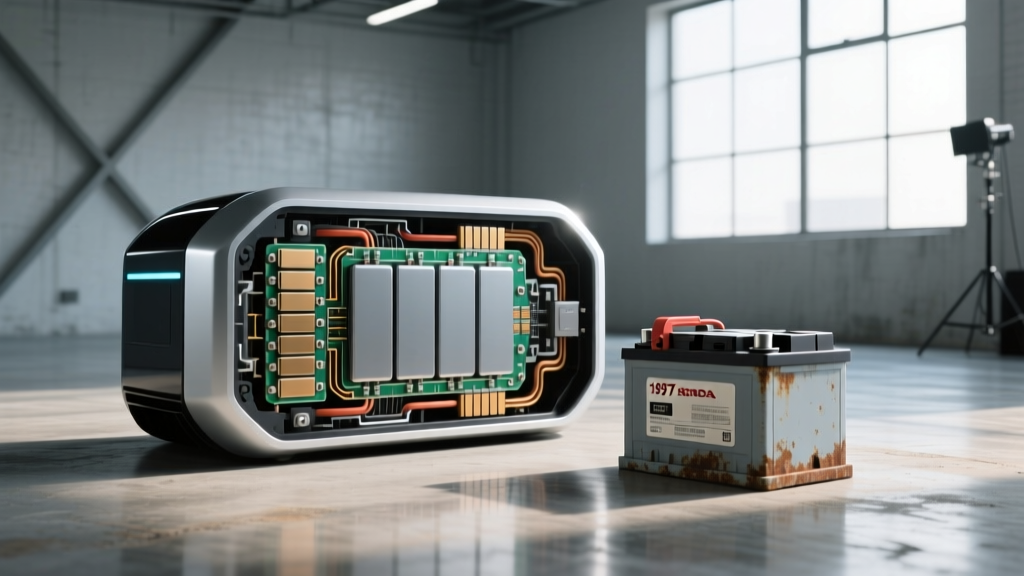
If you search for "1997 Honda Civic battery," you'll find owners reporting 10, 15, even 20 years on a single lead-acid or early NiMH pack — a testament to Honda's over-engineering. But what does that longevity benchmark mean for today's electric vehicles? Modern EV traction batteries are vastly more complex, operating at 400–800 volts and storing 60–120 kWh of energy. The real question for buyers in 2026 isn't whether an EV battery will fail catastrophically — it rarely does — but how much capacity it retains over a decade of use, what replacement costs if needed, and how chemistry choices like LFP vs NMC shape that trajectory.
This guide breaks down EV battery lifespan, degradation data, warranty coverage, replacement economics, and the chemistry trade-offs that determine how your pack ages — all benchmarked against the durability standard that is the 1997 Honda Civic battery era.
How Long Do EV Batteries Actually Last?
The short answer: most EV traction batteries outlast the vehicles they're installed in. Data aggregated from fleets and consumer reports shows that the average modern lithium-ion EV battery retains 85–92% of its original capacity after 150,000 miles (approximately 10–12 years of average US driving at 13,500 miles/year).
For context, a 1997 Honda Civic's original 12V lead-acid battery typically lasted 4–6 years before replacement, and even the most durable examples required at least two or three battery swaps over a 20-year ownership span. The EV traction battery, by contrast, is designed as a lifetime component.
Typical EV Battery Degradation Curve (NMC Chemistry, Average Use):
- Year 1 / 15,000 mi: ~3–5% capacity loss (initial formation loss)
- Year 3 / 45,000 mi: ~6–8% total loss
- Year 5 / 75,000 mi: ~8–12% total loss
- Year 8 / 120,000 mi: ~10–15% total loss
- Year 10 / 150,000 mi: ~12–18% total loss
Sources: Geotab fleet data (2024 update), Recurrent Auto battery health reports.
LFP (lithium iron phosphate) batteries, now standard in base-trim Tesla Model 3/Y, Ford Mustang Mach-E Select, and many Chinese-market imports, show even slower degradation — often 5–8% loss over 150,000 miles — thanks to superior cycle-life chemistry, though with lower energy density.
The 1997 Honda Civic battery comparison is instructive: that car's simplicity meant fewer failure modes. EV batteries face thermal cycling, fast-charge stress, and depth-of-discharge wear — but advanced thermal management systems (liquid cooling/heating) have largely mitigated the catastrophic degradation seen in early EVs like the 2011 Nissan Leaf (which lacked active cooling and saw 20–30% loss within 5 years).
LFP vs NMC/NCA: Which Chemistry Is Better and Why?
Not all EV batteries are the same. The two dominant chemistries in 2026 — LFP (lithium iron phosphate) and NMC/NCA (nickel manganese cobalt / nickel cobalt aluminum) — have fundamentally different aging profiles, performance characteristics, and cost structures.
| Attribute | LFP (LiFePO4) | NMC/NCA |
|---|---|---|
| Energy Density | Lower (~160–180 Wh/kg cell-level) | Higher (~250–300 Wh/kg cell-level) |
| Cycle Life | 3,000–5,000+ cycles to 80% SoH | 1,000–2,000 cycles to 80% SoH |
| Cold-Weather Performance | Weaker; ~20–30% range loss below freezing without preconditioning | Better; ~15–25% range loss below freezing |
| Fast-Charge Tolerance | Excellent; tolerates frequent DCFC with minimal degradation | Moderate; frequent 150+ kW charging accelerates wear |
| Cost (2026) | ~$80–100/kWh at pack level | ~$110–140/kWh at pack level |
| Typical Use | Base/standard-range trims, fleet vehicles, daily commuters | Long-range/performance trims, towing-heavy applications |
| State of Charge Recommendation | Can charge to 100% daily without harm | Best kept 20–80% for daily use; 100% for trips only |
| Cobalt Content | None | Varies; NCA uses less, NMC uses more |
The verdict: LFP wins on longevity and cost if you don't need maximum range per charge. NMC/NCA wins on energy density and cold-weather performance if you regularly drive 300+ miles between charges or live in northern climates. Neither is universally "better" — the right choice depends on your driving pattern.
A real-world example: a 2025 Tesla Model 3 RWD (LFP, ~60 kWh usable, EPA 272 mi) will likely show less degradation at 100,000 miles than a Model 3 Long Range AWD (NMC, ~79 kWh usable, EPA 341 mi) subjected to the same fast-charging habits — but the Long Range starts with more buffer, so both may still deliver 280+ usable miles at that point.
What Does the Battery Warranty Actually Cover?
Federal law (EPA emissions warranty requirements) effectively mandates that EV manufacturers warrant the traction battery for at least 8 years / 100,000 miles (10 years / 150,000 miles in California and states adopting CARB standards). Most manufacturers meet or exceed this baseline.
| Manufacturer (2026 Models) | Battery Warranty | Capacity Retention Threshold |
|---|---|---|
| Tesla (Model 3/Y RWD — LFP) | 8 yr / 100,000 mi | 70% of original capacity |
| Tesla (Model 3/Y LR — NMC) | 8 yr / 120,000 mi | 70% of original capacity |
| Hyundai / Kia (Ioniq 5/6, EV6) | 10 yr / 100,000 mi | 70% of original capacity |
| Ford (Mach-E, F-150 Lightning) | 8 yr / 100,000 mi | 70% of original capacity |
| GM (Ultium-platform: Equinox EV, Blazer EV, Silverado EV) | 8 yr / 100,000 mi | 70% of original capacity (some trims: 60%) |
| Rivian (R1T, R1S) | 8 yr / 175,000 mi | 70% of original capacity |
| BMW (i4, iX, i7) | 8 yr / 100,000 mi | 70% of original capacity |
Critical detail: The warranty covers capacity falling below the stated threshold — not any degradation at all. Losing 15% capacity over 8 years (retaining 85%) is normal and expected, and would not trigger a warranty claim. You would need to drop below 70% (or 60% on some GM trims) to qualify for a replacement or repair under warranty.
This is where the 1997 Honda Civic battery comparison breaks down entirely: a lead-acid battery that can no longer crank the engine is simply dead and needs a $120 replacement. An EV battery at 75% capacity still provides full functionality — just reduced range. A 300-mile EPA vehicle at 75% SoH still delivers ~225 real-world miles, which covers 90%+ of American daily driving needs (the average US commute is ~37 miles round-trip per BTS data).
How Much Does an EV Battery Cost to Replace?
This is the question that generates the most anxiety — and the most misinformation. Let's anchor with real 2026 replacement figures:
| Vehicle / Battery Size | Chemistry | Replacement Cost (Parts + Labor) | Typical Replacement Trigger |
|---|---|---|---|
| Tesla Model 3 RWD (~60 kWh) | LFP | $10,000–$13,000 | Rarely needed; module-level repair more common at $2,000–$4,000 |
| Tesla Model Y LR (~79 kWh) | NMC | $14,000–$18,000 | Typically 200,000+ miles if at all |
| Hyundai Ioniq 5 (~77.4 kWh) | NMC | $13,000–$16,000 | Rare under warranty; module repair available |
| Ford F-150 Lightning Ext. Range (~131 kWh) | NMC | $22,000–$28,000 | Very rare; largest packs command highest prices |
| Chevrolet Bolt EV/EUV (~65 kWh) | NMC | $9,000–$12,000 | Post-recall packs show strong longevity |
| Nissan Leaf (40/62 kWh) | NMC (passive cooling) | $7,000–$10,000 | More common due to thermal management limitations |
The reality check: According to data from Recurrent Auto and Consumer Reports EV reliability surveys, fewer than 2–3% of EVs require a full battery pack replacement outside of warranty. Most battery "failures" are actually isolated module or sensor issues that can be repaired for $2,000–$5,000 without replacing the entire pack.
Compare this to the 1997 Honda Civic battery experience: over 20 years of ownership, a Civic owner might spend $600–$1,000 on three or four lead-acid battery replacements. The EV battery costs far more in a single event but is far less likely to need it — and when you factor in the fuel savings (EVs save $4,000–$8,000 in fuel costs over 100,000 miles depending on local electricity and gas prices), the net economics still favor electrification for most drivers.
Factors That Accelerate (or Preserve) Battery Life
EV battery degradation isn't random. It's driven by measurable, controllable factors:
Battery Care Best Practices (Data-Backed):
- Avoid sustained 100% SoC: For NMC/NCA batteries, daily charging to 80% reduces degradation by ~30–40% compared to daily 100% charges (LFP batteries are exempt — Tesla recommends periodic 100% charges for LFP calibration).
- Minimize DC fast charging above 150 kW: Occasional use is fine, but daily 250–350 kW charging accelerates electrolyte decomposition. Geotab data shows vehicles that DCFC more than 3x/week degrade ~2–3% faster over 4 years than those primarily using Level 2.
- Precondition before fast charging: Cold batteries resist charge; preconditioning (available on Tesla, Hyundai, Ford, GM, BMW) warms the pack to optimal temperature, reducing lithium plating risk.
- Avoid prolonged storage at 0% or 100%: If storing an EV for weeks, set SoC to ~50%. Both extremes accelerate calendar aging.
- Park in shade/garage in extreme heat: Battery degradation roughly doubles for every 10°C above 30°C sustained ambient. Phoenix and Las Vegas vehicles show measurably faster degradation than Seattle vehicles.
- Use Level 2 home charging as your primary method: 7–11 kW Level 2 charging generates far less thermal stress than 150+ kW DC fast charging.
The 1997 Honda Civic battery didn't need any of this — lead-acid chemistry is simple and tolerant of abuse. But the energy density trade-off is enormous: a 12V/50Ah car battery stores ~0.6 kWh. A modern EV battery stores 60–131 kWh — 100–200x more energy — while lasting 10–15 years with proper care.
How to Check and Monitor Your Battery's State of Health (SoH)
State of Health (SoH) is the percentage of original capacity your battery currently retains. A new EV has 100% SoH; at 85% SoH, a 300-mile EPA vehicle delivers roughly 255 miles of range.
Methods to check SoH in 2026:
- In-vehicle displays: Tesla, Hyundai/Kia, BMW, and Mercedes now include battery health indicators in their infotainment or service menus. Tesla's "Battery Health" screen (introduced in 2024 software updates) shows estimated current capacity vs. original.
- OBD-II diagnostic tools: Third-party apps like OBDeleven, LeafSpy (Nissan Leaf), and Scan My Tesla read raw battery management system (BMS) data including cell voltage variance, total energy throughput, and calculated SoH.
- Dealer diagnostics: Any authorized service center can pull a full battery health report. Request this during routine service or pre-purchase inspections on used EVs.
- Third-party services: Companies like Recurrent Auto offer free battery health reports that compare your degradation curve against a fleet of identical vehicles.
- Manual calculation: Charge to 100%, note the displayed range, and compare to the original EPA sticker. Adjust for temperature (cold weather reduces displayed range temporarily, not permanently). This is approximate but directionally useful.
Red flags that warrant a service visit:
- Sudden range drops of 10%+ not explained by temperature
- Cell voltage imbalance warnings (variance >300mV between cells)
- Rapid capacity loss (>5% in a single month)
- Charging speed significantly below the vehicle's rated peak kW without thermal explanation
Emerging Battery Technology: What's Next (2027–2032)
While today's lithium-ion batteries are mature and reliable, several next-generation technologies are approaching commercialization:
Solid-State Batteries: Toyota, Samsung SDI, and QuantumScape are targeting limited production in 2027–2029. Solid-state batteries replace the liquid electrolyte with a solid material, promising 30–50% higher energy density, faster charging (potentially 10–80% in under 10 minutes), and improved safety (no flammable electrolyte). However, manufacturing costs remain 2–4x current lithium-ion, and initial deployment will likely be limited to premium/flagship models. Mass-market availability is not expected before 2030–2032.
Silicon-Dominant Anodes: Companies like Sila Nanotechnologies and Group14 are already supplying silicon-blend anodes to Mercedes (EQG) and other manufacturers. Silicon anodes can store ~10x more lithium ions than graphite, boosting energy density by 20–40%. Expect broader adoption in 2026–2028 model-year vehicles.
Sodium-Ion Batteries: CATL and BYD have begun deploying sodium-ion packs in Chinese-market vehicles (lower-cost, lower energy density, no lithium or cobalt required). US-market adoption is likely 2028+ and initially limited to entry-level/fleet applications where cost matters more than range.
These technologies are announced and in various stages of validation — none are broadly available in US-market vehicles as of early 2026. Buyers should not delay a purchase waiting for solid-state; today's batteries already deliver 200,000+ mile lifespans with proper care.
Frequently Asked Questions
How long do EV batteries last in years and miles?
Most modern EV batteries (2022+) retain 80–90% of original capacity after 150,000 miles / 10–12 years. LFP chemistry batteries often exceed this, with some fleet data showing 90%+ retention at 200,000 miles. Full pack failure is rare — under 3% of EVs require replacement outside warranty according to Recurrent Auto.
How much does an EV battery cost to replace in 2026?
Full pack replacement ranges from ~$7,000 (Nissan Leaf 40 kWh) to ~$28,000 (Ford F-150 Lightning Extended Range 131 kWh). Most common EVs (Tesla Model 3, Hyundai Ioniq 5) fall in the $10,000–$18,000 range. However, module-level repairs for isolated cell failures cost $2,000–$5,000 and are far more common than full replacements.
What does the EV battery warranty cover?
Federal minimum is 8 years / 100,000 miles (10/150,000 in CARB states). Coverage triggers when capacity drops below 70% of original (60% on some GM models). This means the manufacturer will repair or replace the battery if it degrades beyond the threshold — but normal 10–15% degradation over 8 years is expected and not covered.
LFP vs NMC — which battery chemistry should I choose?
Choose LFP if: you want maximum longevity, primarily drive under 250 miles/day, charge at home, want to charge to 100% daily without worry, and prioritize lower cost. Choose NMC/NCA if: you need maximum range per charge (300+ miles), live in cold climates, frequently road-trip, or need the lightest possible vehicle weight. Both chemistries are reliable; the choice is about use-case optimization.
Does fast charging damage my EV battery?
Occasional DC fast charging (1–2x per week) has minimal impact on modern batteries with active thermal management. However, Geotab fleet data shows that vehicles DC fast charging 3+ times per week degrade ~2–3% more over 4 years compared to Level 2-only charging. The biggest risk is frequent 250+ kW charging in hot weather without preconditioning. For daily use, a home Level 2 charger (7–11 kW) is optimal for battery longevity.
Can I still compare EV battery life to a 1997 Honda Civic battery?
The comparison is useful as a longevity mindset anchor — Honda's engineering ethos of overbuilding components persists in modern EV battery design philosophy. But the technologies are fundamentally different: a 1997 Civic battery stored 0.6 kWh and lasted 4–6 years; a 2026 EV battery stores 60–131 kWh and is designed for 15–20 years. The EV battery is a more stressed, more complex component, but it's also more carefully managed by sophisticated battery management systems that actively prevent the conditions that cause premature failure.