If you've shopped for an electric vehicle, you've seen battery capacity expressed in kilowatt-hours (kWh) — 60 kWh, 84 kWh, 100 kWh — but rarely seen the actual cost broken down per unit. Understanding what a 1 kWh battery costs at the cell, pack, and replacement level is the fastest way to evaluate whether an EV's price makes sense and how much financial risk you carry as an owner.
This guide dissects EV battery economics from the cell level up: cost per kWh across chemistries, real-world degradation data, warranty coverage, replacement pricing by model, and the daily habits that determine whether your pack lasts 150,000 miles or 300,000 miles.
The Real Cost of 1 kWh of EV Battery Capacity
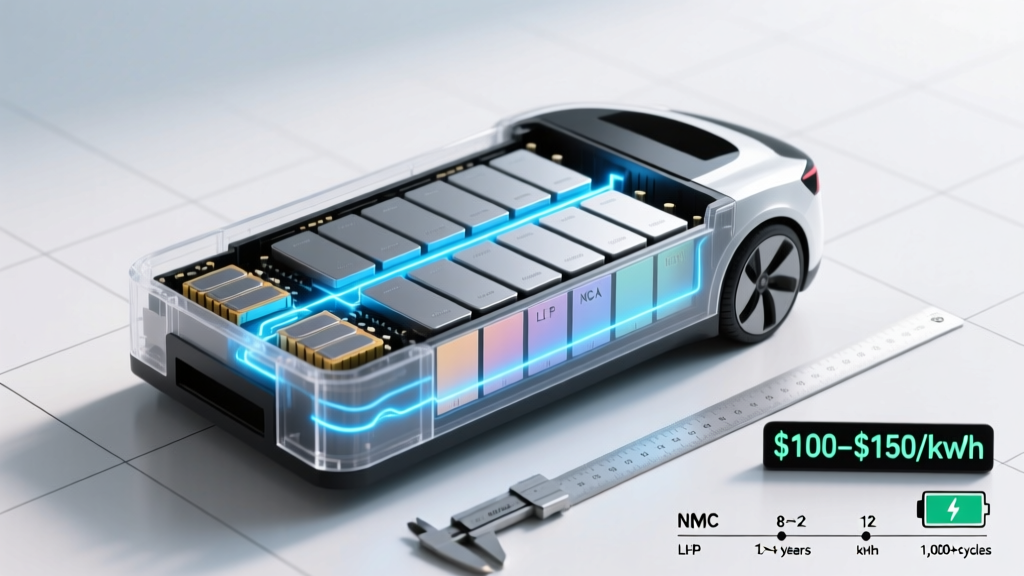
Battery pack pricing has fallen dramatically over the past decade. According to BloombergNEF's annual lithium-ion battery price survey, the average pack price reached approximately $115 per kWh at the cell level and roughly $135–$145 per kWh at the pack level entering 2026. That means the raw battery cost in a vehicle with a 75 kWh usable pack sits around $10,125–$10,875 before integration, thermal management hardware, and manufacturer markup.
But that cell-level number doesn't tell the full story. What you pay for a replacement battery — or what's baked into a new vehicle's MSRP — includes the battery management system (BMS), cooling plates or immersion systems, structural housing, wiring, and dealer labor. The real-world cost to the consumer per usable kWh is closer to $160–$220 depending on the chemistry, manufacturer, and whether you're buying new or replacing out of warranty.
LFP vs NMC/NCA: Which Battery Chemistry Should You Choose?
The two dominant lithium-ion chemistries in 2026 EVs are lithium iron phosphate (LFP) and nickel manganese cobalt (NMC), with nickel cobalt aluminum (NCA) appearing in some Tesla and legacy applications. Your choice of chemistry affects range per kWh, how long the battery lasts, cold-weather behavior, and the price you pay upfront.
| Attribute | LFP (Lithium Iron Phosphate) | NMC / NCA |
|---|---|---|
| Energy Density | Lower (~160–180 Wh/kg cell-level) | Higher (~220–260 Wh/kg cell-level) |
| Typical Cycle Life | 3,000–5,000+ cycles to 80% SoH | 1,000–2,000 cycles to 80% SoH |
| Cold-Weather Performance | Moderate; higher internal resistance below 32°F | Better low-temp discharge and charge acceptance |
| Cost per kWh (Cell) | Lower (~$90–$110) | Higher (~$115–$140) |
| Daily Charging to 100% | Recommended — no degradation penalty | Not recommended; 80% daily limit preferred |
| Cobalt/Nickel Content | Zero cobalt, zero nickel | Contains cobalt and/or nickel |
| Common in 2026 Models | Tesla Model 3/Y RWD, Ford Mustang Mach-E Select, many Chinese-market EVs | Tesla Long Range, Hyundai Ioniq 5/6, Kia EV6/EV9, BMW iX, most AWD/LR trims |
The verdict: LFP is the better choice for daily commuters who charge at home, want maximum cycle life, and don't need the last 10% of range. NMC/NCA is better for buyers who prioritize maximum range per kWh, tow frequently, or live in consistently cold climates where cold-weather charge acceptance matters.
EV Battery Degradation: What the Data Actually Shows
Most EV owners overestimate degradation risk. Large-scale fleet data from sources like Geotab's longitudinal battery health study tracking over 10,000 EVs shows that the average EV loses approximately 1.8% to 2.3% of battery capacity per year under normal use. That translates to roughly 82–88% State of Health (SoH) remaining after 8 years — well above the 70% threshold that triggers warranty replacement.
However, degradation is not linear. Most packs experience a steeper initial drop of 2–4% in the first year as the solid electrolyte interphase (SEI) layer stabilizes, then settle into a slower, more predictable decline. Vehicles subjected to frequent DC fast charging (more than 3–4 sessions per week), sustained high SoC in hot climates, or repeated deep discharges below 10% can see accelerated loss of 3–4% annually.
- Tesla Model 3/Y (NMC, 2020–2022): ~92% SoH at 60,000 miles; ~85% at 120,000 miles
- Chevrolet Bolt EV/EUV (NMC): ~90% SoH at 75,000 miles; slower degradation attributed to conservative BMS buffer
- Tesla Model 3 RWD (LFP, 2022–2024): ~95% SoH at 50,000 miles; minimal degradation with daily 100% charging
- Hyundai Ioniq 5 (NMC, 77.4 kWh): ~91% SoH at 60,000 miles; preconditioning helps preserve fast-charge health
What Does the EV Battery Warranty Actually Cover?
Federal law mandates a minimum battery warranty of 8 years or 100,000 miles (whichever comes first) for all EVs sold in the United States, with 10 years/150,000 miles required in California Air Resources Board (CARB) states. But the critical detail is the capacity retention threshold — the point at which the manufacturer must replace or repair the battery at no cost.
| Manufacturer | Warranty Period | Capacity Threshold | Notes |
|---|---|---|---|
| Tesla | 8 yr / 120,000 mi (Model 3/Y LR); 8 yr / 100,000 mi (RWD) | 70% retention | Covers defects and excessive degradation |
| Hyundai / Kia | 10 yr / 100,000 mi | 70% retention | Among the longest coverage in the industry |
| Ford | 8 yr / 100,000 mi | 70% retention | Covers battery components and capacity loss |
| GM (Chevrolet, Cadillac) | 8 yr / 100,000 mi | 60–70% retention (varies by model) | Ultium platform packs; check specific model terms |
| BMW | 8 yr / 100,000 mi | 70% retention | Modular pack design may allow partial replacement |
| Rivian | 8 yr / 175,000 mi | 70% retention | Highest mileage threshold among major OEMs |
What's covered: Manufacturing defects, cell failures, module imbalances, and capacity degradation below the stated threshold. What's typically excluded: Damage from accidents, flooding, improper modifications, or use outside manufacturer guidelines (such as sustained storage at 0% SoC). Always read the specific warranty booklet for your model year.
EV Battery Replacement Cost: What You'd Actually Pay
The good news: the vast majority of EV batteries outlast the vehicles they're installed in. Data from Recurrent Auto's battery replacement tracker shows that fewer than 2% of EVs in their fleet of over 15,000 vehicles have required a full battery replacement, and most of those were early-model vehicles or covered under warranty.
If you do face an out-of-warranty replacement — typically on a 10- to 15-year-old EV or a high-mileage fleet vehicle — here's what the market looks like in 2026:
| Model (Battery Size) | Replacement Cost Range | Cost per Usable kWh | Availability |
|---|---|---|---|
| Nissan LEAF (40–62 kWh) | $6,500–$9,000 | ~$145–$165/kWh | OEM and refurbished packs available |
| Chevrolet Bolt EV (65 kWh) | $9,000–$14,000 | ~$155–$215/kWh | Post-recall packs; improved thermal management |
| Tesla Model 3/Y (75–82 kWh) | $12,000–$18,000 | ~$160–$220/kWh | OEM through Tesla service; third-party refurb growing |
| Hyundai Ioniq 5 (77.4 kWh) | $11,000–$16,000 | ~$145–$205/kWh | OEM; E-GMP platform packs |
| Ford F-150 Lightning (98–131 kWh) | $18,000–$28,000 | ~$175–$215/kWh | Large packs command premium; labor-intensive |
| BMW iX (76.6–111.5 kWh) | $16,000–$25,000 | ~$185–$225/kWh | Modular design may allow partial module swap |
These figures include the battery pack and typical dealer installation labor. Independent EV shops and third-party refurbishers are increasingly offering 20–35% savings over OEM dealer pricing, particularly for older models like the LEAF and early Bolt. Module-level repair — replacing only degraded cells rather than the full pack — is available for some platforms and can cut costs by 50% or more.
Factors That Accelerate (or Preserve) Battery Life
Your daily charging and driving habits have a measurable impact on how quickly your battery degrades. Here are the factors ranked by impact, based on fleet telematics data and manufacturer engineering guidance:
- Limit DC fast charging to road trips. Daily reliance on 150+ kW DC charging generates sustained heat that accelerates SEI layer growth and lithium plating. Aim for Level 2 home charging as your primary routine.
- Avoid extreme State of Charge. For NMC/NCA packs, set your daily charge limit to 80%. For LFP, charge to 100% as recommended — LFP's flat voltage curve requires periodic full charges for accurate BMS calibration.
- Don't store at 0% or 100% for extended periods. If leaving your EV for a week or more, target 50–60% SoC. Calendar aging accelerates at voltage extremes.
- Use preconditioning before fast charging. Most modern EVs (Tesla, Hyundai/Kia E-GMP, GM Ultium) warm or cool the battery to optimal temperature before accepting a high-power charge. Enable navigation-based preconditioning when routing to a DC fast charger.
- Park in shade or a garage in hot climates. Sustained battery temperatures above 95°F (35°C) accelerate calendar degradation even when the vehicle is parked.
- Drive smoothly in extreme cold. Below 20°F (-7°C), allow the battery to warm through gentle driving before demanding maximum regen or acceleration.
How to Check Your EV's Battery Health (State of Health)
State of Health (SoH) represents your battery's current maximum capacity as a percentage of its original capacity when new. A pack with 90% SoH that started at 75 kWh now holds approximately 67.5 kWh at full charge.
Here's how to monitor SoH across popular platforms:
- Tesla: No native SoH display in the vehicle UI. Use the TeslaFi or Tessie third-party apps to track estimated range at 100% over time. Tesla Service can pull a detailed battery health report on request.
- Hyundai/Kia: The EV battery health percentage is accessible through the infotainment system's EV diagnostic menu on most 2023+ models. The Bluelink/Uvo connected app also shows estimated battery condition.
- GM (Ultium platform): The myChevrolet/myCadillac app provides a battery health indicator. OnStar diagnostics can generate a detailed report.
- Ford: The FordPass app includes a battery health check feature. Dealership OBD-II scans provide module-level voltage data.
- Nissan LEAF: The dashboard "battery health bars" (out of 12) provide a coarse estimate. Third-party tools like LEAF Spy Pro connect via OBD-II for precise SoH, cell voltage deltas, and Hx (health index) readings.
- Universal: Any qualified EV shop can perform an OBD-II scan showing individual cell voltages, pack resistance, and calculated SoH. Annual checks are recommended for vehicles past the 5-year mark.
Emerging Battery Technologies: Solid-State and Beyond
Several next-generation battery technologies are in active development, but none are available in consumer EVs as of early 2026. Here's a realistic assessment:
Solid-state batteries replace the liquid electrolyte with a solid ceramic, polymer, or sulfide material, promising higher energy density (potentially 400+ Wh/kg at the cell level), faster charging, and improved safety. Toyota has announced a solid-state battery for a limited-production EV expected in 2027–2028, with broader availability projected for 2029–2030. Samsung SDI and QuantumScape are also advancing solid-state cells, but manufacturing scale and cost remain significant hurdles. Expect initial solid-state EVs to carry a substantial price premium.
Silicon anode batteries increase the silicon content in the anode (replacing graphite) to boost energy density by 20–40%. Sila Nanotechnologies and Group14 Technologies are supplying early silicon-anode materials to battery manufacturers, with initial automotive applications expected in 2026–2027 model-year premium vehicles. This is an incremental improvement to existing lithium-ion architecture, not a full replacement.
Sodium-ion batteries use abundant sodium instead of lithium, offering lower cost (estimated $50–$70/kWh at scale) and excellent cold-weather performance, but with significantly lower energy density. CATL has begun production of sodium-ion cells for entry-level EVs in China, and limited adoption in budget EVs globally is possible by 2028. These are best suited for urban commuter vehicles where weight and range are less critical than cost.
Frequently Asked Questions
How long do EV batteries last in years and miles?
Based on fleet data from Geotab and Recurrent Auto, most modern EV batteries retain 80–88% of original capacity after 8 years or 120,000–150,000 miles. LFP packs frequently exceed 200,000 miles before reaching 80% SoH. The battery will continue to function beyond this point — it simply holds less energy, reducing range proportionally. Most EV batteries will outlast the vehicle's useful economic life.
How much does it cost to replace an EV battery?
Out-of-warranty replacement costs range from approximately $6,500 for a Nissan LEAF (40 kWh) to $28,000 for a Ford F-150 Lightning Extended Range (131 kWh), including labor. On a per-kWh basis, expect $145–$225/kWh depending on the model and whether you use OEM or refurbished packs. The vast majority of replacements are covered under the federally mandated 8-year/100,000-mile warranty at no cost to the owner.
What does the battery warranty cover?
EV battery warranties cover manufacturing defects, cell or module failures, and capacity degradation below a specified threshold — typically 70% of original capacity — within the warranty period (minimum 8 years/100,000 miles federally, 10 years/150,000 miles in CARB states). Warranties do not cover damage from accidents, modifications, or abuse. Consult your specific model's warranty booklet for exact terms.
LFP vs NMC — which battery chemistry is better?
Neither is universally better. LFP offers longer cycle life (3,000–5,000 cycles vs 1,000–2,000), lower cost, zero cobalt, and tolerance for daily 100% charging — ideal for commuters and home-charging routines. NMC/NCA delivers higher energy density for more range per kWh, better cold-weather charge acceptance, and is standard in long-range and AWD trims. Choose LFP for longevity and value; choose NMC for maximum range and cold-climate performance.
How do I check my EV battery's State of Health?
Methods vary by brand. Tesla owners can use third-party apps like TeslaFi; Hyundai/Kia and GM offer in-app battery health indicators; Nissan LEAF owners can use LEAF Spy Pro via OBD-II. Any qualified EV service center can perform a detailed OBD-II diagnostic showing cell-level voltages and calculated SoH. Annual checks are recommended for vehicles over 5 years old.
Does fast charging damage my EV battery?
Occasional DC fast charging on road trips has minimal impact. However, relying on DC fast charging (150+ kW) as your primary charging method — multiple times per week — generates sustained heat that accelerates degradation. Fleet data shows vehicles that fast-charge daily can lose 3–4% capacity per year versus 1.8–2.3% for those primarily using Level 2 home charging. Use Level 2 as your daily routine and reserve DC fast charging for trips.
Understanding the economics of EV batteries — from the cost of a single kWh of capacity to the real-world degradation you'll experience over a decade of ownership — removes much of the uncertainty from buying electric. The data consistently shows that modern lithium-ion packs, whether LFP or NMC, are engineered to outlast the vehicles they power, and the combination of federal warranty mandates and declining replacement costs makes the long-term financial risk far lower than early EV skeptics predicted.