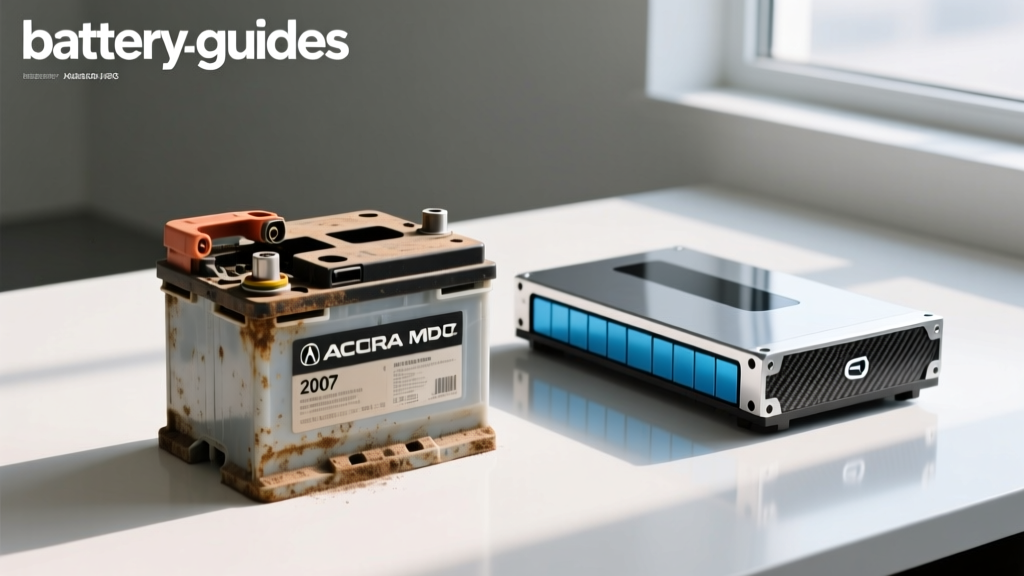
If you've searched for a 2007 Acura MDX battery, you've likely discovered that replacing the 12V starter battery in a nearly two-decade-old luxury SUV costs roughly $150–$250 for a Group 24F or 35 AGM unit. That's a routine maintenance item. But that search also surfaces a bigger question for today's car buyers: what happens when the battery in an electric vehicle needs replacing?
The 2007 MDX is a useful comparison point. Its 12V lead-acid battery powers accessories and cranks a 3.7L V6 — it's a consumable, swapped every 3–5 years without a second thought. An EV's high-voltage traction battery is fundamentally different: it's the most expensive component in the vehicle, designed to last the life of the car, and governed by federal warranty mandates. This guide breaks down exactly what EV battery ownership looks like in 2026 — chemistry, degradation data, replacement costs, warranties, and the habits that maximize longevity.
The 12V Battery vs. the Traction Battery: Why the Distinction Matters
Before diving into lithium-ion packs, let's clear up a persistent confusion — one that the "2007 Acura MDX battery" search perfectly illustrates.
The 12V auxiliary battery in any vehicle (gas, hybrid, or EV) powers lights, infotainment, door locks, and control computers. In the 2007 MDX, it also engages the starter motor. In a modern EV like a Tesla Model Y or Hyundai Ioniq 5, a 12V lithium-iron-phosphate or lead-acid battery still exists, but it doesn't drive the wheels — a DC-DC converter steps down the high-voltage pack to keep it charged.
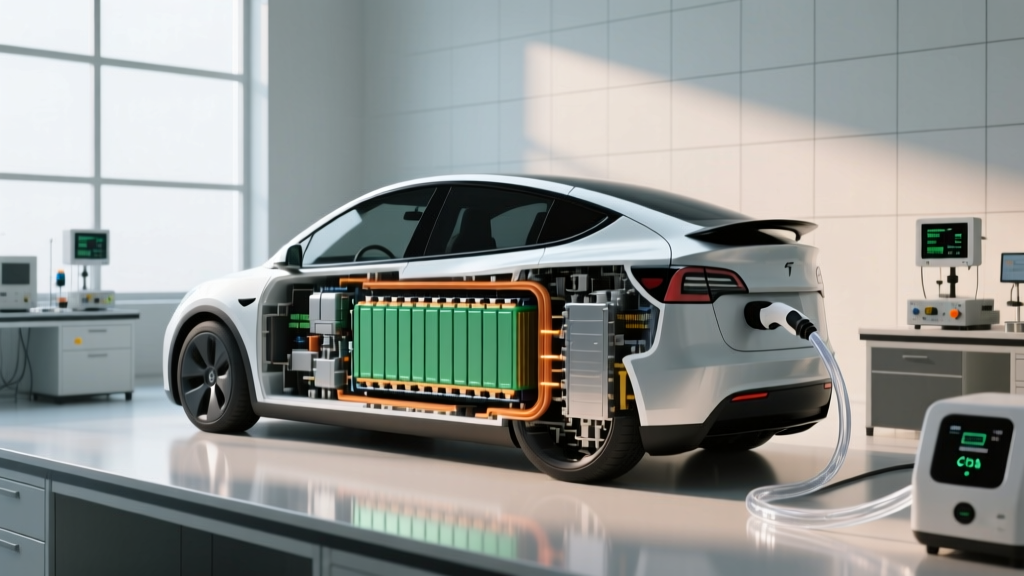
The high-voltage traction battery is what propels an EV. It operates at 400V (or 800V in vehicles like the Ioniq 5 and Porsche Taycan), stores between 50 and 130+ kWh of energy, and weighs 700–1,500 lbs. When we discuss "EV batteries" in this guide, we're talking about this traction pack — not the 12V unit.
Battery Chemistry in 2026: LFP vs. NMC vs. NCA
Not all lithium-ion batteries are the same. The two dominant chemistries in today's EV market are LFP (lithium iron phosphate) and NMC/NCA (nickel manganese cobalt / nickel cobalt aluminum). The chemistry inside your pack dictates range, longevity, cold-weather behavior, and price.
| Attribute | LFP (Lithium Iron Phosphate) | NMC / NCA (Nickel-Based) |
|---|---|---|
| Energy Density | Lower (~160–180 Wh/kg cell-level) | Higher (~220–260 Wh/kg cell-level) |
| Typical EV Range | 200–310 mi (EPA) | 260–400+ mi (EPA) |
| Cycle Life | 3,000–5,000+ cycles to 80% SoH | 1,000–2,500 cycles to 80% SoH |
| Cold Performance | Greater range loss below 32°F (~30–40% loss at 0°F) | Better cold retention (~20–30% loss at 0°F) |
| Charging to 100% | Recommended regularly (helps BMS calibration) | Daily limit of 80% recommended |
| Cost per kWh (pack-level) | ~$90–$110 | ~$120–$150 |
| Cobalt Content | None | Contains cobalt (supply-chain concern) |
| Examples (2026) | Tesla Model 3 RWD, Model Y RWD, Ford Mustang Mach-E Select (base) | Tesla Model Y LR/AWD, Hyundai Ioniq 5, BMW iX, Rivian R1T |
Which is better? It depends on your driving pattern. If you commute under 80 miles daily, charge at home, and live in a mild climate, LFP's superior cycle life and lower cost make it the pragmatic choice — you can charge to 100% nightly without degradation anxiety. If you need 300+ miles of range, tow frequently, or drive in harsh winters, NMC/NCA's energy density and cold-weather advantage justify the trade-off in cycle life.
How Long Do EV Batteries Actually Last?
The short answer: most EV traction batteries outlast the vehicle they're installed in. The long answer requires looking at real degradation data.
According to long-term fleet data aggregated by Geotab's EV Battery Degradation Study (tracking over 10,000 vehicles), the average EV battery loses approximately 2.3% of its capacity per year under typical usage. That means after 10 years, the average pack retains roughly 77–80% of its original capacity.
| Age (Years) | Avg. Capacity Retained | Effective Range (from 300-mi EPA pack) |
|---|---|---|
| Year 1 | ~97% | ~291 mi |
| Year 3 | ~93% | ~279 mi |
| Year 5 | ~88–90% | ~264–270 mi |
| Year 8 | ~82–85% | ~246–255 mi |
| Year 10 | ~77–80% | ~231–240 mi |
| Year 15 | ~68–72% (projected) | ~204–216 mi |
Key observations from this data:
- Early drop is steepest. Most packs lose 2–4% in the first year as the solid-electrolyte interphase (SEI) layer stabilizes, then degradation slows significantly.
- LFP degrades more slowly. Tesla's LFP-equipped Model 3 RWD fleet shows average losses closer to 1.5% per year, meaning 85%+ retention at 10 years.
- Outliers exist. Vehicles subjected to frequent DC fast charging in hot climates (Arizona, Texas) without preconditioning can see 3–4% annual loss.
- Warranty threshold is 70%. Federal mandate requires manufacturers to guarantee at least 70% capacity retention for 8 years / 100,000 miles (10 years / 150,000 miles in CARB states like California, New York, and Massachusetts).
What Does the EV Battery Warranty Actually Cover?
Under U.S. federal law (EPA emissions warranty provisions applied to EV batteries), every new EV sold in the United States carries a minimum battery warranty of 8 years or 100,000 miles, whichever comes first. In states that follow California Air Resources Board (CARB) standards — currently 17 states plus D.C. — the requirement extends to 10 years or 150,000 miles.
| Manufacturer | Warranty Term | Capacity Threshold | Transferable? |
|---|---|---|---|
| Tesla (Model 3/Y RWD, LFP) | 8 yr / 100,000 mi | 70% retention | Yes (automatic) |
| Tesla (Model 3/Y LR, AWD) | 8 yr / 120,000 mi | 70% retention | Yes (automatic) |
| Hyundai / Kia | 10 yr / 100,000 mi | 70% retention | First owner only (10yr); 5yr/60k transferable |
| Ford (Mustang Mach-E, F-150 Lightning) | 8 yr / 100,000 mi | 70% retention | Yes (automatic) |
| BMW (iX, i4) | 8 yr / 100,000 mi | 70% retention | Yes (automatic) |
| Rivian (R1T, R1S) | 8 yr / 175,000 mi | 70% retention | Yes (automatic) |
| GM (Ultium-based) | 8 yr / 100,000 mi | 70% retention (60% on Bolt EV/EUV legacy) | Yes (automatic) |
What triggers a warranty claim? If your battery's State of Health (SoH) drops below the stated threshold (typically 70%) within the warranty period, the manufacturer must repair or replace the pack at no cost. This covers abnormal degradation — not damage from accidents, flooding, or unauthorized modifications.
What's NOT covered: Normal capacity loss above the threshold. If your 8-year-old pack retains 72% capacity, it's functioning within spec even though you've lost ~28% of your original range. Cosmetic issues, 12V battery failures, and charging port hardware are handled under separate warranties.
EV Battery Replacement Cost: The Numbers
This is where the 2007 Acura MDX comparison is starkest. A $180 AGM battery swap at your local auto parts store versus a high-voltage pack replacement that can exceed the car's value. Here's what EV battery replacement actually costs in 2026:
| Vehicle | Battery Size | Chemistry | Replacement Cost (Parts + Labor) | Typical Replacement Timeline |
|---|---|---|---|---|
| Tesla Model 3 RWD | 60 kWh | LFP | $8,000–$12,000 | Rarely before 200,000+ mi |
| Tesla Model Y Long Range | 82 kWh (usable ~75) | NMC | $12,000–$16,000 | Rarely before 150,000+ mi |
| Hyundai Ioniq 5 (AWD) | 77.4 kWh | NMC | $13,000–$18,000 | Rarely before 150,000+ mi |
| Ford F-150 Lightning (Extended) | 131 kWh (usable ~115) | NMC | $20,000–$30,000 | Rarely before 150,000+ mi |
| Chevrolet Bolt EV (2022–2023) | 65 kWh | NMC | $9,000–$14,000 | Rarely before 150,000+ mi |
| BMW iX xDrive50 | 111.5 kWh (usable ~105) | NMC | $22,000–$28,000 | Rarely before 150,000+ mi |
Context that matters: According to data from Consumer Reports and warranty claim records, fewer than 2–3% of EV batteries require full replacement within the first 10 years of ownership. Most degradation is gradual — you don't wake up to a dead pack. When replacement is needed outside warranty, it's usually on vehicles with 150,000+ miles, at which point the vehicle's residual value may not justify the investment (similar to a transmission rebuild on a 200,000-mile gas car).
Module-level repair is growing. Many packs (especially from BMW, VW, and Hyundai) allow individual module replacement rather than swapping the entire pack. A single degraded module replacement can cost $1,500–$4,000 instead of $15,000+.
Factors That Accelerate Battery Degradation
Not all miles are equal when it comes to battery wear. These are the five biggest factors that push degradation above the 2.3% annual average:
1. Frequent DC Fast Charging Without Preconditioning
DC fast charging (Level 3, 50–350 kW) generates significant heat inside the cells. Vehicles that DCFC more than 3 times per week show 1–2% additional annual degradation versus those that primarily charge at home on Level 2. Preconditioning — warming the battery to its optimal 25–35°C before a fast-charge session — is critical. Tesla, Hyundai, and Ford all offer navigation-linked preconditioning that activates automatically when you route to a charger.
2. Sustained High State of Charge (NMC/NCA Packs)
Storing an NMC battery at 100% SoC for extended periods accelerates electrolyte decomposition and cathode stress. For NMC/NCA owners: set your daily charge limit to 80%, and only charge to 100% immediately before a long trip. LFP owners can ignore this — LFP chemistry tolerates 100% storage without meaningful additional wear.
3. Extreme Heat Exposure
Ambient temperatures above 95°F (35°C), combined with a high SoC, are the worst-case scenario for lithium-ion longevity. Vehicles parked outdoors in Phoenix or Houston summers without shade see measurably faster degradation. If you live in a hot climate, prioritize a garage or covered parking and avoid leaving the car at 100% SoC for days.
4. Deep Discharges to 0%
Regularly draining the pack below 5% stresses the anode and can trigger copper dissolution in the cell. Modern BMS (Battery Management Systems) include a buffer — the "0%" on your dashboard still has ~2–5 kWh in reserve — but repeatedly hitting that floor isn't ideal. Try to keep the pack above 10% for daily use.
5. High-Performance Driving & Towing
Sustained high-current draw (track driving, heavy towing, repeated hard acceleration) generates internal cell heat. Occasional spirited driving is fine; daily towing at max capacity in summer heat will accelerate wear. The Ford F-150 Lightning's towing range drop (from ~320 mi unloaded to ~150 mi at max tow) reflects this energy demand — and the corresponding thermal stress on the pack.
How to Check and Monitor Battery Health (SoH)
State of Health (SoH) is the percentage of your battery's current maximum capacity relative to its original factory capacity. A new pack is 100% SoH; a pack that can now store only 60 kWh out of its original 75 kWh is at 80% SoH.
Built-in tools:
- Tesla: Navigate to Service → Battery Health in the app (available since 2024). Displays SoH percentage and degradation curve.
- Hyundai/Kia: The infotainment system's EV diagnostics page shows battery health as a percentage. Also accessible via the Bluelink/UVO connected app.
- Ford: The FordPass app provides a battery health indicator, though it's less granular than Tesla's (shows "Normal" / "Attention Needed" rather than exact %).
- BMW: iDrive's battery health screen shows SoH, accessible through the vehicle settings menu.
OBD-II tools:
Third-party OBD-II dongles paired with apps like OBD2 Scanner for EV, Car Scanner ELM, or LeafSpy (for Nissan Leaf) can read detailed BMS data including individual cell voltages, pack temperature, and precise SoH. These cost $30–$80 for the hardware and are invaluable for used-EV buyers verifying pack condition before purchase.
Dealer diagnostics:
Any authorized dealer can run a full battery health report during a service visit. If you're approaching a warranty milestone (e.g., year 7, mile 95,000) and suspect abnormal degradation, request this proactively to establish a baseline before the warranty expires.
Emerging Battery Technology: What's Next (2027–2032)
Several next-generation technologies are in advanced development. None are available in production vehicles as of 2026, but they will reshape the landscape within the next 3–6 years:
Solid-state batteries replace the liquid electrolyte with a solid ceramic or polymer, promising 30–50% higher energy density, faster charging (10–80% in under 10 minutes), and inherent fire resistance. Toyota has announced a solid-state EV for 2027–2028 with ~620 miles of range (WLTP), while Samsung SDI targets 2027 production. Expect initial deployment in premium models at significant price premiums. Timeline: limited production 2027–2028; mainstream availability 2030+.
Silicon-dominant anodes replace graphite with silicon, which can store roughly 10x more lithium ions per gram. Companies like Sila Nanotechnologies (partnered with Mercedes-Benz for the G-Class EV) and Group14 (partnered with Porsche) are scaling production. Benefits include 20–40% energy density gains without changing cathode chemistry. Timeline: initial production vehicles 2026–2027; broader adoption by 2029.
Sodium-ion batteries use abundant sodium instead of lithium, offering lower cost (~$40–60/kWh projected) and excellent cold performance, but at significantly lower energy density. CATL has begun production for Chinese-market EVs. These are best suited for urban commuter vehicles and energy storage. Timeline: Chinese market now; U.S. market unlikely before 2028–2029.
LMFP (lithium manganese iron phosphate) is an evolution of LFP that adds manganese to boost energy density by ~15–20% while retaining LFP's cost and longevity advantages. CATL and Gotion are scaling LMFP cells for 2026–2027 model-year vehicles. Timeline: initial deployment in 2026–2027 model-year vehicles, primarily from Chinese OEMs.
Frequently Asked Questions
How long do EV batteries last in years and miles?
Based on fleet degradation data, most EV batteries retain 77–85% of their original capacity after 10 years / 150,000 miles. They remain functional well beyond that — just with reduced range. Full failure (requiring replacement) is rare before 150,000–200,000+ miles. LFP-equipped vehicles tend to last longer due to superior cycle life.
How much does an EV battery cost to replace in 2026?
Full pack replacement ranges from $8,000–$12,000 for smaller packs (Tesla Model 3 RWD, 60 kWh LFP) to $20,000–$30,000 for large packs (F-150 Lightning Extended Range, 131 kWh NMC). Module-level repairs, when available, cost $1,500–$4,000. Under federal warranty law, replacement is free if capacity drops below 70% within 8 years / 100,000 miles.
What does the EV battery warranty cover?
Federal law mandates a minimum 8-year / 100,000-mile warranty guaranteeing at least 70% capacity retention. CARB states extend this to 10 years / 150,000 miles. Coverage includes abnormal degradation and manufacturing defects. It does not cover accident damage, flood damage, or normal wear above the 70% threshold. Warranties are generally transferable to subsequent owners.
How do I check my EV battery health?
Most modern EVs display battery State of Health (SoH) through the manufacturer's app or infotainment system. Tesla shows exact SoH % in the app under Service → Battery Health. Third-party OBD-II dongles ($30–$80) paired with EV-specific apps can read detailed cell-level data. Dealers can run comprehensive diagnostics during any service visit.
LFP vs NMC — which battery chemistry should I choose?
Choose LFP if you want maximum longevity (3,000–5,000+ cycles), lower cost, cobalt-free sourcing, and don't mind slightly less range or worse cold-weather performance. Charge to 100% freely. Choose NMC/NCA if you need 300+ miles of range, tow regularly, or drive in harsh winters. Limit daily charge to 80% for best longevity.
Does the 2007 Acura MDX have an EV battery?
No. The 2007 Acura MDX is a conventional gasoline SUV with a 3.7L V6 engine. Its only battery is a standard 12V lead-acid unit (Group 24F or 35, ~$150–$250 replacement). It has no high-voltage traction battery, hybrid system, or electric drivetrain. The comparison in this article uses the 2007 MDX's 12V battery as a reference point for understanding the fundamental difference between conventional 12V batteries and EV traction packs.
Is it worth buying a used EV with a degraded battery?
Yes — if the price reflects the reduced range and the pack is still above 70% SoH. A used EV at 80% SoH still delivers meaningful daily range (e.g., a 300-mi EPA vehicle at 80% = ~240 mi). Verify SoH via OBD-II scan before purchasing, check remaining warranty coverage, and factor in that degradation slows significantly after year 3.
Sources: Geotab EV Battery Health Study, U.S. Department of Energy / fueleconomy.gov, manufacturer warranty documentation (Tesla, Hyundai, Ford, BMW, Rivian). Battery cost estimates derived from BloombergNEF 2025 lithium-ion battery price survey. Tax credit and warranty regulations per IRS §30D and EPA emissions warranty requirements.