If you drive an electric vehicle in New York City, your battery faces a gauntlet most owners in milder climates never consider: relentless stop-and-go traffic that cycles the pack hundreds of times a week, sub-freezing winters that sap range, and a public-charging-dependent lifestyle that often means frequent DC fast charging. Understanding the battery in your New York City EV — its chemistry, how it degrades, what the warranty actually covers, and what a replacement would cost — is the single most important piece of ownership knowledge you can acquire.
This guide dissects every layer of EV battery ownership with exact numbers, real-world data, and practical advice calibrated for urban drivers who rely on their pack every day.
How Long Do EV Batteries Actually Last?
The short answer: far longer than most buyers fear. Data aggregated from fleet operators and long-term owner surveys shows that the average modern EV battery pack loses roughly 5–8% of its original capacity over the first 100,000 miles, then degradation slows considerably. A 2024 study by Geotab, tracking over 10,000 electric vehicles, found that most packs retain between 88% and 93% of their original capacity after five years of typical use.
For a New York City driver averaging 12,000–15,000 miles per year, that translates to roughly 15–20 years before a pack approaches the 70% capacity-retention threshold that manufacturers use as the warranty floor. In other words, most EV batteries will outlast the vehicle they're installed in.
That said, "typical use" is doing heavy lifting in that sentence. Battery lifespan is not a fixed number — it's a function of how you treat the pack. Let's break down the variables.
LFP vs NMC: Which Battery Chemistry Suits Your Driving?
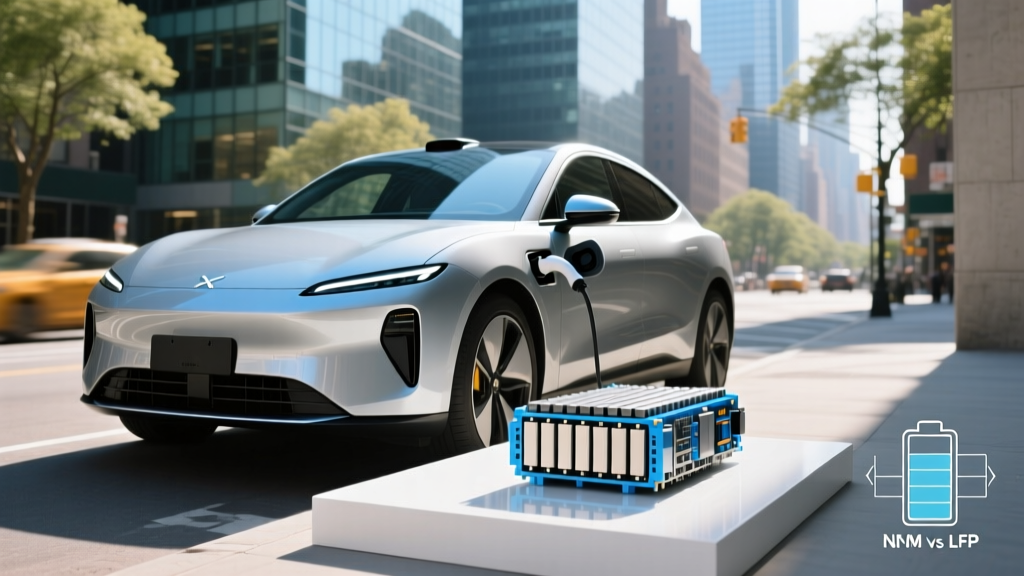
Every EV sold in 2026 uses one of two dominant lithium-ion chemistries: NMC (Nickel Manganese Cobalt, sometimes NCA — Nickel Cobalt Aluminum) or LFP (Lithium Iron Phosphate). The choice between them affects your range, your charging habits, your winter performance, and your long-term costs.
| Attribute | LFP (Lithium Iron Phosphate) | NMC / NCA |
|---|---|---|
| Energy Density | Lower (~150–170 Wh/kg cell-level) | Higher (~200–260 Wh/kg cell-level) |
| Typical Range per Pack Size | Shorter for same kWh | Longer for same kWh |
| Cycle Life | 3,000–5,000+ cycles | 1,000–2,000 cycles |
| Cold-Weather Performance | Moderate; loses 25–35% range below 20°F | Better thermal resilience; ~20–30% loss below 20°F |
| Recommended Daily SoC | 100% (no penalty for full charges) | 80–90% daily; 100% only for trips |
| Cost to Manufacture | Lower (no cobalt or nickel) | Higher (critical minerals cost more) |
| Common In (2026 Models) | Tesla Model 3 RWD, BYD, base Ford Mustang Mach-E Select | Tesla Long Range, Hyundai Ioniq 5, Rivian, BMW iX |
What this means for NYC drivers: If you have home or garage Level 2 charging and mostly drive under 100 miles a day, an LFP pack is a compelling choice — you can charge to 100% nightly without degradation guilt, and the cycle-life advantage is massive. If you need maximum range for weekend trips upstate or to the Hamptons, NMC gives you more miles per kWh of battery weight, but you should set your daily charge limit to 80%.
Degradation Data: What Real Numbers Show
Degradation is not linear. Most packs experience a steeper drop in the first 1–2 years (often 2–4%), then settle into a slow, nearly flat decline. Here's what aggregated fleet data and owner reports show for representative chemistries:
| Year / Mileage | NMC Pack (avg) | LFP Pack (avg) |
|---|---|---|
| Year 1 / ~12,000 mi | 97–98% | 98–99% |
| Year 3 / ~36,000 mi | 93–95% | 96–98% |
| Year 5 / ~60,000 mi | 90–93% | 94–97% |
| Year 8 / ~96,000 mi | 85–90% | 91–95% |
| Year 10 / ~120,000 mi | 82–87% | 88–93% |
Sources: Geotab Battery Health Study, owner-reported data from Recurrent Auto. Note that these are averages — individual results vary based on climate, charging habits, and thermal management system quality.
New York City's climate introduces two stressors: summer heat soak (ambient temperatures above 90°F on parked asphalt) and winter deep cold (sustained temps below 25°F from December through February). Both accelerate degradation if the battery isn't preconditioned. Vehicles with active liquid thermal management — standard on nearly every 2026 model from Tesla, Hyundai/Kia, Ford, GM, BMW, and Rivian — mitigate this substantially. The Nissan Leaf, which still uses passive air cooling on older model years, shows measurably higher degradation in hot climates.
Battery Warranty Terms: What's Actually Covered?
Federal law mandates that EV batteries carry a minimum warranty of 8 years or 100,000 miles (whichever comes first). In California and states that follow CARB rules — including New York — that mandate extends to 10 years or 150,000 miles. Most manufacturers meet or exceed these floors.
| Manufacturer | Warranty Term | Capacity Threshold | Notes |
|---|---|---|---|
| Tesla (Model 3/Y RWD — LFP) | 8 yr / 100,000 mi | 70% retention | 125,000 mi on Long Range/AWD |
| Hyundai / Kia | 10 yr / 100,000 mi | 70% retention | Among the best in the segment |
| Ford (Mustang Mach-E, F-150 Lightning) | 8 yr / 100,000 mi | 70% retention | Covers battery and hybrid/electric components |
| GM (Chevrolet, Cadillac EVs) | 8 yr / 100,000 mi | 70% retention (60% on Bolt) | Bolt uses 60% threshold — check your contract |
| Rivian | 8 yr / 175,000 mi | 70% retention | Higher mileage cap reflects truck use case |
| BMW | 8 yr / 100,000 mi | 70% retention | Includes thermal management system |
Critical nuance: The warranty covers capacity loss below the stated threshold — not a total battery failure. If your 80 kWh pack degrades to 58 kWh (72.5% retention) at year 7, you're above the 70% floor and the manufacturer owes you nothing. A genuine warranty claim typically means the pack has dropped below 56 kWh on an 80 kWh pack. According to the data above, very few packs reach that point within the warranty period under normal use.
The warranty also covers manufacturing defects: bad cells, BMS (Battery Management System) failures, coolant leaks into the pack, and connector faults. It does not cover damage from collisions, flooding, or unauthorized modifications.
EV Battery Replacement Cost: When and How Much?
Full battery replacement is rare — and getting rarer. Most out-of-warranty replacements occur on vehicles that are 10–15 years old, and by that point many owners have moved on to a new vehicle. But if you plan to keep your EV for the long haul, here's what the numbers look like as of 2026:
| Vehicle / Pack Size | Battery Cost (Parts) | Labor | Total Estimate |
|---|---|---|---|
| Tesla Model 3 RWD (~60 kWh LFP) | $8,000–$10,000 | $1,500–$2,500 | $9,500–$12,500 |
| Hyundai Ioniq 5 (~77 kWh NMC) | $12,000–$15,000 | $2,000–$3,000 | $14,000–$18,000 |
| Ford F-150 Lightning Ext. Range (~131 kWh) | $18,000–$25,000 | $2,500–$4,000 | $20,500–$29,000 |
| Chevrolet Equinox EV (~85 kWh) | $11,000–$14,000 | $2,000–$2,500 | $13,000–$16,500 |
| Rivian R1T / R1S (~128 kWh) | $17,000–$22,000 | $3,000–$4,500 | $20,000–$26,500 |
These figures are trending downward. Battery pack prices fell below $100/kWh at the cell level in 2025 for the first time, according to BloombergNEF. As packs age out of warranty in larger volumes, a robust refurbished/remanufactured battery market is emerging — shops like Recurrent-partnered service centers can often replace individual degraded modules for $2,000–$5,000 rather than swapping the entire pack.
Factors That Accelerate (or Protect) Battery Life
Not all miles are created equal. The following factors have the largest measurable impact on how quickly your pack degrades:
- DC Fast Charging Frequency: Occasional fast charging (1–2 times per week) has negligible impact. Daily DC fast charging at 150+ kW, especially without preconditioning, can add 1–3% additional degradation over five years. For NYC apartment-dwellers reliant on public chargers, this is worth monitoring.
- State of Charge Habits: Keeping an NMC pack above 90% or below 10% for extended periods stresses the cells. LFP packs are more tolerant of 100% SoC. The sweet spot for NMC is 20–80% daily.
- Extreme Temperatures: Charging a cold-soaked battery (below 20°F) without preconditioning can cause lithium plating — a permanent, irreversible form of degradation. Always use your vehicle's preconditioning feature before charging in winter.
- High-Discharge Events: Repeated hard acceleration and track use generate excess heat. For daily NYC commuting, this is rarely an issue — stop-and-go traffic actually keeps discharge rates low.
- Calendar Aging: Even a parked EV degrades. Packs stored at 100% SoC in hot conditions lose capacity faster than those stored at 50% in moderate temperatures.
- Set daily charge limit to 80% (NMC) or 100% (LFP)
- Enable battery preconditioning before every DC fast charge
- Plug in and precondition on cold mornings (below 30°F) — this warms the pack using grid power, preserving range and protecting cells
- Avoid leaving the car at 100% SoC for more than 24 hours in summer heat
- Use Level 2 (7–11 kW) as your primary charging method; reserve DC fast charging for road trips or when time-constrained
- Check tire pressure monthly — underinflated tires increase rolling resistance and force the battery to work harder
How to Check Your Battery's State of Health
State of Health (SoH) is the percentage of original capacity your pack currently holds. A brand-new battery is at 100% SoH; one that has degraded to hold 72 kWh out of its original 80 kWh is at 90% SoH.
Here's how to monitor it:
- In-Vehicle Displays: Tesla shows estimated range at 100% charge, from which you can back-calculate SoH. Hyundai/Kia and BMW provide more direct battery health readouts in their service menus.
- OBD-II Dongles + Apps: Devices like the OBDLink SX paired with apps such as EVbat or Scan My Tesla can read the BMS-reported SoH directly. This is the most accurate consumer method.
- Dealer Diagnostics: Any authorized service center can pull a full battery health report. Request this at every annual service visit.
- Third-Party Services: Companies like Recurrent Auto offer free battery health tracking that connects to your vehicle's telematics and provides monthly SoH reports with fleet-comparison benchmarks.
For NYC used-EV buyers, a pre-purchase battery health check is non-negotiable. A vehicle showing 92% SoH at 40,000 miles is a healthy pack; one showing 84% at the same mileage may have been repeatedly fast-charged without preconditioning or stored at high SoC in summer heat.
What's Next: Solid-State and Silicon Anode Batteries
Two emerging technologies promise to reshape EV batteries in the coming years, but neither is available in a production vehicle you can buy today:
Solid-State Batteries replace the liquid electrolyte with a solid ceramic or polymer layer, offering potentially 2–3× the energy density, faster charging (0–80% in under 10 minutes), and reduced fire risk. Toyota has announced a solid-state pack for a limited-production vehicle expected around 2027–2028, and Samsung SDI is targeting 2027 for mass production. Realistically, widespread solid-state availability in mainstream-priced EVs is a 2029–2031 timeline.
Silicon Anode Batteries replace the graphite anode with silicon, which can store roughly 10× more lithium ions per gram. Companies like Sila Nanotechnologies and Group14 are already shipping silicon-dominant anodes in limited applications (the Mercedes G-Class EV uses a Group14 silicon anode in its pack). Expect silicon anode chemistry to proliferate in premium EVs through 2026–2028, trickling down to mainstream models by 2030.
Neither technology changes today's buying decision. Current NMC and LFP packs are mature, well-warrantied, and proven to last the life of the vehicle for the vast majority of owners.
Frequently Asked Questions
How long do EV batteries last in years and miles?
Most modern EV batteries retain 85–93% of their original capacity after 8–10 years or 100,000–150,000 miles. With proper care, a pack can remain functional for 15–20 years before degrading to the 70% threshold. LFP chemistries typically outlast NMC by a measurable margin due to superior cycle life.
How much does an EV battery cost to replace?
Full pack replacement ranges from roughly $9,500 for a smaller LFP pack (Tesla Model 3 RWD) to $29,000 for a large truck pack (F-150 Lightning Extended Range). However, most packs never need replacement during the vehicle's useful life, and individual module repairs can cost $2,000–$5,000.
What does the EV battery warranty actually cover?
The warranty covers capacity loss below a stated threshold (typically 70% of original capacity) within 8 years/100,000 miles (or 10 years/150,000 miles in CARB states like New York). It also covers manufacturing defects in cells, the BMS, and the thermal management system. It does not cover collision damage, flooding, or unauthorized modifications.
How do I check and maximize my EV battery health?
Check SoH via in-vehicle displays, OBD-II apps (EVbat, Scan My Tesla), dealer diagnostics, or services like Recurrent Auto. Maximize health by keeping NMC packs between 20–80% daily, preconditioning before DC fast charging and in cold weather, and favoring Level 2 charging over daily DC fast charging.
LFP vs NMC — which battery chemistry is better for city driving?
For stop-and-go city driving with access to daily Level 2 charging, LFP is generally the better choice: you can charge to 100% without degradation concerns, cycle life is 2–3× longer, and cost is lower. NMC is better when you need maximum range per pack weight — for long commutes, road trips, or towing.
Does frequent DC fast charging damage my battery?
Occasional DC fast charging (2–3 times per week or fewer) has minimal measurable impact on degradation. Daily fast charging at high power (150+ kW) without preconditioning can add 1–3% extra capacity loss over five years. Always precondition the battery before a DC fast charge — this brings cells to the optimal temperature for accepting charge and reduces stress.
Should I worry about battery replacement if I live in a NYC apartment without home charging?
Public-charging reliance does mean more frequent DC fast charging, which is slightly harder on the pack. However, modern thermal management systems are robust enough that this alone won't push a pack below warranty thresholds within the coverage period. Monitor SoH annually, precondition before every fast charge, and don't let the concern prevent you from going electric.