Why "Fully Charged" Matters More Than You Think
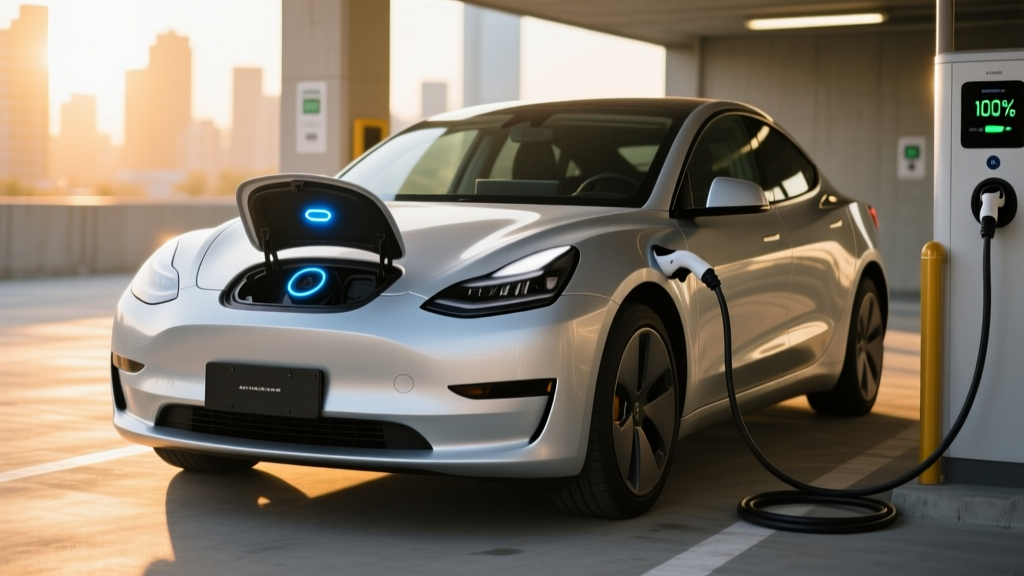
Plug in your EV, wake up to a green 100% on the dash, and head out — it sounds harmless. But routinely leaving a lithium-ion traction battery sitting at maximum state of charge (SoC) accelerates chemical degradation in ways that vary dramatically depending on the cell chemistry inside your pack. For some 2026 models, leaving the battery fully charged overnight every day can shave years off its useful life. For others, it barely registers.
The difference comes down to whether your vehicle uses an NMC/NCA (nickel-manganese-cobalt or nickel-cobalt-aluminum) cathode or an LFP (lithium iron phosphate) cathode. Understanding this distinction — and pairing it with real-world data on degradation, warranty coverage, and replacement costs — is the single highest-leverage thing an EV owner can do for long-term battery health.
This guide covers the chemistry, the numbers, and the daily habits that determine whether your pack delivers 150,000 trouble-free miles or starts showing meaningful range loss by year five.
LFP vs. NMC/NCA: The Chemistry That Defines Your Charging Habits
Not all EV batteries are created equal. The cathode chemistry determines energy density, cycle life, cold-weather performance, cost, and — critically — how the battery tolerates being held at a high state of charge.
| Attribute | LFP (Lithium Iron Phosphate) | NMC / NCA (Nickel-based) |
|---|---|---|
| Energy Density | Lower (~160–180 Wh/kg cell-level) | Higher (~220–260 Wh/kg cell-level) |
| Typical Cycle Life | 3,000–5,000+ cycles to 80% SoH | 1,000–2,000 cycles to 80% SoH |
| Tolerance for 100% SoC | High — manufacturers recommend periodic 100% charges for BMS calibration | Low — sustained 100% accelerates cathode oxidation and electrolyte breakdown |
| Cold-Weather Performance | Weaker — greater range loss below 32°F / 0°C | Better — more resilient in freezing conditions |
| Cost (per kWh, pack-level) | ~$100–$120 | ~$130–$160 |
| Thermal Stability | Excellent — higher onset temperature for thermal runaway | Good — requires more active thermal management |
| Common 2026 Applications | Tesla Model 3/Y RWD, Ford Mustang Mach-E Select (LFP option), BYD models, Rivian Standard pack | Hyundai Ioniq 5/6, Kia EV6/EV9, Tesla Long Range/Performance, BMW iX, Cadillac Lyriq, Chevrolet Equinox EV |
The practical takeaway: If your EV has an NMC or NCA pack, set your daily charge limit to 80% and only charge to 100% when you need the full range for a road trip. If you have LFP, you can — and should — charge to 100% regularly (Tesla recommends at least once a week) because the Battery Management System (BMS) uses the top-of-charge voltage to recalibrate its state-of-charge estimate. With LFP, a battery that is fully charged is actually in its happy place.
How Long Do EV Batteries Actually Last? Degradation Data
The fear that EV batteries need replacing like smartphone batteries is outdated, but degradation is real and measurable. Modern thermal management systems and improved cell chemistries have pushed typical lifespan well beyond 150,000 miles for most packs.
Observed Degradation Benchmarks (aggregated fleet and owner data):
- Tesla Model 3/Y (NMC, 2019–2023): ~5% capacity loss at 50,000 miles, ~8–10% at 100,000 miles, plateauing to ~12–15% by 150,000 miles (per Tesla Impact Reports and Recurrent Auto fleet data).
- Chevrolet Bolt EV/EUV (NMC, 2017–2023): ~6–8% loss at 60,000 miles; some early 2017–2018 packs showed higher loss linked to manufacturing variance, addressed under recall/warranty.
- Hyundai Ioniq 5 (NMC, 2022–2025): Early fleet data from Recurrent Auto shows ~3–4% loss at 30,000 miles — among the best-performing packs in its class.
- Tesla Model 3 RWD (LFP, 2021–2025): ~2–3% loss at 40,000 miles with daily 100% charging; LFP degradation curves are flatter and slower than NMC equivalents.
- Nissan Leaf (passive air cooling, 2011–2017 NMC): 15–25% loss by 60,000–80,000 miles — a cautionary tale about the importance of active liquid thermal management.
A useful rule of thumb: most modern, liquid-cooled EV batteries lose roughly 1–2% capacity per year under normal use, with the steepest drop occurring in the first 10,000–20,000 miles (the "break-in" degradation) before the curve flattens significantly. According to fueleconomy.gov, today's EV batteries are engineered to last the life of the vehicle — typically defined as 150,000–200,000 miles before reaching the 70–80% state-of-health (SoH) threshold.
What Does the Battery Warranty Actually Cover?
Federal law mandates a minimum battery warranty of 8 years / 100,000 miles for all EVs sold in the United States. California and states that follow CARB (California Air Resources Board) emissions rules extend this to 10 years / 150,000 miles. But the details — specifically the capacity retention threshold — matter enormously.
| Manufacturer | Warranty Period | Capacity Retention Threshold | Notes |
|---|---|---|---|
| Tesla (Model 3/Y) | 8 yr / 120,000 mi (LR/AWD); 8 yr / 100,000 mi (RWD) | 70% | Covers defects and capacity below threshold |
| Hyundai / Kia | 10 yr / 100,000 mi | 70% | Among the longest coverage in the industry |
| Ford (Mach-E, F-150 Lightning) | 8 yr / 100,000 mi | 70% | Includes battery components and capacity |
| General Motors (Ultium platform) | 8 yr / 100,000 mi | 70% (estimated, varies by model) | Covers Bolt, Equinox EV, Blazer EV, Lyriq, Silverado EV |
| BMW | 8 yr / 100,000 mi | 70% | Covers i4, iX, i7 |
| Rivian | 8 yr / 175,000 mi | 70% | Highest mileage threshold among mainstream OEMs |
| Volkswagen (ID.4) | 8 yr / 100,000 mi | 70% | Net usable capacity basis |
What's covered: Manufacturing defects, cell failures, module imbalances, and capacity loss that drops the pack below the stated threshold (typically 70% of original usable capacity). What's not covered: Damage from accidents, improper charging equipment, modifications, or failure to follow the owner's manual maintenance schedule. Normal degradation above the 70% threshold is considered expected wear and is not warrantable.
In practice, very few modern EVs fall below 70% capacity within the warranty period. The warranty functions more as a safety net than a prediction of failure.
EV Battery Replacement Cost: Numbers and Context
When a pack does eventually need replacement — typically beyond 150,000–200,000 miles or after physical damage — the cost depends on battery size, chemistry, and whether you're paying for a new OEM pack, a refurbished unit, or a third-party remanufactured pack.
| Vehicle / Pack Size | Chemistry | New OEM Pack (Parts + Labor) | Refurbished / Remanufactured |
|---|---|---|---|
| Tesla Model 3 RWD (~60 kWh) | LFP | $12,000–$15,000 | $8,000–$10,000 |
| Tesla Model Y LR (~75 kWh) | NMC | $14,000–$18,000 | $10,000–$13,000 |
| Hyundai Ioniq 5 (~77.4 kWh) | NMC | $15,000–$20,000 | $11,000–$14,000 |
| Ford F-150 Lightning Ext. Range (~131 kWh) | NMC | $22,000–$30,000 | $16,000–$20,000 |
| Chevrolet Equinox EV (~85 kWh) | NMC (Ultium) | $16,000–$21,000 | $11,000–$15,000 |
| Rivian R1T Large Pack (~128 kWh) | NMC | $20,000–$28,000 | $14,000–$18,000 |
Context that matters: Battery pack prices have declined roughly 80% since 2013 and continue to fall. By the time most 2026 EVs actually need a replacement (2035–2040), packs will cost significantly less. Additionally, many packs can be repaired at the module level — replacing 2–4 degraded modules rather than the entire pack — for $3,000–$7,000. The vast majority of EV batteries outlive the vehicle they're installed in. According to Recurrent Auto's 2025 battery longevity study, fewer than 1.5% of EVs in their tracked fleet of 15,000+ vehicles have required a full battery replacement outside of warranty recalls.
Factors That Accelerate (or Preserve) Battery Life
Degradation isn't just about age and mileage. How you charge, where you park, and what ambient temperatures your pack endures all shape the degradation curve.
The Five Biggest Degradation Accelerators
- Sustained high SoC (NMC/NCA only): Holding an NMC pack at 100% for hours or days — especially in warm weather — increases cathode surface oxidation and electrolyte decomposition. If your battery is fully charged, drive it soon rather than letting it sit. Set your charge limit to 80% for daily use.
- Frequent DC fast charging at high power: Repeatedly using 150+ kW DC fast chargers generates internal heat and lithium plating risk, particularly when the pack is cold. Occasional fast charging is fine; daily reliance on it adds measurable wear. Preconditioning the battery before fast charging (a feature in most 2026 EVs) mitigates this significantly.
- Extreme heat exposure: Prolonged parking in 95°F+ ambient temperatures with a high SoC is the worst-case scenario for NMC chemistry. Garage parking or shade makes a measurable difference over years.
- Deep discharge cycles: Regularly draining the pack below 10% SoC stresses the anode. Try to keep the battery between 20–80% for NMC or 20–100% for LFP in normal driving.
- Calendar aging: Even a parked EV degrades. A pack stored at 50% SoC in moderate temperatures ages far less than one stored at 100% in a hot garage.
Daily Battery Care Checklist
- ☐ Set charge limit to 80% for NMC/NCA; 100% is fine for LFP
- ☐ Use scheduled charging to finish charging just before departure (minimizes time at high SoC)
- ☐ Precondition the battery before DC fast charging (enable navigation to charger in your EV's app)
- ☐ Avoid parking in direct sun with a high state of charge during summer
- ☐ Don't let the pack sit below 10% for extended periods
- ☐ Use Level 2 home charging as your primary method — it's gentler on the pack than daily DCFC
- ☐ If storing the vehicle for 2+ weeks, set SoC to ~50% and leave it plugged in with a charge limit
How to Monitor Your Battery's State of Health (SoH)
State of Health (SoH) is the percentage of your battery's original usable capacity that remains. A new pack is 100% SoH; a pack that originally held 75 kWh but now holds 67.5 kWh is at 90% SoH.
Methods to Check SoH
- In-vehicle display: Some 2026 models (notably Tesla, Hyundai/Kia, and BMW) display battery health or degradation estimates in the settings or service menu. Tesla's service mode shows estimated range at 100% vs. the original EPA figure — the ratio approximates SoH.
- OBD-II diagnostic tools: Devices like the OBDLink MX+ paired with apps such as EVNotify or LeafSpy (for Nissan) can read the BMS-reported SoH directly. This is the most accurate consumer-accessible method.
- Third-party telemetry services: Recurrent Auto offers free battery health reports by connecting to your vehicle's telematics data. They compare your pack's degradation to their fleet averages for the same model and climate zone.
- Dealer diagnostic: During service visits, dealerships can pull a full BMS log showing cell-level voltage balance, internal resistance, and SoH. Request this report if you're considering selling or buying a used EV.
What's normal vs. concerning: A 2–3% loss in the first year is typical and not a cause for alarm. A sudden drop of 5%+ in a short period, or a single module showing significantly different voltage than others (visible via OBD-II), warrants a warranty service visit.
Emerging Battery Technology: What's Next (and When)
Several next-generation technologies promise to reshape battery longevity, energy density, and charging speed — but timelines matter. None of these are available in production vehicles as of early 2026.
- Solid-state batteries: Replace the liquid electrolyte with a solid ceramic or polymer, promising 400+ Wh/kg energy density, 10,000+ cycle life, and inherent thermal stability. Toyota has announced limited production in a 2027–2028 vehicle; Samsung SDI targets 2027. Realistic mass-market availability: 2029–2032. Cost remains the primary barrier — current solid-state cells are estimated at 4–5x the cost of equivalent NMC cells.
- Silicon-dominant anodes: Replacing graphite anodes with silicon can boost energy density 20–40%. Companies like Sila Nanotechnologies and Group14 are supplying early production cells (Mercedes-Benz G-Class 580e uses a Group14 silicon-anode pack). Expect broader adoption in premium EVs by 2027–2028.
- Sodium-ion batteries: Cheaper and more abundant than lithium, with excellent cold performance, but ~30% lower energy density. CATL began limited production in Chinese-market EVs in 2024–2025. US-market adoption likely 2028+, initially in fleet and budget segments.
- LMFP (lithium manganese iron phosphate): An evolution of LFP adding manganese for ~15–20% higher energy density while retaining LFP's safety and cycle-life advantages. Expected in Tesla and BYD models by 2027–2028.
These technologies are worth tracking, but they shouldn't delay a purchase decision today. Current-generation LFP and NMC packs, properly cared for, already deliver 150,000–200,000+ miles of usable service life.
Frequently Asked Questions
Is it bad if my EV battery is fully charged overnight?
For NMC/NCA batteries, yes — routinely holding the pack at 100% SoC for 8–12 hours accelerates degradation. Use your EV's scheduled charging feature so it reaches your target (80%) right before you leave. For LFP batteries, charging to 100% overnight is not only acceptable but recommended for BMS calibration.
How long do EV batteries last in years and miles?
Most modern, liquid-cooled EV batteries retain 70–85% of original capacity at 150,000 miles / 12–15 years. Many will outlast the vehicle itself. Air-cooled packs (early Nissan Leaf, some older models) degrade faster, losing 20–30% in 6–8 years.
How much does it cost to replace an EV battery?
New OEM replacement packs range from ~$12,000 for a 60 kWh LFP pack to ~$30,000 for a 131 kWh NMC pack (like the F-150 Lightning Extended Range). Refurbished packs cost 30–40% less. Module-level repairs run $3,000–$7,000. Fewer than 2% of EVs ever need a full replacement.
What does the federal battery warranty cover?
All US-market EVs carry a minimum 8-year/100,000-mile battery warranty (10 yr/150,000 mi in CARB states). It covers defects and capacity loss below the manufacturer's threshold (typically 70% SoH). It does not cover accident damage, improper charging, or normal degradation above the threshold.
LFP vs. NMC — which is better for me?
Choose LFP if you want maximum cycle life, lower cost, and the convenience of daily 100% charging — and you don't need the absolute longest range or best cold-weather performance. Choose NMC if you need higher energy density (longer range per kWh), better cold-weather range retention, and faster DC charging speeds — and you're willing to manage charge limits (80% daily). Neither is universally "better"; the right choice depends on your driving patterns and climate.
Does DC fast charging damage my battery?
Occasional DC fast charging (1–3 times per week) causes negligible additional degradation in modern, liquid-cooled packs. Daily DCFC at 150+ kW, especially without battery preconditioning, adds measurable wear over time. For daily charging, a Level 2 home charger (7–11.5 kW) is the gold standard for battery longevity.
Bottom Line: Charge Smart, Not Anxious
The single most impactful habit for NMC/NCA owners is simple: set your daily charge limit to 80% and only charge to 100% when you'll drive the range immediately. LFP owners have it easier — charge to 100% freely and let the BMS do its job. Beyond that, avoid extreme heat + high SoC combinations, precondition before fast charging, and monitor your SoH once or twice a year via OBD-II or a telematics service.
Modern EV batteries are remarkably durable. The data consistently shows that with basic care, your pack will deliver well over a decade and 150,000+ miles of reliable service — and by the time it ever does need attention, replacement costs will be a fraction of today's prices.