The High-Voltage Battery Is the Heart of Your EV
If you searched for "battery operated impact wrench" and landed here, you're in the wrong garage — but stick around. The lithium-ion packs powering modern electric vehicles share foundational chemistry with the cordless tools in your shop, yet the engineering scale, thermal management, and longevity expectations are orders of magnitude apart. This guide covers everything an EV buyer or owner needs to know about the high-voltage traction battery: chemistry trade-offs, real-world degradation data, warranty coverage, replacement economics, and how to monitor and maximize battery health over a decade or more of ownership.
Critical distinction: This article covers the high-voltage traction battery (typically 400V–800V, 50–130 kWh) that propels the vehicle. The 12V auxiliary battery that powers lights, infotainment, and computers is a separate, conventional lead-acid or lithium unit — and is not discussed here.
LFP vs NMC/NCA: Which Battery Chemistry Is Right for You?
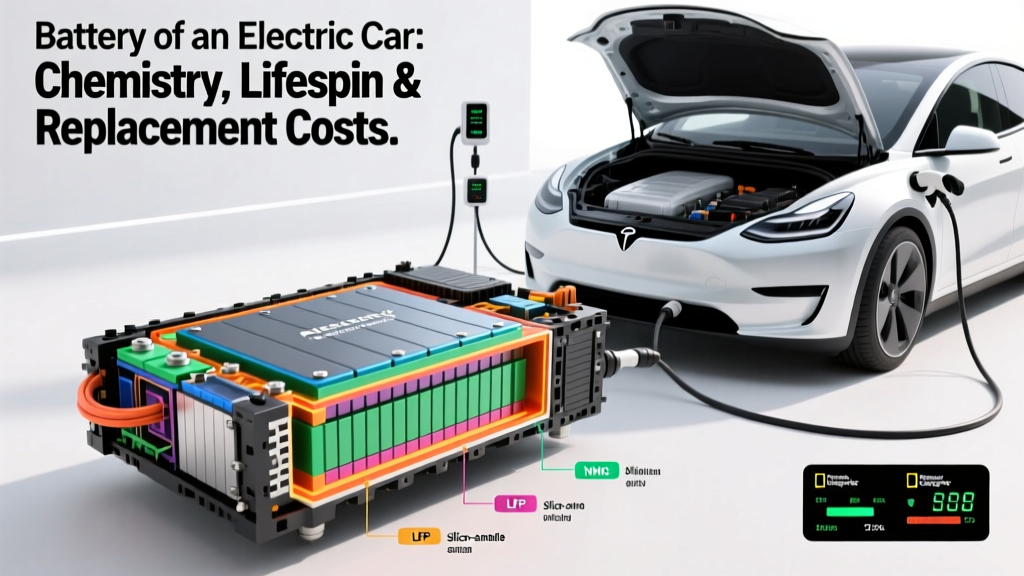
Not all EV batteries are built the same. The cathode chemistry determines energy density, cycle life, thermal stability, cold-weather performance, and cost. In 2026, two chemistries dominate the US market:
- LFP (Lithium Iron Phosphate): Used in standard-range Tesla Model 3/Y, Ford Mustang Mach-E Select, and several Chinese-market imports. Lower energy density but exceptional cycle life and thermal stability.
- NMC (Nickel Manganese Cobalt) / NCA (Nickel Cobalt Aluminum): Used in most long-range and performance EVs — Tesla Long Range, Hyundai Ioniq 5/6, Rivian, GM Ultium platform vehicles, BMW iX. Higher energy density, better cold-weather performance, but more expensive and with slightly shorter cycle life.
| Attribute | LFP (Lithium Iron Phosphate) | NMC / NCA |
|---|---|---|
| Energy Density | ~160–180 Wh/kg (lower) | ~220–300 Wh/kg (higher) |
| Cycle Life | 3,000–6,000+ cycles | 1,000–2,500 cycles |
| Calendar Life | 15–20+ years typical | 10–15 years typical |
| Cold Performance | More range loss below 32°F (~25–35% loss) | Better cold retention (~15–25% loss) |
| Thermal Stability | Excellent — very low thermal runaway risk | Good — requires robust BMS and cooling |
| Charging to 100% | Recommended regularly for SoC calibration | Best kept 20–80% for daily use |
| Cost | ~$100–120/kWh (pack level) | ~$130–160/kWh (pack level) |
| Cobalt Content | Zero | Contains cobalt (supply chain concern) |
| Typical Use Case | Standard-range, urban commuting, fleet | Long-range, performance, AWD, towing |
The practical takeaway: If you drive mostly in moderate climates, charge at home, and don't need 320+ miles of range, LFP is arguably the better long-term ownership choice — you can charge to 100% daily without degradation guilt, and the pack will likely outlast the vehicle. If you need maximum range, tow frequently, live in cold climates, or want the lightest possible pack, NMC/NCA is the right call.
How Long Do EV Batteries Actually Last? Real Degradation Data
The fear of a dead battery is the single biggest psychological barrier to EV adoption. The data tells a reassuring story: most modern EV batteries lose 5–15% of their original capacity over 100,000–200,000 miles and will outlast the vehicle's useful life in the majority of cases.
Observed Degradation Curves (Fleet & Owner Data):
- Year 1 / 15,000 mi: ~2–4% capacity loss (initial "break-in" drop, then plateau)
- Year 3 / 45,000 mi: ~5–8% total loss
- Year 5 / 75,000 mi: ~7–10% total loss
- Year 8 / 120,000 mi: ~10–15% total loss
- Year 10 / 150,000 mi: ~12–18% total loss (varies heavily by climate and charging habits)
Sources: Geotab fleet data (50,000+ EVs), Recurrent Auto battery health reports, Tesla Impact Reports.
Key insight from Recurrent Auto's analysis of over 15,000 vehicles: degradation is non-linear. Most loss occurs in the first two years, then the curve flattens significantly. A battery that has lost 8% in year three is not on track to lose 8% every three years — it may only lose another 5–7% over the next seven years.
Real-world range impact: A Tesla Model 3 Long Range (EPA 341 mi, 82 kWh usable, NMC) that has degraded 10% after five years and 80,000 miles will still deliver roughly 307 miles of EPA-equivalent range. In real-world highway driving at 70 mph in moderate temperatures, expect ~260–275 miles — still ample for most daily needs and road trips with a single DC fast-charge stop.
What Does the EV Battery Warranty Actually Cover?
Federal law mandates a minimum 8-year/100,000-mile battery warranty for all EVs sold in the US. California Air Resources Board (CARB) states require 10-year/150,000-mile coverage. Most manufacturers meet or exceed these minimums.
| Manufacturer | Warranty Term | Capacity Threshold | Coverage Details |
|---|---|---|---|
| Tesla (Model 3/Y LFP) | 8 yr / 120,000 mi | 70% retention | Defects + degradation below threshold |
| Tesla (Model 3/Y LR NMC) | 8 yr / 120,000 mi | 70% retention | Defects + degradation below threshold |
| Hyundai / Kia (E-GMP) | 10 yr / 100,000 mi | 70% retention | Defects + degradation; 10/100k in CARB states |
| GM (Ultium platform) | 8 yr / 100,000 mi | 70% retention (60% for Bolt-era) | Defects + degradation |
| Ford (Mach-E, F-150 Lightning) | 8 yr / 100,000 mi | 70% retention | Defects + degradation below threshold |
| Rivian | 8 yr / 175,000 mi | 70% retention | Defects + degradation; generous mileage cap |
| BMW (iX, i4) | 8 yr / 100,000 mi | 70% retention | Defects + degradation |
| Volkswagen (ID.4) | 8 yr / 100,000 mi | 70% retention | Defects + degradation |
What triggers a warranty claim: If your battery's State of Health (SoH) drops below the stated threshold (typically 70% of original capacity) within the warranty period, the manufacturer must repair or replace the pack at no cost. In practice, very few owners hit this threshold within the warranty window — the vast majority of warranty claims are for manufacturing defects (bad cell, BMS fault, cooling leak) rather than normal degradation.
What voids the warranty: Physical damage (collision, flood, road debris puncture), unauthorized modifications to the battery or charging system, use of non-OEM charging equipment that causes damage, and failure to follow basic maintenance (e.g., ignoring coolant leak warnings that lead to thermal damage).
EV Battery Replacement Cost: What You'll Actually Pay
Out-of-warranty battery replacement is the nightmare scenario EV skeptics cite. Here are the real numbers for 2025–2026 model-year vehicles, based on manufacturer service bulletins and independent shop data:
| Vehicle | Battery Size | Chemistry | Replacement Cost (Parts + Labor) |
|---|---|---|---|
| Tesla Model 3 Standard Range | 60 kWh | LFP | $8,000–$12,000 |
| Tesla Model 3/Y Long Range | 82 kWh | NMC | $12,000–$16,000 |
| Hyundai Ioniq 5 | 77.4 kWh | NMC | $11,000–$15,000 |
| Ford Mustang Mach-E Extended | 91 kWh | NMC | $14,000–$18,000 |
| Ford F-150 Lightning Extended | 131 kWh | NMC | $18,000–$25,000+ |
| Chevrolet Equinox EV | 85 kWh | NMC (Ultium) | $12,000–$16,000 |
| Rivian R1T (Large Pack) | 135 kWh | NMC | $20,000–$28,000 |
| BMW iX xDrive50 | 111.5 kWh | NMC | $18,000–$24,000 |
Context that matters:
- Most EVs never need a full battery replacement. Data from Geotab and Recurrent shows that fewer than 2% of EVs require pack replacement due to degradation alone. Most replacements are for defect or physical damage — and defects are caught under warranty.
- Module-level repair is increasingly common. Many packs (especially GM Ultium, Hyundai E-GMP, Rivian) are designed with modular cell groups. A shop can replace a single degraded or failed module for $2,000–$5,000 rather than swapping the entire pack.
- Costs are declining. Pack-level pricing has fallen from ~$1,200/kWh in 2010 to roughly $100–$160/kWh in 2026, per BloombergNEF. Expect continued gradual declines as LFP adoption grows and manufacturing scales.
- The car will likely be totaled before the battery dies. A 12-year-old EV with 180,000 miles and 80% battery health still has a functional, drivable pack — but the vehicle's resale value may be under $5,000, making a $15,000 replacement economically illogical.
Factors That Accelerate (or Slow) Battery Degradation
Not all miles are equal when it comes to battery wear. These are the variables you can control:
Battery Longevity Best Practices:
- Daily charge limit: Set to 80% for NMC/NCA; 100% is fine for LFP. Avoid routinely sitting at 100% SoC for days.
- Avoid deep discharge: Don't regularly run below 10% SoC. The battery management system (BMS) has a buffer, but deep cycling still stresses cells.
- DC fast charging frequency: Occasional road-trip fast charging is fine. Daily DC fast charging (150+ kW) accelerates degradation by ~1–3% extra over 5 years vs. Level 2 home charging. The heat generated at high C-rates is the primary culprit.
- Thermal management: Park in shade or a garage in hot climates. In cold climates, use preconditioning (plug in and warm the battery before driving) to reduce stress. Batteries degrade fastest when held at high SoH AND high temperature simultaneously — a fully charged car sitting in a 100°F driveway for a week is the worst-case scenario.
- Precondition for fast charging: Most EVs (Tesla, Hyundai E-GMP, GM Ultium) automatically precondition the battery when you navigate to a DC fast charger. This brings the cells to optimal temperature (~95–105°F), enabling faster charging AND reducing stress. Always use the vehicle's built-in charger navigation for this reason.
- Storage: If storing for 2+ weeks, leave the car plugged in at ~50% SoC (most EVs have a storage or "scheduled departure" mode). Never store at 100% or below 10%.
What you can't fully control: Ambient climate (extreme heat is worse than extreme cold for long-term degradation), calendar aging (all lithium-ion cells degrade over time regardless of use), and manufacturing variance (some packs degrade faster than identical packs in identical conditions).
How to Check and Monitor Your Battery's State of Health
State of Health (SoH) is the percentage of original capacity your battery retains. A new EV has 100% SoH; a five-year-old car might show 90–93%. Here's how to check it:
In-Vehicle Methods
- Tesla: No native SoH display in the app as of 2026, but you can estimate it by charging to 100% and comparing displayed range to original EPA range. Third-party tools like TeslaFi or Scan My Tesla (via OBD-II) provide more precise SoH readings.
- Hyundai/Kia: The infotainment system's EV menu shows a battery health indicator (simplified bar graph). For precise SoH, use an OBD-II reader with apps like Car Scanner or ABRP.
- GM (Ultium): The myChevrolet/myCadillac app includes a battery health indicator. The onboard diagnostics also track SoH, accessible via OBD-II.
- Ford: FordPass app provides a battery health status (Good/Fair/Poor). For granular data, OBD-II tools with FORScan can read detailed SoH percentages.
Third-Party Tools and Services
- Recurrent Auto: Free service that connects to your EV's telematics and provides ongoing SoH tracking, degradation curves, and comparisons to similar vehicles. Highly recommended for all EV owners.
- OBD-II adapters + apps: Devices like the OBDLink SX or vLinker (~$30–$80) paired with apps such as Car Scanner, ABRP (A Better Route Planner), or LeafSpy (Nissan Leaf) can read real-time SoH, cell voltage variance, and temperature data.
- Dealer diagnostic check: Request a battery health report during service visits. Most manufacturers can print a detailed SoH report with cell-level data.
What to watch for: A sudden drop in SoH (more than 2–3% in a month), significant cell voltage imbalance (one cell group consistently 50+ mV lower than others), or a noticeable reduction in range that doesn't correlate with temperature. These may indicate a defective module that could warrant a warranty claim.
What's Next? Solid-State, Silicon Anodes, and Realistic Timelines
Emerging battery technologies promise step-change improvements, but buyers should understand the difference between lab demonstrations, pilot production, and mass-market availability.
Solid-State Batteries
Solid-state cells replace the liquid electrolyte with a solid ceramic, polymer, or sulfide material. The theoretical benefits are significant: ~40–50% higher energy density (potentially 500+ mile range in a sedan), faster charging (10–80% in under 10 minutes), and dramatically improved safety (no flammable electrolyte).
Realistic timeline: Toyota has announced limited solid-state production for 2027–2028, initially in low-volume models. Samsung SDI targets 2027 for mass production. QuantumScape is shipping prototype cells to automotive partners. Expect solid-state to appear in premium, low-volume vehicles by 2028–2029 and reach mainstream affordability (~$100/kWh pack level) no earlier than 2032–2035. This is forward-looking and subject to manufacturing and cost hurdles.
Silicon Anode Technology
Replacing graphite anodes with silicon can increase energy density by 20–40%. Companies like Sila Nanotechnologies (partnered with Mercedes-Benz and Panasonic) and Group14 (partnered with Porsche) are bringing silicon-dominant anodes to production.
Realistic timeline: The Mercedes G-Class electric SUV (2025–2026) uses Sila's silicon anode cells. Porsche's next-generation Macan EV is expected to incorporate Group14 silicon anodes. Expect broader adoption by 2028–2030 as manufacturing yields improve. Already in limited production — not vaporware, but not yet mainstream.
Sodium-Ion Batteries
Sodium-ion cells use abundant, cheap sodium instead of lithium. Energy density is lower (~120–150 Wh/kg), but cost could drop below $60/kWh. CATL has begun mass production for Chinese-market vehicles.
Realistic timeline: Expect sodium-ion in US-market budget EVs and as range-extender packs in PHEVs by 2028–2030. Not a replacement for long-range NMC, but a viable option for 150–200 mile city cars.
Frequently Asked Questions
How long do EV batteries last in years and miles?
Based on fleet data from Geotab and Recurrent Auto, modern EV batteries (2020+ models with active liquid cooling) typically retain 80–88% of original capacity after 10 years or 150,000 miles. Many will remain functional (above 70% SoH) for 15–20 years. LFP chemistry packs tend to outlast NMC by 3–5 years on average due to superior cycle life.
How much does an EV battery cost to replace out of warranty?
Full pack replacement ranges from approximately $8,000 for a 60 kWh LFP pack (Tesla Model 3 Standard Range) to $25,000+ for a 131 kWh NMC pack (F-150 Lightning Extended Range). However, fewer than 2% of EVs require full pack replacement due to degradation. Module-level repairs for isolated cell failures typically cost $2,000–$5,000.
What does the EV battery warranty cover?
All US-market EVs carry a minimum 8-year/100,000-mile battery warranty (10-year/150,000-mile in CARB states). Coverage includes manufacturing defects and degradation below a stated capacity threshold — typically 70% of original capacity. If SoH drops below this threshold within the warranty period, the manufacturer repairs or replaces the pack at no cost. Physical damage, unauthorized modifications, and abuse are excluded.
How do I check my EV battery's State of Health?
Options include: your vehicle's native battery health display (varies by brand), the manufacturer's mobile app (FordPass, myChevrolet), third-party services like Recurrent Auto (free, connects via telematics), or OBD-II adapters (~$30–$80) paired with apps like Car Scanner or TeslaFi for detailed cell-level data. A dealer diagnostic check during service visits provides the most authoritative reading.
LFP vs NMC — which battery chemistry is better?
Neither is universally "better." LFP wins on longevity (3,000–6,000+ cycles vs. 1,000–2,500), cost ($100–120/kWh vs. $130–160/kWh), safety, and the ability to charge to 100% daily without degradation concern. NMC wins on energy density (longer range in a lighter, smaller pack), cold-weather performance, and fast-charging speed. Choose LFP for standard-range urban/suburban driving in moderate climates. Choose NMC for long-range, cold-climate, towing, or performance use cases.
Does frequent DC fast charging damage the battery?
Occasional DC fast charging (road trips, 1–3 times per month) has minimal impact on long-term battery health — expect perhaps 1–3% additional degradation over 5 years compared to exclusive Level 2 home charging. Daily DC fast charging at 150+ kW is more stressful due to sustained high temperatures and high C-rates. If you must rely on DC fast charging daily, precondition the battery (use in-dash navigation to the charger), avoid charging above 80% unless necessary, and monitor SoH quarterly.
Should I be worried about buying a used EV with an older battery?
Check the SoH before purchasing. A 4-year-old EV with 90%+ SoH is a strong buy. Request a dealer battery health report or use an OBD-II tool. Verify remaining warranty coverage (the 8-year/100,000-mile battery warranty transfers to subsequent owners). Avoid vehicles with SoH below 80% unless the price reflects the diminished range and the battery is near warranty expiration.