If you've typed "can you charge a battery on the car" into a search engine, you're probably dealing with one of two scenarios: you want to know whether your EV's high-voltage traction battery recharges while you drive (spoiler: it absolutely does, through regenerative braking and the motor), or you're wondering about the long-term health, charging habits, and eventual replacement cost of the battery pack that powers your electric vehicle.
This guide addresses the full picture. We'll break down how EV batteries charge on the car, what chemistry is inside your pack, how much capacity you'll lose over time, what the warranty actually covers, and what you'd pay if a replacement were ever needed. No fear-mongering, no marketing fluff — just the data.
How EV Batteries Charge While You Drive
Every battery electric vehicle (BEV) and plug-in hybrid (PHEV) recharges its traction battery during operation through regenerative braking. When you lift off the accelerator or press the brake pedal, the electric motor reverses its function, acting as a generator that converts kinetic energy back into electrical energy and stores it in the battery pack.
In practice, this means:
- City driving with frequent deceleration recovers more energy than steady highway cruising.
- One-pedal driving modes (available on models like the Nissan Leaf, Chevrolet Bolt, and most Tesla vehicles) maximize regen by aggressively slowing the car when you lift off the throttle, recapturing energy that would otherwise be lost to friction brakes.
- Mountain descents can add meaningful range — on a long downhill grade, drivers report recovering 5–15 miles of range depending on elevation change and vehicle mass.
Regenerative braking typically recovers 15–25% of energy spent during mixed driving, according to testing by the U.S. Department of Energy's fueleconomy.gov. It will never fully recharge a depleted pack — that's what Level 2 and DC fast charging are for — but it extends range and reduces brake wear significantly.
One critical distinction: the 12-volt auxiliary battery (which powers lights, infotainment, and computers) is charged by a DC-DC converter that steps down voltage from the main traction battery. If your 12V battery dies, it's usually because the car sat unplugged for weeks and the traction battery depleted to the point where the DC-DC converter stopped maintaining the 12V system. This is different from the high-voltage traction battery itself.
LFP vs. NMC: Which Battery Chemistry Is in Your EV?
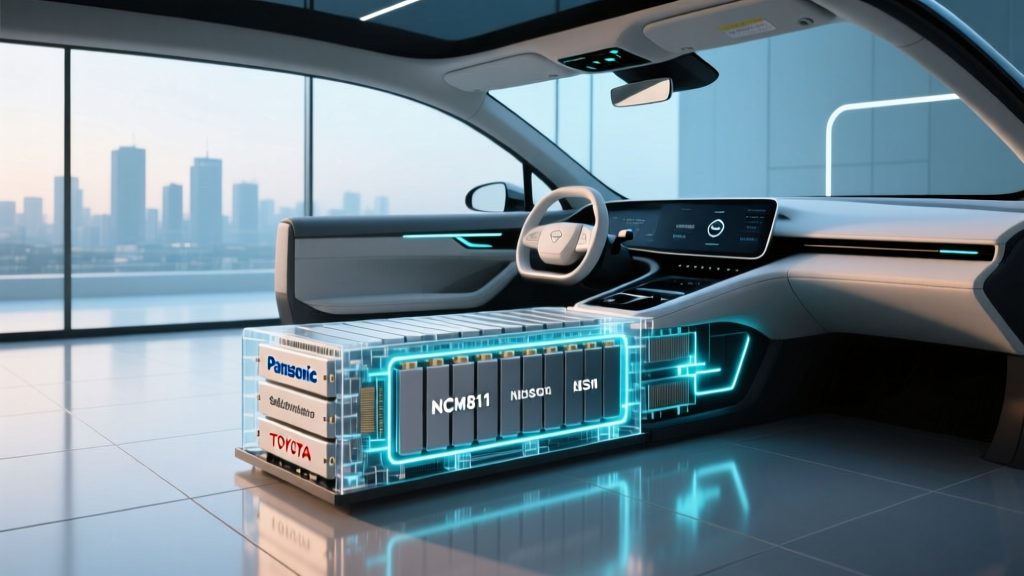
The two dominant lithium-ion chemistries in 2026 EVs are LFP (lithium iron phosphate) and NMC (nickel manganese cobalt), with NCA (nickel cobalt aluminum) used in some Tesla and Rivian applications. Your battery's chemistry determines its energy density, lifespan, cold-weather behavior, and cost.
| Attribute | LFP (Lithium Iron Phosphate) | NMC / NCA (Nickel-based) |
|---|---|---|
| Energy Density | Lower (~150–170 Wh/kg cell-level) | Higher (~220–280 Wh/kg cell-level) |
| Cycle Life | 3,000–5,000+ cycles to 80% capacity | 1,000–2,000 cycles to 80% capacity |
| Cold-Weather Performance | Weaker — greater range loss below 32°F | Better — more tolerant of sub-freezing temps |
| Thermal Stability | Excellent — less prone to thermal runaway | Good — requires more active thermal management |
| Cost (per kWh) | Lower — no cobalt or nickel | Higher — commodity metals cost more |
| Recommended Charging Habit | Can charge to 100% regularly | Best kept between 20–80% for daily use |
| Common in (2026 models) | Tesla Model 3/Y RWD, BYD, Rivian Standard, Ford Mustang Mach-E Select | Tesla Long Range/Performance, Hyundai Ioniq 5/6, BMW iX, most luxury EVs |
Which is better? It depends on your use case. If you prioritize maximum range per charge, cold-weather driving, or performance, NMC/NCA is the stronger choice. If you want maximum battery lifespan, lower cost, and don't mind slightly less range, LFP is superior — and you can charge it to 100% daily without the degradation penalty that NMC packs suffer at high state of charge.
EV Battery Degradation: What the Data Actually Shows
Every lithium-ion battery loses capacity over time. The key question is how much and how fast. Based on aggregated fleet data and long-term owner reports, here's what degradation looks like for modern EVs:
Typical Degradation Curve (NMC Packs, Average Climate):
- Year 1 / 15,000 miles: 2–4% capacity loss (initial "break-in" drop)
- Year 3 / 45,000 miles: 6–9% total loss
- Year 5 / 75,000 miles: 8–12% total loss
- Year 8 / 120,000 miles: 10–15% total loss
- Year 10 / 150,000 miles: 12–18% total loss
LFP packs tend to degrade more slowly, often showing only 5–8% loss at the 8-year / 100,000-mile mark under normal use, according to data compiled by Geotab's EV battery health study.
These numbers mean that a vehicle with an original EPA range of 310 miles would realistically deliver roughly 270–280 miles after 5 years of typical use — still entirely usable for daily driving and road trips.
The degradation curve is non-linear: the steepest loss occurs in the first year or two, then the rate flattens significantly. Most packs will outlast the vehicle's body, suspension, and interior before reaching a point where range becomes impractical.
Factors That Accelerate (or Slow) Battery Degradation
Not all miles are equal when it comes to battery wear. Here are the primary factors under your control:
Battery Care Checklist: Maximize Your Pack's Life
- Avoid frequent DC fast charging above 150 kW. Occasional road-trip fast charging is fine, but daily use of 250–350 kW chargers generates heat that accelerates degradation. A 2023 study by IDTechEx found that packs fast-charged more than 3 times per week degraded ~2–3% more over 4 years than those primarily charged on Level 2.
- Keep NMC packs between 20–80% SoC for daily driving. Charging to 100% and letting the car sit for hours stresses the cathode. LFP packs are exempt from this — charge to 100% freely.
- Precondition the battery before fast charging. Most modern EVs do this automatically when you navigate to a charger. A cold battery charged at high power suffers lithium plating, which permanently reduces capacity.
- Park in shade or a garage in extreme heat. Sustained battery temperatures above 95°F (ambient, not cell temp) accelerate chemical breakdown. Vehicles with active thermal management (Tesla, Hyundai E-GMP, GM Ultium) handle this better than passively cooled packs.
- Don't let the pack sit at 0% or 100% for extended periods. If storing the car for weeks, leave it at ~50% SoC.
- Use Level 2 (7–11 kW) home charging as your primary method. This is the gentlest, most efficient way to charge and produces the least thermal stress.
EV Battery Warranty: What's Actually Covered?
Federal law in the United States mandates that EV batteries carry a minimum warranty of 8 years or 100,000 miles (whichever comes first). In California Air Resources Board (CARB) states, that extends to 10 years or 150,000 miles. Most manufacturers exceed the federal minimum voluntarily.
| Manufacturer | Battery Warranty | Capacity Retention Threshold |
|---|---|---|
| Tesla (Model 3/Y) | 8 yr / 120,000 mi (Long Range, Performance) or 8 yr / 100,000 mi (RWD) | 70% of original capacity |
| Hyundai / Kia (E-GMP) | 10 yr / 100,000 mi | 70% of original capacity |
| GM (Ultium — Chevrolet, Cadillac, GMC) | 8 yr / 100,000 mi | 70% of original capacity |
| Ford (Mustang Mach-E, F-150 Lightning) | 8 yr / 100,000 mi | 70% of original capacity |
| Rivian | 8 yr / 175,000 mi (Max pack) or 8 yr / 120,000 mi (Standard/Large) | 70% of original capacity |
| BMW (iX, i4, i7) | 8 yr / 100,000 mi | 70% of original capacity |
The capacity retention threshold is critical: the warranty only triggers a replacement or repair if your battery falls below that percentage (typically 70%) of its original usable kWh during the warranty period. A pack that degrades from 77.4 kWh usable to 56 kWh (72.5%) would not qualify — even though you've lost over 20 kWh of capacity. In practice, very few modern packs fall below 70% within the warranty window based on fleet data.
Warranties cover defects and abnormal degradation. They do not cover damage from accidents, flooding, improper charging equipment, or unauthorized modifications. Check your owner's manual for specific exclusions.
EV Battery Replacement Cost: The Numbers
If your battery degrades beyond the warranty threshold or suffers physical damage, replacement is expensive — but it's rarely needed during the vehicle's practical life. Here are current replacement cost ranges for 2026:
| Vehicle / Battery Size | Battery Capacity | Estimated Replacement Cost (Parts + Labor) |
|---|---|---|
| Chevrolet Bolt EV / EUV | 65 kWh (NMC) | $14,000 – $16,500 |
| Tesla Model 3 RWD | 60 kWh (LFP) | $13,000 – $16,000 |
| Tesla Model Y Long Range | 75 kWh (NMC/NCA) | $16,000 – $20,000 |
| Hyundai Ioniq 5 | 77.4 kWh (NMC) | $15,000 – $19,000 |
| Ford F-150 Lightning Extended Range | 131 kWh (NMC) | $25,000 – $32,000 |
| GMC Hummer EV | 212 kWh (NMC, Ultium) | $35,000 – $42,000 |
Context matters here. The average age of a scrapped passenger vehicle in the U.S. is roughly 12 years, according to NHTSA data. Given that modern EV battery packs are demonstrating 85–90% capacity retention at the 10-year mark under normal use, the vast majority of EV batteries will never need replacement during the vehicle's useful life. When replacement is needed, it's typically due to manufacturing defects (covered by warranty) or collision damage (covered by insurance).
Some manufacturers, including Tesla and GM, offer refurbished or remanufactured replacement packs at a lower cost than new units. Module-level repair — replacing only the degraded or failed cell modules rather than the entire pack — is also becoming more common at specialized EV service centers, reducing costs to $5,000–$10,000 depending on the failure.
How to Check Your EV Battery's State of Health (SoH)
State of Health (SoH) is a percentage representing your battery's current maximum capacity relative to its original capacity when new. A new battery is 100% SoH; a battery that can only hold 85% of its original kWh is at 85% SoH.
Here's how to monitor it:
1. In-Vehicle Displays
Some EVs display SoH or degradation information directly. Hyundai and Kia E-GMP vehicles show a battery health percentage in the settings menu. Tesla does not display SoH natively, but you can estimate it by comparing your displayed range at 100% charge to the original EPA figure.
2. Third-Party Apps and OBD-II Tools
Apps like TeslaFi, Tessie, and Scan My Tesla (for Tesla vehicles) read battery management system (BMS) data via the car's API or OBD-II port to estimate SoH. For non-Tesla EVs, OBD-II dongles paired with apps like Leaf Spy (Nissan) or ABRP (A Better Route Planner) can pull battery health data.
3. Dealer Diagnostics
Any authorized dealer can run a battery health report. Request one during routine service visits, especially before the warranty expires — if degradation is approaching the threshold, you'll want documentation.
4. Manual Calculation
Charge to 100% (for LFP) or your normal daily limit and note the displayed range or kWh available. Compare to the vehicle's original spec. If your Ioniq 5 originally showed 303 miles at 100% and now shows 272, that's roughly 90% SoH. This method is approximate because the BMS estimate can drift, but it's directionally useful.
Emerging Battery Technology: What's Next?
Several next-generation battery technologies are in development, though none are yet available in production consumer vehicles as of 2026:
Solid-State Batteries: These replace the liquid electrolyte with a solid material, promising higher energy density (potentially 400+ Wh/kg at the cell level), faster charging, and improved safety. Toyota has announced a solid-state battery for a limited-production vehicle, targeting 2027–2028, but mass-market availability is not expected before 2030. Samsung SDI and QuantumScape are also pursuing solid-state technology with pilot production lines running.
Silicon Anode Batteries: Companies like Sila Nanotechnologies and Group14 are developing silicon-dominant anodes that can increase energy density by 20–40% over current graphite anodes. These are beginning to appear in limited applications (the Mercedes G-Class 580e uses a silicon-anode battery from Sila) and are expected to become more common in premium EVs by 2027–2028.
Sodium-Ion Batteries: CATL and BYD are producing sodium-ion cells for lower-cost, lower-range applications. These won't replace lithium-ion in long-range EVs but may appear in budget city cars and energy storage systems within the next 2–3 years.
For buyers today, current lithium-ion technology (both LFP and NMC) is mature, well-understood, and demonstrably durable. Waiting for solid-state is not a practical strategy if you need a vehicle now — today's packs are already lasting 150,000+ miles with manageable degradation.
Frequently Asked Questions
How long do EV batteries last in years and miles?
Based on fleet data, most modern EV battery packs retain 80–88% of their original capacity at 10 years or 150,000 miles. Many will outlast the vehicle itself. LFP packs tend to last longer in terms of cycle life than NMC packs, though both chemistries are proving durable well beyond their warranty periods.
How much does an EV battery cost to replace?
Replacement costs range from roughly $13,000 for a Tesla Model 3 RWD (60 kWh LFP) to over $35,000 for a GMC Hummer EV (212 kWh Ultium). However, the vast majority of EV batteries never need replacement during the vehicle's life. Warranty coverage handles most premature failures, and insurance covers collision damage.
What does the EV battery warranty cover?
Federal law requires a minimum 8-year/100,000-mile battery warranty. Most warranties guarantee that the battery will retain at least 70% of its original capacity during the warranty period. If capacity drops below that threshold, the manufacturer will repair or replace the pack at no cost. Warranties do not cover accident damage, misuse, or unauthorized modifications.
How do I check and maximize my EV battery health?
Check SoH through your vehicle's settings menu, third-party apps (TeslaFi, Leaf Spy), or a dealer diagnostic report. To maximize health: use Level 2 home charging as your primary method, keep NMC packs between 20–80% daily (LFP can go to 100%), precondition before fast charging, avoid letting the car sit at extreme SoC levels, and minimize exposure to sustained high heat.
LFP vs NMC — which battery chemistry is better and why?
Neither is universally better. LFP offers longer cycle life (3,000–5,000+ cycles), lower cost, better thermal stability, and the ability to charge to 100% daily — but has lower energy density and worse cold-weather performance. NMC delivers more range per kWh, better cold-weather behavior, and is preferred for long-range and performance models — but degrades faster if routinely charged to 100% and costs more per kWh. Choose LFP if you want maximum longevity and value; choose NMC if you need maximum range and cold-weather capability.
Does regenerative braking charge the battery while driving?
Yes. Regenerative braking converts kinetic energy into electrical energy during deceleration and stores it in the traction battery. In mixed city driving, regen typically recovers 15–25% of energy that would otherwise be lost. It extends range but cannot fully recharge a depleted battery — external charging (Level 2 or DC fast) is still required.
Is it safe to use DC fast charging regularly?
Occasional DC fast charging is safe and expected. However, daily use of high-power (150+ kW) fast charging generates sustained heat that accelerates degradation by approximately 2–3% over a 4-year period compared to primarily Level 2 charging. For daily charging, a home Level 2 charger (7–11 kW) is gentler on the battery and more cost-effective.