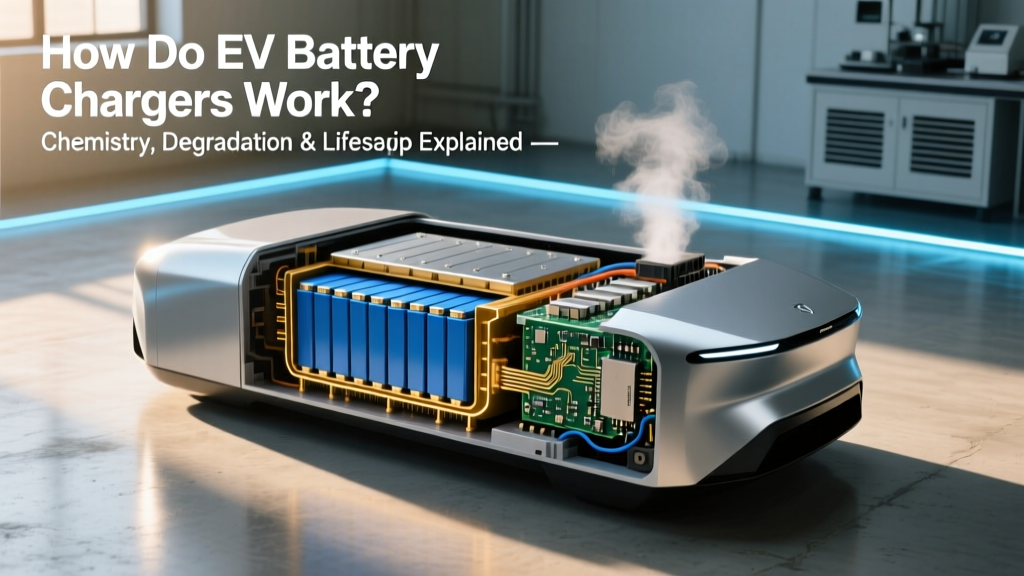
When you plug an electric vehicle into a Level 2 home charger or a 350 kW DC fast-charging stall, a complex orchestration of power electronics, thermal management, and cell-level chemistry determines how quickly energy flows into your battery pack — and how that pack will age over the next decade. Understanding how EV battery chargers work isn't just an academic exercise; it directly informs which charging habits will preserve your pack's capacity and which will accelerate degradation.
This guide breaks down the physics of EV charging from the wall to the cell, compares the two dominant lithium-ion chemistries on the market in 2026, and provides hard data on battery degradation, warranty coverage, and replacement costs across popular models.
The Physics of EV Charging: From Grid to Cell
Every EV battery pack is an assembly of hundreds or thousands of individual lithium-ion cells wired in series and parallel to achieve a target voltage (typically 400V or 800V nominal) and energy capacity measured in kilowatt-hours (kWh). When you connect a charger, the process differs fundamentally depending on the charging level.
Level 1 (120V AC): The vehicle's onboard charger converts household alternating current to direct current at a rate of roughly 1.0 to 1.4 kW. This adds approximately 3 to 5 miles of range per hour — adequate for overnight replenishment of daily driving but impractical for larger packs.
Level 2 (240V AC): A dedicated home or public Level 2 station delivers AC power at 7.2 kW to 19.2 kW, depending on amperage (30A to 80A circuits). The onboard charger again performs the AC-to-DC conversion. Most modern EVs accept between 7.7 kW and 11.5 kW onboard, meaning a 48A Level 2 circuit (11.5 kW) can add 30 to 45 miles of range per hour.
DC Fast Charging (Level 3): Here, the AC-to-DC conversion happens inside the charging station itself, not in the car. The station feeds direct current straight into the battery pack at power levels ranging from 50 kW to 350 kW (and up to 500 kW on some 2026 heavy-duty truck chargers). Because the onboard charger is bypassed, charge speeds are dramatically faster — but the battery management system (BMS) must carefully regulate current to prevent overheating and lithium plating at the anode.
Inside the Pack: LFP vs. NMC Chemistry Explained
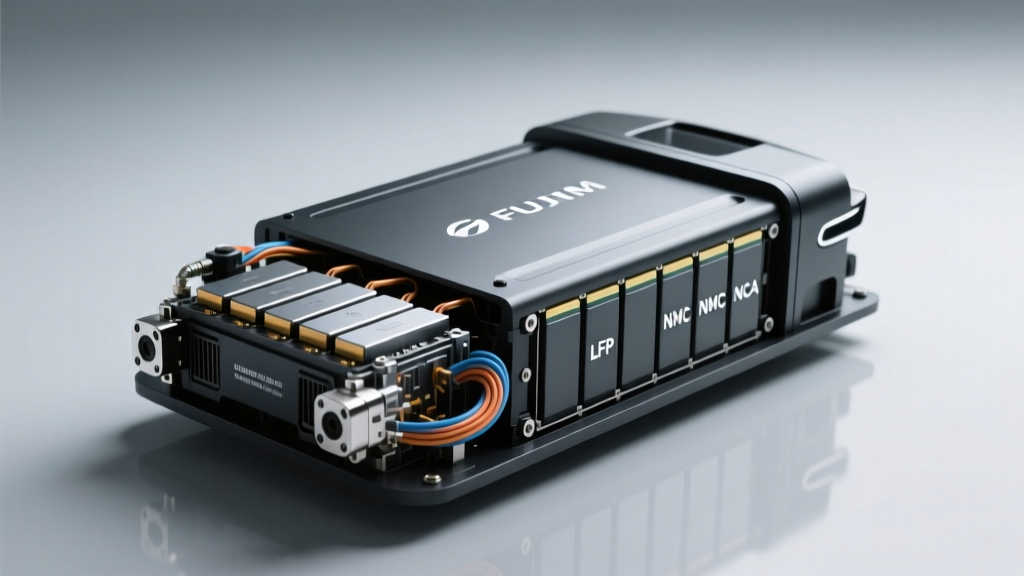
The two dominant cathode chemistries in 2026 EV battery packs are lithium iron phosphate (LFP) and nickel manganese cobalt (NMC), with some manufacturers using nickel cobalt aluminum (NCA) variants. The chemistry choice profoundly affects energy density, longevity, cost, and how the battery responds to charging patterns.
| Attribute | LFP (Lithium Iron Phosphate) | NMC/NCA (Nickel-based) |
|---|---|---|
| Energy Density (cell-level) | 160–200 Wh/kg | 250–300 Wh/kg |
| Typical Cycle Life | 3,000–6,000+ cycles to 80% SoH | 1,000–2,500 cycles to 80% SoH |
| Recommended Daily SoC | 100% (can charge fully daily) | 80% for daily use; 100% for trips only |
| Cold-Weather Performance | Reduced — slower charge acceptance below 32°F | Better low-temp charge/discharge |
| Cost per kWh (2026 cell-level) | ~$70–$90/kWh | ~$100–$130/kWh |
| Thermal Stability | Excellent — higher runaway threshold | Good — requires more active thermal management |
| Common In 2026 Models | Tesla Model 3/Y RWD, Ford Mustang Mach-E Select, BYD, Rivian Standard | Tesla Long Range, Hyundai Ioniq 5/6, BMW iX, VW ID.4 Pro S, Lucid |
Which is better? It depends on your use case. If you lack home charging and rely on frequent DC fast charging, LFP's tolerance for 100% state of charge and superior cycle life makes it the pragmatic choice. If you need maximum range from a smaller, lighter pack — say, for a long-range AWD sedan — NMC's higher energy density wins. Neither chemistry is universally superior; the right choice aligns with your driving profile.
Battery Degradation: What the Real Data Shows
Battery degradation — the gradual loss of usable capacity over time — remains one of the most cited concerns among prospective EV buyers. The good news, backed by fleet data, is that modern packs degrade far more slowly than early-generation cells did a decade ago.
According to aggregated fleet data from Recurrent Auto, which tracks over 15,000 EVs in real-world conditions, the median degradation profile for 2023–2026 model-year EVs looks like this:
- Year 1: 1–3% capacity loss (initial formation stabilization)
- Year 2–3: Additional 1–2% per year
- Year 5: Total loss typically 8–12% from new
- Year 8: Total loss typically 10–16% from new
- Year 10+: Most packs retain 75–85% of original capacity
These figures represent normal use. Vehicles subjected to frequent DC fast charging (more than three times per week), sustained high state of charge in hot climates, or repeated deep discharge cycles may see degradation 2–5 percentage points worse over the same period.
Factors That Accelerate (or Slow) Battery Aging
Not all miles and charging sessions are created equal. The following factors have the most measurable impact on long-term battery health:
Battery Care Checklist for Maximum Longevity
- Limit DC fast charging frequency: Use Level 2 for daily charging; reserve DCFC for road trips. Data from IDTechEx shows packs charged primarily on Level 2 degrade 1–3% less over five years than those relying heavily on DCFC.
- Maintain 20–80% SoC for NMC: Store and daily-drive NMC packs in this window. LFP packs can be charged to 100% daily without significant penalty — in fact, Tesla recommends periodic 100% charges for LFP to allow the BMS to recalibrate cell balancing.
- Precondition before fast charging: Most EVs (Tesla, Hyundai/Kia E-GMP, BMW, Ford) automatically precondition the battery when a DC fast charger is set as your navigation destination. This brings the pack to optimal temperature (roughly 77–95°F / 25–35°C), enabling faster charge acceptance and reducing lithium plating risk.
- Avoid prolonged storage at extreme SoC: If leaving the vehicle for more than two weeks, set charge limit to 50–60% and keep the vehicle plugged in if possible so the thermal management system can operate.
- Minimize exposure to extreme heat: Park in shade or a garage when possible. Sustained ambient temperatures above 95°F accelerate electrolyte decomposition. Active liquid cooling in modern packs mitigates this, but thermal stress still accumulates.
- Use scheduled charging: Set your vehicle or charger to begin charging during off-peak hours and finish shortly before departure, minimizing time spent sitting at 100% SoC.
EV Battery Warranty Terms: What's Actually Covered
Federal law mandates that EV battery packs carry a minimum warranty of 8 years or 100,000 miles (10 years/150,000 miles in California Air Resources Board states). However, the specific capacity-retention threshold that triggers a warranty claim varies by manufacturer.
| Manufacturer | Warranty Period | Capacity Retention Threshold | Notes |
|---|---|---|---|
| Tesla (Model 3/Y) | 8 yr / 120,000 mi (LR/AWD) 8 yr / 100,000 mi (RWD) | 70% (LR/AWD) 70% (RWD/LFP) | Covers defects and capacity below threshold |
| Hyundai / Kia | 10 yr / 100,000 mi | 70% | Among the longest coverage in the segment |
| Ford (Mach-E, F-150 Lightning) | 8 yr / 100,000 mi | 70% | Covers battery components and capacity loss |
| General Motors (Ultium platform) | 8 yr / 100,000 mi | 70% | Includes battery management system components |
| BMW | 8 yr / 100,000 mi | 70% | Covers high-voltage battery and related components |
| Rivian | 8 yr / 175,000 mi | 70% | Higher mileage threshold than most competitors |
| Volkswagen (ID.4) | 8 yr / 100,000 mi | 70% | Covers net usable capacity below threshold |
In practice, the vast majority of EV batteries never fall below the 70% threshold within the warranty period. The warranty serves as a floor — most packs will retain 80–88% capacity at the 8-year mark under normal use. If your pack does drop below the threshold, the manufacturer typically replaces defective modules or the full pack at no cost.
EV Battery Replacement Cost: When and How Much
Battery replacement is the scenario that generates the most anxiety — and the most misinformation. The critical context: most EV battery packs outlast the vehicle itself. Full-pack replacements under normal ownership are rare. When they do occur, it's typically due to a manufacturing defect (covered by warranty) or physical damage from a collision.
For out-of-warranty replacements — relevant primarily for high-mileage fleet vehicles or second- and third-owners of older EVs — costs have declined substantially as cell prices have fallen.
| Model | Pack Size | Estimated Replacement Cost | Notes |
|---|---|---|---|
| Tesla Model 3 (LFP, RWD) | ~60 kWh | $8,000–$12,000 | LFP cells cheaper; module-level repair may reduce cost |
| Tesla Model Y (Long Range, NMC) | ~75 kWh | $12,000–$16,000 | Structural pack complicates labor |
| Hyundai Ioniq 5 (NMC) | ~77.4 kWh | $11,000–$15,000 | E-GMP platform; modular replacement possible |
| Ford F-150 Lightning (Extended Range) | ~131 kWh | $18,000–$25,000 | Largest consumer pack; higher material cost |
| Chevrolet Equinox EV | ~85 kWh | $10,000–$14,000 | Ultium modular architecture may reduce partial-replacement cost |
| BMW i4 / iX | ~81–111 kWh | $14,000–$22,000 | Premium segment; higher labor and diagnostic costs |
These figures include parts and labor but assume a full-pack replacement. Many manufacturers now support module-level replacement — swapping only the degraded or defective modules within the pack — which can reduce costs by 40–60%. As the EV fleet ages, third-party refurbishers and recycled-cell packs are expected to further reduce out-of-pocket costs.
Monitoring Battery Health: How to Check State of Health (SoH)
State of Health (SoH) is expressed as a percentage of the battery's current maximum capacity relative to its original capacity when new. A pack at 92% SoH holds 92% of the energy it did on day one.
Most 2026 EVs provide SoH data through one or more of these methods:
- In-vehicle display: Tesla's battery health indicator (Settings > Service > Battery Health), Hyundai/Kia's EV battery status screen, and BMW's iDrive battery diagnostics all provide a percentage or qualitative indicator.
- OBD-II diagnostic tools: Third-party OBD-II readers like the OBDeleven, Carly, or dedicated EV tools (e.g., the EV BATTERY Health Checker apps paired with compatible dongles) can read the BMS-reported SoH directly. This is the most accurate consumer-accessible method.
- Manufacturer service centers: Any authorized dealer can run a full battery diagnostic that reports individual module voltages, internal resistance, and overall SoH. This is the documentation you'll want if pursuing a warranty claim.
- Charging-log analysis: Apps like Tessie (for Tesla) or EVNotify can estimate SoH by comparing actual energy accepted during a known 10–100% charge session against the pack's rated capacity. This is less precise but useful for trend tracking.
Check SoH at least twice per year, and always before purchasing a used EV. A vehicle with 60,000 miles showing 94% SoH has aged normally; one showing 83% at the same mileage warrants investigation.
What's Next: Solid-State and Silicon-Anode Batteries
Several next-generation battery technologies are in advanced development, though none are yet available in production consumer EVs as of early 2026.
Solid-state batteries replace the liquid electrolyte with a solid ceramic, glass, or polymer separator. The theoretical benefits are significant: 30–50% higher energy density, faster charging (potential for 10–80% in under 10 minutes), and dramatically improved thermal stability. Toyota has announced plans for limited solid-state EV production in 2027–2028, while QuantumScape continues validation testing with Volkswagen. However, manufacturing scale-up, cost reduction, and cycle-life durability at production volumes remain unsolved challenges. Realistic mass-market availability is likely 2029–2032.
Silicon-anode batteries — which replace or supplement the graphite anode with silicon to increase lithium-ion storage capacity — are closer to commercialization. Companies like Sila Nanotechnologies and Group14 are supplying silicon-anode materials to battery manufacturers, with incremental energy-density gains of 15–25% expected in production cells by 2027–2028. These will likely debut in premium vehicles before reaching mainstream price points.
Neither technology changes the ownership calculus for buying an EV today. Current-generation LFP and NMC packs already deliver 200,000+ miles of usable life with proper care — well beyond the median vehicle ownership period.
Frequently Asked Questions
How long do EV batteries last in years and miles?
Based on fleet data from Recurrent Auto and manufacturer projections, modern EV battery packs are designed to last 15–20 years or 200,000–300,000 miles before capacity drops below 70–80% of original. Most packs will outlast the vehicle's useful life. The key variables are chemistry (LFP generally outlasts NMC in cycle count), charging habits, and thermal exposure.
How much does it cost to replace an EV battery?
Out-of-warranty full-pack replacement costs range from approximately $8,000 for a smaller LFP pack (e.g., Tesla Model 3 RWD) to $25,000 for a large NMC pack (e.g., Ford F-150 Lightning Extended Range). Module-level repairs can reduce costs by 40–60%. The vast majority of EV owners never pay for a battery replacement — defects are covered by the 8-year/100,000-mile minimum federal warranty.
What does the EV battery warranty actually cover?
EV battery warranties cover manufacturing defects and capacity loss below a specified threshold (typically 70% retention) over 8 years/100,000 miles (10 years/150,000 miles in CARB states). They do not cover damage from accidents, improper modifications, or use of non-approved charging equipment. The warranty is transferable to subsequent owners.
How do I check and maximize my EV's battery health?
Check SoH through your vehicle's built-in diagnostics, an OBD-II reader, or a dealer service visit. To maximize longevity: use Level 2 charging for daily use, limit NMC packs to 80% SoC for daily driving (LFP can go to 100%), precondition the battery before DC fast charging, avoid prolonged storage at extreme SoC levels, and minimize exposure to sustained high ambient temperatures.
LFP vs. NMC — which battery chemistry should I choose?
Choose LFP if you want maximum cycle life, can charge to 100% daily, prioritize lower cost, and don't need the absolute longest single-charge range. Choose NMC if you need higher energy density for longer range in a lighter package, frequently drive in cold climates, or want faster DC fast-charge acceptance in low temperatures. Both chemistries will comfortably outlast a typical ownership period with proper care.