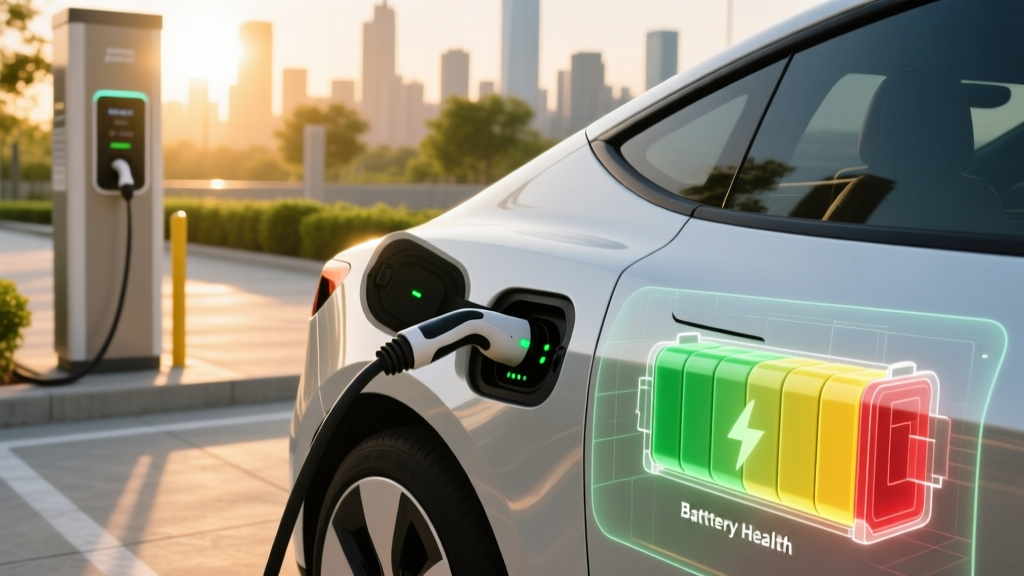
When you ask "what form of energy is a battery," the precise answer is chemical potential energy. An EV battery stores energy in the chemical bonds of its electrode materials and releases it as electrical energy through electrochemical reactions. Unlike a capacitor (which stores energy in an electric field) or a flywheel (kinetic energy), a lithium-ion battery converts chemical energy to electrical energy on discharge — and reverses the process when you plug in to charge.
For EV buyers and owners, this isn't just a physics trivia answer. The specific chemistry inside your battery pack — whether it's lithium iron phosphate (LFP) or nickel manganese cobalt (NMC) — determines your vehicle's range, charging speed, longevity, cold-weather performance, and eventual replacement cost. This guide covers the engineering reality of EV batteries in 2026, with hard data on degradation, warranty coverage, and what you can actually do to maximize your pack's lifespan.
How an EV Battery Stores Chemical Energy
A lithium-ion battery cell consists of three core components: a cathode (positive electrode), an anode (typically graphite or a graphite-silicon blend), and a liquid electrolyte that allows lithium ions to shuttle between them. During discharge, lithium ions move from the anode through the electrolyte to the cathode, releasing electrons through an external circuit — that electron flow is the electricity that drives your motor. Charging reverses the process, pushing ions back to the anode using grid power.
The energy density of this chemical storage system is measured in watt-hours per kilogram (Wh/kg) at the cell level or kilowatt-hours (kWh) at the pack level. For context, a 2026 Tesla Model Y Long Range carries roughly 75 kWh of usable energy in its pack, while a Ford F-150 Lightning Extended Range holds about 131 kWh. The kWh figure represents the total chemical energy the battery can store and deliver — not the rate at which it charges or discharges, which is measured in kilowatts (kW).
Every EV also carries a separate 12V auxiliary battery for accessories and vehicle computers. This guide focuses exclusively on the high-voltage traction battery — the large pack that propels the vehicle and represents the single most expensive component in any EV.
Battery Chemistry Showdown: LFP vs NMC in 2026
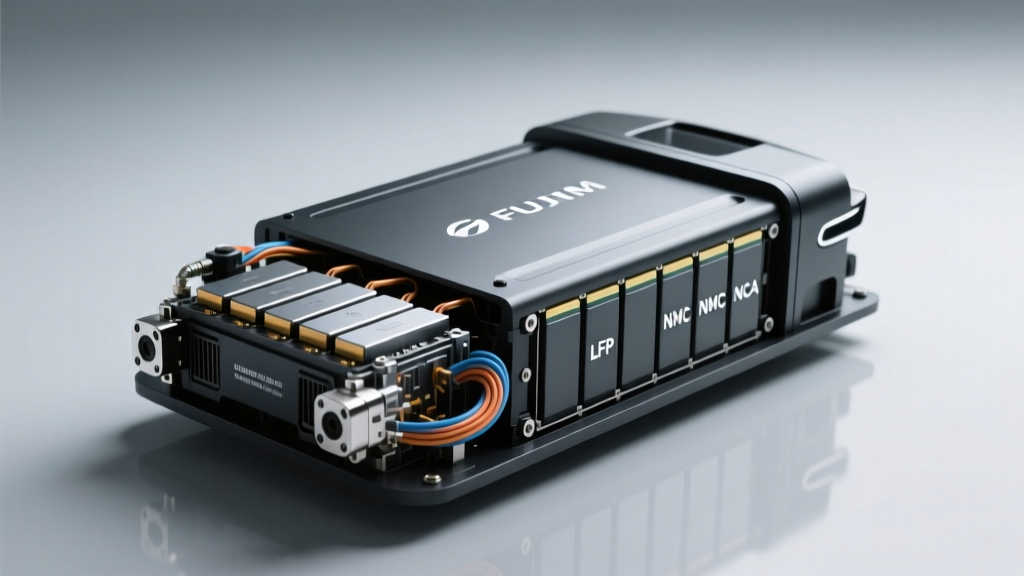
The two dominant cathode chemistries in the 2026 EV market are lithium iron phosphate (LFP, also called LiFePO4) and nickel manganese cobalt (NMC). Each has distinct trade-offs that affect real-world ownership.
| Attribute | LFP (Lithium Iron Phosphate) | NMC (Nickel Manganese Cobalt) |
|---|---|---|
| Energy Density (cell-level) | ~160–180 Wh/kg | ~220–260 Wh/kg |
| Cycle Life (to 80% capacity) | 3,000–5,000+ cycles | 1,000–2,500 cycles |
| Cold-Weather Performance | Moderate — larger range loss below 32°F | Better — smaller cold-weather penalty |
| Peak DC Fast Charge Rate | Typically 150–170 kW | Typically 200–350 kW |
| Cobalt/Nickel Content | None — iron and phosphate only | Contains cobalt and nickel |
| Cost per kWh (pack-level) | ~$90–$110 | ~$120–$150 |
| Typical Use Cases | Standard-range models, fleet vehicles | Long-range and performance models |
| Recommended Charge Habit | Can charge to 100% daily | Daily limit to 80–90%; 100% for trips only |
| Notable 2026 Vehicles | Tesla Model 3 RWD, Model Y RWD, Ford Mustang Mach-E Select | Hyundai Ioniq 5 Long Range, BMW iX, Rivian R1T Max Pack |
The key practical difference: LFP batteries trade some energy density and cold-weather range for dramatically longer cycle life, lower cost, and the ability to charge to 100% daily without accelerated degradation. NMC batteries pack more energy into a lighter, smaller package — critical for 300+ mile range targets — but benefit from daily charge limits of 80–90% to preserve longevity.
Neither chemistry is universally "better." If your commute is under 60 miles round-trip and you want a battery that could realistically outlast 300,000 miles with minimal degradation, LFP is the stronger pick. If you need maximum range for road trips or live in a cold climate where every mile of buffer matters, NMC delivers.
How Long Do EV Batteries Actually Last?
Based on aggregated fleet data and manufacturer reports through 2025–2026, the typical EV battery retains 85–92% of its original capacity after 100,000 miles and 78–88% after 150,000 miles. Most modern packs are engineered to deliver at least 70% capacity at 200,000 miles — the point at which replacement might become economically worth considering.
Typical Degradation Curve (NMC and LFP combined fleet averages):
- Year 1 / 15,000 mi: 2–4% capacity loss (initial formation loss)
- Year 3 / 45,000 mi: 5–7% total loss
- Year 5 / 75,000 mi: 7–10% total loss
- Year 8 / 120,000 mi: 10–15% total loss
- Year 10 / 150,000 mi: 12–20% total loss
Sources: Geotab fleet battery health study, Recurrent Auto battery data. Individual results vary based on climate, charging habits, and chemistry.
The degradation curve is non-linear: the steepest drop occurs in the first year or two (called "formation loss" as the solid electrolyte interface stabilizes), then the rate flattens significantly. This is why a 3-year-old EV with 40,000 miles often retains 94%+ of its battery — better than many buyers expect.
Cold-climate owners should note that range reduction in winter (often 20–30% below EPA estimates at temperatures below 20°F) is temporary and recovers when temperatures rise. This is not permanent degradation — it's a reversible effect of slowed electrochemical reaction rates in cold electrolyte.
EV Battery Warranty Terms: What's Actually Covered
Federal law mandates a minimum EV battery warranty of 8 years / 100,000 miles (10 years / 150,000 miles in California Air Resources Board states). Most manufacturers set a capacity retention threshold of 70% — if your battery drops below 70% of its original capacity within the warranty period, the manufacturer must repair or replace it.
| Manufacturer | Battery Warranty | Capacity Threshold | Notes |
|---|---|---|---|
| Tesla (Model 3/Y RWD — LFP) | 8 yr / 120,000 mi | 70% | Higher mileage threshold than NMC trims |
| Tesla (Model 3/Y LR/Perf — NMC) | 8 yr / 100,000 mi | 70% | Standard federal minimum |
| Hyundai / Kia | 10 yr / 100,000 mi | 70% | Above-minimum duration |
| Ford (Mach-E, F-150 Lightning) | 8 yr / 100,000 mi | 70% | Standard coverage |
| BMW (iX, i4, i7) | 8 yr / 100,000 mi | 70% | Includes battery management system |
| Rivian (R1T, R1S) | 8 yr / 175,000 mi | 70% | Among the highest mileage caps |
| CARB States (CA, NY, WA, etc.) | 10 yr / 150,000 mi (minimum) | Varies by OEM | Applies to all EVs sold in these states |
Critical detail: warranty coverage applies to capacity loss below the threshold, not to normal gradual degradation. If your battery retains 72% capacity at year 7, you won't qualify for a warranty replacement even though you've lost 28% of your original range. The warranty is a floor, not a guarantee of minimal loss.
EV Battery Replacement Cost: What to Budget For
Full battery pack replacement remains rare — Recurrent Auto reports fewer than 2.5% of EVs in their dataset have needed a battery replacement, and most of those were covered under warranty. When replacement is needed out of warranty, costs in 2026 typically fall in these ranges:
| Vehicle / Pack Size | Battery Capacity | Estimated Replacement Cost | When Typically Needed |
|---|---|---|---|
| Tesla Model 3 RWD (LFP) | ~57 kWh | $8,000 – $12,000 | Rarely; 250,000+ mi with LFP |
| Tesla Model Y Long Range (NMC) | ~75 kWh | $12,000 – $16,000 | 200,000+ mi in most cases |
| Hyundai Ioniq 5 Long Range | ~77.4 kWh | $11,000 – $15,000 | 200,000+ mi |
| Ford F-150 Lightning Ext. Range | ~131 kWh | $20,000 – $28,000 | 150,000 – 200,000+ mi |
| Chevrolet Silverado EV (Max Range) | ~200 kWh | $28,000 – $38,000 | 150,000+ mi; largest packs cost most |
Pack-level battery pricing has fallen to roughly $110–$140/kWh in 2026, down from $200+/kWh just a few years ago. Labor for removal and installation typically adds $1,500–$3,000. Some manufacturers now offer refurbished or remanufactured packs at 30–40% below new-pack pricing, and module-level repairs (replacing individual failed modules rather than the entire pack) can cut costs significantly for certain designs.
The honest framing: for the vast majority of EV owners, battery replacement is a theoretical concern, not a practical one. The average American drives ~14,000 miles per year; at that rate, you'd need to own your EV for over 14 years to reach 200,000 miles. Most vehicles are traded or sold well before the battery becomes a financial liability.
What Affects Battery Life — and What You Can Control
Not all miles are equal when it comes to battery wear. The following factors have the most measurable impact on long-term capacity retention:
- State of Charge (SoC) habits: Storing an NMC battery at 100% SoC for extended periods accelerates calendar degradation. For NMC packs, set your daily charge limit to 80–90% and only charge to 100% when departing on a road trip within a few hours. LFP packs are more tolerant of 100% SoC — Tesla and Ford recommend periodic full charges for LFP to keep the battery management system calibrated.
- DC fast charging frequency: Occasional DC fast charging (1–2 times per week) shows negligible impact in current data. However, exclusive DC fast charging — particularly at rates above 150 kW in hot climates — correlates with 2–4% additional capacity loss over 100,000 miles compared to primarily Level 2 home charging. Use Level 2 for daily needs; save DC fast charging for road trips.
- Extreme heat exposure: Sustained battery temperatures above 95°F accelerate electrolyte decomposition. Park in shade or a garage in hot climates. Vehicles with active liquid thermal management (standard on most 2026 EVs) handle this far better than older passive-cooled packs.
- Extreme cold charging: Charging a cold-soaked battery (below 20°F) without preconditioning can cause lithium plating on the anode — a permanent damage mechanism. Always use your vehicle's preconditioning feature before charging in freezing weather. Most 2026 EVs automatically precondition the battery when you navigate to a charger.
- Deep discharge cycles: Regularly driving below 10% SoC stresses the battery. Try to keep your pack between 15–85% for daily use (NMC) or 10–100% (LFP, which handles full cycles better).
- Storage conditions: If storing an EV for weeks or months, set the SoC to approximately 50% and leave it plugged in if possible so the thermal management system can maintain battery temperature.
How to Check and Monitor Your Battery's State of Health
State of Health (SoH) is a percentage representing your battery's current maximum capacity relative to its original capacity when new. A battery at 92% SoH can store 92% of the energy it could on day one.
Built-in vehicle tools: Most 2026 EVs display estimated range and energy consumption in the instrument cluster or app, but few expose a direct SoH percentage. Tesla's service menu (accessible via the touchscreen) shows battery health metrics. Hyundai/Kia's infotainment system includes an EV battery diagnostics page. BMW's iDrive provides battery condition status in the vehicle settings.
OBD-II diagnostic tools: Third-party devices like the OBDLink MX+ paired with apps such as EVBatMon or LeafSpy (for Nissan Leaf) can read the battery management system's reported SoH directly. These typically cost $50–$120 for the adapter and provide real-time cell voltage data, pack temperature, and capacity estimates.
Third-party services: Companies like Recurrent Auto offer free battery health reports by connecting to your vehicle's telematics data. These reports benchmark your pack's degradation against thousands of similar vehicles, giving you a data-driven picture of where your battery stands.
The manual method: Charge to 100%, note the displayed range, and compare it to the EPA-rated range when new. A 2026 Ioniq 5 with an EPA range of 303 miles that shows 275 miles at full charge has roughly 90% SoH (adjusting for temperature and driving conditions). This method is approximate but requires no extra equipment.
Emerging Battery Tech: Solid-State and Silicon Anodes
Several next-generation battery technologies are in development, though none are widely available in production EVs as of early 2026:
Solid-state batteries replace the liquid electrolyte with a solid material (ceramic, sulfide, or polymer), potentially offering 40–50% higher energy density, faster charging, and improved safety (no flammable electrolyte). Toyota has announced a solid-state battery targeting 2027–2028 production, initially in limited volumes for select models. Samsung SDI and QuantumScape are also advancing solid-state cells, but no automaker currently sells a solid-state EV in the US market. Realistic widespread availability is 2029–2032 at the earliest, with initial applications likely in premium vehicles due to high manufacturing costs.
Silicon-dominant anodes replace or supplement graphite with silicon, which can store roughly 10x more lithium ions per unit mass. Companies like Sila Nanotechnologies and Group14 are supplying silicon-anode materials to battery manufacturers. The 2026 Mercedes-Benz G-Class EV uses a silicon-dominant anode from Sila, achieving higher energy density in its pack. Expect silicon anode adoption to expand through 2027–2028 as production scales, offering 10–20% energy density improvements over conventional graphite anodes.
Sodium-ion batteries are entering the market as a low-cost alternative for shorter-range and stationary applications. CATL has begun shipping sodium-ion packs for certain Chinese-market EVs. While energy density (~120–150 Wh/kg) trails lithium-ion, the raw material cost advantage is significant. US-market adoption for passenger EVs is not expected before 2028.
These technologies are genuine engineering advances, not vaporware — but the gap between lab demonstration and mass-produced, cost-competitive, automotive-grade battery packs typically spans 5–8 years. Current LFP and NMC chemistries will remain dominant through at least 2030.
Frequently Asked Questions
What form of energy does an EV battery store?
An EV battery stores chemical potential energy in its electrode materials. During discharge, electrochemical reactions convert this chemical energy into electrical energy. During charging, electrical energy from the grid is converted back into chemical potential energy. This reversible chemical storage is what makes lithium-ion batteries rechargeable.
How long do EV batteries last in years and miles?
Most modern EV batteries retain 85–92% capacity at 100,000 miles and 78–88% at 150,000 miles. In terms of years, expect 15–20+ years of usable life before capacity drops below 70%. LFP batteries generally last longer in cycle count than NMC, though both chemistries typically outlast the vehicle they're installed in.
How much does it cost to replace an EV battery?
Out-of-warranty replacement costs range from roughly $8,000 for smaller packs (57 kWh, like the Tesla Model 3 RWD) to $28,000–$38,000 for the largest packs (131–200 kWh, like the F-150 Lightning Extended Range or Silverado EV). However, fewer than 2.5% of EVs have required battery replacement, and most of those were covered under the 8-year/100,000-mile federal warranty minimum.
What does the EV battery warranty cover?
Federal law requires at least 8 years / 100,000 miles of battery coverage (10/150,000 in CARB states). Coverage applies if your battery's capacity drops below the manufacturer's threshold — typically 70% of original capacity. The warranty covers defects and abnormal degradation but not normal gradual capacity loss above the threshold. Some manufacturers, like Rivian, extend coverage to 175,000 miles.
LFP vs NMC — which battery chemistry is better for me?
Choose LFP if you want maximum longevity, lower cost, and don't need 300+ miles of range. LFP tolerates daily 100% charging and offers 3,000–5,000+ cycle life. Choose NMC if you need long range, better cold-weather performance, or faster DC charging speeds — but plan to set your daily charge limit to 80–90%. Neither is universally superior; the right choice depends on your driving patterns and climate.
Does fast charging damage my EV battery?
Occasional DC fast charging (a few times per week) has minimal impact on battery health based on current fleet data. However, exclusive reliance on DC fast charging — especially at high power levels in hot climates — can add 2–4% extra capacity loss over 100,000 miles compared to Level 2 home charging. For optimal longevity, use Level 2 for daily charging and reserve DC fast charging for road trips.
How do I check my EV battery's health?
You can check battery State of Health (SoH) through your vehicle's built-in diagnostics menu, an OBD-II adapter with an EV-specific app (like OBDLink MX+ with EVBatMon), a third-party service like Recurrent Auto, or by comparing your 100% charge range to the original EPA rating. A battery at 92% SoH stores 92% of its original capacity.