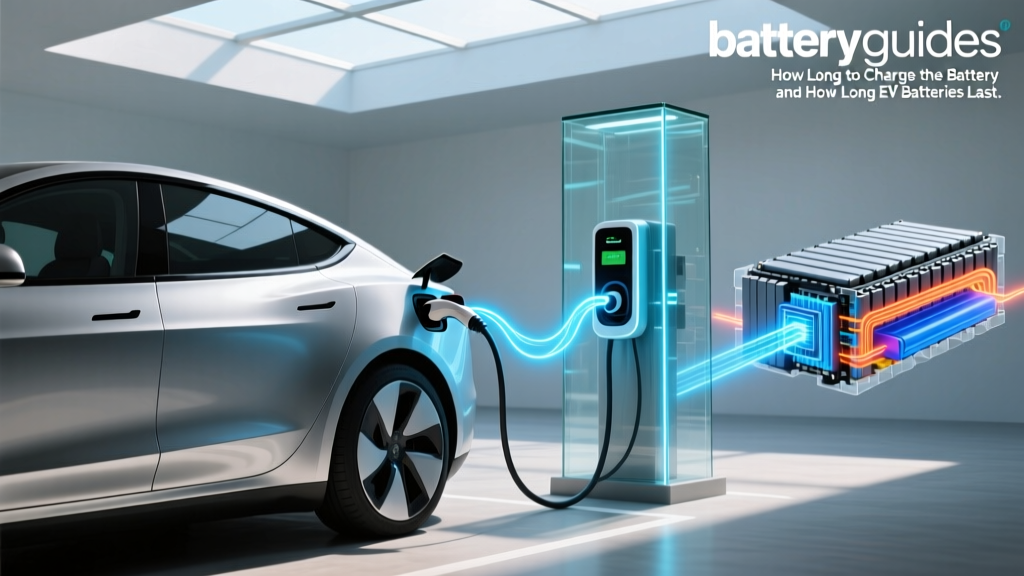
Two questions dominate every EV buyer's research: how long to charge the battery from empty to full, and how many years that battery will survive before needing replacement. The answers depend heavily on battery chemistry, charging habits, thermal management, and the specific vehicle platform. This guide breaks down exact charge times across levels, real-world degradation data, replacement economics, and the chemistry trade-offs that determine your pack's lifespan.
How Long to Charge the Battery: Level 1, Level 2, and DC Fast Charging
Charge time is a function of battery capacity (measured in kilowatt-hours, or kWh — the total energy the pack stores) divided by the power delivery rate of your charger (measured in kilowatts, or kW — how fast energy flows into the pack). A 75 kWh battery on a 7.7 kW Level 2 charger takes roughly 9.7 hours from 0% to 100%. That same battery on a 250 kW DC fast charger can reach 80% in about 20–25 minutes, though the charge curve tapers significantly above 80%.
| Charging Level | Power (kW) | ~60 kWh Battery (0–100%) | ~85 kWh Battery (0–100%) | ~100 kWh Battery (0–100%) | Miles Added/Hour |
|---|---|---|---|---|---|
| Level 1 (120V household) | 1.0–1.4 kW | 43–60 hours | 61–85 hours | 71–100 hours | 3–5 mi/hr |
| Level 2 (240V home/public) | 7.2–11.5 kW | 5–8 hours | 7–12 hours | 9–14 hours | 20–40 mi/hr |
| DC Fast Charging (Level 3) | 50–350 kW | 10–80% in 18–45 min | 10–80% in 18–40 min | 10–80% in 20–35 min | 150–300 mi/hr (peak) |
Why 10–80% and not 0–100%? Lithium-ion charge curves taper dramatically above 80% State of Charge (SoC) to protect cell longevity. A Tesla Model Y on a V3 Supercharger (250 kW peak) might pull 250 kW at 15% SoC but drop to under 40 kW by the time it hits 85%. This is why manufacturers quote 10–80% times — the final 20% can take as long as the first 80%.
Real-world charge time also depends on preconditioning — warming or cooling the battery to its optimal charging temperature (typically 25–40°C / 77–104°F). Without preconditioning, especially in cold weather below 32°F, a pack that could accept 250 kW may be limited to 50–80 kW until it warms up, adding 15–25 minutes to a fast-charging stop. Most modern EVs (Tesla, Hyundai/Kia E-GMP, GM Ultium, Ford) precondition automatically when you navigate to a charger.
LFP vs NMC/NCA: Which Battery Chemistry Lasts Longer?
The two dominant chemistries in 2026 EVs are LFP (lithium iron phosphate) and NMC/NCA (nickel manganese cobalt / nickel cobalt aluminum). The chemistry choice affects energy density, cycle life, cold-weather performance, cost, and charging behavior — and it's the single biggest predictor of how long your battery will last.
| Attribute | LFP (Lithium Iron Phosphate) | NMC / NCA (Nickel-based) |
|---|---|---|
| Energy Density | Lower (~150–180 Wh/kg cell-level) | Higher (~220–300 Wh/kg cell-level) |
| Cycle Life | 3,000–5,000+ cycles to 80% capacity | 1,000–2,500 cycles to 80% capacity |
| Calendar Life | 15–20+ years estimated | 10–15 years typical |
| Cold Performance | Weaker below 14°F (-10°C); more range loss | Better low-temp conductivity |
| Cost (per kWh) | ~$80–100/kWh (2026 cell pricing) | ~$110–140/kWh (2026 cell pricing) |
| Charging to 100% | Recommended regularly; BMS needs full charge for calibration | 80% daily recommended; 100% for trips only |
| Thermal Stability | Superior; less prone to thermal runaway | Good but requires more active thermal management |
| Common 2026 Vehicles | Tesla Model 3/Y RWD, Ford Mustang Mach-E Select (LFP option), BYD models | Tesla Long Range/Performance, Hyundai Ioniq 5/6, GM Ultium vehicles, Rivian, Porsche Taycan |
Which is better? For maximum longevity and lowest cost, LFP wins — its cycle life of 3,000–5,000+ cycles means even daily charging to 100% for 15 years may not degrade the pack below 80% capacity. The trade-off is lower energy density (less range per pound) and weaker cold-weather performance. For maximum range and performance in a lighter package, NMC/NCA is superior, but you'll need to baby it more — keeping daily SoC between 20–80% and avoiding frequent DC fast charging to maximize lifespan.
Real-World Degradation Data: What to Expect Over Time
EV battery degradation is not linear. Most packs experience a steeper drop in the first 1–2 years (roughly 2–5% loss as cells stabilize), then a long, slow linear decline. Based on aggregated fleet data from sources including Recurrent Auto and Tesla's own impact reports, here are realistic degradation benchmarks:
- Year 1: 2–3% capacity loss (rapid initial stabilization)
- Year 2–3: Additional 2–4% loss (total ~5–7% by year 3)
- Year 5: Total ~8–12% loss (88–92% capacity retained)
- Year 8: Total ~10–15% loss (85–90% capacity retained)
- Year 10: Total ~12–18% loss (82–88% capacity retained)
- Year 15: Total ~18–25% loss (75–82% capacity retained)
LFP packs in similar conditions typically show 5–10% total loss at year 8 and 10–15% at year 15, reflecting their superior cycle life.
Extreme cases exist: some early Nissan Leaf models (passive air cooling, no active thermal management) saw 20–30% degradation within 5 years in hot climates. Conversely, Tesla's fleet data shows Model S/X packs retaining ~90% capacity at 150,000 miles on average. The difference is almost entirely attributable to thermal management quality and charging habits.
Battery Warranty Terms: What Manufacturers Guarantee
Federal law mandates a minimum 8-year / 100,000-mile warranty on EV battery packs (10 years / 150,000 miles in CARB states including California, New York, Massachusetts, and others). Most manufacturers exceed this baseline. Here's how major 2026 warranties compare:
| Manufacturer | Warranty Period | Mileage Limit | Capacity Retention Threshold |
|---|---|---|---|
| Tesla (Model 3/Y LFP) | 8 years | 120,000 miles | 70% |
| Tesla (Model 3/Y LR, Model S/X) | 8 years | 120,000–150,000 mi | 70% |
| Hyundai / Kia | 10 years | 100,000 miles | 70% |
| GM (Ultium platforms) | 8 years | 100,000 miles | 70% (60% for Bolt-based) |
| Ford (Mach-E, F-150 Lightning) | 8 years | 100,000 miles | 70% |
| Rivian | 8 years | 175,000 miles (R1T/R1S) | 70% |
| BMW (i4, iX, i7) | 8 years | 100,000 miles | 70% |
| Volkswagen (ID.4, ID.7) | 8 years | 100,000 miles | 70% |
The warranty threshold matters: if your pack drops below 70% of original capacity within the warranty period, the manufacturer must repair or replace it at no cost. In practice, warranty claims remain rare — fueleconomy.gov data and fleet studies consistently show fewer than 1–2% of EV batteries requiring warranty replacement. Most packs outlive the vehicles they're installed in.
EV Battery Replacement Cost: When and How Much
When a pack does need replacement outside warranty — typically after 12–15+ years or 200,000+ miles for liquid-cooled packs — costs vary dramatically by vehicle, battery size, and chemistry. Prices have fallen steadily; 2026 replacement costs reflect both cheaper LFP cells and improved modular repair options.
| Vehicle (Example) | Battery Size | Chemistry | Full Pack Replacement | Module-Level Repair |
|---|---|---|---|---|
| Tesla Model 3 RWD | ~60 kWh | LFP (CATL) | $7,000–$10,000 | $1,500–$3,000 |
| Tesla Model Y Long Range | ~75 kWh | NMC (Panasonic/LG) | $12,000–$16,000 | $2,000–$4,500 |
| Hyundai Ioniq 5 | ~77.4 kWh | NMC (SK On) | $10,000–$14,000 | $2,000–$4,000 |
| Ford F-150 Lightning Ext. Range | ~131 kWh | NMC (SK On) | $18,000–$25,000 | $3,000–$6,000 |
| Chevrolet Silverado EV | ~200 kWh | NMC (Ultium) | $22,000–$30,000 | $3,500–$7,000 |
| Rivian R1T (Max Pack) | ~149 kWh | NMC (Samsung) | $18,000–$24,000 | $3,000–$5,500 |
Key context: Most modern packs are modular — a technician can replace individual modules (sections of cells) rather than the entire pack. A single module failure might cost $2,000–$4,000 rather than $15,000+ for a full swap. This modular repair approach is standard on GM Ultium, Hyundai E-GMP, and newer Tesla platforms, significantly reducing worst-case costs.
By comparison, a gasoline vehicle's engine or transmission replacement at high mileage often costs $4,000–$8,000, and may need to happen more than once over 200,000 miles. The EV battery is functionally equivalent to an engine — but with far fewer moving parts and a longer expected service life.
Factors That Accelerate or Preserve Battery Life
- Daily SoC limits: Set charge limit to 80% for NMC/NCA; 100% is fine for LFP. Avoid routinely sitting at 100% or below 10%.
- DC fast charging: Use for road trips, not daily commutes. Frequent 150+ kW charging accelerates degradation by ~1–2% per year versus L2-only charging.
- Extreme heat: Park in shade or a garage when possible. Sustained ambient temps above 95°F (35°C) with a high SoC accelerate calendar degradation. Active thermal management mitigates this significantly.
- Extreme cold: Precondition before driving and charging. Cold doesn't cause permanent damage but temporarily reduces range by 15–30% below 20°F (-7°C).
- Storage: If storing for weeks, keep SoC at 40–60%. Never store at 100% or near 0% for extended periods.
- Regen braking: Use standard or moderate regen settings. Max regen in cold weather can stress cells if they're below optimal temperature (most EVs limit regen automatically when cold).
- Software updates: Install OTA updates — manufacturers regularly refine battery management algorithms to improve longevity.
The single most impactful habit is avoiding sustained high SoC in hot conditions. A pack sitting at 100% SoC in 100°F ambient heat degrades roughly 3–5× faster than one sitting at 50% SoC in 70°F conditions. This is why fleet vehicles in Phoenix or Dubai show higher degradation rates than identical vehicles in Seattle or Denver.
How to Check and Monitor Battery Health (State of Health)
State of Health (SoH) is the percentage of original capacity your pack retains. A new pack is 100% SoH; a pack with 10% degradation is at 90% SoH. Here's how to check it:
- In-vehicle displays: Tesla shows estimated range at 100% charge (compare to original EPA range). Hyundai/Kia offers a battery health screen in the EV menu. BMW and Mercedes include SoH percentages in their service menus.
- OBD-II scanners and apps: Tools like OBD2 diagnostics adapters paired with apps (e.g., Leaf Spy for Nissan, ABRP-linked tools, or manufacturer-specific diagnostics) can read actual SoH percentage from the BMS (Battery Management System).
- Third-party services: Companies like Recurrent Auto and Geotab offer battery health reports based on telematics data — useful for used-EV buyers.
- Dealer diagnostics: Any authorized dealer can run a full BMS health check, typically free during service visits. Request this before buying a used EV.
- Manual calculation: Charge to 100%, note the displayed kWh added (via charger app or vehicle), and compare to the pack's rated capacity. If your 75 kWh pack only accepted 65 kWh from 5% to 100%, your SoH is approximately 87%.
For used-EV buyers, SoH is the most important metric — more predictive of remaining useful life than mileage alone. A 60,000-mile vehicle with 94% SoH is in better battery shape than a 30,000-mile vehicle that was routinely fast-charged to 100% in hot weather and sits at 88% SoH.
How Long Do EV Batteries Actually Last?
Based on current data, the answer is longer than most buyers expect:
- NMC/NCA packs with active liquid cooling and moderate care: 150,000–250,000 miles / 12–18 years before dropping below 70% capacity.
- LFP packs with similar care: 250,000–400,000+ miles / 15–25 years before reaching 70% capacity.
- Poorly managed packs (no thermal management, frequent 100% SoC + DCFC, hot climate): 80,000–120,000 miles / 8–12 years.
The median 2026 EV with liquid-cooled battery management will likely outlast its first owner's planned ownership period. According to IRS §30D credit data and industry registrations, the average EV is kept for 6–8 years — well within the battery's useful life and warranty coverage.
Emerging Battery Technology: What's Next
Several next-generation technologies are in development but are not yet available in production vehicles as of 2026:
- Solid-state batteries: Promised to deliver 40–60% higher energy density, faster charging (potentially 10–80% in under 10 minutes), and near-zero degradation risk. Toyota, Samsung SDI, and QuantumScape have announced production timelines targeting 2027–2030 for limited vehicle integration. Expect initial deployment in premium models (likely $80K+ MSRP) before reaching mainstream vehicles around 2030–2032. These are announced/preliminary — no consumer vehicle currently ships with a full solid-state pack.
- Silicon-dominant anodes: Companies like Sila Nanotechnologies and Group14 are replacing graphite anodes with silicon composites, boosting energy density by 20–40%. Early deployments are appearing in select 2026–2027 models (e.g., Mercedes-Benz partnerships) but at limited scale.
- Sodium-ion batteries: Cheaper than LFP and free of lithium/cobalt, with slightly lower energy density. CATL and BYD are deploying these in Chinese-market vehicles; US/European availability is expected around 2027–2028 for budget segments.
- LMFP (lithium manganese iron phosphate): A hybrid of LFP's safety with NMC's energy density. Expected to enter mainstream production around 2027.
These technologies will eventually push battery lifespans beyond 300,000+ miles and reduce replacement costs further — but for buyers shopping today, current LFP and NMC chemistries with modern thermal management already deliver more longevity than most ownership cycles require.
Frequently Asked Questions
How long does it take to charge an EV battery at home?
On a Level 2 home charger (7.2–11.5 kW), expect 5–14 hours for a full 0–100% charge depending on battery size. Most owners plug in overnight and wake up to a full battery — similar to charging a phone. A typical 75 kWh pack on a 48-amp (11.5 kW) charger takes about 6.5 hours from empty.
How long does it take to charge an EV battery at a public fast charger?
At a 150–350 kW DC fast charger, most 2026 EVs reach 10–80% in 18–30 minutes. Hyundai/Kia E-GMP vehicles on 800V architecture can hit 10–80% in as little as 18 minutes at a 350 kW station. Tesla V4 Superchargers deliver up to 250–350 kW depending on location. Expect the final 80–100% to add another 15–25 minutes due to charge-curve tapering.
Is it bad to charge my EV battery to 100% every day?
For NMC/NCA chemistry, yes — daily 100% charging accelerates degradation. Set your charge limit to 80% for daily use and 100% only for long trips. For LFP chemistry, daily 100% charging is recommended — the BMS needs full charges to accurately calibrate capacity readings, and LFP's cycle life handles it without meaningful degradation.
How much does it cost to replace an EV battery?
Full pack replacement ranges from roughly $7,000 for a small LFP pack (Tesla Model 3 RWD) to $25,000+ for a large NMC pack (F-150 Lightning Extended Range, Chevrolet Silverado EV). However, most modern packs support module-level repair at $1,500–$6,000, and the vast majority of packs never need replacement during typical ownership.
Does fast charging damage my EV battery?
Frequent DC fast charging (150+ kW) accelerates degradation by approximately 1–2% per year compared to Level 2-only charging, according to fleet data from Geotab and Recurrent Auto. Occasional fast charging on road trips has negligible impact. The concern is daily fast charging as your primary routine — if that's your situation, expect slightly faster degradation but still 10+ years of useful battery life.
What voids an EV battery warranty?
Typical exclusions include: damage from accidents, flooding, or fire; modifications to the battery or BMS; using the vehicle as a stationary power source outside manufacturer-approved V2H/V2L features; and failure to install recommended software updates. Normal charging habits (even frequent fast charging) do not void the warranty.
Can I check my EV battery health myself?
Yes. Most EVs display estimated range at 100% charge — compare this to the original EPA range for a rough SoH estimate. For precise readings, use an OBD-II diagnostic tool compatible with your vehicle, visit a dealer for a BMS health report, or use a third-party service like Recurrent. Always check SoH before buying a used EV.