The Real Average Life of an EV Battery: What the Data Shows
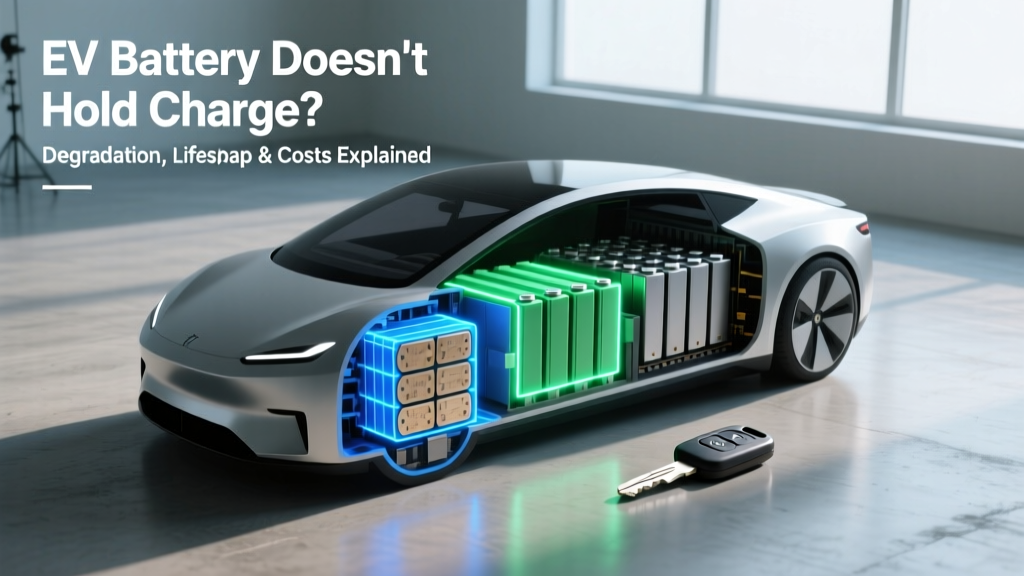
If you're researching the average life of auto battery packs in electric vehicles, the short answer is encouraging: modern EV traction batteries routinely last 15–20 years and 150,000–200,000+ miles before reaching 70% of their original capacity — the threshold most manufacturers use to define end-of-life. That means the high-voltage battery will outlast the rest of the vehicle in the majority of cases.
But "average life" hides important nuance. A battery doesn't die suddenly like a phone going black; it gradually loses usable capacity over time, a process called degradation. A 250-mile EPA-rated EV with 15% degradation still delivers ~212 miles of range — perfectly usable for most drivers. Understanding how chemistry, charging habits, and climate interact with that degradation curve is what separates informed buyers from anxious ones.
This guide breaks down the hard numbers behind EV battery longevity in 2026, including real-world degradation data from fleets and long-term tests, replacement cost realities, warranty coverage specifics, and the LFP vs NMC chemistry decision that affects your battery's lifespan from day one.
LFP vs NMC/NCA Chemistry: The Lifespan Foundation
The single biggest factor determining how long your EV battery lasts is its cell chemistry. Two dominant chemistries power nearly every EV sold in the US today, and they age very differently.
NMC (Nickel Manganese Cobalt) and its variant NCA (Nickel Cobalt Aluminum) offer higher energy density — meaning more range in a lighter, smaller pack. This is why NMC powers most long-range EVs: the Tesla Model 3 Long Range, Hyundai Ioniq 5, Ford Mustang Mach-E Extended Range, and most premium EVs. The trade-off is a somewhat shorter cycle life and greater sensitivity to sustained high states of charge.
LFP (Lithium Iron Phosphate) sacrifices about 15–20% energy density for dramatically longer cycle life — often 3,000–5,000+ full charge cycles vs. 1,000–2,000 for NMC. LFP also tolerates regular 100% charging without the accelerated degradation that NMC experiences at high SoC. Tesla uses LFP in the Model 3 and Model Y Standard Range; Ford offers LFP in the Mustang Mach-E Select; and several Chinese-market imports use it exclusively.
| Attribute | LFP (Lithium Iron Phosphate) | NMC/NCA (Nickel-based) |
|---|---|---|
| Energy Density | ~160–180 Wh/kg (lower) | ~220–260 Wh/kg (higher) |
| Typical Cycle Life | 3,000–5,000+ cycles | 1,000–2,000 cycles |
| 100% SoC Charging | Tolerates well; recommended periodically for BMS calibration | Accelerates degradation; 80% daily limit recommended |
| Cold-Weather Performance | Weaker below 32°F; greater range loss | Better low-temp performance |
| Cost per kWh | ~$90–$110 (lower) | ~$120–$150 (higher) |
| Cobalt Content | None | Yes (supply-chain/ethical considerations) |
| Thermal Stability | Excellent; lower runaway risk | Good; requires more active thermal management |
| Typical Use | Standard-range, fleet, high-mileage | Long-range, performance, AWD models |
Which is better for longevity? If your priority is maximum calendar life and you don't need 300+ miles of range, LFP is the clear winner. Fleet operators and high-mileage commuters increasingly spec LFP for this reason. If you need maximum range or live in a cold climate where every mile counts in winter, NMC/NCA remains the practical choice — with the understanding that you'll manage SoC more carefully.
Degradation Data: What Actually Happens Over Time
EV battery degradation follows a predictable curve: a steeper initial drop in the first 1–2 years (typically 2–5%), followed by a long, slow linear decline. Most modern EVs lose roughly 1–2% of capacity per year after the initial settling period.
Typical EV Battery Degradation Curve (NMC Chemistry)
| Time / Mileage | Avg. Capacity Retained | Range Impact (on 300-mi EPA vehicle) |
|---|---|---|
| Year 1 / 15,000 mi | 96–98% | ~290–294 mi |
| Year 3 / 45,000 mi | 93–95% | ~279–285 mi |
| Year 5 / 75,000 mi | 90–93% | ~270–279 mi |
| Year 8 / 120,000 mi | 85–90% | ~255–270 mi |
| Year 10 / 150,000 mi | 82–87% | ~246–261 mi |
| Year 15 / 200,000 mi | 75–82% | ~225–246 mi |
Sources: Geotab fleet data analysis (6,300+ EVs), Recurrent Auto battery health reports, manufacturer long-term testing data. Individual results vary by chemistry, climate, and charging habits.
LFP batteries degrade more slowly. Data from fleet operators and Recurrent Auto's battery health analysis shows LFP packs commonly retain 90%+ capacity at 100,000 miles, with some Tesla Model 3 Standard Range vehicles showing less than 5% loss at 80,000 miles.
Critical context: These figures represent average degradation under mixed-use conditions. Your specific experience depends heavily on the factors in the next section. Also, the EPA range figure on the window sticker is already measured with the battery at 100% SoC when new — so a 10% degradation means you lose roughly 10% of that sticker range in real-world terms.
What the Battery Warranty Actually Covers
Federal law mandates that EV battery warranties cover a minimum of 8 years / 100,000 miles (in California Air Resources Board states, it's 10 years / 150,000 miles for vehicles certified to CARB standards). Most manufacturers meet or exceed the federal floor.
But warranty coverage isn't just about duration — it's about the capacity retention threshold that triggers a claim. Most automakers guarantee the battery will retain 70% of original capacity during the warranty period. Some are more generous:
| Manufacturer | Warranty Period | Capacity Threshold | Notes |
|---|---|---|---|
| Tesla (Model 3/Y LFP) | 8 yr / 120,000 mi | 70% | Longer mileage for LFP variants |
| Tesla (Model 3/Y NMC LR) | 8 yr / 120,000 mi | 70% | |
| Hyundai / Kia | 10 yr / 100,000 mi | 70% | Industry-leading duration |
| Ford (Mach-E / F-150 Lightning) | 8 yr / 100,000 mi | 70% | |
| GM (Ultium-based) | 8 yr / 100,000 mi | 70% | Covers battery and drive components |
| Volkswagen (ID.4) | 8 yr / 100,000 mi | 70% | |
| Rivian | 8 yr / 175,000 mi | 70% | Higher mileage cap for truck use |
| BMW (i4 / iX) | 8 yr / 100,000 mi | 70% |
Key warranty nuances:
- What's covered: Capacity loss below the threshold, manufacturing defects, and cell/module failures. The warranty typically covers parts and labor for battery repair or replacement.
- What's NOT covered: Gradual degradation above the threshold (e.g., losing 15% capacity over 6 years is "normal"), damage from accidents, flooding, or unauthorized modifications, and range loss from extreme ambient temperatures (range recovery in moderate temps is expected).
- Replacement vs. repair: Many manufacturers now replace individual modules rather than the entire pack, reducing cost and waste. A single failed module in a multi-module pack can be swapped without replacing the full battery.
- Transferability: Battery warranties transfer to subsequent owners, which supports resale value. Verify this in your purchase agreement.
EV Battery Replacement Cost: The Real Numbers
The fear of a $20,000+ battery replacement is the most persistent anxiety in EV ownership. Here's what the data actually shows:
Most EV batteries never need full replacement during the vehicle's useful life. Based on Geotab's fleet study of over 6,300 electric vehicles and Recurrent Auto's analysis, the failure rate of modern EV batteries requiring full pack replacement is well under 5% within the first 10 years. The vast majority of EVs are retired, totaled, or traded in before their batteries reach end-of-life.
That said, if you do need a replacement — whether from a rare defect outside warranty, accident damage, or owning a vehicle well past its warranty period — here are the current cost ranges:
| Vehicle / Pack Size | Battery Capacity | Full Pack Replacement Cost | Module Repair Cost |
|---|---|---|---|
| Tesla Model 3 Standard Range (LFP) | ~57 kWh | $8,000–$12,000 | $1,500–$3,000 |
| Tesla Model Y Long Range (NMC) | ~75 kWh | $12,000–$16,000 | $2,000–$4,000 |
| Hyundai Ioniq 5 (NMC) | ~77.4 kWh | $11,000–$15,000 | $2,000–$3,500 |
| Ford Mustang Mach-E ER (NMC) | ~91 kWh | $14,000–$18,000 | $2,500–$4,500 |
| Ford F-150 Lightning ER (NMC) | ~131 kWh | $18,000–$25,000 | $3,000–$6,000 |
| Chevrolet Bolt EV (NMC) | ~65 kWh | $9,000–$13,000 | $1,500–$3,000 |
| Rivian R1T / R1S (NMC) | ~128 kWh | $18,000–$22,000 | $3,000–$5,500 |
Costs include parts and labor, sourced from manufacturer service bulletins, independent EV repair shops, and Kelley Blue Book service estimates. Prices vary by region and service provider. Refurbished/remanufactured packs can reduce costs by 30–50%.
When is replacement actually needed? A full pack replacement is typically only necessary when multiple modules fail simultaneously or when the pack suffers physical/thermal damage. Single-module failures — the more common scenario — are repaired at a fraction of the cost, and most occur within the warranty period.
Cost trajectory: Battery pack prices have fallen from over $1,000/kWh in 2010 to approximately $110–$130/kWh at the cell level in 2026, according to BloombergNEF. As the first generation of EVs ages, a growing refurbished battery market is emerging, offering replacement packs at 40–60% below new-pack pricing.
Factors That Accelerate or Extend Battery Life
Your battery's lifespan isn't fixed — it's shaped by how you charge, drive, and store the vehicle. Here are the variables with the largest measurable impact:
Battery Longevity: What Helps and What Hurts
🟢 Practices That Extend Life
- Daily charging to 80% (NMC/NCA): Limiting maximum SoC to 80% for daily use can add years to an NMC pack. Most EVs allow you to set a charge limit in the app or infotainment system.
- 100% charging for LFP: LFP batteries benefit from periodic 100% charges to recalibrate the Battery Management System (BMS). Tesla recommends charging LFP vehicles to 100% at least once per week.
- Preconditioning before DC fast charging: Warming the battery to its optimal temperature range (typically 77–95°F / 25–35°C) before a fast-charge session reduces stress. Most EVs do this automatically when you navigate to a charger.
- Moderate ambient storage: Parking in shade or a garage during extreme heat, and plugging in during extreme cold (so the thermal management system can maintain battery temperature using grid power rather than battery energy).
- Level 2 home charging as primary method: Slow, steady Level 2 charging (7–11 kW) generates far less heat and cell stress than repeated DC fast charging.
🔴 Practices That Accelerate Degradation
- Frequent DC fast charging: Exclusively relying on 150+ kW DC fast charging can add 1–3% additional degradation per year compared to primarily Level 2 charging, per Geotab fleet data. Occasional road-trip fast charging is fine; daily fast charging is the concern.
- Sustained 100% SoC (NMC/NCA): Leaving an NMC battery at 100% for days or weeks accelerates calendar degradation. Charge to 100% only when you plan to drive soon after.
- Deep discharge to 0%: Regularly draining the battery below 10% stresses cells. The BMS maintains a buffer (typically 2–5% below the displayed 0%), but habitually running the pack very low isn't ideal.
- Extreme heat exposure: Sustained ambient temperatures above 100°F (38°C), especially with a high SoC, accelerate chemical degradation. This is why hot-climate fleets show slightly higher degradation rates.
- Towing and high-load driving in heat: Sustained high current draw (towing, track driving, mountain passes) generates internal cell heat that compounds with ambient temperature.
Monitoring Your Battery's State of Health (SoH)
State of Health (SoH) is the metric that tells you how much of your battery's original capacity remains. A new battery has an SoH of 100%; a battery at 85% SoH holds 85% of its original kWh.
How to check SoH in 2026:
- In-vehicle displays: Many EVs now show battery health or estimated range vs. original in the infotainment system. Tesla's service menu, Hyundai's EV battery health screen, and BMW's iDrive battery info all provide capacity estimates.
- Manufacturer apps: Tesla, Ford, Hyundai, and others surface battery health data in their companion apps, often under a "Battery" or "Vehicle Health" tab.
- OBD-II diagnostic tools: Devices like the OBDLink MX+ paired with apps such as EV Health or LeafSpy (for Nissan Leaf) can read BMS data directly, providing SoH percentage, cell voltage variance, and cycle count.
- Third-party services: Companies like Recurrent Auto offer free battery health reports that benchmark your vehicle against thousands of identical models, showing whether your degradation is typical, above-average, or concerning.
- Dealer diagnostic check: During service visits, dealerships can run a full battery diagnostic that provides a detailed SoH report — useful for pre-purchase inspections on used EVs.
When to be concerned: If your SoH drops more than 3–4% in a single year (after the initial first-year settling), or if you notice sudden range drops that don't correlate with temperature changes, schedule a diagnostic. Cell imbalance — where one module degrades faster than others — can sometimes be corrected by the BMS through rebalancing, but may require module replacement if severe.
Emerging Battery Technology: What's Next (and When)
Several next-generation battery technologies promise to further extend EV battery life, but it's critical to separate what's available now from what's still in development.
Solid-state batteries replace the liquid electrolyte in current lithium-ion cells with a solid material, promising higher energy density, faster charging, improved safety, and potentially 5,000+ cycle life. Toyota, Samsung SDI, and QuantumScape are among the leaders. Toyota has announced solid-state EV prototypes with 750+ km range and 10-minute fast charging, targeting limited commercial production in 2027–2028. However, mass-market availability at competitive pricing is not expected before 2030 at the earliest, per industry analysts at BloombergNEF. These are announced/preliminary timelines and subject to manufacturing scale-up challenges.
Silicon-dominant anodes (from companies like Sila Nanotechnologies and Group14) replace graphite anodes with silicon, increasing energy density by 20–40%. These are already appearing in limited applications — the Mercedes G-Class 580e uses a silicon-anode battery — and are expected to become more common in production EVs by 2027–2028. They improve range more than cycle life directly, but the higher energy density can allow manufacturers to use smaller packs for the same range, reducing weight and thermal stress.
Sodium-ion batteries from CATL and others offer a lower-cost, cobalt-free alternative with excellent cycle life (4,000+ cycles) but lower energy density. These are beginning to appear in Chinese-market EVs and are expected to reach global markets primarily in entry-level and fleet vehicles by 2027–2029.
Bottom line for today's buyers: Current lithium-ion technology (both LFP and NMC) is mature, well-understood, and proven to deliver 150,000–200,000+ miles of service. Waiting for solid-state or other next-gen batteries is not necessary for most buyers — today's EVs will serve reliably for the life of the vehicle.
Frequently Asked Questions
How long do EV batteries last in years and miles?
Modern EV batteries (2023–2026 production) typically last 15–20 years and 150,000–200,000+ miles before degrading to 70% of original capacity. LFP-chemistry batteries often exceed 200,000 miles with less than 20% loss. Most EVs are retired for other reasons (body damage, technology upgrades, ownership changes) before the battery reaches end-of-life. According to Geotab's fleet study of over 6,300 EVs, the average annual degradation rate is approximately 1.8% after the first year.
How much does it cost to replace an EV battery?
Full battery pack replacement costs range from approximately $8,000 for a ~57 kWh pack (Tesla Model 3 Standard Range) to $25,000 for a ~131 kWh pack (Ford F-150 Lightning Extended Range). However, most replacements involve individual module repairs at $1,500–$6,000 rather than full pack swaps. Under the federal 8-year/100,000-mile warranty, defects and below-threshold degradation are covered at no cost to the owner. The growing refurbished battery market offers additional cost savings of 30–50% for out-of-warranty replacements.
What does the EV battery warranty actually cover?
Federal law requires a minimum 8-year / 100,000-mile battery warranty (10 years / 150,000 miles in CARB states). The warranty covers capacity loss below the manufacturer's threshold (typically 70% of original capacity), manufacturing defects, and cell/module failures — including parts and labor. It does not cover normal degradation above the threshold, accident damage, or range loss from extreme temperatures that recovers in moderate conditions. Warranties are fully transferable to subsequent owners.
How can I check my EV battery's health?
Check your battery's State of Health (SoH) through your vehicle's infotainment battery health screen, the manufacturer's companion app, an OBD-II diagnostic tool (such as OBDLink MX+ with EV Health app), or a free third-party report from services like Recurrent Auto. During routine service, dealerships can also run a full diagnostic. Monitor for SoH drops of more than 3–4% per year (after the first year) as a signal to seek professional evaluation.
Is LFP or NMC better for battery longevity?
LFP (Lithium Iron Phosphate) is significantly better for longevity: 3,000–5,000+ charge cycles vs. 1,000–2,000 for NMC, plus tolerance for regular 100% charging. If you don't need maximum range and live in a moderate climate, LFP is the longevity-optimal choice. NMC/NCA is better when you need maximum range per charge, better cold-weather performance, or lighter vehicle weight — and with proper SoC management (80% daily limit), NMC batteries still deliver 150,000+ miles of reliable service.
Does fast charging damage EV batteries?
Occasional DC fast charging (road trips, a few times per month) has minimal impact on battery life. However, exclusive reliance on DC fast charging — especially at 150+ kW — can add 1–3% additional degradation per year compared to primarily Level 2 home charging, according to Geotab fleet data. The key mitigations are: preconditioning the battery before fast charging (most EVs do this automatically when navigating to a charger), avoiding fast charging above 80% SoC (the charge curve slows dramatically past 80% anyway), and using Level 2 charging as your daily routine.
Do EV batteries degrade in cold weather?
Cold weather causes temporary range loss (20–40% at temperatures below 20°F / -7°C) due to increased internal resistance and energy used for cabin/battery heating — but this is not permanent degradation. Range recovers when temperatures rise. However, chronic exposure to extreme heat (sustained 100°F+ ambient with high SoC) does cause permanent calendar degradation. Cold-climate owners should plug in when parked to allow the thermal management system to maintain battery temperature using grid power.