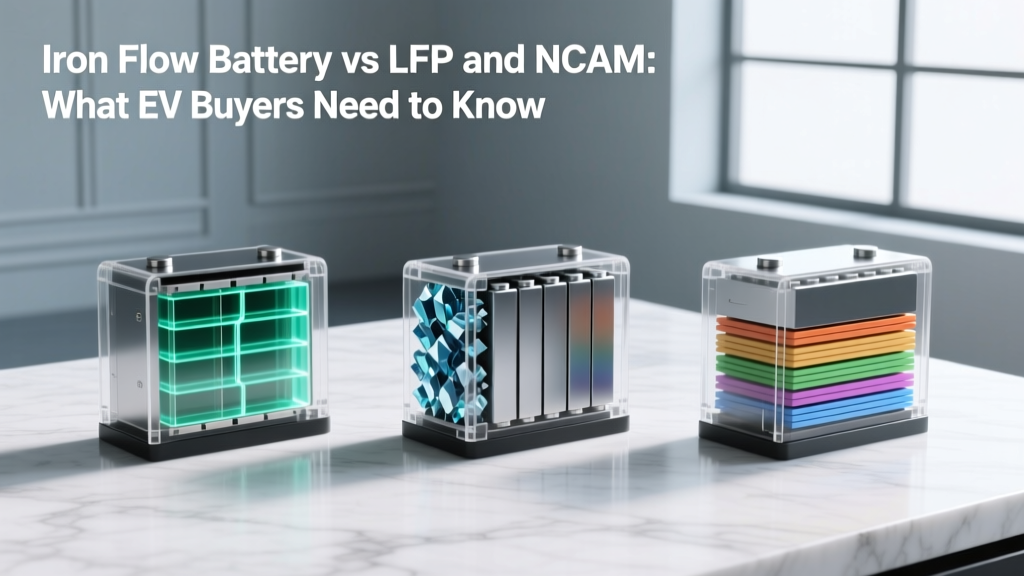
When you're researching an electric vehicle, the traction battery pack is the single most expensive component in the car — and the one most buyers understand the least. Automakers use different types of automotive batteries depending on the vehicle's price point, intended range, and performance targets. In 2026, two dominant lithium-ion chemistries define the market: LFP (lithium iron phosphate) and NMC/NCA (nickel manganese cobalt / nickel cobalt aluminum). Each has distinct trade-offs in energy density, cycle life, cold-weather performance, and cost.
This guide breaks down exactly what's inside modern EV battery packs, how long they realistically last, what warranties cover, and what emerging technologies like solid-state cells might change down the road.
Why Battery Chemistry Matters More Than Battery Size
A battery's capacity is measured in kWh (kilowatt-hours) — the total energy it stores. But two EVs with the same kWh pack can deliver vastly different real-world range, charging speeds, and long-term durability depending on the chemistry inside those cells.
Chemistry determines:
- Energy density: How much energy fits in a given weight and volume — directly affects range and vehicle weight.
- Cycle life: How many full charge-discharge cycles the pack tolerates before significant degradation.
- Thermal stability: How well the cells handle heat (from fast charging) and cold (from winter driving).
- Cost per kWh: Raw material costs vary dramatically — cobalt is expensive and supply-constrained; iron and phosphate are cheap and abundant.
Most mainstream EVs in 2026 use one of two chemistries. Here's how they stack up.
LFP vs NMC/NCA: Chemistry Comparison
| Attribute | LFP (Lithium Iron Phosphate) | NMC / NCA (Nickel-Based) |
|---|---|---|
| Energy density | ~160–180 Wh/kg (lower) | ~220–300 Wh/kg (higher) |
| Typical cycle life | 3,000–5,000+ cycles | 1,000–2,000 cycles |
| Cold-weather performance | Weaker — greater range loss below 32°F | Better — less range loss in cold |
| Fast-charge tolerance | Good — handles frequent DCFC well | Moderate — repeated 250+ kW sessions accelerate wear |
| Cost per kWh (cell level) | ~$70–90/kWh | ~$100–140/kWh |
| Cobalt content | None | Yes (NMC) / minimal (NCA) |
| Recommended daily SoC | 100% is fine | 80% preferred for daily use |
| Common in (2026 examples) | Tesla Model 3/Y RWD, Ford Mustang Mach-E Select (LFP trims), BYD models | Tesla Long Range/Performance, Hyundai Ioniq 5/6, Kia EV6/EV9, Rivian R1T/R1S, BMW iX |
The bottom line: If you prioritize maximum range and don't mind charging to 80% daily, NMC delivers more miles per pound. If you want a battery that tolerates daily 100% charges, frequent DC fast charging, and will likely outlast the vehicle itself, LFP is the durability king. Neither is universally "better" — the right choice depends on your driving pattern.
How Long Do EV Batteries Actually Last?
The most persistent myth in EV ownership is that batteries need replacement every few years like a phone battery. The data says otherwise.
Real-world fleet data collected by Recurrent Auto, which tracks over 15,000 EVs in daily use, shows that most modern EV battery packs lose between 5% and 12% of their original capacity over the first 100,000 miles. Degradation is steepest in the first 1–2 years (roughly 2–5% loss), then flattens into a slow, linear decline.
Typical EV Battery Degradation Curve
| Vehicle Age / Mileage | Average Capacity Retained (NMC) | Average Capacity Retained (LFP) |
|---|---|---|
| Year 1 / ~12,000 mi | 95–97% | 97–99% |
| Year 3 / ~36,000 mi | 90–94% | 94–97% |
| Year 5 / ~60,000 mi | 87–92% | 92–96% |
| Year 8 / ~100,000 mi | 82–90% | 88–94% |
| Year 10 / ~120,000 mi | 78–88% | 86–92% |
Sources: Recurrent Auto fleet data, Geotab battery health studies. Individual results vary with climate, charging habits, and thermal management quality.
For context, an EV with an EPA-rated 310-mile range and 88% capacity retention still delivers roughly 273 miles — more than adequate for daily driving and road trips. The vast majority of EV batteries in 2026 models are engineered to outlast the vehicle's useful economic life. Full pack replacements due to age-related degradation are rare; most warranty claims involve manufacturing defects in individual cell groups, not wholesale wear-out.
What the Battery Warranty Actually Covers
Federal law mandates that EV battery warranties cover a minimum of 8 years or 100,000 miles (whichever comes first) in most states. In California Air Resources Board (CARB) states — including California, New York, Massachusetts, and others — the mandate extends to 10 years or 150,000 miles.
However, the warranty doesn't cover all capacity loss. Every manufacturer sets a capacity retention threshold — typically between 60% and 70% — below which they'll repair or replace the pack.
2026 EV Battery Warranty Comparison
| Manufacturer | Warranty Period | Capacity Threshold | Notes |
|---|---|---|---|
| Tesla (Model 3/Y) | 8 yr / 100,000 mi (RWD) or 120,000 mi (Long Range) | 70% | Transferrable to subsequent owners |
| Hyundai / Kia (Ioniq 5, EV6, EV9) | 10 yr / 100,000 mi | 70% | Among the longest in the industry |
| Ford (Mach-E, F-150 Lightning) | 8 yr / 100,000 mi | 70% | Covers battery components and capacity |
| GM (Blazer EV, Equinox EV, Silverado EV) | 8 yr / 100,000 mi | 70% (some Ultium models 60%) | Verify threshold by specific model |
| BMW (iX, i4, i7) | 8 yr / 100,000 mi | 70% | Includes battery conditioning system |
| Rivian (R1T, R1S) | 8 yr / 175,000 mi | 70% | Higher mileage cap reflects truck use case |
Key distinction: A battery at 69% capacity has lost nearly a third of its original range — that's a meaningful hit. But hitting that threshold within 8 years is statistically uncommon for liquid-cooled packs in mainstream EVs. Most degradation-related warranty claims involve defective modules, not normal wear.
EV Battery Replacement Cost: What You'd Actually Pay
If your battery does fail outside of warranty — or you're buying an older used EV and budgeting for a worst case — here's what replacement looks like in 2026:
Estimated EV Battery Replacement Costs (2026)
| Vehicle / Pack Size | Battery Capacity | Estimated Parts Cost | Estimated Labor | Total Range |
|---|---|---|---|---|
| Tesla Model 3 RWD | ~60 kWh (LFP) | $6,000–$8,500 | $1,500–$2,500 | $7,500–$11,000 |
| Tesla Model Y Long Range | ~82 kWh (NMC) | $10,000–$14,000 | $2,000–$3,000 | $12,000–$17,000 |
| Hyundai Ioniq 5 | ~77.4 kWh (NMC) | $9,000–$13,000 | $2,000–$3,500 | $11,000–$16,500 |
| Ford F-150 Lightning (Extended) | ~131 kWh (NMC) | $15,000–$22,000 | $3,000–$5,000 | $18,000–$27,000 |
| Chevrolet Bolt EV/EUV (legacy) | ~65 kWh (NMC) | $7,000–$10,000 | $2,000–$3,000 | $9,000–$13,000 |
Costs are estimates based on 2025–2026 parts pricing and independent shop labor rates. OEM dealer costs may be higher. Cell-level prices have dropped ~40% since 2022, reducing out-of-pocket replacement costs.
The important context: most EV batteries never need full replacement. When issues do arise, many shops (and OEMs) can replace individual modules rather than the entire pack — a $1,500–$4,000 repair rather than a five-figure job. Full pack replacements are typically needed only after severe physical damage, coolant intrusion, or manufacturing defects affecting multiple cell groups.
Factors That Accelerate (or Preserve) Battery Life
Not all miles are equal when it comes to battery wear. Here's what actually moves the degradation needle:
Battery Health Checklist
- DC fast charging frequency: Occasional DCFC (1–2 times per week) is fine. Daily 350 kW sessions on an NMC pack without preconditioning will accelerate degradation. LFP packs handle frequent DCFC better due to stronger thermal stability.
- State of charge (SoC) habits: For NMC batteries, keeping daily SoC between 20–80% minimizes stress. For LFP, charging to 100% regularly is recommended — LFP's flat voltage curve means the BMS needs full charges to calibrate accurately.
- Extreme temperatures: Sustained exposure to ambient heat above 95°F is more damaging than cold. Always precondition the battery before fast charging in cold weather — this warms the cells and prevents lithium plating.
- Storage at high SoC: Parking an NMC vehicle at 100% SoC for weeks in hot weather is one of the most damaging things you can do. Store at 50–60% if the car will sit unused.
- Regenerative braking settings: Aggressive regen in cold weather can stress cells that haven't warmed up. Many EVs automatically limit regen when the battery is cold — don't override this.
How to Monitor Your Battery's State of Health (SoH)
State of Health (SoH) is the percentage of original capacity your battery retains. A brand-new pack is 100% SoH; a pack that has degraded to hold only 85 of its original 100 kWh is at 85% SoH.
Here's how to check it:
- In-vehicle displays: Tesla's app (under Battery Health), Hyundai/Kia's EV settings menu, and BMW's iDrive system show estimated SoH or remaining capacity. Not all brands surface this natively.
- OBD-II diagnostic tools: Devices like the OBDLink SX or Carista adapter, paired with apps such as Leaf Spy (Nissan) or Scan My Tesla, can read detailed battery telemetry — individual cell voltages, pack temperature, and precise SoH percentage.
- Third-party services: Companies like Recurrent offer battery health reports based on connected-car data, which can be useful when buying a used EV.
- Dealer diagnostic: Any authorized service center can run a full battery health scan. Request one during routine service, especially before a warranty expires.
If you're buying a used EV, always verify SoH before purchase. A vehicle at 90% SoH with 40,000 miles is in excellent shape; one at 78% SoH with 60,000 miles may indicate abusive charging habits or a defective module.
Emerging Battery Technology: What's Coming (and When)
Two technologies are frequently cited as the next leap in EV batteries. Here's where they actually stand:
Solid-State Batteries
Solid-state cells replace the liquid electrolyte with a solid material (ceramic, sulfide, or polymer), offering higher energy density (potentially 400+ Wh/kg), faster charging, and improved safety. Toyota has announced a solid-state EV pilot for 2027–2028, and Samsung SDI and QuantumScape are shipping prototype cells to automakers. However, manufacturing yield, cost, and scalability remain significant hurdles. Realistic mass-market availability: 2029–2032, initially in premium vehicles.
Silicon Anode Cells
Replacing graphite anodes with silicon can boost energy density by 20–40%. Companies like Sila Nanotechnologies and Group14 are already supplying silicon-dominant anode materials to battery manufacturers. Expect to see this in production EVs by 2027–2028, primarily as incremental range improvements in existing NMC platforms rather than entirely new vehicle architectures.
Neither technology is available in a production vehicle you can buy today. Any claims otherwise refer to limited pilots or concept demonstrations. For a 2026 purchase, LFP and NMC remain your choices — and both are mature, well-understood chemistries with extensive real-world track records.
Frequently Asked Questions
How long do EV batteries last in years and miles?
Based on fleet data from Recurrent Auto and Geotab, most modern liquid-cooled EV batteries retain 80–90% of their original capacity at 100,000 miles (roughly 8 years of average driving). Many will outlast the vehicle itself, reaching 150,000–200,000 miles before capacity drops below 70%. LFP chemistries generally outlast NMC by a significant margin in cycle life.
How much does it cost to replace an EV battery?
Full pack replacement in 2026 ranges from approximately $7,500 for a smaller LFP pack (Tesla Model 3 RWD) to $27,000 for a large NMC pack (F-150 Lightning Extended Range). However, most repairs involve individual module replacement at $1,500–$4,000. Full replacements are uncommon and typically covered under the 8-year/100,000-mile warranty.
What does the EV battery warranty cover?
Federal law requires a minimum 8-year/100,000-mile warranty on EV batteries (10 years/150,000 miles in CARB states). The warranty covers manufacturing defects and capacity loss below a specified threshold — usually 70% of original capacity. It does not cover damage from accidents, modifications, or neglect (such as failing to maintain coolant levels).
LFP vs NMC — which battery type is better for me?
Choose LFP if you want maximum longevity, plan to charge to 100% daily, frequently use DC fast chargers, or live in a moderate climate. Choose NMC if you need maximum range per charge, regularly drive in cold weather, or prioritize performance. Both chemistries are reliable — the right choice depends on your usage pattern, not an absolute quality ranking.
How do I maximize my EV battery's health?
For NMC packs: keep daily SoC between 20–80%, precondition before fast charging, avoid parking at 100% SoC in heat, and limit consecutive 350 kW DCFC sessions. For LFP packs: charge to 100% regularly (the BMS needs it for calibration), and don't worry as much about DCFC frequency. For both: use Level 2 home charging as your primary method, keep the thermal management system maintained, and avoid storing the vehicle at extreme SoC levels for extended periods.
Does fast charging damage the battery?
Moderate DC fast charging (1–3 sessions per week at 150–250 kW) causes negligible additional degradation in modern liquid-cooled packs. The risk increases with daily use of ultra-fast (350 kW+) chargers on NMC packs, especially without battery preconditioning. LFP packs tolerate frequent fast charging better. For daily use, Level 2 home charging (7–11 kW) remains the gentler and more economical option.