Equinox EV Battery Size and Specs at a Glance
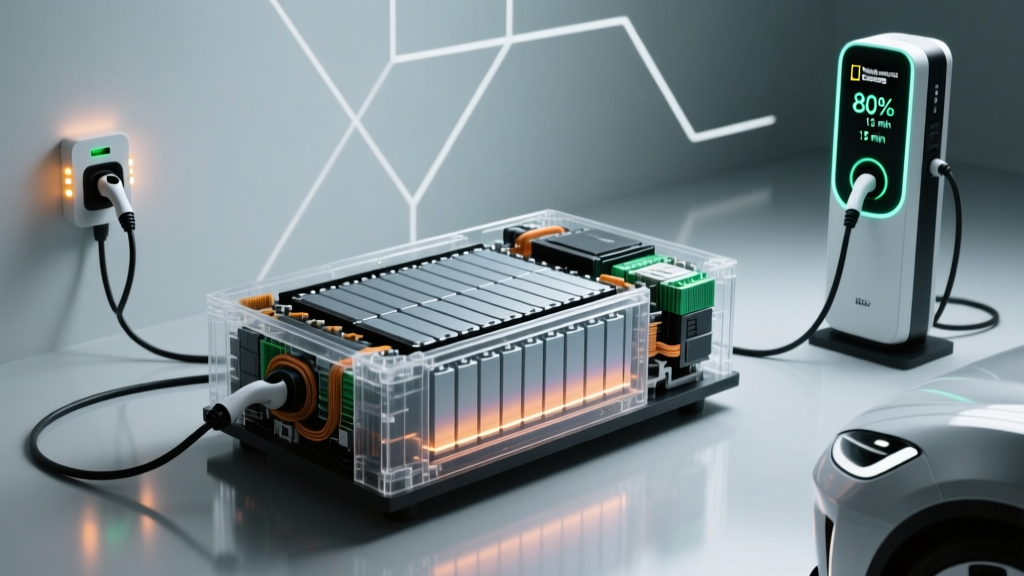
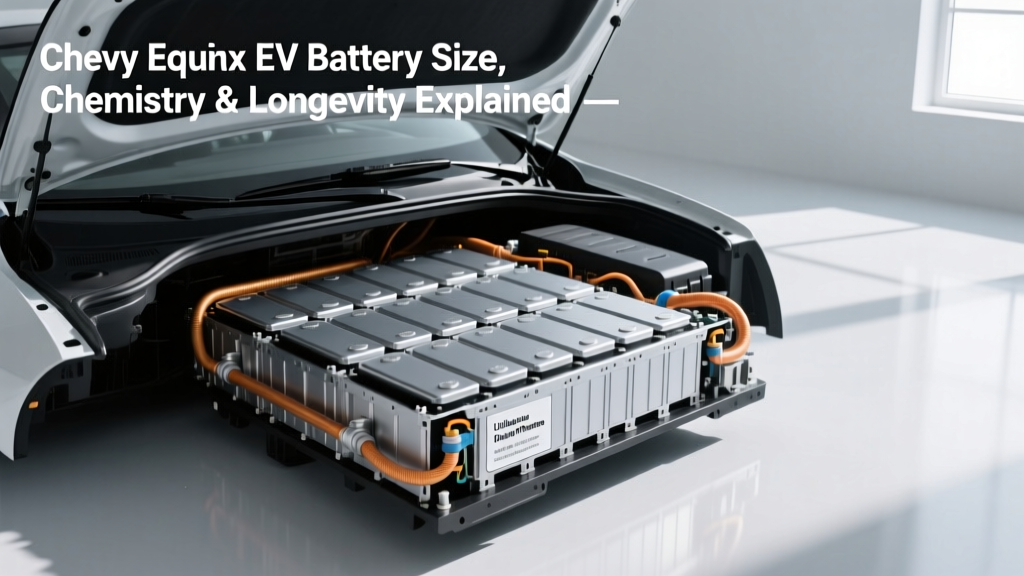
The Chevrolet Equinox EV rides on GM's Ultium platform and uses a single battery pack across all trims for the current model generation. If you're researching the Equinox EV battery size, here are the exact figures you need before we get into chemistry, degradation, and long-term ownership costs.
| Specification | Value |
|---|---|
| Usable Battery Capacity | ~85 kWh |
| Gross Battery Capacity | ~89 kWh (estimated, includes buffer) |
| Cell Chemistry | NMC (Nickel Manganese Cobalt) — Ultium pouch cells |
| Cell Format | Large-format pouch |
| EPA Range (FWD, LT trim) | 319 miles |
| EPA Range (AWD / RS trim) | 285–307 miles |
| Max DC Fast Charge Rate | 150 kW (peak) |
| 10–80% DC Fast Charge Time | ~30 minutes (estimated) |
| Level 2 AC Charge Rate | 11.5 kW (onboard charger) |
| Battery/Powertrain Warranty | 8 years / 100,000 miles |
| Battery Cooling | Active liquid thermal management |
The 85 kWh usable capacity places the Equinox EV in the mid-pack among compact electric crossovers — slightly smaller than the Hyundai Ioniq 5's 84 kWh pack (comparable) but considerably larger than the base Tesla Model Y's ~75 kWh. GM reserves roughly 4 kWh as a top-and-bottom buffer to protect against over-charge and deep-discharge degradation, which is standard practice across the industry.
NMC Chemistry in the Equinox EV: Why GM Chose It
The Equinox EV uses NMC (Nickel Manganese Cobalt) lithium-ion pouch cells manufactured through GM's Ultium Cells joint venture with LG Energy Solution. Understanding why GM selected NMC — and how it compares to the other dominant chemistry, LFP — is essential for evaluating long-term battery health.
NMC vs LFP: The Trade-Off Matrix
| Attribute | NMC (Equinox EV) | LFP (e.g., Tesla Model 3 RWD, base Ford Mustang Mach-E Select) |
|---|---|---|
| Energy Density | Higher — more kWh per kg, enabling 319 mi in a compact crossover | Lower — requires larger/heavier pack for equivalent range |
| Cost per kWh | Higher (cobalt and nickel add material cost) | Lower — no cobalt, cheaper raw materials |
| Cycle Life | ~1,000–1,500 full cycles before significant degradation | ~2,000–3,000+ full cycles |
| Cold-Weather Performance | Better low-temp discharge and charge acceptance | Reduced charge rate and range in freezing temps |
| Recommended Charge Habit | Daily charge to 80%; 100% only for road trips | GM and Tesla recommend charging to 100% regularly |
| State of Charge Estimation | Relatively straightforward (voltage curve is sloped) | Flat voltage curve makes SoC estimation less precise |
| Thermal Runaway Risk | Slightly higher (mitigated by active cooling) | Lower — inherently more stable chemistry |
Why NMC for the Equinox EV? GM needed high energy density to deliver over 300 miles of range in a vehicle with a base MSRP under $35,000 (before incentives). LFP's lower energy density would have required either a heavier pack (hurting efficiency and handling) or reduced range. NMC strikes the balance for a mainstream crossover where buyers expect both range and price competitiveness.
The trade-off is that NMC cells degrade slightly faster than LFP over thousands of cycles and require the owner to avoid routinely charging to 100% for daily use. More on care habits below.
How Long Do EV Batteries Last? Degradation Data
This is the question every prospective EV buyer asks. The data is now robust enough to answer with real numbers rather than speculation.
- Year 1 / 15,000 miles: ~2–4% capacity loss (initial "break-in" drop)
- Year 3 / 45,000 miles: ~5–8% total loss
- Year 5 / 75,000 miles: ~8–12% total loss
- Year 8 / 100,000 miles: ~10–15% total loss
- Year 10 / 150,000 miles: ~12–20% total loss (highly variable based on care)
Sources: Recurrent Auto battery degradation studies, Geotab fleet data analysis, and GM's own warranty threshold.
For the Equinox EV's 85 kWh usable pack, a 10% loss at 100,000 miles means you'd have roughly 76.5 kWh usable — translating to approximately 287 miles of EPA-equivalent range instead of 319. That's still very livable for daily driving.
The degradation curve is not linear. Most NMC packs experience a steeper drop in the first 10,000–20,000 miles as the solid electrolyte interphase (SEI) layer stabilizes on the anode, then settle into a slow, near-linear decline. According to Recurrent Auto's battery longevity research, the majority of modern liquid-cooled EV batteries retain well above 90% capacity at 50,000 miles.
What Kills Batteries Early
Outlier degradation (20%+ before 100,000 miles) is almost always linked to:
- Frequent DC fast charging to 100%: High charge rates at high SoC generate heat and lithium plating on the anode.
- Consistent storage at 100% SoC: Sitting fully charged for days accelerates calendar aging, especially in hot climates.
- Deep discharge to 0%: Dropping below the buffer risks copper dissolution on the anode current collector.
- Extreme heat exposure: Sustained ambient temperatures above 95°F combined with high SoC are the worst-case scenario for calendar degradation.
Equinox EV Battery Warranty: What's Covered
GM provides one of the more straightforward battery warranties in the segment. Here are the exact terms:
| Term | Detail |
|---|---|
| Duration | 8 years / 100,000 miles (whichever comes first) |
| Capacity Retention Threshold | 70% of original capacity (approximately 59.5 kWh usable) |
| Coverage Type | Defects and excessive capacity loss below threshold |
| Remedy | Repair, replacement, or recalibration at GM's discretion |
| Transferability | Yes — transfers to subsequent owners automatically |
| Exclusions | Damage from accidents, flooding, improper modifications, or unauthorized charging equipment |
The 70% threshold is an industry-standard number, matching what Tesla, Ford, Hyundai, and most other manufacturers offer. In practical terms, GM is warranting that your Equinox EV will retain at least ~223 miles of EPA range (70% of 319) over the warranty period. Real-world fleet data suggests the vast majority of liquid-cooled NMC packs will never dip below this threshold under normal use — the warranty is protection against manufacturing defects, not a prediction of typical performance.
Federal law under the EPA's emissions warranty provisions also requires that battery packs on EVs sold in CARB-adopting states carry a 10-year/150,000-mile warranty on the emissions-related components. Check your state's specific requirements through your local DMV or the IRS §30D guidance for compliance details.
Battery Replacement Cost: What to Budget (and When)
Here's where honesty matters. Most EV batteries will outlast the vehicle they're installed in. But if you're planning a 15-year ownership horizon or buying used, replacement cost is a legitimate factor.
| Scenario | Estimated Cost (Parts + Labor) | Likelihood |
|---|---|---|
| Full pack replacement (out of warranty) | $14,000 – $20,000 | Very low — most packs don't need full replacement |
| Module-level repair (1–2 bad modules) | $2,500 – $6,000 | Low — Ultium's modular design allows partial repair |
| BMS (Battery Management System) replacement | $1,500 – $3,000 | Rare |
| Coolant system repair (leak, pump failure) | $800 – $2,500 | Uncommon but possible over 10+ years |
GM's Ultium platform is designed with serviceability in mind. Unlike early EV packs that required full-unit replacement for a single bad cell, the Ultium pack is organized into modules that can be individually diagnosed and swapped. This means a single degraded or defective module can be replaced for a fraction of the full-pack cost.
For context, the average age of a vehicle scrapped in the US is roughly 12 years. At that age with normal mileage (~150,000–180,000 miles), an NMC pack will likely retain 75–85% of its original capacity — still well above the warranty threshold. Full replacement is a worst-case scenario, not an expected ownership cost.
How to Maximize Equinox EV Battery Health
NMC chemistry rewards consistent, moderate habits. Here's a practical care framework based on battery-science fundamentals:
- Daily charge limit: 80%. Use the myChevrolet app or infotainment system to set a charge limit. Reserve 100% for road-trip departure mornings.
- Avoid sitting at 100%. If you charge to full, drive within a few hours. Don't leave the car at 100% SoC overnight in summer heat.
- Don't let it sit at 0%. If you're approaching empty, charge soon. Extended storage near 0% risks anode copper dissolution.
- Use DC fast charging strategically. For road trips, it's fine. For daily charging, Level 2 at home (11.5 kW) is gentler on the cells. The Equinox EV's 150 kW peak rate is moderate by current standards, which helps limit heat generation.
- Precondition before fast charging. Use the EV routing feature in navigation to precondition the battery before arriving at a DC fast charger. A warm battery charges faster and with less stress.
- Park in shade or a garage when possible. Sustained heat is the single biggest enemy of long-term calendar aging. A garage in Arizona will add years to your pack.
- Don't obsess over it. Modern BMS systems actively manage cell balancing, thermal regulation, and charge limits. Follow the basics and let the engineering do the rest.
Monitoring State of Health (SoH)
The Equinox EV does not expose a direct SoH percentage through the dashboard like some competitors (Hyundai's Bluelink, for example, provides a battery health readout). Here's how to monitor your pack:
- myChevrolet app: Check for any battery-related diagnostic alerts or service notifications.
- OBD-II diagnostic tools: Third-party apps like Car Scanner or ABRP OBD can read battery cell voltage deltas and estimated SoH from the BMS via the OBD-II port.
- Dealer diagnostic scan: During routine service, ask your Chevy dealer to run a battery health report. They can pull cell-level voltage data and compare it to baseline.
- Range tracking: The simplest method — track your full-charge range estimate over time. A drop from 319 to 290 miles over 40,000 miles is roughly 9% degradation, which is normal.
Factors That Accelerate Degradation (The Science)
Understanding why batteries degrade helps you make better charging decisions.
Calendar aging occurs even when the car isn't driven. The electrolyte slowly reacts with electrode surfaces, thickening the SEI layer and consuming active lithium. This process accelerates at high SoC and high temperature. A car stored at 100% SoC in a 100°F garage will lose more capacity in a year than one stored at 50% in a climate-controlled space — even with zero miles driven.
Cycle aging is wear from charge-discharge cycles. Each full cycle (0–100–0%) causes micro-cracking in the NMC cathode particles and gradual loss of lithium inventory. Partial cycles (e.g., 30–80%) are far less stressful — roughly 3–4x less wear per kWh cycled compared to full-depth cycles.
Fast charging heat: At 150 kW, the Equinox EV's pack generates significant internal heat. The liquid cooling system works to manage this, but repeated high-rate charging pushes cell temperatures higher than slow Level 2 charging, accelerating SEI growth. The effect is measurable but not catastrophic — data from Geotab's fleet battery study shows that vehicles fast-charging frequently lose roughly 1–3% more capacity over 3 years compared to those primarily using Level 2.
Cold charging without preconditioning: Charging an NMC pack below freezing without warming it first can cause lithium metal to plate onto the anode surface instead of intercalating into it. This is irreversible capacity loss. The Equinox EV's thermal management system mitigates this, but it's still wise to precondition in winter before any DC fast-charge session.
What's Next: Solid-State and Silicon Anode Batteries
If you're timing a purchase, you've likely heard about next-generation battery technologies. Here's where they actually stand as of 2026:
Silicon-dominant anodes are already entering production in limited applications (GM has signaled partnerships with startups in this space). Replacing graphite anodes with silicon can boost energy density by 20–40%, meaning the same physical pack could store more kWh. Expect this to appear in GM vehicles within the 2027–2029 timeframe, likely in premium models first.
Solid-state batteries replace the liquid electrolyte with a solid ceramic, polymer, or sulfide material. The promise is higher energy density, faster charging, and improved safety (no flammable electrolyte). Toyota, Samsung SDI, and QuantumScape have all announced pilot production, but no solid-state EV battery is currently available in any production vehicle sold in the US. Realistic mass-market availability is 2029–2032 at the earliest, and initial costs will be premium.
The practical takeaway: the NMC pack in today's Equinox EV is mature, well-understood technology with proven longevity data. Waiting for solid-state means waiting at least 3–5 years for vehicles that will carry a significant price premium initially.
Frequently Asked Questions
What is the exact Equinox EV battery size?
The Chevrolet Equinox EV has approximately 85 kWh of usable battery capacity (roughly 89 kWh gross, with a ~4 kWh top-and-bottom buffer). This is an NMC lithium-ion pack built on GM's Ultium platform using large-format pouch cells.
How long will the Equinox EV battery last?
Based on industry degradation data for liquid-cooled NMC packs, expect 85–90% capacity retention at 100,000 miles (roughly 6–8 years of average driving). Most packs will remain above the 70% warranty threshold well beyond 150,000 miles. The battery is likely to outlast the vehicle itself.
How much does it cost to replace the Equinox EV battery?
A full out-of-warranty pack replacement is estimated at $14,000–$20,000, but this scenario is extremely rare. The Ultium platform supports module-level repair, where a single faulty module can be replaced for $2,500–$6,000. Under the 8-year/100,000-mile warranty, excessive degradation below 70% capacity is covered at no cost.
Should I charge the Equinox EV to 100% every day?
No. NMC chemistry lasts longest when kept between roughly 20% and 80% for daily use. Set your charge limit to 80% through the myChevrolet app or vehicle settings. Charge to 100% only when you need the full range for a long trip, and try to depart shortly after reaching full charge rather than letting it sit.
Does the Equinox EV use LFP or NMC batteries?
The Equinox EV uses NMC (Nickel Manganese Cobalt) chemistry in Ultium pouch cells. NMC offers higher energy density than LFP, which is how GM achieves 319 miles of EPA range in a compact crossover at this price point. The trade-off is slightly fewer lifecycle cycles and a recommendation to avoid daily 100% charges.
Is the Equinox EV battery covered under the federal tax credit?
The Equinox EV has qualified for varying amounts of the IRS §30D Clean Vehicle Credit depending on model year and battery-sourcing requirements. Eligibility depends on your income (AGI caps: $150K single / $300K joint), the vehicle's MSRP (must be under $80,000 for SUVs), and critical-mineral/battery-component sourcing rules that tighten annually. The credit can be transferred to the dealer as a point-of-sale discount. Always verify current eligibility on IRS.gov or with a tax professional before purchasing.
Can I check my Equinox EV's battery health myself?
GM does not provide a direct State of Health percentage on the dashboard. You can estimate degradation by tracking your full-charge range over time, use a third-party OBD-II scanner app to read BMS data, or request a battery health report from your Chevy dealer during service visits.