The single biggest financial question in EV ownership isn't range or charging speed—it's whether the high-voltage traction battery will outlast the car. After a decade of real-world EV ownership, teardown data, and manufacturer warranty claims, the answer is increasingly clear: modern lithium-ion traction packs routinely exceed 150,000 miles with manageable degradation. But "manageable" depends heavily on chemistry, climate, and how you charge.
This guide covers the data behind electric vehicle battery life, the chemistry trade-offs between LFP and NMC/NCA cells, what warranties actually cover, what a replacement costs if you need one, and the daily habits that preserve capacity over a decade or more.
LFP vs NMC/NCA: The Chemistry That Defines Your Battery's Lifespan
Not all EV batteries are built the same. The cathode chemistry determines energy density, cycle life, cold-weather performance, and ultimately how many years the pack will serve before meaningful degradation. In 2026, two chemistries dominate the US market:
- NMC (Nickel Manganese Cobalt) / NCA (Nickel Cobalt Aluminum): Higher energy density, better cold-weather range retention, used in most long-range and performance models (Tesla Model 3 Long Range, Hyundai Ioniq 5, Ford Mustang Mach-E Extended Range).
- LFP (Lithium Iron Phosphate): Lower energy density but significantly longer cycle life, no cobalt, lower cost, and can be charged to 100% daily without accelerated degradation. Used in Tesla Model 3/Y Standard Range, base Ford Mustang Mach-E, and several Chinese-market imports.
| Attribute | LFP (Lithium Iron Phosphate) | NMC / NCA |
|---|---|---|
| Energy Density | ~160-180 Wh/kg (lower) | ~220-260 Wh/kg (higher) |
| Cycle Life | 3,000-5,000+ cycles | 1,000-2,000 cycles |
| Daily Charging to 100% | Recommended by manufacturers | Not recommended; 80% daily limit advised |
| Cold-Weather Performance | Moderate; more range loss below 32°F | Better low-temp conductivity |
| Cost per kWh | ~$80-100 (lower) | ~$110-140 (higher) |
| Typical Degradation at 100K mi | ~5-8% | ~8-12% |
| Common Applications | Standard-range / fleet vehicles | Long-range / performance models |
Which is better? For daily commuters who can charge at home and don't need maximum range, LFP is the longevity winner—Tesla explicitly tells LFP owners to charge to 100% at least weekly to keep the BMS calibrated. For road-trippers, cold-climate drivers, or anyone prioritizing maximum EPA range in a single charge, NMC/NCA remains the practical choice. Neither chemistry is universally superior; the right answer depends on your driving pattern.
How Long Do EV Batteries Actually Last?
The short answer: far longer than most buyers expect. Data aggregated from Tesla's 2025 Impact Report, Geotab's fleet battery study of over 10,000 EVs, and Recurrent Auto's analysis of 15,000+ vehicles consistently shows that modern EV batteries retain 85-92% of original capacity at the 100,000-mile mark. Catastrophic failure (sudden cell death requiring full replacement) remains rare—under 1.5% of vehicles in these datasets.
Typical Degradation Curve (NMC/NCA, Moderate Climate):
- Year 1 (0-15K mi): 2-4% loss — initial formation period, steepest part of the curve
- Years 2-4 (15K-60K mi): Gradual linear decline, ~1-2% per year
- Years 5-8 (60K-120K mi): Continued slow decline; most packs at 85-90% State of Health
- Years 9-12 (120K-180K+ mi): Packs reaching 78-85% SoH; still functional but reduced range
LFP packs typically track 3-5 percentage points higher across this timeline. Cold-climate and frequent DC fast-charging use cases may see 2-4% additional loss.
The critical insight: degradation is non-linear. Most capacity loss occurs in the first 20,000-30,000 miles as the solid electrolyte interphase (SEI) layer forms on the anode. After that, the curve flattens considerably. A battery that has lost 5% in its first year hasn't "used up" a quarter of its life—it's entering its stable phase.
What the Battery Warranty Actually Covers
Federal law mandates a minimum 8-year/100,000-mile warranty on EV battery packs for emissions-related components, and most manufacturers exceed this for the traction battery specifically. But the fine print matters enormously. Warranties cover defects and excessive degradation—not normal wear that stays above the retention threshold.
| Manufacturer | Warranty Period | Mileage Cap | Capacity Retention Threshold |
|---|---|---|---|
| Tesla (Model 3/Y LFP) | 8 years | 120,000 mi | 70% |
| Tesla (Model S/X) | 8 years | 150,000 mi | 70% |
| Hyundai / Kia | 10 years | 100,000 mi | 70% |
| Ford (Mach-E / F-150 Lightning) | 8 years | 100,000 mi | 70% |
| GM (Ultium-based) | 8 years | 100,000 mi | 70% (60% on Bolt EV/EUV) |
| Rivian | 8 years | 175,000 mi (R1T/R1S) | 70% |
| BMW (i4/iX) | 8 years | 100,000 mi | 70% |
Key caveat: The 70% threshold means a battery that degrades to 71% capacity at 95,000 miles is functioning within warranty spec—even though you've lost nearly a third of your original range. This is why understanding your real-world range needs at purchase matters. A 300-mile EPA vehicle at 70% retention gives you 210 miles—still livable for most commutes, but a meaningful reduction for road-trippers.
According to fueleconomy.gov, battery degradation claims should be documented through dealer diagnostic scans that read the BMS-reported State of Health. Keep records of these scans if you plan to file a warranty claim.
EV Battery Replacement Cost: What You'd Actually Pay
This is where fear-mongering runs rampant, so let's anchor the numbers in reality. Full battery replacement is uncommon—most EVs are retired or sold before the pack fails entirely. But if you're buying a used EV out of warranty or plan to keep a vehicle past 200,000 miles, here's the current landscape:
| Vehicle / Battery Size | Battery Capacity | Estimated Replacement Cost | Notes |
|---|---|---|---|
| Tesla Model 3 Standard Range | ~60 kWh (LFP) | $8,000 - $12,000 | LFP packs cheaper; module-level repair often possible |
| Tesla Model Y Long Range | ~75 kWh (NMC) | $12,000 - $16,000 | Structural pack; full replacement typical |
| Hyundai Ioniq 5 | 77.4 kWh (NMC) | $14,000 - $18,000 | E-GMP platform; module replacement emerging |
| Ford F-150 Lightning Extended | ~131 kWh (NMC) | $20,000 - $28,000 | Largest consumer pack; highest cost |
| Chevrolet Equinox EV | ~85 kWh (NMC Ultium) | $12,000 - $16,000 | Ultium modular design allows partial replacement |
| Nissan LEAF (40/62 kWh) | 40-62 kWh | $6,500 - $9,000 | Older platform; air-cooled; widely available refurbished packs |
When is replacement typically needed? In practice, very few owners pay for a full pack replacement. The scenarios where it happens:
- Catastrophic cell failure (rare, usually covered by warranty if within period)
- High-mileage fleet vehicles past 200,000+ miles where degraded range becomes operationally unviable
- Used-EV buyers who purchased a vehicle with a heavily degraded pack and want to restore range
An emerging alternative is module-level replacement. Packs like GM's Ultium and Hyundai's E-GMP use modular cell groups. If one module degrades disproportionately, a specialist can replace just that module for $2,000-$5,000 rather than swapping the entire pack. This is becoming standard practice at independent EV shops.
Five Factors That Accelerate (or Preserve) Battery Life
Battery degradation isn't just a function of time—it's driven by how you treat the cells. Here are the five highest-impact factors, ranked by effect size based on fleet data from Geotab and Recurrent:
1. State of Charge Habits (Highest Impact)
- Keeping an NMC/NCA battery between 20-80% SoC for daily use reduces degradation by an estimated 30-40% compared to regular 100% charges.
- LFP batteries are the exception: manufacturers recommend periodic 100% charges for BMS calibration.
- Avoid leaving any EV at 100% SoC for extended periods (days), especially in heat.
2. DC Fast-Charging Frequency
- Occasional DC fast charging (1-2x per week) shows negligible impact in current data.
- Exclusive DC fast charging (daily, no Level 2 access) correlates with 2-4% additional degradation over 100K miles.
- The real risk is thermal: fast charging in hot weather without adequate preconditioning stresses cells most.
3. Temperature Extremes
- Prolonged exposure to ambient temperatures above 95°F accelerates electrolyte decomposition.
- Sub-freezing temperatures cause temporary range loss (20-40% reduction at 20°F) but don't permanently damage cells unless you fast-charge a cold-soaked battery without preconditioning.
- Garage parking and thermal preconditioning are the most impactful mitigations.
4. Charge Speed and Preconditioning
- Always precondition before DC fast charging. Most EVs do this automatically when you navigate to a charger (Tesla, Rivian, Hyundai E-GMP vehicles).
- Preconditioning warms the cells to ~95-105°F, enabling faster charge acceptance and reducing lithium plating risk.
5. Depth of Discharge Cycles
- Shallow cycles (e.g., charging from 40-70%) are gentler than deep cycles (10-90%).
- If your commute uses 20% of the battery, charging back to 80% nightly is better than draining to 10% and charging to 90% every other day.
How to Check Your Battery's State of Health
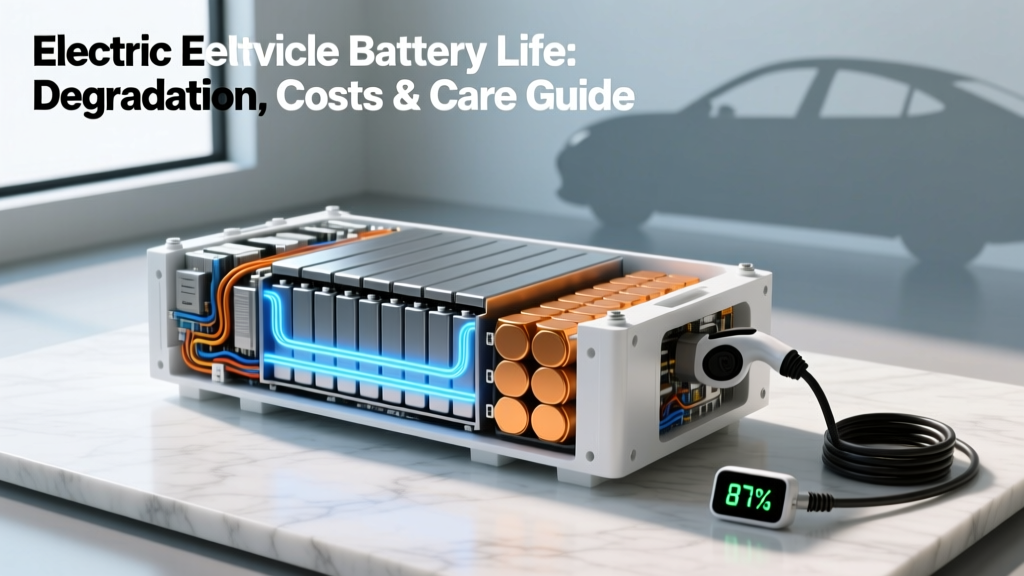
State of Health (SoH) is the percentage of original capacity your battery currently holds. A new battery is 100% SoH; a battery that held 75 kWh when new and now holds 66 kWh is at 88% SoH. Here's how to monitor it:
- In-vehicle BMS readout: Some vehicles (Tesla via the service menu, Hyundai/Kia via the infotainment diagnostic screen) display SoH directly. On Tesla, hold the software version text for 3 seconds to access the service menu.
- OBD-II diagnostic apps: Tools like LeafSpy (Nissan LEAF), OBDeleven (VW group), and Scan My Tesla read the BMS-reported SoH, cell voltage variance, and pack temperature via the OBD-II port.
- Dealer diagnostic scan: Any authorized dealer can pull a full battery health report. Request this during routine service visits and keep the printout for resale documentation.
- Third-party services: Companies like Recurrent Auto offer free battery health reports that compare your degradation to a fleet of identical vehicles—useful for understanding whether your pack is tracking normally.
What to watch for: Cell voltage variance (the spread between the highest and lowest cell group in the pack) is often a better early-warning indicator than overall SoH. A variance exceeding 100mV at rest suggests an imbalanced module that may need attention.
Solid-State and Silicon Anode: What's Next (and When)
Several next-generation battery technologies promise step-change improvements in energy density and longevity. Here's a realistic assessment of their availability:
- Solid-state batteries: Toyota, Samsung SDI, and QuantumScape have announced production timelines targeting 2027-2029 for initial vehicle integration. These promise 500+ mile ranges, 10-minute fast charging, and 10,000+ cycle life. However, manufacturing scale-up remains the unresolved challenge. Status: announced/preliminary; not available in any production vehicle as of 2026.
- Silicon-dominant anodes: Companies like Sila Nanotechnologies and Group14 are replacing graphite anodes with silicon composites, boosting energy density 20-40%. Initial deployments are appearing in premium vehicles (Mercedes-Benz G-Class EV uses a silicon-anode pack from Sila). Status: early production; limited availability in select 2025-2026 models.
- Sodium-ion batteries: CATL and BYD have begun production of sodium-ion cells for lower-cost, shorter-range applications. These eliminate lithium and cobalt entirely but offer ~30% lower energy density. Status: production for Chinese-market vehicles; no US availability yet.
For buyers deciding today: current lithium-ion technology is mature, well-understood, and backed by extensive degradation data. Waiting for solid-state means a 3-5 year delay with no guarantee of pricing parity at launch.
Frequently Asked Questions
How long do EV batteries last in years and miles?
Most modern EV batteries retain 85-92% capacity at 100,000 miles and remain functional well past 150,000-200,000 miles. In calendar years, expect 12-15+ years of usable service before degradation makes the vehicle impractical for its intended use. LFP chemistry packs typically outlast NMC/NCA by 3-5 percentage points of capacity retention over the same period.
How much does it cost to replace an EV battery?
Full pack replacement ranges from approximately $6,500 for a Nissan LEAF to $20,000-$28,000 for a Ford F-150 Lightning Extended Range pack. Most mainstream vehicles (Tesla Model 3/Y, Hyundai Ioniq 5, Chevrolet Equinox EV) fall in the $10,000-$18,000 range including labor. However, full replacement is rarely needed—module-level repairs cost $2,000-$5,000 and are increasingly available at independent EV specialists.
What does the EV battery warranty actually cover?
Federal law requires a minimum 8-year/100,000-mile battery warranty. Most manufacturers warrant the pack against defects and degradation below 70% of original capacity for 8-10 years and 100,000-175,000 miles (varies by brand). The warranty does not cover normal degradation that stays above the threshold, damage from accidents or misuse, or capacity loss from exclusively using non-recommended charging methods.
Should I be worried about DC fast charging degrading my battery?
Occasional DC fast charging (a few times per week) has a minimal effect on modern battery packs with active thermal management. The data shows that exclusive reliance on DC fast charging—never using Level 2—adds roughly 2-4% degradation over 100,000 miles compared to primarily Level 2 charging. The bigger risk is fast-charging a cold-soaked battery without preconditioning, which can cause lithium plating. Always navigate to the charger through the vehicle's nav system to trigger automatic preconditioning.
Is LFP better than NMC for battery longevity?
For pure cycle life and longevity, yes—LFP cells are rated for 3,000-5,000+ cycles versus 1,000-2,000 for NMC/NCA, and LFP packs can be charged to 100% daily without accelerated degradation. The trade-offs are lower energy density (meaning less range for the same pack size) and reduced cold-weather performance. If you need maximum range or live in a cold climate, NMC/NCA remains the better fit. If you commute daily, charge at home, and prioritize a 15+ year battery lifespan, LFP is the longevity champion.
How do I maximize my EV battery's lifespan?
The five highest-impact practices: (1) Keep NMC/NCA daily charge limits at 80% and only charge to 100% for road trips; charge LFP to 100% regularly for BMS calibration. (2) Use Level 2 charging as your primary method. (3) Always precondition before DC fast charging. (4) Avoid leaving the vehicle at 100% SoC or below 10% SoC for extended periods. (5) Park in a garage or shaded area in hot climates to reduce thermal stress. Following these practices, fleet data suggests you can limit degradation to under 10% over 100,000 miles on most modern packs.