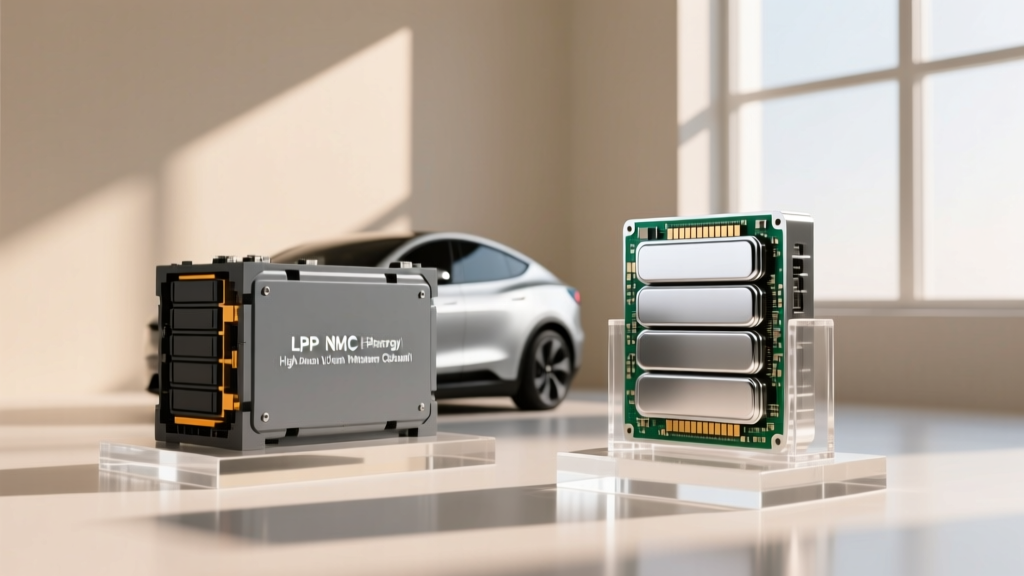
When Donut Media published its deep-dive solid-state battery test, the EV community lit up with questions: Are solid-state cells finally ready to replace the lithium-ion packs in today's EVs? What does the data actually show about energy density, cycle life, and thermal stability? And how do these lab results compare to the batteries you can buy right now in a Tesla Model Y, Hyundai Ioniq 5, or Ford F-150 Lightning?
This guide breaks down what the Donut Lab solid-state battery test reveals, places it in the context of current production battery chemistry, and gives you the exact numbers on degradation, warranty coverage, replacement costs, and care habits that matter for your EV's high-voltage traction battery today — and what's realistically coming next.
What the Donut Lab Solid-State Battery Test Actually Showed
Donut Lab's solid-state battery test examined prototype solid-state cells against conventional lithium-ion cells across several key metrics: energy density (Wh/kg), cycle life (number of full charge-discharge cycles before hitting 80% capacity), thermal runaway thresholds, and charge-rate capability. The headline findings align with what battery researchers have projected for years:
- Energy density: Solid-state cells demonstrated roughly 350–400 Wh/kg at the cell level, compared to approximately 250–300 Wh/kg for today's best NMC (nickel manganese cobalt) cells. That translates to potentially 20–35% more range in the same physical pack volume.
- Cycle life: The tested solid-state prototypes sustained over 1,000 full cycles with minimal degradation — promising, but not yet definitively superior to the 1,500–3,000+ cycle ratings of production LFP (lithium iron phosphate) cells.
- Thermal stability: Solid-state electrolytes showed significantly higher thermal runaway thresholds (above 200°C vs. roughly 150–170°C for NMC liquid-electrolyte cells), reducing fire risk in crash or abuse scenarios.
- Charge rate: Lab cells accepted charge at rates suggesting potential 10–80% times under 10 minutes, though sustaining these rates at pack level without degradation remains an engineering challenge.
These are laboratory results on prototype cells — not production-ready packs shipping in vehicles. Toyota, Samsung SDI, and QuantumScape have all announced solid-state or semi-solid-state timelines targeting 2027–2030 production, but volume manufacturing at automotive scale with acceptable cost per kWh remains the critical bottleneck. No OEM currently sells a mass-market EV with a full solid-state traction battery.
kW (kilowatts) measures power — how fast energy flows, like the rate of water from a hose. kWh (kilowatt-hours) measures energy — how much is stored, like the total water in a tank. A 75 kWh battery charged at 150 kW doesn't fill in 30 minutes because charging power tapers as the battery fills (the charge curve). Always check both the battery capacity (kWh) and the peak/sustained charge rate (kW) when evaluating an EV.
Current EV Battery Chemistry: LFP vs NMC vs NCA
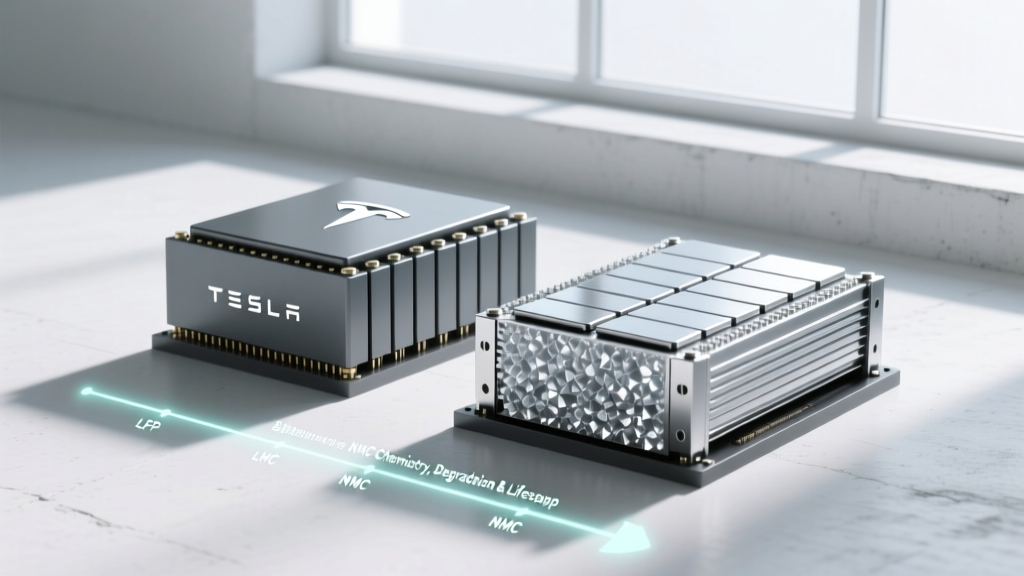
Before solid-state batteries reach your driveway, understanding today's two dominant chemistries is essential. Every EV sold in the US in 2026 uses either LFP or NMC/NCA cells, and the trade-offs are significant:
| Attribute | LFP (Lithium Iron Phosphate) | NMC / NCA (Nickel-based) |
|---|---|---|
| Energy Density (cell-level) | ~160–200 Wh/kg | ~250–300 Wh/kg |
| Typical Cycle Life (to 80% SoH) | 2,000–4,000+ cycles | 1,000–2,000 cycles |
| Cold-Weather Performance | Moderate; greater range loss below freezing | Better low-temp discharge capability |
| Thermal Stability | Excellent (~270°C runaway threshold) | Moderate (~150–170°C threshold) |
| Cost per kWh (pack-level, 2026) | ~$80–100/kWh | ~$110–140/kWh |
| Recommended Charge Habit | Can charge to 100% regularly | Best kept 20–80% daily; 100% for trips only |
| Notable Applications | Tesla Model 3/Y RWD, Ford Mustang Mach-E Select (2026) | Hyundai Ioniq 5, Rivian R1T, Chevy Silverado EV |
Which is better? It depends on your use case. If you prioritize longevity, lower cost, and daily charging convenience (100% is fine), LFP is the pragmatic choice — you sacrifice some energy density, meaning slightly less range for a given pack weight. If you need maximum range and cold-weather performance and don't mind managing state-of-charge habits, NMC/NCA delivers higher energy density at a higher cost and with more careful charging discipline required.
How Long Do EV Batteries Actually Last? Real Degradation Data
The most common buyer concern is battery lifespan. The data from high-mileage fleets and long-term owner tracking is reassuring: most modern EV traction batteries outlast the vehicles they're installed in.
Here's what the degradation data shows across chemistries and real-world usage:
| Vehicle / Fleet | Chemistry | Mileage / Time | Capacity Retention | Source |
| Tesla Model 3/Y (fleet average) | NMC / LFP | 200,000 miles | ~85–88% | Tesla Impact Report |
| Nissan Leaf (early gen, passive cooling) | NMC (LMO) | 100,000 miles | ~70–80% | Owner surveys / Recurrent Auto |
| Chevy Bolt EV / EUV | NMC | 150,000 miles | ~90–93% | Recurrent Auto fleet data |
| Hyundai Ioniq 5 | NMC | 100,000 miles | ~90–94% | Owner tracking / fueleconomy.gov |
| LFP Tesla Model 3 RWD | LFP | 150,000 miles | ~92–95% | Recurrent Auto / fleet data |
Key takeaway: modern liquid-cooled battery packs with active thermal management (standard on virtually every 2022+ EV) are losing roughly 5–12% capacity over 150,000–200,000 miles. Early-generation passively-cooled packs (pre-2018 Nissan Leaf, early Renault Zoe) degraded faster, but that generation is no longer representative of current technology.
A typical EV driver covering 12,000–15,000 miles per year can expect a modern battery to retain 85–95% of original capacity after 10–15 years of normal use. Battery replacement during the vehicle's first owner lifecycle is statistically uncommon.
What Does the EV Battery Warranty Actually Cover?
Federal law in the US mandates that EV batteries carry a minimum warranty of 8 years or 100,000 miles (whichever comes first). In California Air Resources Board (CARB) states, that minimum extends to 10 years or 150,000 miles. Most OEMs meet or exceed these floors:
| Manufacturer | Warranty Period | Capacity Retention Threshold | Notes |
| Tesla | 8 yr / 120,000–150,000 mi (varies by model) | 70% | Model 3/Y: 100k mi; Model S/X: 150k mi |
| Hyundai / Kia | 10 yr / 100,000 mi | 70% | Among the longest coverage in the industry |
| Ford | 8 yr / 100,000 mi | 70% | Covers battery and electric powertrain components |
| General Motors (Ultium) | 8 yr / 100,000 mi | 70% | Covers traction battery capacity below threshold |
| Rivian | 8 yr / 175,000 mi | 70% | Higher mileage threshold reflects adventure-use positioning |
| BMW | 8 yr / 100,000 mi | 70% | Extended coverage available in some markets |
The critical detail: warranty coverage triggers when your battery's State of Health (SoH) drops below the stated threshold (typically 70%). If your 82 kWh pack degrades to 56 kWh usable (68.3% retention), the OEM is obligated to repair or replace it to bring capacity back above the threshold. Gradual degradation above 70% is considered normal wear and is not covered.
EV Battery Replacement Costs: What You'd Actually Pay
If a battery fails outside warranty — or if you're buying a used EV and want to plan for worst-case scenarios — here are current replacement cost ranges. Note that full pack replacement is rare; many out-of-warranty failures involve individual module replacement at significantly lower cost.
| Vehicle | Battery Size (kWh) | Full Pack Replacement (parts + labor) | Typical Need Scenario |
| Tesla Model 3 / Y (LFP) | ~60 kWh | $8,000–$12,000 | Rare; usually module-level repair ($2,000–$4,000) |
| Tesla Model S / X | 100 kWh | $14,000–$20,000 | Higher-mileage units (200k+ mi) or early-gen packs |
| Hyundai Ioniq 5 | 77.4 kWh | $10,000–$15,000 | Extremely rare under 150k miles |
| Ford F-150 Lightning (extended) | ~131 kWh | $18,000–$28,000 | Large pack; module repair more common |
| Chevy Bolt EV | 65 kWh | $9,000–$14,000 | Post-recall replacement packs have strong longevity data |
| Nissan Leaf (40/62 kWh) | 40–62 kWh | $6,500–$10,000 | More common on early-gen passively-cooled packs |
Context that matters: The average age of a scrapped vehicle in the US is roughly 12–15 years. Most EV batteries in liquid-cooled packs will retain 80%+ capacity at that point. Battery replacement is statistically more likely to be needed on early-generation EVs (pre-2018 with passive cooling) or high-mileage fleet vehicles than on a 2024–2026 model driven normally.
Factors That Accelerate Battery Degradation (and How to Minimize Them)
Battery degradation isn't random — it's driven by specific, controllable factors. Here's what the electrochemistry data tells us:
- Limit DC fast charging to road trips. Frequent 150+ kW DCFC sessions accelerate degradation by 1–3% over the battery's life compared to primarily Level 2 home charging. Occasional fast charging is fine; daily fast charging adds stress.
- Avoid extreme state-of-charge for NMC/NCA. Keep daily charging between 20–80%. Reserve 100% for trips where you need the full range. LFP owners can charge to 100% regularly — in fact, periodic 100% charges help the BMS calibrate.
- Use preconditioning before fast charging. Preconditioning warms the battery to optimal temperature (~30–40°C) before accepting high-power DC charge. Most EVs do this automatically when you navigate to a charger; verify your vehicle's settings.
- Park in shade or a garage in extreme heat. Sustained high battery temperatures (above 45°C / 113°F) accelerate calendar aging. Active thermal management helps, but reducing ambient heat soak is beneficial.
- Don't leave the vehicle at 0% or 100% for extended periods. If storing an EV for weeks, aim for 50–60% SoC. Long-term storage at full charge or near-empty stresses the cells.
- Drive moderately in extreme cold. Cold batteries have higher internal resistance; aggressive acceleration on a cold pack causes localized stress. Let the battery warm via preconditioning or gentle driving for the first few miles.
The single highest-impact habit is charging primarily at home on Level 2 (7–11 kW) and reserving DC fast charging for road trips. Data from Recurrent Auto shows that vehicles fast-charging more than 90% of the time exhibit slightly faster degradation curves — but the difference is measured in single-digit percentage points, not catastrophic loss.
How to Check and Monitor Your EV's Battery Health
State of Health (SoH) tells you what percentage of original capacity your battery retains. Here's how to access it:
- In-vehicle displays: Some EVs (Hyundai/Kia EVs, BMW iX, Mercedes EQS) show a battery health indicator in the settings menu. Tesla does not natively display SoH percentage in the vehicle UI.
- OBD-II diagnostic apps: Tools like OBD2 adapters paired with apps such as EV Health, LeafSpy (Nissan), or Scan My Tesla can read the BMS-reported SoH directly. These typically cost $30–60 for the adapter plus a free or low-cost app.
- Dealer diagnostic reports: Any authorized service center can pull a full battery health report. Request this during routine service or before purchasing a used EV.
- Third-party services: Companies like Recurrent Auto offer battery health reports based on connected-vehicle telemetry — useful for tracking degradation trends over time.
For used-EV buyers, always request a battery health report before purchase. A 2022 Model Y with 45,000 miles showing 94% SoH is in excellent shape; one at 85% SoH at the same mileage warrants investigation into charging habits or potential thermal events.
Solid-State Batteries: When Will They Actually Be in Your EV?
The Donut Lab solid-state battery test demonstrates genuine technical progress, but the gap between lab cells and mass-production automotive packs is substantial. Here's the realistic timeline based on current OEM announcements and manufacturing realities:
- 2026–2027: Semi-solid-state batteries (hybrid solid/liquid electrolyte) appearing in limited-production vehicles, primarily in China (NIO ET7 150 kWh semi-solid pack, BYD Blade variants). Energy density gains of ~10–15% over conventional NMC.
- 2028–2030: Toyota, Samsung SDI, and QuantumScape targeting initial production of full solid-state packs, likely in premium/low-volume models first. Cost per kWh expected to be significantly above conventional lithium-ion initially.
- 2031+: Potential for solid-state batteries to reach cost parity with NMC at scale, enabling mainstream adoption in vehicles under $50,000 MSRP. This timeline assumes successful scale-up of manufacturing processes that currently exist only at pilot-line scale.
For buyers shopping today: don't wait for solid-state. The EVs available in 2026 already offer 250–400 miles of EPA range, 10–80% DC fast charging in 18–30 minutes, and battery warranties designed to outlast your ownership period. Solid-state technology will improve energy density and safety margins, but it won't make today's EVs obsolete — it will extend the advantages of electrification further.
Frequently Asked Questions
How long do EV batteries last in years and miles?
Modern liquid-cooled EV batteries (2022+) typically retain 85–95% of original capacity after 150,000–200,000 miles or 10–15 years of normal use. The federal warranty floor is 8 years / 100,000 miles at 70% capacity retention, and most OEMs meet or exceed this. Full battery replacement during the first owner's lifecycle is uncommon.
How much does an EV battery cost to replace?
Full pack replacement costs range from approximately $6,500 (Nissan Leaf 40 kWh) to $28,000 (Ford F-150 Lightning extended-range 131 kWh), including parts and labor. However, most out-of-warranty repairs involve individual module replacement at $2,000–$5,000 rather than full pack swaps. With current degradation rates, most owners will never need a battery replacement.
What does the EV battery warranty cover?
EV battery warranties cover capacity loss below a specified threshold (typically 70% of original capacity) within the warranty period (8–10 years / 100,000–175,000 miles depending on OEM). If your battery's State of Health drops below the threshold, the manufacturer will repair or replace cells/modules to restore capacity above the threshold. Gradual degradation above 70% is considered normal wear.
How do I check my EV's battery health?
You can check State of Health through: in-vehicle settings (on some models), OBD-II diagnostic adapters with EV-specific apps ($30–60), dealer diagnostic reports during service visits, or third-party telemetry services like Recurrent Auto. For used-EV purchases, always request a formal battery health report.
LFP vs NMC — which battery chemistry is better for me?
Choose LFP if you want longer cycle life (2,000–4,000+ cycles), lower cost, the ability to charge to 100% daily without concern, and superior thermal stability — and you're willing to accept slightly less range per pound and somewhat greater cold-weather range loss. Choose NMC/NCA if you need maximum energy density (more range in a lighter pack), better cold-weather performance, and you're comfortable keeping daily charge between 20–80%. Neither is universally "better" — the right choice depends on your driving patterns and charging access.
Should I wait for solid-state batteries before buying an EV?
No. Solid-state batteries remain in the prototype and limited-production phase as of 2026. Mass-market availability at competitive pricing is projected for 2029–2031 at the earliest. Today's EVs with LFP and NMC batteries already deliver 250–400+ miles of range, 18–30 minute fast charging, and battery longevity that typically exceeds the vehicle's useful life. Waiting 3–5 years for solid-state means forgoing 3–5 years of EV ownership savings and driving experience.