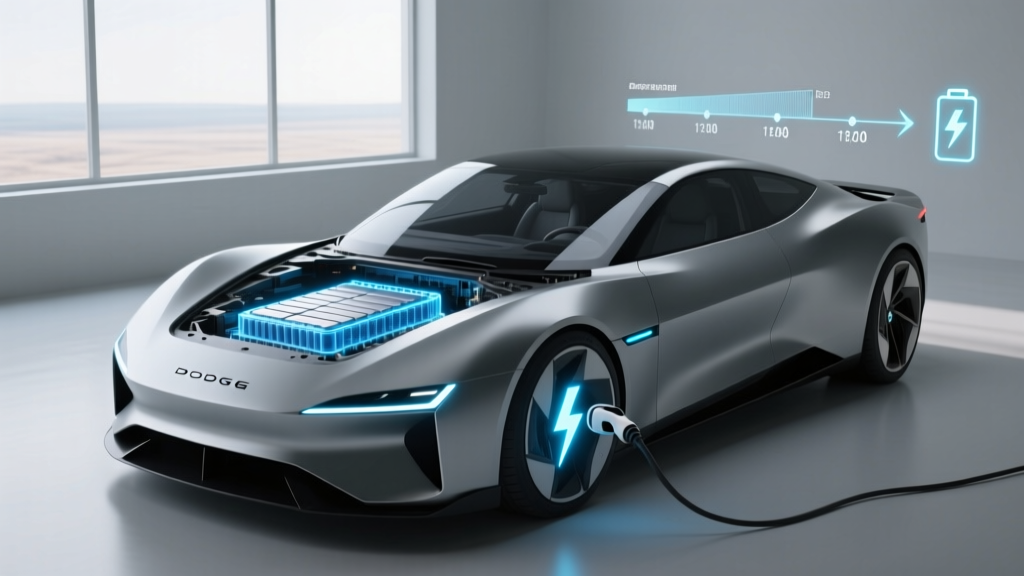
The Dodge Charger Daytona — the first battery-electric muscle car from Stellantis — hinges entirely on its high-voltage pack. Branded under the historic Daytona name for its top trims, this EV uses a large-format lithium-ion battery that dictates everything from its 318-mile EPA range to its 800-volt fast-charging capability. But what chemistry is inside, how long will it last, and what does replacement cost if things go wrong?
This guide breaks down every critical battery detail for the Dodge Daytona EV lineup (2024–2026 model years), compares the NMC chemistry it uses against the LFP packs found in competing EVs, and gives you a data-driven framework for maximizing pack longevity.
Dodge Daytona Battery Specifications at a Glance
| Specification | Daytona R/T (340 kW) | Daytona Scat Pack (496 kW) |
|---|---|---|
| Battery Chemistry | NMC (Nickel Manganese Cobalt) | NMC (Nickel Manganese Cobalt) |
| Usable Capacity | 100.5 kWh | 100.5 kWh |
| Voltage Architecture | 800V nominal | 800V nominal |
| EPA Range | 318 mi | 260 mi |
| Real-World Range (highway 70 mph) | ~265–285 mi | ~215–235 mi |
| Peak DC Fast Charge Rate | ~270 kW | ~270 kW |
| 10–80% DC Charge Time | ~27 min | ~27 min |
| Level 2 AC Charge Rate | 11 kW (onboard charger) | 11 kW (onboard charger) |
| Horsepower | 456 hp (496 hp w/ Direct Connection) | 670 hp |
| 0–60 mph | 4.7 sec | 3.3 sec |
| Base MSRP | $59,595 | $73,590 |
| Federal §30D Tax Credit | Not eligible (MSRP/sourcing) | Not eligible (MSRP/sourcing) |
NMC Chemistry Explained: Why Dodge Chose It Over LFP
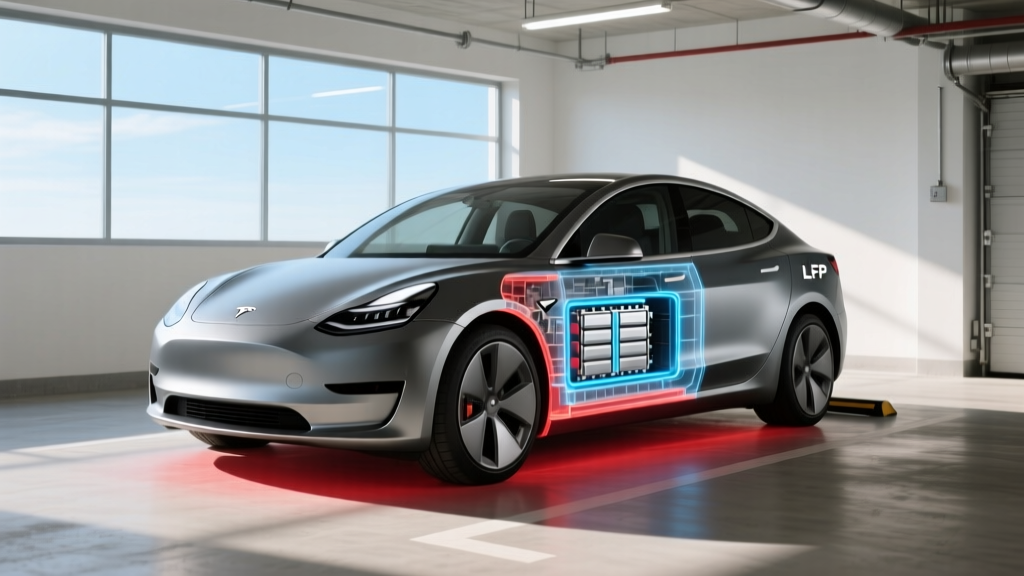
The Dodge Daytona uses an NMC (nickel manganese cobalt) lithium-ion battery, not the LFP (lithium iron phosphate) chemistry found in some Tesla Model 3 Standard Range and Ford Mustang Mach-E Select trims. This is a deliberate engineering choice driven by the Daytona's performance targets.
| Attribute | NMC (Dodge Daytona) | LFP (e.g., Tesla Model 3 RWD) |
|---|---|---|
| Energy Density | Higher (~250–300 Wh/kg cell-level) | Lower (~160–200 Wh/kg cell-level) |
| Weight for 100 kWh Pack | ~400–450 kg | ~500–600 kg |
| Cycle Life | ~1,000–2,000 full cycles | ~3,000–5,000+ full cycles |
| Cold-Weather Performance | Better low-temp conductivity | Reduced charge acceptance below 32°F |
| Peak Power Delivery | Higher discharge C-rate for acceleration | Moderate C-rate; limits 0–60 in heavy packs |
| Thermal Stability | Good; requires active thermal management | Excellent; inherently more stable |
| Cobalt Content | Yes (ethical sourcing concerns) | None |
| Cost per kWh (2026) | ~$110–130/kWh | ~$80–100/kWh |
| Best For | Performance, range, cold climates | Longevity, daily commuting, budget EVs |
For a 670-hp muscle car weighing over 5,800 pounds, NMC's superior energy density and discharge capability are essential. An equivalent LFP pack capable of delivering Scat Pack–level power would be significantly heavier, hurting handling and reducing the vehicle's already challenged efficiency. The trade-off: NMC degrades slightly faster than LFP over time and costs more per kWh to manufacture.
How Long Do Dodge Daytona Batteries Last?
The short answer: almost certainly longer than you'll own the car. Modern NMC packs with active liquid thermal management — like the Daytona's — are engineered for 150,000–200,000+ miles before capacity loss becomes practically noticeable.
- Year 1 / 15,000 mi: ~2–4% capacity loss (initial formation loss)
- Year 3 / 45,000 mi: ~6–9% total loss
- Year 5 / 75,000 mi: ~9–12% total loss
- Year 8 / 100,000 mi: ~12–16% total loss
- Year 10 / 150,000 mi: ~16–22% total loss (estimated)
Sources: Geotab fleet battery health study, Recurrent Auto battery degradation data. Actual results vary with climate, charging habits, and usage patterns.
Applied to the Daytona R/T's 100.5 kWh usable capacity and 318-mile EPA range: at 100,000 miles (year 8), you'd likely retain roughly 84–88 kWh usable, translating to approximately 267–280 miles of range. That's a meaningful reduction but far from making the car unusable.
The key degradation drivers for the Daytona specifically:
- High-power launches: Repeated hard acceleration (easy to do with 670 hp) generates internal cell heat that accelerates electrolyte decomposition.
- DC fast charging frequency: Daily 270 kW sessions stress NMC cells more than Level 2 home charging. The 800V architecture is efficient but high C-rates still generate heat.
- State of charge extremes: Regularly charging to 100% and draining to near 0% widens the voltage swing across cells, promoting lithium plating.
Battery Warranty: What Stellantis Covers
| Component | Coverage Period | Mileage Limit | Capacity Threshold |
|---|---|---|---|
| High-Voltage Battery Pack | 8 years | 100,000 miles | Below 70% of original capacity |
| Electric Powertrain (motors, inverter) | 8 years | 100,000 miles | Functional failure |
| Battery Management System (BMS) | 8 years | 100,000 miles | Functional failure |
Stellantis warrants the Daytona's high-voltage battery against capacity loss below 70% for 8 years or 100,000 miles, whichever comes first. This aligns with the federal minimum mandate under EPA/CARB guidelines for EV battery warranties and matches competitors like Ford and Hyundai. Note: California Air Resources Board (CARB) states may require extended coverage — California, for instance, mandates 10 years/150,000 miles for certain emissions-related EV components. Check your state's specific requirements via your local DMV or the EPA.
What the warranty does not cover: gradual capacity loss above 70% (normal wear), damage from accidents, flooding, improper modifications, or use of non-approved charging equipment.
EV Battery Replacement Cost: What Daytona Owners Should Budget
| Vehicle / Pack Size | Battery Cost (parts) | Labor & Calibration | Estimated Total |
|---|---|---|---|
| Dodge Daytona (100.5 kWh NMC) | $12,000–$16,000 | $2,500–$4,000 | $14,500–$20,000 |
| Tesla Model 3 (75 kWh NMC/LFP) | $10,000–$14,000 | $1,500–$2,500 | $11,500–$16,500 |
| Ford F-150 Lightning (131 kWh NMC) | $18,000–$25,000 | $3,000–$5,000 | $21,000–$30,000 |
| Chevy Bolt EV (65 kWh NMC) | $8,000–$11,000 | $1,500–$2,500 | $9,500–$13,500 |
For the Daytona's 100.5 kWh NMC pack, expect a total out-of-warranty replacement cost between $14,500 and $20,000 at current 2026 pricing. However, context matters enormously: most EV batteries never require full replacement. Data from Recurrent Auto shows that fewer than 3% of modern liquid-cooled EV battery packs are replaced under warranty, and catastrophic failure outside warranty is exceptionally rare.
If a Daytona battery does develop issues, module-level repair is often possible. The pack consists of multiple modules, and a single degraded or faulty module can sometimes be replaced for $2,000–$5,000 rather than swapping the entire pack. This requires a certified Stellantis EV technician with high-voltage training.
Maximizing Dodge Daytona Battery Health: A Practical Care Guide
- Daily charging limit: Set charge limit to 80% for routine driving. Reserve 100% for road trips only.
- Avoid deep discharge: Try not to let SoC drop below 10–15%. The BMS maintains a bottom buffer, but repeated deep cycles stress NMC cells.
- Home charging preference: Use Level 2 (240V, ~11 kW) for daily charging. The slower charge rate generates less cell heat than DC fast charging.
- DC fast charging moderation: Limit 270 kW DC sessions to road trips. If you must fast-charge daily, precondition the battery (the Daytona does this automatically when a DC charger is navigated to).
- Cold weather protocol: In sub-freezing temperatures, always precondition the battery before fast charging. Plug in at home and use scheduled departure to warm the pack on grid power.
- Hot weather parking: Avoid leaving the Daytona at high SoC (above 80%) in direct sun for extended periods. Heat + high voltage = accelerated degradation.
- Storage: If storing the vehicle for 2+ weeks, leave SoC at approximately 50% and keep it plugged in so the thermal management system can maintain optimal temperature.
- Launch control moderation: The Scat Pack's 670 hp is thrilling, but repeated hard launches generate significant cell heat. Allow cool-down between aggressive drives.
Monitoring Battery State of Health (SoH)
The Daytona's Uconnect 5 infotainment system provides battery status information, but for detailed State of Health (SoH) monitoring, owners have several options:
- In-vehicle display: The instrument cluster and Uconnect EV pages show current SoC, estimated range, and energy flow. Some Stellantis EVs include a battery health percentage in the settings menu — check under Vehicle → EV Settings.
- OBD-II diagnostic tools: Third-party tools like OBDeleven or dedicated EV scanners can read the BMS-reported SoH percentage. This compares current maximum charge capacity against the factory-original value.
- Dealer diagnostic: A Stellantis dealer can run a full battery health report during scheduled service. Request this at every annual inspection, especially as you approach the 8-year/100,000-mile warranty boundary.
- Third-party services: Companies like Recurrent Auto offer free battery health monitoring by connecting to your vehicle's telematics data. These services track capacity trends over time and benchmark your pack against similar vehicles.
A healthy Daytona battery at 50,000 miles should show an SoH of 90–94%. If your SoH drops below 85% before 75,000 miles, that's a signal to adjust charging habits or schedule a dealer diagnostic to check for module imbalance.
What's Next: Solid-State and Silicon-Anode Batteries
Stellantis has announced partnerships with Factorial Energy on solid-state battery development, targeting prototype demonstrations by 2026–2027 and potential production vehicles by 2028–2030. Solid-state batteries promise higher energy density (potentially 400+ Wh/kg at cell level), faster charging, and improved safety due to the elimination of liquid electrolyte.
Silicon-anode technology — which replaces the graphite anode with silicon to increase lithium storage capacity — is closer to production. Companies like Sila Nanotechnologies and Group14 are already supplying silicon-dominant anodes for select 2025–2026 EVs, offering 10–20% energy density gains over conventional graphite anodes.
Reality check: Neither technology is available in any production vehicle as of early 2026. The current Daytona's NMC pack with its 800V architecture represents state-of-the-art for 2024–2026 production EVs. Solid-state batteries are not expected to reach mainstream, affordable vehicles until 2029 at the earliest, and retrofitting existing vehicles is not feasible due to fundamentally different pack architectures.
Frequently Asked Questions
How long do Dodge Daytona EV batteries last in real-world use?
Based on degradation data from similar liquid-cooled NMC packs, expect the Daytona's 100.5 kWh battery to retain approximately 84–88% of its original capacity at 100,000 miles (roughly year 8). This translates to a range reduction from 318 EPA miles to approximately 267–280 miles. Full pack failure is rare — fewer than 3% of modern EV batteries require replacement.
How much does a Dodge Daytona battery replacement cost?
An out-of-warranty full pack replacement for the 100.5 kWh NMC battery is estimated at $14,500–$20,000 (parts and labor) at 2026 pricing. However, module-level repairs — replacing only the degraded section — may cost $2,000–$5,000. Under the 8-year/100,000-mile warranty, replacement due to capacity loss below 70% is covered at no cost.
What does the Dodge Daytona battery warranty cover?
Stellantis covers the high-voltage battery pack, battery management system, and electric powertrain for 8 years or 100,000 miles. The warranty triggers if capacity drops below 70% of original or if a functional failure occurs. CARB states (including California, New York, and others) may mandate extended 10-year/150,000-mile coverage.
Is the Dodge Daytona eligible for the federal EV tax credit?
No. As of 2026, the Dodge Charger Daytona does not qualify for the IRS §30D federal tax credit. The Scat Pack's $73,590 MSRP exceeds the $55,000 sedan cap, and the R/T at $59,595 also exceeds this limit. Additionally, battery component and critical mineral sourcing requirements may disqualify it regardless of price. Always verify current eligibility on IRS.gov or consult a tax professional before purchasing.
LFP vs NMC: which battery chemistry is better for the Daytona?
For the Daytona's performance mission, NMC is the correct engineering choice. Its higher energy density keeps pack weight manageable for a 5,800+ lb car, and its superior discharge C-rate enables the Scat Pack's 3.3-second 0–60 time. LFP would require a heavier, larger pack to deliver equivalent power. However, LFP offers longer cycle life (3,000–5,000+ cycles vs. NMC's 1,000–2,000) and lower cost, making it better suited for daily commuter EVs where maximum performance isn't required.
Does frequent DC fast charging damage the Daytona battery?
Occasional DC fast charging (road trips, a few times per month) has minimal impact on battery health thanks to the Daytona's active liquid thermal management system. However, daily use of 270 kW DC charging accelerates NMC degradation compared to Level 2 home charging. The high C-rate generates more internal cell heat. For daily charging, a home Level 2 setup at 11 kW (adding roughly 30–35 miles of range per hour) is gentler on the pack and significantly cheaper per kWh.
How do I check my Daytona's battery health percentage?
Check the Uconnect 5 EV settings menu for a battery health indicator. For more detailed SoH data, use an OBD-II EV scanner or request a full battery diagnostic report from your Stellantis dealer. Third-party services like Recurrent Auto also offer free telematics-based health monitoring that tracks your capacity trend against a fleet benchmark.