The Next Five Years: An EV Battery Technology Showdown
The electric vehicle industry is currently navigating a massive transitional phase. As we look at the EV battery technology roadmap for the next five years, it is clear that the era of a single, monolithic battery chemistry dominating the market is over. Instead, we are entering a period of intense diversification and head-to-head competition between distinct battery architectures. For consumers, fleet managers, and automotive engineers, understanding these diverging paths is critical for making informed purchasing and investment decisions. According to the International Energy Agency's Global EV Outlook 2024, battery chemistry shifts are being driven by a complex matrix of raw material costs, geopolitical supply chain security, and the demand for faster charging speeds.
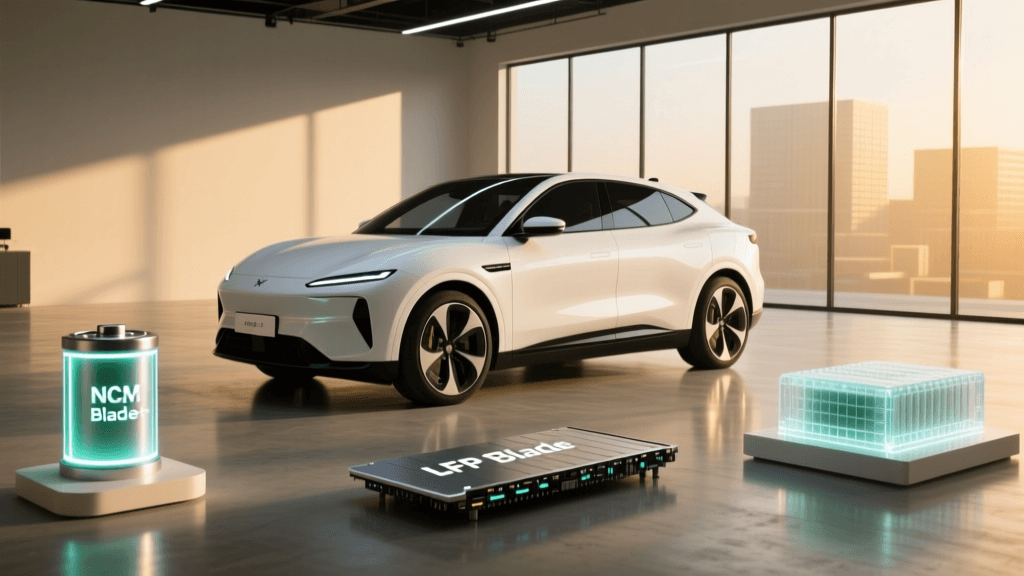
In this comprehensive showdown, we will pit the three leading battery technologies against one another: Tesla’s large-format Cylindrical NMC cells, BYD’s LFP Blade Cell architecture, and the highly anticipated Solid-State batteries championed by Toyota and Samsung SDI. We will analyze their energy density, degradation patterns, manufacturing costs, and total lifecycle value to determine which technology will ultimately win the next five-year roadmap.
Contender 1: Large-Format Cylindrical NMC Cells (The 4680 Standard)
Spearheaded by Tesla and rapidly adopted by manufacturers like BMW and Panasonic, the large-format cylindrical cell—measuring 46mm in diameter and 80mm in height—represents the pinnacle of current lithium-ion energy density optimization. By moving from the previous 2170 standard to the 4680 format, manufacturers are drastically reducing the ratio of inactive casing material to active electrochemical material. This results in a significant boost to volumetric energy density.
The true innovation of the 4680 NMC (Nickel Manganese Cobalt) cell lies in its manufacturing process, specifically the use of dry electrode coating. Traditional wet coating requires toxic solvents that must be baked off in massive, energy-intensive ovens. Dry coating eliminates this step, reducing factory footprint and energy consumption. Furthermore, the tabless electrode design minimizes the distance electrons must travel, drastically reducing internal resistance. This translates to superior thermal management and the ability to sustain higher DC fast-charging rates without triggering thermal throttling.
However, NMC chemistries remain vulnerable to supply chain bottlenecks regarding nickel and cobalt. While the 4680 format is structurally brilliant, its reliance on expensive transition metals means it will likely remain reserved for premium, long-range, and high-performance vehicle segments over the next half-decade.
Contender 2: LFP Blade Cell Architecture (The Structural Vanguard)
On the opposite end of the spectrum sits the Lithium Iron Phosphate (LFP) Blade cell, popularized by BYD and now being integrated into standard-range vehicles by Tesla, Ford, and others. LFP chemistry abandons expensive nickel and cobalt entirely, relying on abundant iron and phosphate. Historically, LFP suffered from poor energy density and terrible cold-weather performance. The Blade architecture solves the density issue not through chemical tweaks, but through radical structural engineering.
The Blade cell is exceptionally long, thin, and flat, resembling a sword blade. This unique form factor allows the cells to be packed tightly into a Cell-to-Pack (CTP) design, where the battery cells themselves act as structural cross-members for the vehicle's chassis. By eliminating traditional modules and packing hardware, the volumetric utilization of the battery pack increases by nearly 50%, effectively bridging the energy density gap between LFP and NMC at the pack level.
From a longevity and safety perspective, LFP Blade cells are unmatched. They are virtually immune to thermal runaway, easily passing rigorous nail-penetration tests without catching fire. Furthermore, LFP chemistry tolerates regular 100% state-of-charge (SoC) cycles without the severe degradation penalties seen in NMC cells. This makes the LFP Blade the undisputed champion for daily commuters, urban delivery fleets, and budget-conscious buyers.
Contender 3: Solid-State Batteries (The Holy Grail)
Solid-state batteries (SSBs) replace the flammable liquid electrolyte found in traditional lithium-ion cells with a solid material, such as a sulfide, oxide, or polymer. This fundamental shift unlocks the use of pure lithium-metal anodes, which can theoretically double the energy density of current batteries while cutting charging times down to under ten minutes. According to research highlighted by the Argonne National Laboratory's Battery Research Overview, solid-state architectures also promise vastly improved safety profiles, as the solid electrolyte acts as a physical barrier against the formation of dendrites that cause short circuits.
Toyota and Samsung SDI have mapped out aggressive roadmaps, promising commercial solid-state EVs by 2027 and 2028. However, the head-to-head reality is that manufacturing sulfide-based solid electrolytes requires incredibly strict dry-room conditions, as the material degrades upon contact with ambient moisture, releasing toxic hydrogen sulfide gas. The capital expenditure required to retool gigafactories for solid-state production is astronomical.
Over the next five years, solid-state technology will likely remain confined to ultra-premium luxury vehicles, specialized aerospace applications, and limited pilot fleets. It is a game-changing technology, but its widespread cost-parity with liquid lithium-ion is still a decade away.
Head-to-Head Comparison Matrix
To visualize how these three technologies stack up against one another for the upcoming model years, review the data table below:
| Metric | Cylindrical NMC (4680) | LFP Blade Cell | Solid-State (Sulfide) |
|---|---|---|---|
| Cell-Level Energy Density | ~300 Wh/kg | ~170 Wh/kg | ~400 - 500 Wh/kg |
| Pack-Level Volumetric Efficiency | High (Structural Pack) | Very High (CTP Design) | Moderate (Early Gen) |
| Optimal Charging Habit | 20% - 80% SoC Daily | 100% SoC Tolerated | Rapid 10-100% Capable |
| Thermal Runaway Risk | Moderate (Requires Cooling) | Extremely Low | Negligible |
| Estimated Cost per kWh (Pack) | $110 - $130 | $80 - $100 | $300+ (Current Prototypes) |
| Market Availability (Next 5 Yrs) | Mass Market / Premium | Mass Market / Entry Level | Luxury / Limited Run |
Cost Analysis and Total Lifecycle Ownership
When evaluating battery technology, the initial sticker price is only a fraction of the story; total lifecycle cost analysis is paramount. The U.S. Department of Energy's Vehicle Technologies Office continuously tracks battery cost trajectories, noting that while raw material fluctuations cause short-term volatility, the long-term trend favors chemistries that minimize expensive transition metals.
LFP Blade Cells offer the lowest total cost of ownership (TCO) for the average consumer. Because LFP chemistry can endure 3,000 to 5,000 full charge cycles before experiencing significant degradation, an LFP battery will likely outlast the physical chassis of the vehicle. For fleet operators running delivery vans or ride-share vehicles that charge daily, the LFP Blade cell is an economic no-brainer, effectively reducing battery replacement risk to near zero over a 10-year operational window.
Cylindrical NMC Cells present a higher upfront cost and require more careful state-of-charge management to maximize lifespan. However, their superior energy density and fast-charging capabilities translate to higher resale values in the used car market, particularly for buyers in rural areas or those who frequently embark on long road trips where range anxiety is a primary concern. The structural nature of the 4680 pack also reduces vehicle weight, improving tire wear and suspension longevity.
Solid-State Batteries will carry a massive premium over the next five years. Early adopters will essentially be paying a 'pioneer tax' to fund the R&D and manufacturing scale-up of these cells. While the lifespan and performance metrics are theoretically superior, the replacement cost out of warranty could be financially devastating until economies of scale are achieved post-2030.
The Verdict: Actionable Advice for Buyers and Fleets
So, who wins the EV battery technology roadmap showdown for the next five years? The answer is that there is no single winner; rather, the market is bifurcating based on specific use cases.
- For the Daily Commuter and Urban Fleet Buyer: The LFP Blade Cell is the undisputed champion. If your daily driving falls under 250 miles and you have access to home or depot charging, buy an LFP-equipped vehicle. You can charge it to 100% every night without guilt, ensuring maximum range availability while securing a battery that will easily survive a decade of heavy use.
- For the Road Warrior and Premium Buyer: The Cylindrical NMC (4680) architecture is your best bet. If you regularly drive cross-country, tow heavy loads, or live in a region with sparse charging infrastructure, the energy density and rapid DC charging speeds of NMC cells justify the higher initial cost and stricter charging habits.
- For the Tech Enthusiast and Luxury Buyer: Solid-State Batteries will begin appearing in flagship models from brands like Toyota, Mercedes-Benz, and NIO toward the end of the five-year window. Unless you are purchasing a high-end luxury vehicle where budget is secondary to cutting-edge performance, it is highly recommended to wait until the late 2020s for solid-state technology to mature and reach cost parity.
Ultimately, the next five years will be defined by the democratization of LFP for the masses and the refinement of large-format cylindrical cells for premium performance, while solid-state technology quietly matures in the background, waiting for its turn to disrupt the industry all over again.