Inside the Cybertruck Battery: 4680 Cells and Structural Design
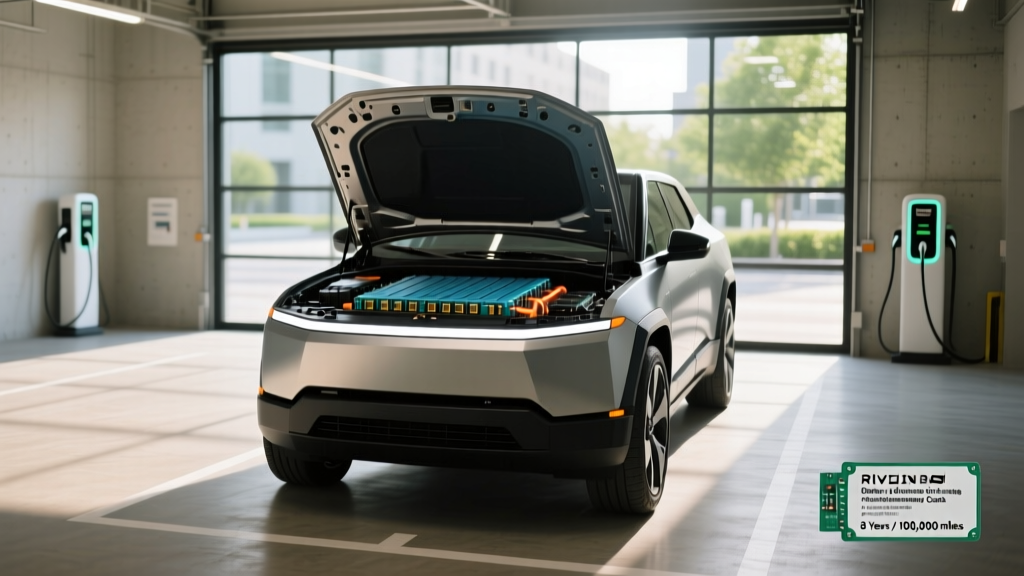
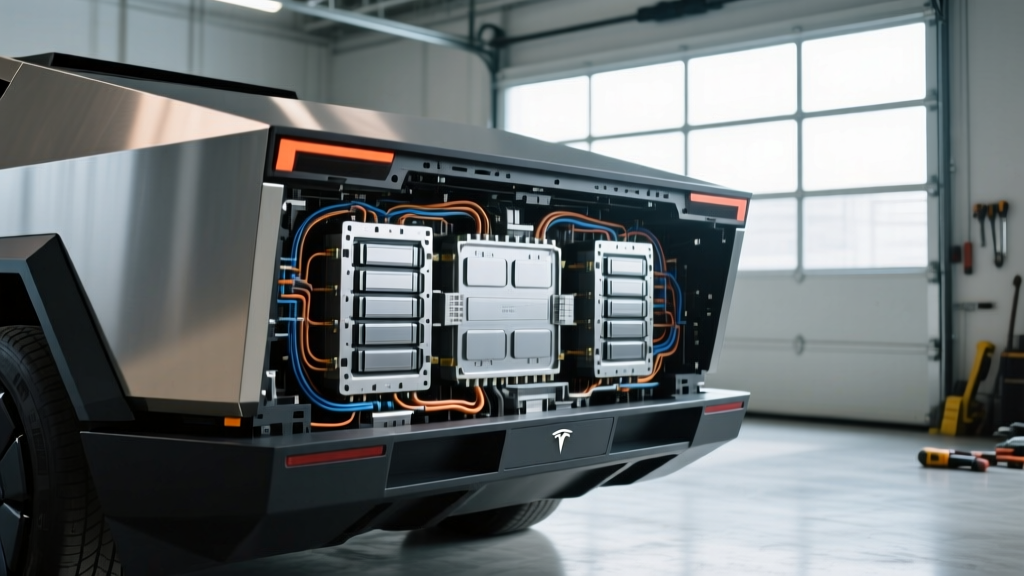
The Tesla Cybertruck uses a fundamentally different battery architecture than most EVs on the road. Rather than relying on conventional 2170 cylindrical cells or prismatic pouches, the Cybertruck is built around Tesla's 4680 cell format — named for its dimensions (46 mm diameter, 80 mm height). These larger cells are integrated into a structural battery pack that serves as part of the vehicle's chassis, reducing overall weight and improving torsional rigidity.
The usable battery capacity varies by trim. The Dual Motor AWD variant carries approximately 123 kWh of usable energy, while the tri-motor Cyberbeast uses a similar pack tuned for higher discharge rates. Both configurations employ NMC (nickel manganese cobalt) chemistry, chosen for its high energy density — a critical requirement given the Cybertruck's 6,600+ lb curb weight and up to 340-mile EPA range target.
| Spec | Dual Motor AWD | Cyberbeast (Tri-Motor) |
|---|---|---|
| Battery Chemistry | NMC (4680 cells) | NMC (4680 cells) |
| Usable Capacity | ~123 kWh | ~123 kWh |
| EPA Range | 340 miles | 320 miles |
| Peak DC Fast Charge | 250 kW (V3 Supercharger) | 250 kW (V3 Supercharger) |
| 10–80% DC Charge Time | ~28 minutes | ~28 minutes |
| Level 2 Charge Rate | 11.5 kW (48A) | 11.5 kW (48A) |
| 0–60 mph | 3.9 seconds | 2.6 seconds |
| Horsepower | 600 hp | 845 hp |
| Battery Warranty | 8 yr / 120,000 mi | 8 yr / 120,000 mi |
| Base MSRP (2025 MY) | $79,990 | $99,990 |
Real-world range note: The EPA 340-mile figure assumes mixed driving at moderate temperatures. In sustained highway driving at 75+ mph, expect approximately 270–295 miles. In cold weather (below 32°F), range can drop to 240–260 miles due to cabin heating demands and increased internal battery resistance. The Cybertruck's large frontal area and stainless-steel exoskeleton contribute to higher aerodynamic drag than sleeker EVs, which amplifies highway efficiency losses.
EPA vs. Real World: 340 mi (sticker) → ~270–295 mi (highway) → ~240–260 mi (cold weather). Plan charging stops around 220 miles for a safety buffer on road trips.
NMC vs. LFP: Why the Cybertruck Uses Nickel-Based Chemistry
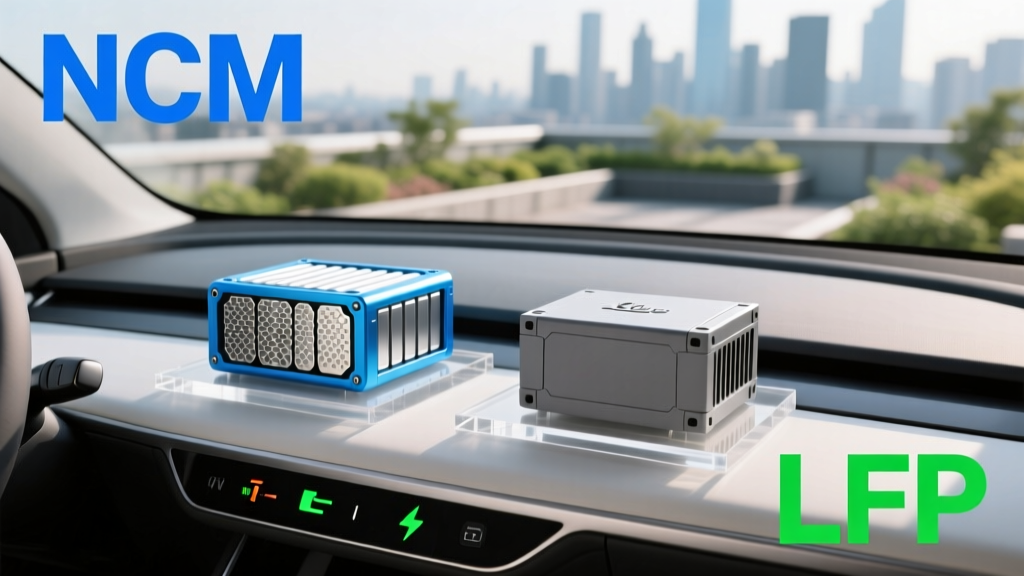
Tesla offers two primary battery chemistries across its lineup: NMC/NCA (nickel-based) and LFP (lithium iron phosphate). The Model 3 and Model Y Standard Range variants use LFP, while the Cybertruck, Model S, Model X, and all long-range/performance variants use NMC or NCA. Understanding the trade-offs explains why Tesla made this choice for a heavy, long-range truck.
| Factor | NMC / NCA (Cybertruck) | LFP (Model 3/Y Std Range) |
|---|---|---|
| Energy Density | ~250–300 Wh/kg (higher) | ~160–180 Wh/kg (lower) |
| Cycle Life | ~1,000–1,500 cycles to 80% SoH | ~2,500–3,500+ cycles to 80% SoH |
| Cold-Weather Performance | Better low-temp discharge | More range loss in freezing temps |
| Cost per kWh | Higher ($130–150/kWh cell-level) | Lower ($90–110/kWh cell-level) |
| Recommended Daily SoC | 80% (to reduce degradation) | 100% (can charge fully daily) |
| Thermal Stability | Good (requires active cooling) | Excellent (inherently safer) |
| Best For | Long range, performance, heavy vehicles | Daily commuting, cost-sensitive buyers |
The Cybertruck's 6,600+ lb weight and 340-mile range target demand the energy density that only NMC can provide in a practical package. An equivalent LFP pack would weigh significantly more and reduce payload and range. The trade-off is that NMC degrades faster than LFP and requires more careful state-of-charge management — which we'll cover in the battery care section below.
Degradation Data: What Cybertruck Owners Can Actually Expect
Battery degradation is a fact of lithium-ion chemistry, but the rate is slower than most first-time EV buyers fear. Based on Tesla's own Impact Report data and aggregated fleet telemetry from Model S/X vehicles using similar NMC chemistry, here is what the degradation curve looks like in practice:
Typical NMC Degradation Curve (Tesla fleet data):
- Year 1 / 15,000 mi: ~2–4% capacity loss (initial formation loss)
- Year 3 / 45,000 mi: ~6–8% total loss
- Year 5 / 75,000 mi: ~8–12% total loss
- Year 8 / 120,000 mi: ~12–17% total loss
- Year 10 / 150,000 mi: ~15–20% total loss (projected)
Source: Tesla Impact Reports (2022–2024), fueleconomy.gov for baseline efficiency data.
The degradation curve is non-linear: the steepest loss occurs in the first 10,000–20,000 miles as the solid electrolyte interphase (SEI) layer forms on the anode. After that, degradation slows significantly and becomes roughly linear at about 1–2% per year under normal use.
For the Cybertruck specifically, a 15% loss at 120,000 miles would reduce the 340-mile EPA range to approximately 289 miles — still very usable for daily driving and road trips. The 4680 cell's dry-electrode manufacturing process (pioneered via Tesla's Maxwell acquisition) is designed to improve cycle life over prior-generation 2170 NMC cells, though long-term fleet data on 4680 packs specifically is still accumulating as of 2026.
What the Cybertruck Battery Warranty Covers — and What It Doesn't
Tesla provides an 8-year / 120,000-mile battery warranty on the Cybertruck (whichever comes first). This is consistent with the broader Tesla warranty framework for all long-range and performance vehicles. Here is what it covers:
| Coverage Item | Details |
|---|---|
| Duration | 8 years or 120,000 miles (whichever comes first) |
| Minimum Capacity Retention | 70% of original capacity |
| What Triggers a Claim | Battery drops below 70% SoH during warranty period |
| Remedy | Tesla repairs or replaces pack to meet 70% threshold |
| Defect Coverage | Manufacturing defects in battery pack and drive unit |
| Exclusions | Damage from accidents, flooding, fire, misuse, unauthorized modifications |
| Transferable? | Yes — warranty transfers to subsequent owners automatically |
The 70% retention threshold is the industry standard — most automakers (Ford, GM, Hyundai, BMW) use the same benchmark over 8 years/100,000 miles. Tesla's 120,000-mile limit is slightly more generous than some competitors. Importantly, this warranty covers capacity degradation, not just catastrophic failure, which is the more common concern for EV owners.
Based on fleet data, the vast majority of Tesla NMC packs retain well above 80% capacity at the 8-year mark under normal use. A warranty claim is statistically unlikely unless the pack has a manufacturing defect or has been subjected to extreme abuse (daily DC fast charging to 100%, prolonged storage at 0% SoC, or repeated exposure to extreme heat without preconditioning).
Cybertruck Battery Replacement Cost: The Numbers
This is the question that generates the most anxiety among prospective EV buyers. Here is the reality: most EV batteries outlive the vehicle they're installed in. Full pack replacement under normal ownership is rare. But if you need one — whether out of warranty or due to damage — here is what it costs:
| Scenario | Estimated Cost | Context |
|---|---|---|
| Cybertruck full pack (out of warranty) | $18,000–$25,000 | 123 kWh NMC 4680 pack; includes labor |
| Single module replacement | $3,000–$6,000 | If only one module is faulty; Tesla service can isolate |
| Model 3/Y LFP pack (comparison) | $12,000–$16,000 | Smaller ~60 kWh pack; lower cell cost |
| Model S/X pack (comparison) | $15,000–$22,000 | 100 kWh NMC; similar architecture |
| Typical ICE engine replacement | $4,000–$10,000 | For baseline comparison |
Context matters enormously here. The Cybertruck's battery is a structural component — it is bonded into the chassis, making replacement more labor-intensive than a conventional EV with a bolt-in pack. However, Tesla's service network is increasingly capable of module-level repairs rather than full-pack swaps, which can reduce costs significantly.
The realistic scenario for most owners: you will sell or trade the Cybertruck long before the battery needs replacement. At 150,000 miles with ~15–20% degradation, the truck still has ~270–290 miles of usable range — perfectly functional for a second or third owner.
How to Maximize Cybertruck Battery Health: A Practical Checklist
NMC chemistry is more sensitive to abuse than LFP, which means your daily habits matter. Here is a data-backed care protocol for Cybertruck owners:
- Set daily charge limit to 80%: NMC degrades fastest at high SoC. Use 80% for daily driving and only charge to 100% when you need full range for a road trip. The Tesla app lets you set this once and forget it.
- Avoid storing below 20% or above 90%: If the truck will sit for more than a week, leave it plugged in at 50–60% SoC. Extended storage at 0% can cause copper dissolution on the anode; storage at 100% accelerates electrolyte oxidation.
- Minimize DC fast charging when possible: Supercharging is fine for road trips, but daily 250 kW DC charging accelerates degradation by ~1–2% over the pack's lifetime versus Level 2 home charging. The 4680 cell's tabless design helps manage heat during fast charging, but physics still favors slower electrons.
- Use preconditioning before Supercharging: Navigate to a Supercharger in the Tesla nav system, and the car will automatically warm the battery to optimal charging temperature (~95–104°F). This reduces charging time and prevents lithium plating on cold cells.
- Park in shade or a garage in extreme heat: Prolonged exposure to ambient temperatures above 100°F accelerates calendar degradation. The thermal management system runs even when parked, but it consumes energy and works harder in direct sun.
- Don't obsess over regen braking settings: Regenerative braking does not meaningfully affect battery degradation. Use whatever setting you prefer for driving comfort.
- Keep tires properly inflated: Under-inflated tires increase rolling resistance, forcing the battery to work harder and generating more heat. The Cybertruck's weight makes this especially important.
Monitoring Battery Health: How to Check Your Cybertruck's SoH
Unlike a gas car's engine, you can't hear a degrading battery. Here is how to monitor State of Health (SoH) on the Cybertruck:
In the Tesla app and vehicle display: Tesla shows estimated range at full charge, which indirectly reflects degradation. If your Cybertruck showed 340 miles at 100% when new and now shows 310 miles at 100% after 30,000 miles, that implies roughly 8.8% degradation. However, the displayed range is an estimate and can fluctuate with temperature and recent driving patterns.
Third-party SoH tools: Services like Recurrent Auto and TeslaFi can provide more granular battery health data by logging charge/discharge cycles and calculating actual capacity from energy consumed versus distance driven. TeslaFi, for instance, tracks kWh added during each charge session, allowing you to calculate true usable capacity over time.
Tesla Service diagnostic: If you suspect abnormal degradation, Tesla Service can run a full pack diagnostic that reads individual module voltages, internal resistance, and capacity measurements. This is the most accurate SoH assessment and is typically performed during warranty claim evaluations.
What to watch for: A sudden drop in displayed range (more than 5% in a single month) or a noticeable imbalance between modules (which Tesla Service can detect) may indicate a cell or module defect rather than normal degradation. This is exactly the scenario the warranty is designed to cover.
Looking Ahead: Solid-State and Silicon-Anode Batteries
The battery landscape is evolving rapidly, and Cybertruck owners often ask whether next-generation chemistries will make their packs obsolete. Here is a realistic assessment:
Solid-state batteries: These replace the liquid electrolyte with a solid material, promising higher energy density (~400–500 Wh/kg), faster charging, and improved safety. Toyota, Samsung SDI, and QuantumScape are leading development. However, as of 2026, solid-state packs remain in limited pilot production and are not expected in mass-market vehicles until 2028–2030 at the earliest. Manufacturing scalability and cost remain significant hurdles.
Silicon-anode batteries: Companies like Sila Nanotechnologies and Group14 are developing silicon-dominant anodes that can increase energy density by 20–40% over graphite. Tesla's 4680 cells already incorporate a silicon-carbon composite anode, making the Cybertruck an early beneficiary of this technology. Expect incremental improvements in silicon content in future 4680 generations.
What this means for current owners: Your Cybertruck's 4680 NMC pack represents the current state of production battery technology. While solid-state will eventually offer meaningful improvements, it will not arrive as a retrofit for existing vehicles. The practical advice: buy the EV that meets your needs today rather than waiting for a technology that is still 3–5 years from mass production.
Frequently Asked Questions
How long do Cybertruck batteries last?
Based on Tesla fleet data for NMC chemistry, expect the Cybertruck battery to retain 80–85% of original capacity at 150,000 miles (roughly 10 years of average driving). At that point, the 340-mile EPA range would translate to approximately 270–290 miles — still highly functional. The battery is designed to outlast the vehicle's typical ownership lifecycle. Per Tesla's Impact Report, their packs show less than 15% average degradation at 200,000 miles across the fleet.
How much does it cost to replace a Cybertruck battery?
A full out-of-warranty pack replacement runs $18,000–$25,000, including labor. However, Tesla Service can often perform module-level repairs for $3,000–$6,000 if only a single module has failed. Within the 8-year/120,000-mile warranty, replacement is free if capacity drops below 70%. For most owners, a full pack replacement will never be necessary.
Does Supercharging damage the Cybertruck battery?
Occasional Supercharging (road trips, a few times per month) has a minimal impact on degradation — roughly 1–2% additional loss over the pack's lifetime compared to exclusive Level 2 home charging. The 4680 cell's tabless electrode design and advanced thermal management reduce heat buildup during fast charging. Daily Supercharging to 100% is what accelerates wear. Use Level 2 at home for daily needs and Supercharge freely on trips.
Is the Cybertruck battery covered if I buy used?
Yes. Tesla's battery warranty transfers automatically to subsequent owners. If you buy a 2024 Cybertruck with 40,000 miles in 2026, you still have approximately 6 years and 80,000 miles of battery warranty remaining. The warranty is tied to the vehicle VIN, not the original purchaser. Always verify remaining warranty through Tesla Service before buying used.
LFP vs. NMC — which is better for a truck?
For a heavy, long-range vehicle like the Cybertruck, NMC is the correct choice. Its higher energy density (~250–300 Wh/kg vs. LFP's ~160–180 Wh/kg) means the pack can store more energy without excessive weight. LFP excels in cycle life and cost but would require a heavier, bulkier pack to achieve 340 miles — reducing payload capacity and efficiency. LFP is better suited to lighter, shorter-range vehicles like the Model 3 Standard Range where daily 100% charging convenience matters more than maximum range.
Can I check my Cybertruck battery health myself?
Yes, with some caveats. Monitor your displayed range at 100% charge over time — a gradual decline indicates normal degradation. For more precise tracking, use TeslaFi or Recurrent Auto to log actual kWh consumed per charge cycle. For a definitive SoH reading, schedule a diagnostic with Tesla Service. They can read individual module data and confirm whether your pack is degrading within expected parameters.